10 min read · Copy-ready senior rewrites
You've done the work that feels senior, but the file still reads like a strong contributor role. That's usually a packaging problem: tasks first, scope buried, title line too generic for the req you're chasing. You're not missing years; you're missing the lines recruiters skim first.
Check your resume for free after you rewrite the top third of page one. If the checker sees your headline level but your bullets still sound junior, humans will notice the same gap in Greenhouse.
Tonight you're not inventing promotions. You're swapping examples so a hiring manager sees ownership in the first screen. We'll use before-and-after blocks you can paste, then trim what still screams execution-only. You don't need a longer resume; you need clearer lines at the top.
Quick Wins
- Add target level plus domain to the headline line under your name.
- Move your strongest scope bullet to line one under the current employer.
- Delete internship clutter from the top third of page one.
Headline and title line that match the req level
Recruiters match your headline to the posting title before they read bullet one. A generic function label forces them to guess level.
Before: Jane Okonkwo · Marketing Manager
After: Jane Okonkwo · Senior Marketing Manager · B2B SaaS · $4M pipeline scope
The after line stays truthful if Jane already owns that pipeline number in reviews. You're clarifying level and domain, not renaming the employer's HR title in the experience block below.
Before: Alex Rivera · Software Engineer
After: Alex Rivera · Staff Software Engineer · Platform reliability · 8 engineers mentored
Use the internal level only if payroll agrees. When HR called you Senior, say Senior in the headline even if your email signature said Engineer II.
Summary swaps that sound like ownership
Skip paragraph essays. Two lines with scope beat a fluffy story about passionate innovators.
Before: Operations professional with experience improving processes and working with cross-functional teams.
After: Operations leader owning vendor portfolio and site launches for 12 retail locations. Cut average opening cycle from 11 weeks to 7 through playbooks adopted by district managers.
Before: Product manager who loves user-centric design and agile ceremonies.
After: Product manager for checkout platform serving 2M monthly active users. Prioritized roadmap with payments, risk, and support leads; shipped fraud rules update that dropped chargebacks 9% in one quarter.
Numbers inside these samples illustrate strong lines, not market-wide outcomes. Swap in your real metrics from performance reviews or dashboards you own.
Bullet pairs: task voice vs senior voice
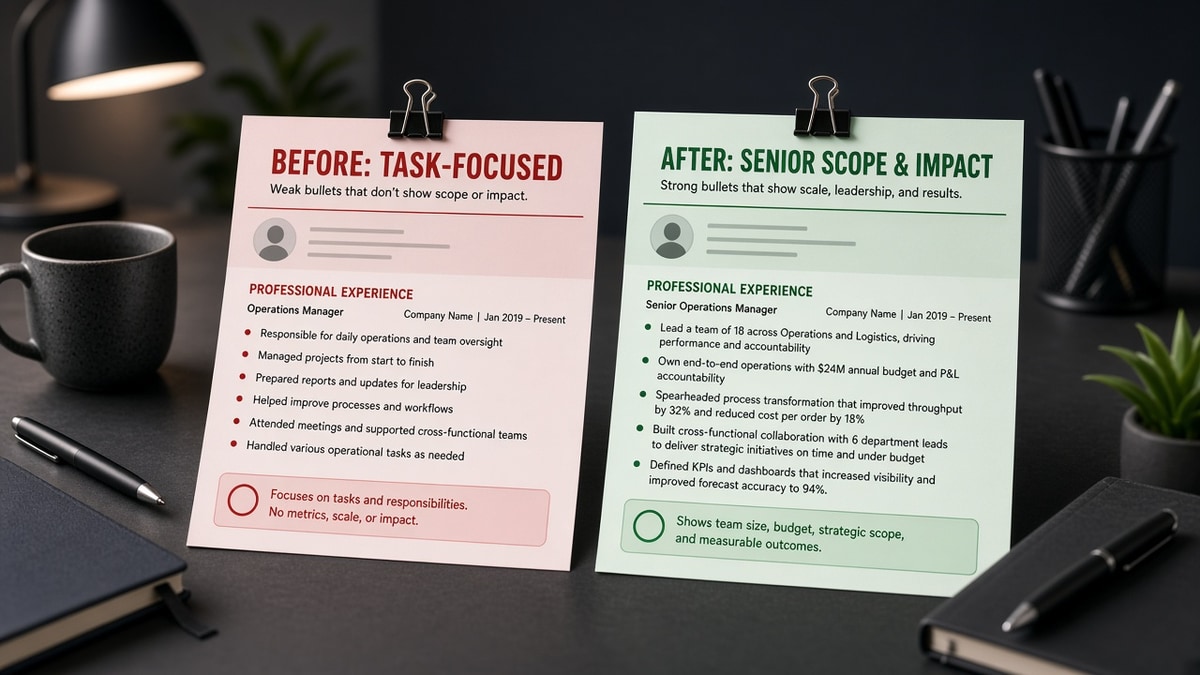
Move the strongest line to bullet one under each recent role. Tasks can live lower or disappear if they repeat.
Customer success
Before: Handled escalations and updated Salesforce notes.
After: Owned renewal strategy for 28 enterprise accounts ($3.2M ARR), raising gross retention from 91% to 94% in FY24.
Engineering
Before: Worked on API performance improvements.
After: Led migration of billing API to async workers, cutting p95 latency from 800ms to 220ms for 40k daily jobs.
Finance
Before: Prepared monthly reports for leadership.
After: Built rolling forecast model for $18M opex line, giving CFO weekly variance alerts adopted in board prep.
People management
Before: Helped train new hires on onboarding.
After: Managed six analysts across two time zones; promoted two to senior roles within 18 months through structured coaching plans.
I've opened Workday profiles for senior reqs where bullet one still said "responsible for daily tasks." That tells me the candidate is a level below the posting before I read the rest of the file.
Program management
Before: Attended steering meetings and tracked RAID logs.
After: Owned program governance for ERP rollout across finance and supply chain, clearing 22 critical risks before go-live.
Scope lines recruiters and parsers both catch
Senior filters often hunt plain tokens: P&L, budget, headcount, region, policy, roadmap, board, acquisition. Place them inside dated bullets, not only in the summary.
- Team: "Directed 14 FTEs plus 6 contractors across QA and support."
- Budget: "Held $2.5M tools budget with quarterly zero-based reviews."
- Revenue: "Owned pricing tests on self-serve tier that lifted ARPU $1.40."
- Geography: "Ran LATAM support site with three team leads in Mexico City and São Paulo."
- Decision rights: "Final approver on vendor RFPs over $50k."
For how systems read progression, see how ATS evaluates seniority after you add scope lines.
Cut clutter that hides senior work
Old internships on page one. Move them to the end or drop them when you have 8+ years. Senior skims should start with recent scope.
Duplicate tools lists. If SQL appears in five bullets, you do not need SQL six times in a skills cloud. Keep the list short and let bullets carry proof.
Passive verbs. Swap "assisted with," "helped," and "involved in" for owned, led, approved, or negotiated where true.
Every-I bullets. Mix sentence openings so the eye catches outcomes. Senior leaders still use I when they made the call; they also name teams and partners.
Pair trims with resume length guidelines that actually work so you do not solve seniority by adding pages.
Copy-paste senior resume pass
Work top to bottom on page one before you touch older roles. This sequence keeps changes honest and fast.
Copy-paste senior pass (20 minutes)
1) Write the posting title level next to your name in the headline.
2) Replace summary fluff with two lines: scope plus one metric you own.
3) Under current role, move the highest-scope bullet to position one.
4) Add team size, budget, or geography to any bullet where you held the pen.
5) Export PDF and skim only the top third as if you had six seconds.
Before: Page one opens with college clubs and a 2014 internship.
After: Page one opens with the last eight years, each role showing wider scope than the prior line.
Design / UX leadership
Before: Created wireframes for product team.
After: Set design standards for checkout squad of 9, lifting test-task completion 14% after unified component library shipped.
Sales leadership
Before: Managed territory and hit quota most quarters.
After: Ran West region with 11 AEs ($28M quota), rebuilding pipeline hygiene that raised forecast accuracy from 62% to 81%.
Test senior positioning against a real req
Paste your edited file into the job match score tool for one senior posting. If leadership tokens only appear in the summary, move them into dated bullets next.
Run the free ATS resume checker to confirm headers and dates still parse after you reorder bullets. Senior language does not excuse a broken Experience block.
When a posting asks for a letter, repeat your headline scope line in the cover letter generator so the attachment matches page one.
Ship the senior skim
What to change on your resume to look more senior is visible in the first screen: headline level, summary scope, and bullet one under your current employer. Keep titles honest, paste the examples that fit, and cut task noise that buries the story.
- Rewrite headline and summary with one scope metric you can defend.
- Reorder each recent role so outcome lines sit on top.
- Mirror posting senior tokens inside dated bullets, not only in skills.
Run the job match score on a target posting after edits, then run a free resume check on the PDF you will upload. Need a clean template? Use the free resume builder and paste your senior bullets into a single-column layout. Keep the cover letter aligned with the same scope line via the cover letter generator when the employer requests one.
Read more
Frequently asked questions
No. Use the official title from payroll or HR records. You can clarify scope in the headline or a subtitle line, such as Project Manager, Enterprise Programs, when the internal title was generic. Inflated titles fail background checks and erode trust in the first phone screen.
Aim for one concrete scope or outcome signal in the first two bullets of your current role, then sprinkle metrics where you truly own the number. Senior files read empty when every line is a task. They read inflated when every line claims revenue without context.
Show influence scope instead of headcount: cross-functional teams, vendor budgets, executive stakeholders, or policy decisions you owned. Phrases like led a twelve-person project team across legal and product parse the same leadership tokens many filters hunt.
Length does not signal level. A dense page with three scope-rich roles beats three pages of tasks. Trim older execution work so the top third of page one screams the level you want next.
Keyword stuffing in a skills cloud without dated proof still fails human review. Align title level and scope lines with the posting, keep standard headers, and repeat must-have leadership terms inside recent bullets so parsers tie them to dates.