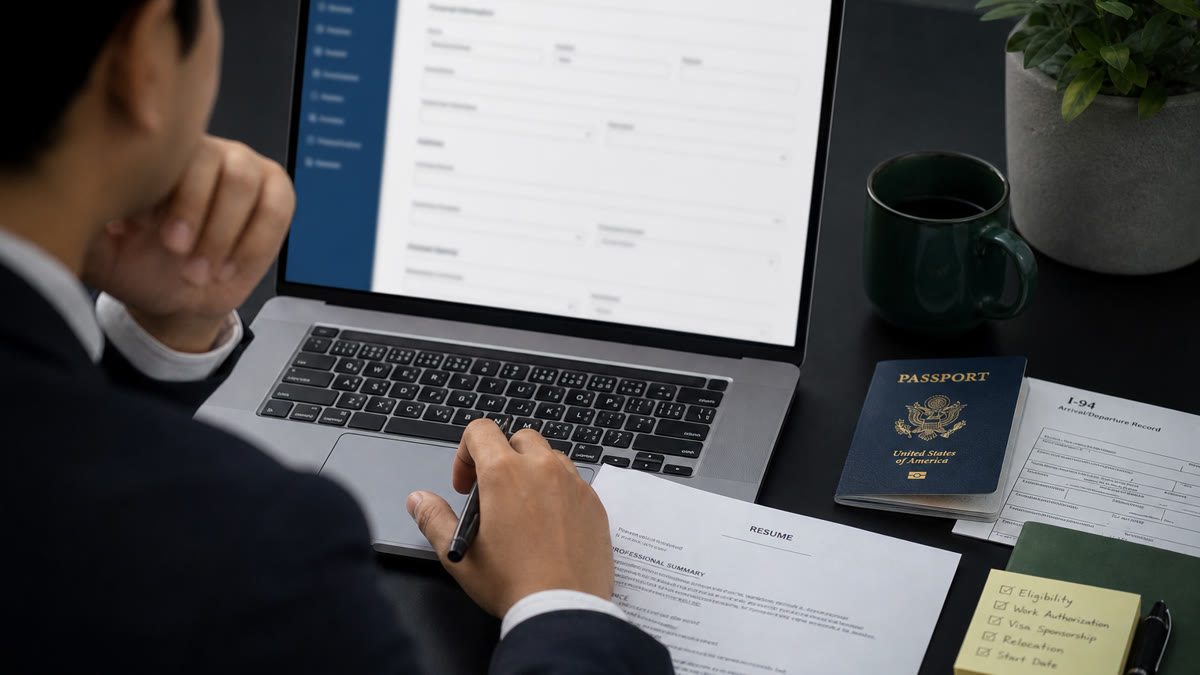
Visa sponsorship questions on US job applications are not trick questions—they are compliance filters. Answer each field based on your current legal work authorization and your real future sponsorship needs, using the exact categories Workday, iCIMS, and Greenhouse provide. Strategic answering means reading "authorized to work" and "require sponsorship" as separate questions, aligning your resume, and targeting employers who actually file for candidates with your visa profile—not selecting answers you hope will slip past a knockout rule.
International candidates lose interviews for two opposite reasons: checking the wrong box and hiding sponsorship needs until late stages. Both create problems at Form I-9 verification. This guide maps the most common application questions, how major ATS platforms treat your answers, and what to write in optional fields so recruiters see timing and visa type without you overstating eligibility.
| Application question | What it usually means | Strategic answer approach |
|---|---|---|
| Are you legally authorized to work in the US? | Current permission to perform work—citizenship, green card, valid EAD, or active visa with work rights | Yes if you hold valid work authorization today; specify visa type in comments |
| Will you now or in the future require sponsorship? | Employer must petition USCIS or extend status for continued employment | Answer yes when H-1B, PERM, or transfer is needed; note OPT end date if timing matters |
| Work authorization type (dropdown) | Structured category for HR reporting and knockout logic | Pick the exact status on your I-94 or EAD—not "Other" unless required |
| Eligible to work without sponsorship? | Combined filter: no future employer action needed | US citizens and green card holders yes; OPT and H-1B holders usually no for long-term |
Key Takeaways
- Read authorization and sponsorship as separate questions—never merge them
- Answer truthfully; false eligibility fails I-9 and background checks
- Use comment fields for visa type, expiration, and STEM OPT or H-1B timing
- Target postings that mention sponsorship when you need it
- Keep resume, LinkedIn, and application answers consistent
What US employers actually mean by work authorization questions
Federal law requires employers to verify identity and employment authorization after hire using USCIS Form I-9 . Application questions appear earlier because sponsorship costs money, takes months, and carries legal risk. Recruiters are not testing your vocabulary—they are deciding whether you can start on the role's timeline without an immigration project the req was not budgeted for.
The USCIS working in the United States overview lists visa categories with different work permissions. Your application answers should mirror the category on your I-94, EAD card, or approval notice—not the category you plan to have after a future petition. "Authorized to work" asks about today. "Require sponsorship" asks whether the company must file for you later.
For a deeper breakdown of the eligibility phrase itself, see what eligible to work in the US means on applications . The strategic layer is matching each form field to your document stack before you spend time tailoring a resume for a req that cannot sponsor you.
Key Takeaway: application questions predict I-9 success—answer for the status you can prove with documents on day one, not the status you are pursuing.
How Workday, iCIMS, and Greenhouse screen sponsorship answers
Enterprise employers configure knockout rules differently, but the pattern is consistent: a wrong sponsorship answer removes you from the recruiter queue before anyone opens your resume. Workday Recruiting often stores eligibility answers in candidate profiles that auto-fill on future applications—stale answers from an old OPT period can poison new submissions if you do not update the profile.
iCIMS frequently places work authorization in the first application page alongside EEO questions. Boolean recruiter searches can filter "sponsorship required = no" when the hiring manager marked the role as no-sponsorship. Greenhouse custom questions vary by company; some startups add free-text fields that are the best place to explain STEM OPT extension timing or an H-1B cap lottery history.
None of these systems reward creative answers. They reward accurate categories plus optional context. Before you upload a resume, confirm the file parses cleanly—see Workday resume format guidance —then run a match check in HireFlow's ATS resume checker so skills keywords are not lost to formatting while eligibility answers are under review.
SHRM guidance for HR teams notes that employers should apply sponsorship policies consistently across similar roles. The SHRM resource on employing foreign national employees reminds organizations to train recruiters on lawful screening—not to use authorization questions to exclude protected classes. For you as a candidate, that means companies with real sponsorship programs usually say so in the posting; silent postings plus strict knockout rules often mean no sponsorship regardless of your qualifications.
Common Mistake: assuming a human will override a sponsorship knockout because your resume is strong—many reqs never reach a human when the filter is enabled.
Key Takeaway: treat Workday profile fields, iCIMS page-one dropdowns, and Greenhouse custom questions as permanent records—update them every time your visa status changes.
Question-by-question playbook for common application fields
Forms rarely use immigration attorney language. They use HR shorthand. Map each prompt to your documents before you click submit.
"Are you legally authorized to work in the United States?"
Answer yes if you currently have work permission: US citizen, lawful permanent resident, valid EAD, or nonimmigrant status that includes work authorization (active H-1B, L-1, O-1, TN in permitted situations, F-1 on OPT with valid EAD). Answer no only if you have no current work permission and would need the employer to create it from scratch before you could start—a rare path outside structured programs.
"Will you now or in the future require sponsorship for employment visa status?"
This is the high-stakes field. If you will need H-1B, O-1, TN renewal beyond limits, or PERM green card sponsorship to stay employed long term, answer yes. F-1 students on CPT or OPT who will eventually need H-1B should answer yes to future sponsorship even when currently authorized. US citizens and green card holders answer no.
Work authorization type dropdown
Choose the closest listed category: F-1 CPT, F-1 OPT, STEM OPT extension, H-1B, H-4 EAD, L-2 EAD, TN, refugee/asylee EAD, adjustment of status EAD, or US permanent resident. Avoid "Other" when a specific option exists—recruiters report "Other" candidates as higher review burden.
Optional comments or additional information
Use this field for facts, not persuasion. Good content: visa type, EAD expiration date, STEM OPT eligible through [month/year], H-1B selected in FY2026 lottery with pending filing, or H-1B transfer possible with 60-day portability. Bad content: asking the employer to make an exception or listing reasons you deserve sponsorship.
The Department of Labor's foreign labor certification programs page explains why some employers hesitate—PERM and prevailing wage steps take months. Showing you understand timing builds recruiter trust more than a generic "willing to relocate" sentence.
Key Takeaway: optional comment fields are for visa facts and dates—save advocacy for networking messages after you pass the eligibility screen.
OPT, CPT, H-1B, and green card: which answers to select
Each status has a distinct pattern on application forms. Mixing them up is more damaging than stating sponsorship need honestly.
| Your status | Authorized to work? | Require sponsorship? | What to add in comments |
|---|---|---|---|
| F-1 CPT (active) | Yes | Yes, before CPT ends or for post-graduation role | CPT employer match, program end date, OPT eligibility |
| F-1 OPT / STEM OPT | Yes with valid EAD | Yes for H-1B or other long-term status | EAD expiration, STEM extension used or available |
| H-1B (employed) | Yes | Yes if changing employers (transfer) | I-797 validity, transfer/portability timing |
| Pending green card (EAD) | Yes if EAD valid | Depends—note if employer must continue PERM/I-140 | EAD category code, renewal filed if applicable |
| US citizen / green card | Yes | No | Usually leave blank unless form asks citizenship |
Cap-gap and STEM OPT extension rules change filing windows. If you are graduating in May and the employer files H-1B in April, note both graduation date and whether you qualify for cap-gap extension in the comments field. Recruiters planning cohort starts need that calendar math upfront—not in a third-round interview. When a posting says "must be authorized without sponsorship," an OPT candidate is often a poor fit even if authorized today—competing where sponsorship is listed saves cycles. Our US work authorization FAQs for job applications covers recruiter follow-up questions you should expect after you answer accurately.
Pro Tip: if you have both CPT and OPT history, answer for the authorization that will be active on your earliest realistic start date—not the status you hold while applying.
Key Takeaway: current authorization and future sponsorship are independent variables—chart both before touching any dropdown.
Before/after application answer rewrites
Weak answers are vague, contradictory, or argumentative. Strong answers are short, document-aligned, and consistent across every field on the same form.
| Before (weak) | After (strategic) |
|---|---|
| Authorized: Yes. Sponsorship: No. (STEM OPT candidate needing future H-1B) | Authorized: Yes. Sponsorship: Yes, will require H-1B before OPT expires 03/2028. Comments: F-1 STEM OPT, EAD valid through 03/2028, eligible for one additional STEM extension if needed. |
| Work auth dropdown: Other. Comments: I can work anywhere, visa not an issue. | Work auth dropdown: H-1B. Comments: Current H-1B with Employer A valid through 09/2027; seeking H-1B transfer; 60-day portability after separation. |
| Resume header: "US work authorized." Application: Require sponsorship — Yes. | Resume footer line: "F-1 OPT — authorized through 08/2027; will require H-1B sponsorship." Application answers match same dates and visa type. |
Resume wording should support—not contradict—the application. For placement and phrasing rules, see visa sponsorship on resume: what to write safely .
Key Takeaway: one source of truth for visa type and expiration—if the resume, LinkedIn, and Workday profile disagree, recruiters assume the worst case.
Aligning your resume and cover letter with application answers
The application form is the legal-adjacent record; the resume is the skills record. Keep them separate in purpose but aligned in facts. A single work authorization line at the bottom of the resume is enough for most candidates: visa category, authorization end date, and whether employer sponsorship will be needed.
Do not put sponsorship need in the resume summary where it becomes the first line a parser and recruiter read—unless the posting explicitly asks for upfront disclosure. Do not claim "no sponsorship required" on a resume when the application will say yes. That inconsistency triggers manual compliance review and slows offers.
Cover letters earn their space when you add timing the dropdown cannot hold: willing to start after H-1B approval, available for cap-gap after graduation, or open to remote start while transfer petitions. Keep it to two sentences. Recruiters scanning fifty applications want dates, not essays.
LinkedIn settings matter too. If your profile says "open to work" in the US but your headline omits authorization context, recruiters may assume citizen status until the application contradicts it. A neutral headline format—role title plus visa timing when appropriate—reduces surprise when HR opens your Workday submission.
After alignment, verify resume keywords still match the posting in HireFlow's ATS checker —eligibility gets you considered; skills get you interviewed.
Key Takeaway: resume proves qualifications; application proves eligibility—never swap those jobs.
How Workday, iCIMS, and Greenhouse screen sponsorship answers differently
The same truthful answer can route differently depending on which ATS powers the career site. Workday often stores work-authorization responses in a candidate profile that persists across requisitions at that employer—changing your answer on a second application without updating the profile can create a compliance mismatch recruiters see before they open your resume. iCIMS frequently attaches authorization status to the application record itself, which means each new req may ask again but still flags contradictions when prior applications exist in the same tenant. Greenhouse tends to surface sponsorship needs in recruiter-facing sidebar metadata, so a "will need sponsorship" selection can appear beside your name even when your resume never mentions visa status.
Knockout logic is rarely published, but practitioners report three common patterns: hard filters that auto-archive anyone who selects "will require sponsorship" on reqs tagged no-sponsorship; soft filters that rank authorized candidates higher without formal rejection; and compliance holds that pause applications when answers conflict with EEO or veteran self-ID data entered on the same form. None of these replace human review for specialized roles—but they decide whether a human ever sees your file.
| Platform | Where answer lives | Typical recruiter view |
|---|---|---|
| Workday | Candidate profile + application | Authorization icon on applicant grid |
| iCIMS | Application record per req | Compliance tab + search filters |
| Greenhouse | Application custom fields | Sidebar badge on candidate card |
Before you mass-apply, open one posting from each target employer and read the sponsorship language in the legal footer and job description. Employers that sponsor H-1B routinely list "authorized to work" plus "will sponsor qualified candidates" in the same paragraph. Those that do not sponsor often state "candidates must be authorized to work in the United States without sponsorship" in bold—treat that as a hard skip if you need a new petition.
Pro Tip: after answering authorization questions on Workday, scroll back to the profile preview page—some instances display your selections in a summary panel recruiters screenshot during intake calls.
Common mistakes that trigger auto-rejection or compliance flags
- Answering no to sponsorship when you will need H-1B: discovered at offer stage; offer revoked and reputation damaged with that employer.
- Selecting US citizen or permanent resident without status: fails I-9 on day one; may constitute fraud in extreme cases.
- Contradicting answers across forms: Workday profile says no sponsorship, new application says yes—recruiters pause for compliance review.
- Using "Other" for standard visas: slows routing and signals unfamiliarity with your own status.
- Applying to no-sponsorship reqs when you need filing: wastes tailoring time; instant knockout on most platforms.
- Arguing in comment fields: "I hope you will sponsor me" does not replace accurate categories.
- Ignoring cap and lottery timing: employers planning April H-1B filings need your history in writing early.
USCIS lists acceptable documents for I-9 in its Form I-9 acceptable documents guide . If you cannot produce the document that matches your application answer, you cannot pass verification—no interview performance overrides that.
Common Mistake: treating sponsorship questions as optional because they sit below the resume upload—on many reqs they are knockout fields evaluated first.
Key Takeaway: honesty plus targeting beats optimism plus mass applying—filter yourself to sponsorable reqs before you optimize bullets.
Pre-submit checklist for visa sponsorship application questions
- Read the posting for sponsorship language—apply only if aligned with your needs.
- Separate "authorized today" from "need future sponsorship" on every form.
- Select the specific visa or EAD category—not "Other" when a match exists.
- Add EAD or I-797 expiration dates in optional comment fields.
- Note H-1B lottery selection or prior filing year if relevant to timing.
- Match resume work authorization line to application answers exactly.
- Update saved Workday or iCIMS profile if status changed since last application.
- Keep I-94, EAD, and approval notices accessible for recruiter requests.
- Run resume keyword check against posting after eligibility fields are complete.
- Save PDF confirmation screenshot with answers in case of portal glitches.
Key Takeaway: ten minutes on eligibility fields prevents weeks of silence from a knockout you could have predicted from the job ad.
Before and after (ATS-safe wording)
Key Takeaway: keep the same fact, add the tool name and a number.
| Before | After |
|---|---|
| Responsible for reports and team support. | Built weekly Workday headcount reports that cut manager follow-ups by 30%. |
| Used office software and helped customers. | Processed 40+ Greenhouse tickets/week in Zendesk with 96% CSAT. |
| Improved processes across the department. | Mapped the Taleo requisition workflow and cut time-to-post from 5 days to 2. |
Frequently asked questions
Only if the question is narrowly about current authorization. If you hold valid OPT, CPT, or H-1B status tied to a current employer, you are authorized to work now and can answer yes—then disclose future sponsorship needs in the separate sponsorship field. If the form combines both into one question like 'authorized to work without employer sponsorship,' answer no when sponsorship is required. Misreading combined questions is one of the most common causes of instant rejection and later I-9 problems.
Answer honestly based on your actual immigration path. If you are on OPT with STEM extension eligibility, you may answer that you do not require immediate sponsorship but will require H-1B sponsorship before a stated date. If you need a new employer to file H-1B or green card sponsorship, answer yes to future sponsorship. Use the optional comments field to note your visa type, expiration window, and prior lottery participation—recruiters use that detail to route you to roles with active sponsorship budgets.
Often yes, when the employer configured a knockout filter. Workday, iCIMS, and Greenhouse all support disqualification rules on sponsorship answers. That is not a reason to lie—false answers fail background checks and Form I-9 verification. Instead, target postings that state sponsorship is available, answer accurately, and use your resume and outreach to compete where sponsorship is possible. A truthful no-match on a no-sponsorship req saves you weeks of ghosting.
Select the work authorization category that matches your EAD or OPT approval—many forms list F-1 OPT or STEM OPT Extension as distinct options. For 'authorized to work today,' answer yes while your EAD is valid. For sponsorship, note that OPT is temporary work authorization and that you will need H-1B or another long-term status before expiration. Include your OPT end date in optional fields when the form allows it so recruiters can assess timing against their filing calendar.
Keep the application form as the system of record for eligibility answers. On the resume, a single plain-text work authorization line near the bottom is enough when the posting asks for it—see our guide on visa sponsorship resume wording. Never contradict the application: if the form says you require sponsorship, your resume should not imply unlimited permanent authorization. Consistency across Workday fields, resume, and LinkedIn prevents compliance flags.
Eligible to work usually means you currently have legal permission to perform work in the United States—citizenship, green card, valid EAD, or active visa status with work permission. Require sponsorship means the employer must petition USCIS or otherwise sponsor you for continued or new work authorization. You can be eligible today and still require future sponsorship; the fields measure different things. Treating them as synonyms causes wrong dropdown selections and recruiter distrust.
Some ATS platforms let you edit responses while the req is open; others lock answers at submit. If your status changes—EAD renewal approved, H-1B transfer filed—email the recruiter with updated documentation rather than silently changing answers when the system allows edits. For future applications, update your candidate profile in Workday or iCIMS so saved answers do not auto-fill incorrectly on the next role.
Pending is not the same as approved. If your EAD is valid through renewal or your H-1B transfer is filed with continuity of employment, describe that status in optional comments and select the category that matches your current document. Do not select 'US citizen' or 'permanent resident' until those statuses are final. Recruiters familiar with immigration timing will ask for receipt notices; inaccurate categories fail compliance review fast.