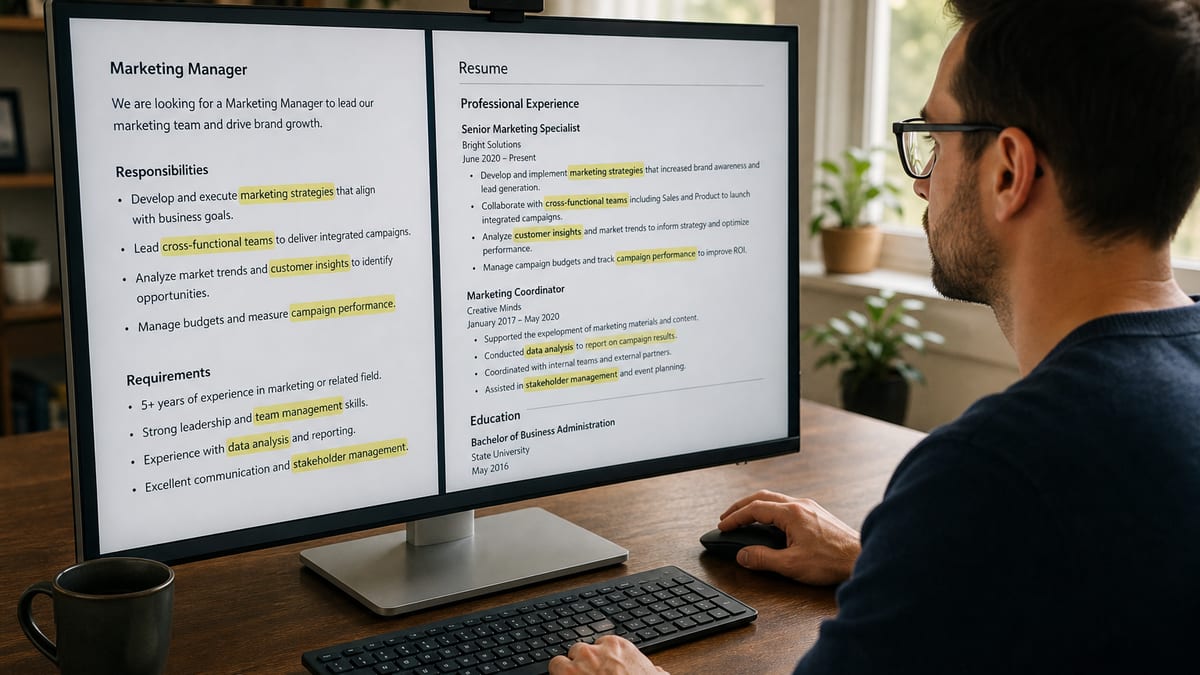
Pull every named skill, tool, and credential from the first third of the posting. Mark the ones you can genuinely evidence. Make each one appear in your title line, summary, or a bullet where you actually used it. Fifteen minutes per application, and stop once the must-haves are covered.
Matching a resume to a posting is a mechanical task that most people either skip entirely or take much too far. Skipping it is why one identical file sent to forty roles produces silence. Taking it too far produces a resume stuffed with terms the candidate cannot defend, which converts a screening call into an uncomfortable interrogation.
Below: which parts of a posting to weight and which to ignore, a ten-minute gap-list method, where each matched term should land, three bullet rewrites that absorb terms honestly, how much matching is enough, the line between tailoring and fabricating, and what to do with vague or recycled postings.
Key Takeaways
- Which third of a posting carries the real requirements
- A ten-minute gap list you can build for any role
- Three bullet rewrites that absorb terms without stuffing
- Why chasing a 90% match rate backfires
- A repeatable 15-minute per-application workflow
Reading a job posting properly
Start Here
A posting is not one document. It is three or four documents pasted together by different people, and only some of them describe the job.
| Part of the posting | Weight | Why |
|---|---|---|
| Job title | Very high | What recruiters search by first |
| First 3–5 responsibilities | Very high | Written by the hiring manager, in priority order |
| "Required" list | High | Often used as literal screening criteria |
| "Preferred" list | Medium | A wish list; two-thirds coverage is fine |
| Company description | Low | Marketing copy reused across every role |
| Benefits and legal text | None | Boilerplate; contains no requirements |
One habit worth building: read the responsibilities before the requirements. Requirements lists are frequently written by a recruiter from a template, while responsibilities tend to be written by the person who needs the work done. When the two disagree, believe the responsibilities.
Build the gap list in ten minutes
Do This Next
Three columns: what they asked for, whether you have it, and where it currently appears on your resume. The third column is the one that produces your edit list.
- List every named noun from the top third. Tools, methods, credentials, systems, domains. Ignore adjectives entirely.
- Mark each one: have it, adjacent, or do not have it. "Adjacent" means you have done something close enough to describe honestly — Looker when they want Tableau, for instance.
- Search your current resume for each "have it" term. Use the find function. You will be surprised how many are missing entirely.
- Note where each one already appears. Title line, summary, a bullet, the skills list, or nowhere.
- Fix only the gaps. Terms you have that appear nowhere, or appear only in the skills list with no supporting evidence.
The "adjacent" column is where judgment lives. Naming a comparable tool and saying so plainly — "built dashboards in Looker; equivalent work in Tableau" — is honest and often accepted. Writing "Tableau" flat when you have never opened it is not, and it is the exact claim an interviewer probes.
Where each matched term should land
Key Takeaway
Important terms should appear twice: once near the top for positioning, once inside a bullet as evidence. A term that lives only in the skills list is a claim without proof.
Title line. Match the posting's job title where your experience honestly supports it. This single line is the highest-weight position on the page and most candidates leave it blank.
Summary. One rewritten line naming the specific problem the posting describes. If the posting leads with "own the reporting stack for a scaling finance team," your summary should say you have done that.
Top three bullets of your most recent role. Reordering is faster than rewriting and almost as effective. Lead with the bullet closest to their first responsibility.
Skills line. For exact-match coverage of tools, using their spelling plus the alternate form in parentheses. This is coverage, not persuasion. For the full picture on which terms are worth carrying at all, see the resume keywords guide .
What matters technically is that all of it survives extraction. Workday builds your candidate profile from the flat text of your file and infers total experience from date ranges; Greenhouse assembles a structured profile from clean single-column PDFs and takes nothing usable from graphics or icon-based skill bars, and Lever, iCIMS, and Taleo behave the same way. A perfectly matched term inside a sidebar is a term that never arrived.
Before and after: absorbing terms into real bullets
Quick Win
Each rewrite below adds the posting's exact term inside a claim the candidate can defend. That is the whole technique — no separate keyword block required.
Posting asks for "stakeholder management"
Before: Worked with different departments to deliver the system upgrade on schedule.
After: Owned stakeholder management across 4 departments and 2 external vendors for a 9-month ERP migration, holding scope through three budget reviews.
Posting asks for "demand forecasting"
Before: Used historical data to help plan inventory levels across our product range.
After: Built demand forecasting models across 900 SKUs in Excel and SQL, cutting stockouts 34% and reducing excess inventory holding by $180K.
Posting asks for "incident response"
Before: Was part of the on-call rotation and helped resolve production issues when they came up.
After: Led incident response for 4 production services on a 6-engineer on-call rotation; cut mean time to resolution from 74 minutes to 21 by writing runbooks for the top 10 failure modes.
Notice that no bullet became longer than it needed to be, and none of them reads as keyword insertion. The term arrived attached to a number, which is what makes it credible rather than decorative.
Check the match and the parse together. Paste the job description, upload your file, and see which terms landed — and which sections never made it out of the document. Free, no signup.
Run a free ATS resume check →How much matching is enough
Myth Busting
No employer has a match-rate threshold. The number comes from whichever tool you used, and pushing it into the nineties almost always means adding claims you cannot support.
A sensible target is all of the stated must-haves and roughly two-thirds of the preferred list. Past that, each additional point of match rate costs more honesty than it buys attention, because the remaining gaps are usually the skills you genuinely do not have.
The match rate is also easy to game in ways that help nobody. A block of terms pasted at the bottom of the page will raise the number and will be recognized instantly by the human who reads the parsed profile. So will a skills list that suddenly contains fourteen tools none of which appear anywhere in your work history.
A better stopping rule: read your tailored resume as though you were the hiring manager and ask which claim you would probe first. If the answer is a term you added twenty minutes ago and cannot speak to for ninety seconds, remove it. That test is more useful than any percentage.
Postings where matching does not work
Reality Check
Several categories of posting cannot be matched usefully, and recognizing them saves hours that would otherwise go into applications that were never going anywhere.
Vague or template postings
A posting with no named tools and only generic responsibilities was probably written outside the team. Match against two or three comparable postings for the same title at similar companies instead, and use the pattern across them as your requirement list.
Agency reposts and aggregator duplicates
The same role often appears through several agencies with rewritten descriptions. Match against the version on the employer's own careers site where you can find it, since that is the text the internal recruiter is working from.
Postings that describe two jobs
A single listing asking for a data engineer and a data analyst usually means the team has not decided. Match against whichever half you are stronger in and say so explicitly in your summary rather than trying to cover both weakly.
Roles with an internal candidate
Some postings exist to satisfy a policy requiring open advertisement. Signals include an unusually specific combination of requirements, a very short application window, and a description that reads like one person's resume. No amount of matching helps, and it is worth recognizing so you stop attributing the rejection to your file.
The repeatable 15-minute workflow
Pro Tip
Keep one clean master file. Tailoring should be four small edits to a copy, never a rebuild — a rebuild is how structural formatting errors creep back in.
- Duplicate your master file and name it for the company. Never edit the master.
- Match the title line to the posting's title, where honest.
- Rewrite one summary line to name their stated problem.
- Reorder your top three bullets so the closest one leads.
- Run the find function for each must-have term and add any that are genuinely missing, inside a bullet.
- Export and save as firstname-lastname-resume.pdf. Not the company name in the filename — that gets awkward when you reuse it.
Because you only ever change four things, structural formatting stays intact across every variant, so one parse check on the master covers the whole set. That is the practical reason to work from a copy rather than rebuilding per application.
What to match in the cover letter instead
Watch Out
A cover letter is the wrong place for keyword coverage and the right place for the one thing a resume cannot carry: why this specific role, in your own words.
People often treat the cover letter as a second chance to hit terms they could not fit into the resume. That is a waste of the only free-form space you get. The resume already handles coverage; the letter should handle the gap between what your history shows and what this employer needs.
Three things belong in it. The first is a specific reason for this company, drawn from something real — a product decision, a market they entered, a problem their posting names. The second is your closest matching experience stated once, with the number attached. The third is the honest bridge over any obvious gap: a career change, a shorter tenure than they might expect, a tool you have adjacent rather than exact experience with.
That last one matters more than candidates think. A hiring manager looking at a resume with one visible mismatch will either guess at an explanation or move on. One plain sentence — "I have run this in Looker rather than Tableau, and the modelling work transfers directly" — removes the guess and frequently keeps you in the pile. Everything else in the letter is decoration by comparison.
Bottom line
Final Word
Weight the top third, build the gap list, close only the gaps you can evidence, and make four edits to a copy of your master file. Then stop.
Tailoring works because it fixes an information problem, not because it games a system. A recruiter scanning for evidence that you have done this specific job before should find it in the first ten seconds, and on an untailored resume that evidence is usually present but buried four bullets down under a role heading from three years ago.
Try it once on the role you most want: build the gap list, make the four edits, and compare the top third of the page against the untailored version. The difference is usually obvious enough that you stop needing convincing.
See which terms actually matched
Paste the job description, upload your resume, and get the matched terms, the gaps, and the raw text a parser extracted. Free, no signup, no scan limit.
Run the Free ATS Resume CheckAlso useful: resume keywords guide · free resume builder
Frequently asked questions
Pull every named skill, tool, and credential from the first third of the posting, mark the ones you can genuinely evidence, and make sure each appears in your title line, summary, or a bullet where you used it. That takes about fifteen minutes and is most of what tailoring means in practice.
Cover the stated must-haves and roughly two-thirds of the preferred list. Chasing 90% or higher usually means adding terms you cannot defend, which produces interviews that go badly. The number is a vendor's formula, not an employer's threshold, and no recruiter ever sees it.
The first third, where the genuine requirements sit, and any line phrased as "required" or "must have." The bottom of a posting is usually legal boilerplate and copied company description. Weighting the whole document equally is how people end up matching against text nobody wrote deliberately.
Copy the exact terminology for skills and tools, because matching is literal — if they write "A/B testing" and you wrote "split testing," add their form. Do not copy whole sentences of responsibilities into your bullets. Recruiters recognize their own posting language immediately and it reads as hollow.
Apply anyway if you meet the must-haves and most of the preferred list, and lead with the closest adjacent evidence you have. Do not add the term to your resume to close the gap on paper. A missing preferred skill costs you far less than a claimed skill that collapses under one follow-up question.
Tailor the title line, one summary line, and the order of your top three bullets. That is fifteen minutes and captures most of the benefit. Rewriting the entire document per application is unsustainable across a real search and produces diminishing returns after the first few changes.
Yes. A resume rewritten to mirror one posting often loses the coherent story that makes you credible, and it reads as assembled rather than earned. If your tailored version no longer sounds like a description of your actual career, you have gone past the useful point.
Find two or three postings for the same title at similar companies and match against the pattern across them. Vague postings are often written by someone outside the team, so the real requirements will show up in how comparable employers describe the same role.