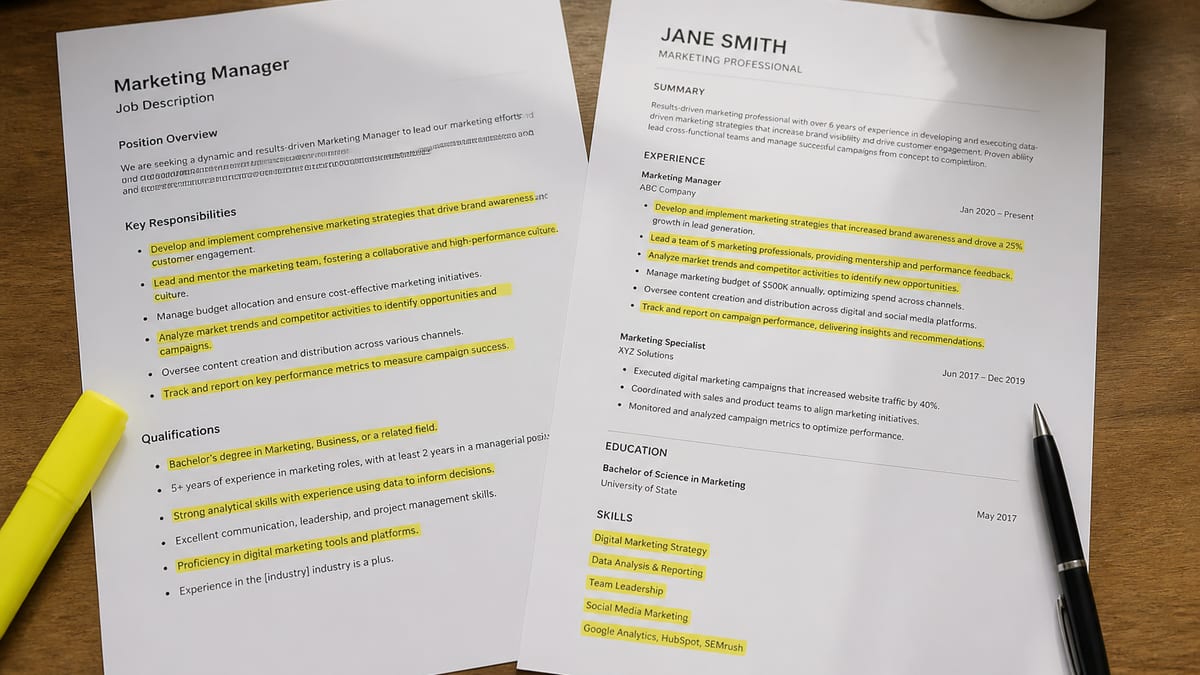
Only three kinds of word get matched: hard skills, tools and platforms, and titles or certifications. Take them from the first third of the job posting, where the real requirements sit, and place each one in at least two spots — your title line or summary, and inside a bullet that proves it.
Nearly every resume already contains keywords. The problem is that they are usually the wrong kind — adjectives nobody searches for — or the right kind sitting in a skills list with no evidence attached. A recruiter searching their database for "Snowflake" finds you either way. A recruiter reading the result decides whether to call based on whether the term appears somewhere you did something with it.
Below: what counts as a keyword and what does not, a ten-minute extraction method for any posting, a placement table by section, the truth about keyword density, ready-made lists for eight job functions, before and after rewrites, and the edge cases where the standard advice misleads.
Key Takeaways
- The three keyword types that get matched — and the one that never does
- A ten-minute method to extract keywords from any posting
- Where on the page each keyword carries the most weight
- Starter keyword lists for eight common functions
- Why keyword density is a myth borrowed from web SEO
What counts as a resume keyword
Start Here
A keyword is something a person would type into a search box. "Kubernetes" qualifies. "Hardworking" does not, because no recruiter has ever run that query.
Three categories carry essentially all the value:
- Hard skills. Named capabilities with boundaries: financial modeling, penetration testing, media buying, root cause analysis, contract negotiation.
- Tools and platforms. The most literal category and the easiest to match: Salesforce, SAP, Figma, Terraform, Epic, Tableau, HubSpot.
- Titles, certifications, and domain terms. Senior Data Engineer, CPA, HIPAA, GDPR, SOX, ISO 27001, GAAP.
What does not count: personality adjectives, effort claims, and vague collective nouns. "Team player," "results-driven," "strong work ethic," "passionate" — none of these appears in a search, and each one spends a line that a specific tool or outcome could have used.
A useful test before adding any term: would a recruiter filling this role ever type this word to shorten a list of four hundred candidates? If not, it is not a keyword, whatever else it may be.
Find your keywords in ten minutes
Do This Next
Generic keyword lists are a starting point. The posting in front of you is the answer key, and the first third of it is where the real requirements live.
- Paste three postings for the same role into one document. One posting is a sample of one; three shows you what the market consistently asks for.
- Highlight every noun that names a skill, tool, or credential. Ignore verbs and adjectives on this pass entirely.
- Mark anything that appears in all three. Repetition across postings is the strongest signal of a genuine requirement.
- Weight the top third heavily. Requirements written first are usually the ones the hiring manager cares about; the bottom of a posting is often boilerplate.
- Split your list into can-prove and cannot-prove. Only the first column goes on the resume. The second becomes your learning list.
- Check for exact phrasing. If a posting says "A/B testing" and you wrote "split testing," add their form too.
The can-prove split is the step people skip, and it is the one that matters most. A resume optimized past your actual experience produces screening calls that go badly and burns the relationship with a recruiter who may have had a better-fitting role next month.
Where to place keywords for maximum weight
Key Takeaway
Position changes meaning. The same word is a claim in a skills list, a positioning statement in your title line, and evidence inside a bullet with a number attached.
| Location | Weight | Put what here |
|---|---|---|
| Title line under your name | Highest | The target job title, matched to the posting |
| Summary (2–3 lines) | Very high | Three or four defining skills plus years |
| Experience bullets | High, with proof | Tools and skills tied to outcomes and numbers |
| Skills section | Medium | Exact-match tool names for coverage |
| Certifications | High when required | Full name plus acronym plus issuer |
| Headers, footers, images | Often zero | Nothing you need read |
The rule that follows: important keywords appear at least twice — once near the top for positioning, once inside a bullet for evidence. A term that only exists in the skills list is a claim; a term that only exists in a bullet is easy for a scanning reader to miss.
The last row matters more than it looks. Text in headers, footers, text boxes, and images is frequently dropped during extraction. People put their contact details and sometimes their entire skills sidebar there, then wonder why nothing matched. For placement mechanics in more depth, see the resume keywords checklist .
Starter keyword lists by job function
Pro Tip
Use these as a prompt for what you may have forgotten, not as a list to copy. Anything here that you cannot evidence should stay off your resume.
- Software engineering: Python, Go, TypeScript, React, Kubernetes, Docker, CI/CD, Terraform, PostgreSQL, system design, code review, incident response, distributed systems
- Data and analytics: SQL, dbt, Snowflake, Airflow, Tableau, Power BI, ETL, data modeling, experimentation, A/B testing, statistical analysis, data governance
- Marketing: SEO, SEM, paid social, marketing automation, HubSpot, Google Analytics 4, attribution, content strategy, lifecycle marketing, CAC, conversion rate optimization
- Sales: Salesforce, pipeline management, forecasting, MEDDIC, enterprise sales, quota attainment, renewals, territory planning, outbound prospecting, contract negotiation
- Finance and accounting: GAAP, IFRS, financial modeling, month-end close, variance analysis, FP&A, reconciliation, SOX compliance, NetSuite, audit support
- Human resources: talent acquisition, onboarding, HRIS, Workday, employee relations, compensation benchmarking, performance management, DEI programs, FMLA administration
- Operations and supply chain: demand planning, inventory management, S&OP, vendor management, Lean, Six Sigma, ERP, logistics, cost reduction, process documentation
- Healthcare: patient assessment, EHR, Epic, Cerner, HIPAA, care coordination, medication administration, clinical documentation, infection control, triage
Two cautions. First, some of these terms are competitive gates rather than differentiators — every applicant for a data role lists SQL, so listing it gets you into the pile rather than out of it. What differentiates is the bullet showing scale. Second, tool names age fast; a stack from six years ago dates you more than it qualifies you.
Keyword density and stuffing: what actually happens
Myth Busting
Density is a web SEO idea that never applied to resumes. Systems check presence and context. Repetition adds nothing and costs you with the human reader.
Myth: repeat each keyword three to five times. No mainstream applicant tracking system rewards frequency. Matching is binary at the term level, and relevance beyond that is judged by a person. The ninth instance of "project management" only makes the page harder to read.
Myth: hidden white text still works. Extraction ignores color. The hidden block lands in the parsed profile in full view of the recruiter, where it looks exactly like what it is. Companies treat it as attempted deception, and the outcome is worse than a missing keyword — it is a closed door at a company that would otherwise have talked to you.
Myth: paste the whole job description in tiny font. Same failure, more obvious. Also common: a keyword blob at the bottom of the page. Recruiters recognize it immediately, and any match it produces is undone by the twenty seconds a human spends reading it.
What replaces all of this: coverage. Have the important terms present, in context, in at least two places. Then spend your remaining effort on the numbers in your bullets, which is what actually converts a match into a call.
Synonyms, acronyms, and literal matching
Watch Out
Do not assume a system understands that two terms mean the same thing. Write both forms once and stop worrying about which one the recruiter thinks in.
Recruiter searches run against extracted text and match literal strings. Workday builds a candidate profile from the flat text of your file, so a term that never appears as text never enters the index. Greenhouse handles clean single-column PDFs well and pulls nothing usable out of graphics or icon-based skill bars. Lever, iCIMS, and Taleo behave the same way, which is convenient: fixing for one fixes for all.
Pairs worth writing out in full at least once: Search Engine Optimization (SEO), Customer Relationship Management (CRM), Applicant Tracking System (ATS), Key Performance Indicator (KPI), Certified Public Accountant (CPA), Electronic Health Record (EHR), Continuous Integration and Continuous Deployment (CI/CD).
Job titles need the same treatment when your internal title was unusual. If you were a "Growth Ninja" and the market calls it Performance Marketing Manager, write the market title and put the internal one in parentheses. Nobody searches for ninja, and internal vocabulary is invisible outside the company that invented it.
Before and after: keywords with evidence attached
Quick Win
Each rewrite below adds keywords and gets shorter to read, because specifics replace filler rather than sitting beside it.
Marketing manager
Before: Detail-oriented marketer with a passion for driving results through creative digital campaigns.
After: Ran paid social and SEM across a $1.2M annual budget in Google Ads and Meta; cut blended CAC 28% in two quarters using a Google Analytics 4 attribution rebuild.
Financial analyst
Before: Strong analytical skills used to support various finance functions and reporting requirements.
After: Built the FP&A model for a $60M business unit in NetSuite and Excel; cut month-end close from 9 days to 4 and reduced forecast variance from 12% to 4%.
Registered nurse
Before: Compassionate nurse dedicated to providing excellent patient care in a fast-paced hospital setting.
After: Managed a 6-patient med-surg assignment on nights using Epic for clinical documentation; led the unit infection control audit that raised hand-hygiene compliance from 81% to 96%.
Count the keywords gained: paid social, SEM, Google Ads, CAC, Google Analytics 4; FP&A, NetSuite, month-end close, forecast variance; med-surg, Epic, clinical documentation, infection control. Every one arrived attached to something verifiable.
Check which keywords actually survived. Terms in a sidebar, header, or graphic often never make it into the extracted text — see yours in under a minute, free and without an account.
Run a free ATS resume check →Edge cases where standard keyword advice misleads
Reality Check
Match-rate tools assume you already work in the target field. Four common situations break that assumption, and the right move is to accept a lower score.
Career changers
A matcher will report a dozen missing terms, and adding them all produces a resume that collapses under one follow-up question. Include only what you can evidence from past work, projects, or study, and lead with the transferable thing you genuinely owned. A lower match rate with a coherent story beats a high one you cannot defend.
Regional and national vocabulary
The same job carries different words in different markets — CV versus resume, chartered accountant versus CPA, mobile versus cell. Use the target market's vocabulary, not your home market's. This also applies to spelling: organisation and organization are two different strings to a literal matcher.
Contractors and consultants
Long client lists spread keywords thin across many short entries. Group engagements under one consulting entry and concentrate the strongest terms in three or four substantial bullets. Concentration reads better and scans better than a scatter of two-line roles.
Highly senior roles
Executive screening runs on scope rather than tools — budget owned, org size, revenue responsibility, board exposure. A VP resume dense with software names reads junior. The keywords that matter at that level are numbers.
Bottom line
Final Word
Take terms from the posting, keep only what you can prove, place each one twice, and write both the acronym and the full form. Skip density entirely.
Keyword work has a low ceiling and a high floor. Doing it badly — missing the terms the posting names, hiding them in a graphic, or stuffing a block at the bottom — costs you interviews. Doing it well gets you into the consideration set, and then the numbers in your bullets decide everything after that.
Tonight: open the posting you most want, highlight every skill, tool, and credential in the first third, and check each against your resume. Add the missing ones you can genuinely evidence, in a bullet rather than a list. That is usually thirty minutes of work and the highest-return thirty minutes in a job search.
See which keywords your resume really contains
Paste a job description, upload your file, and see the terms that matched, the ones that did not, and the text a parser actually extracted. Free, no signup.
Run the Free ATS Resume CheckAlso useful: free resume builder · keyword placement checklist
Frequently asked questions
Concrete, searchable terms: hard skills (financial modeling, SQL), tools and platforms (Salesforce, Kubernetes), job titles, certifications, and industry vocabulary. They are the words a recruiter types into a candidate search. Adjectives like "motivated" and "detail-oriented" are not keywords, because nobody searches for them.
Aim to cover the requirements that appear in the first third of the posting, which is usually eight to fifteen distinct terms. Coverage matters more than count — one accurate mention inside a real bullet beats five repetitions in a list. If you cannot defend a term in an interview, its presence is a liability rather than an asset.
Highest value first: the title line under your name, the summary, then inside experience bullets where they carry evidence. A skills section is useful for exact-match coverage of tools, but a term that only appears there reads as a claim without proof. Aim to have important keywords in at least two places.
No. Applicant tracking systems check presence and context, not a percentage. The density idea is borrowed from old web SEO and does not transfer. Repeating a term nine times does not raise your standing and does make the resume read badly to the human who opens it next.
Both, once: "Search Engine Optimization (SEO)." Matching is literal, so a recruiter searching one form will not find the other. Mirror the posting's spelling exactly and put the alternate in parentheses. This single habit recovers more missed matches than any other keyword tactic.
No, and it is now actively harmful. Parsers extract all text regardless of color, so the hidden block appears in the profile a recruiter reads — visibly out of place. It is treated as an attempt to deceive, and it ends candidacies at companies that would otherwise have interviewed you.
Pull terms from three postings in the target field, then mark only the ones you can genuinely evidence from past work, projects, or study. Expect a lower match rate at first — that is accurate rather than a problem to solve. Filling the gap with unearned terms produces interviews you cannot survive.
Yes, but demonstrated rather than declared. "Excellent communicator" persuades nobody and matches nothing. "Presented quarterly results to a 40-person leadership group" shows the same quality and carries specifics a reader can picture. Keep the adjective list short and let the bullets do the work.