Short answer
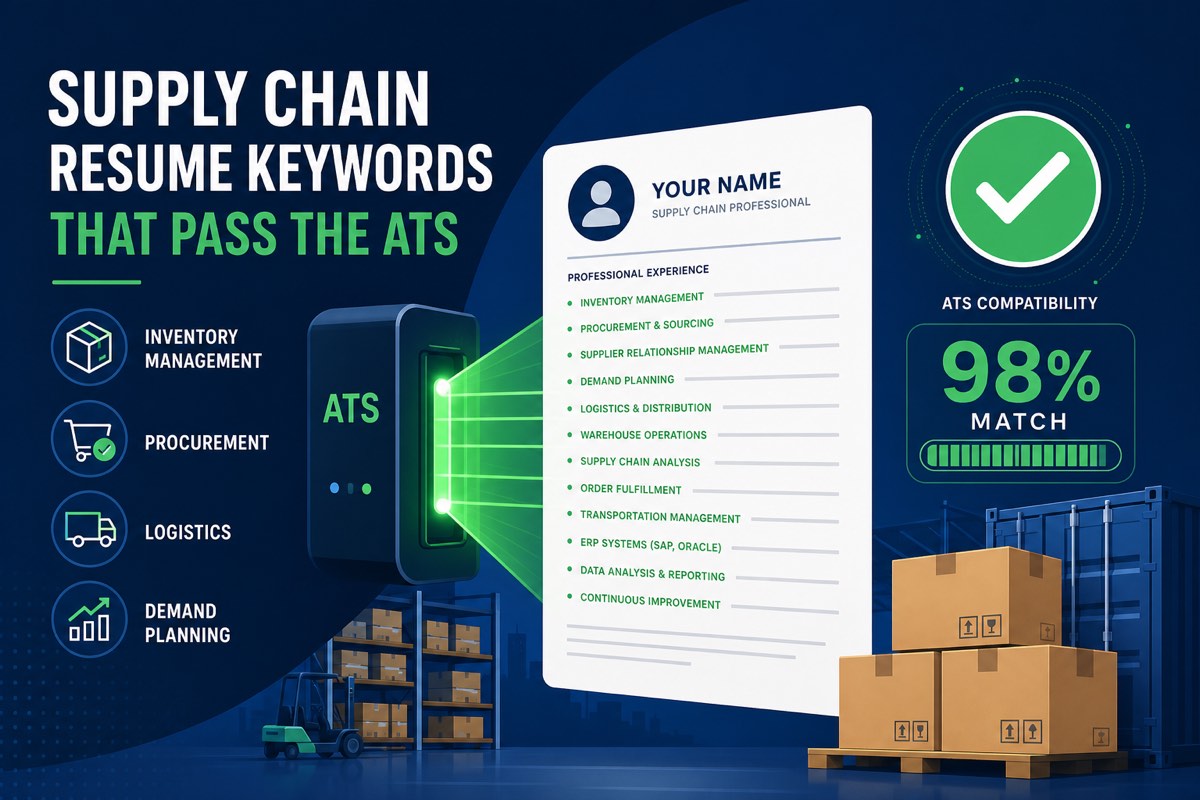
Supply chain resumes get filtered out most often for missing exact-match terms—not for lacking experience. An ATS searches for specific software names (SAP, Oracle SCM, WMS), process terms (demand forecasting, procurement, inventory optimization), and certifications (APICS CPIM, CSCP) pulled straight from the job posting. Below is the full 2026 list organized by category and by job title, plus templates you can adapt in minutes and a 2-minute pre-submit checklist.
A supply chain resume that lists real responsibilities in generic language often gets filtered before a human ever reads it—not because the experience is thin, but because the ATS is searching for specific terms the resume never uses. Rewriting the same experience around the exact keywords recruiters and ATS software actually scan for is usually one of the most impactful edits a supply chain candidate can make. This guide breaks down exactly which words those are and how to use them without sounding like a keyword list.
Key Takeaways
- 60+ supply chain keywords organized into 6 categories, not one long list to skim past
- A keyword table broken down by job title—coordinator through director
- A before/after rewrite showing keyword-sparse vs. keyword-rich phrasing
- Certifications that carry real ATS weight, and how to list them correctly
- Copy/paste bullet templates and a 2-minute pre-submit checklist
Why qualified supply chain resumes get filtered out
An Applicant Tracking System doesn't evaluate your judgment or your work ethic— it searches. When a recruiter opens a requisition, the ATS either ranks every submitted resume against the job description or lets the recruiter search the database by keyword. Either way, your resume needs the same specific terms the posting uses, not just related ideas.
This is exactly where supply chain candidates lose ground. Writing "helped manage inventory and worked with vendors" is true, but it doesn't contain a single term an ATS is actually searching for. "Managed inventory levels across 3 distribution centers using SAP, reducing stockouts by 18%" contains four: inventory management, distribution centers, SAP, and a quantified outcome. Same responsibility, dramatically different ATS visibility.
Key Takeaway: An ATS searches for the exact terms a posting uses—related language is not enough, even when the underlying experience matches.
Quick Checklist: Must-Have Supply Chain Resume Keywords
Before diving deeper, here's a checklist to keep your resume ATS-ready and recruiter-friendly:
- Include core supply chain terms like "Inventory Management," "Procurement," and "Logistics Coordination."
- Name your actual software and tools: "SAP," "Oracle SCM," "WMS," "Excel VBA."
- Use action verbs tied to supply chain outcomes: "Optimized," "Reduced," "Streamlined."
- Spell out certifications in full: "APICS CPIM," "CSCP," or "Six Sigma Green Belt."
- Quantify achievements: "Reduced lead times by 15%" or "Managed $5M in vendor contracts."
Keep this checklist handy as you craft or revise your resume for each application.
Key Takeaway: Core terms, named tools, action verbs, full certification names, and quantified outcomes cover most of what an ATS scan is looking for.
The Master Keyword List, Organized by Category
Dumping every keyword you can find into one list gets you keyword stuffing, not a stronger resume. Instead, pull from the category that matches what you actually did, and weave 2–4 terms per category naturally into your bullet points.
1. Inventory & Warehouse
Inventory Management · Inventory Control · Cycle Counting · Stock Optimization · Warehouse Operations · Order Fulfillment · Warehouse Management System (WMS) · Just-In-Time (JIT) Inventory
2. Procurement & Sourcing
Procurement · Strategic Sourcing · Supplier Relationship Management · Vendor Management · Contract Negotiation · Cost Reduction · Purchase Order Management · Supplier Qualification
3. Logistics & Transportation
Logistics Coordination · Transportation Management · Freight Management · Route Optimization · Distribution Center Operations · Fleet Management · Third-Party Logistics (3PL) · On-Time Delivery
4. Planning & Forecasting
Demand Forecasting · Demand Planning · Sales & Operations Planning (S&OP) · Capacity Planning · Supply Chain Analysis · Inventory Planning · Production Scheduling
5. Systems & Software
SAP · Oracle SCM · Enterprise Resource Planning (ERP) · Warehouse Management System (WMS) · Excel VBA · Power BI · Tableau · Transportation Management System (TMS)
6. Process Improvement & Leadership
Lean Manufacturing · Six Sigma · Continuous Improvement · Root Cause Analysis · Cross-Functional Team Leadership · Risk Management · Data Analysis · Process Optimization
Pair these keywords with quantifiable results—a percentage, a dollar figure, a timeframe—to maximize both ATS score and recruiter impact.
Key Takeaway: Pull 2–4 keywords per category from whichever categories match your actual work—dumping every term into one resume reads as stuffing, not strength.
Supply Chain Resume Keywords by Job Title
An ATS scan for a "Supply Chain Director" posting weighs different terms than one for a "Supply Chain Coordinator" posting. Match your emphasis to your target level.
| Job title | Keywords to emphasize |
|---|---|
| Supply Chain Coordinator | Order processing, inventory tracking, WMS, cycle counting, vendor communication |
| Supply Chain / Logistics Analyst | Data analysis, demand forecasting, Excel VBA, Power BI, KPI reporting, process optimization |
| Supply Chain Planner | Demand planning, S&OP, capacity planning, inventory optimization, ERP systems |
| Procurement Specialist / Buyer | Strategic sourcing, contract negotiation, supplier qualification, cost reduction, purchase orders |
| Logistics / Transportation Manager | Route optimization, freight management, TMS, 3PL, fleet management, on-time delivery |
| Warehouse / Operations Manager | Warehouse operations, labor management, Lean, Six Sigma, safety compliance, WMS administration |
| Supply Chain Director / VP | Supply chain strategy, P&L ownership, cross-functional leadership, network optimization, risk management |
For a deeper dive into two specific titles, see our logistics resume keywords guide and operations manager resume keywords guide .
Key Takeaway: A coordinator-level resume and a director-level resume should emphasize different keyword sets—match your emphasis to the seniority of the role, not just the function.
Before/After: Keyword Optimization in Action
Here's a quick transformation showing how targeted keywords improve ATS compatibility and recruiter impact.
Before (keyword-sparse)
Managed supply chain tasks and helped with inventory and shipping. Worked with vendors and improved some processes.
After (keyword-rich & quantified)
Optimized inventory management processes, reducing stockouts by 20%. Coordinated procurement activities with 15+ vendors using SAP and Oracle SCM, streamlining logistics and cutting lead times by 10%.
The "after" version aligns with ATS scanning and clearly signals skills and achievements recruiters want. Want to see exactly how your own resume scores against a specific posting? Run it through HireFlow's Job Match Score tool for a side-by-side keyword comparison.
Key Takeaway: The facts stay identical between before and after—what changes is naming the tools, the scale, and the outcome explicitly instead of describing the work in vague terms.
Step-by-Step: How to Integrate These Keywords
Here's a tactical roadmap to work the right keywords throughout your resume efficiently:
- Analyze the job description: extract keywords and phrases directly from the listing—skills, tools, and certifications.
- Map keywords to your experience: identify where your accomplishments genuinely match. Never force irrelevant terms.
- Optimize your summary and skills section: place top keywords early, especially in your professional summary and skills list.
- Use keywords inside bullet points: start bullets with action verbs and weave keywords into achievement statements.
- Highlight certifications and tools in a dedicated section using exact, ATS-recognized terms.
- Test before you submit: use HireFlow's free ATS checker to confirm keyword presence and formatting before you apply.
Following this process ensures your resume passes ATS scans and appeals to the human recruiter reading it next.
Key Takeaway: Pull keywords from the actual job description first, then map them to genuine experience—never force a term that does not fit your background.
Copy/Paste Bullet Templates
Adapt these templates with your own numbers to quickly build ATS-friendly, keyword-rich bullet points.
- Inventory management: "Managed inventory levels using [WMS/SAP], reducing stock discrepancies by X% and improving order accuracy."
- Procurement: "Negotiated contracts with suppliers to cut procurement costs by X%, ensuring timely delivery and quality compliance."
- Logistics coordination: "Coordinated logistics operations across multiple warehouses, optimizing transportation routes and decreasing delivery times by X%."
- Demand forecasting: "Implemented forecasting models that improved inventory planning accuracy by X%, minimizing stockouts and excess inventory."
- Continuous improvement: "Led Six Sigma projects that reduced process cycle times by X%, enhancing overall supply chain efficiency."
- Team leadership: "Supervised cross-functional teams of X members to deliver supply chain initiatives on time and under budget."
Customize each template with your specific tools, numbers, and outcomes for maximum ATS and recruiter impact.
Key Takeaway: Templates are a starting point—replace every bracketed placeholder with your actual tools and numbers before you submit anything.
Curious how many of these keywords your current resume is missing? Run a free scan on hireflow.net to get an instant compatibility score.
Certifications That Carry Real ATS Weight
Certifications are some of the highest-value keywords on a supply chain resume—list them by their full, official name so the ATS matches them correctly.
| Certification | What it signals to recruiters |
|---|---|
| APICS CPIM | Production and inventory management fundamentals; widely recognized baseline credential |
| ASCM/APICS CSCP | End-to-end supply chain management expertise; strong signal for planner and manager roles |
| CLTD | Logistics, transportation, and distribution specialization |
| Six Sigma Green/Black Belt | Process improvement and data-driven problem solving |
| PMP | Project management rigor, useful for cross-functional supply chain initiatives |
Don't have one yet? That's fine—list the skill itself ("inventory forecasting," "process improvement") rather than leaving the space blank.
Key Takeaway: List certifications by their full official name (not an abbreviation the ATS may not recognize) so the match registers correctly.
Common Mistakes to Avoid
Many applicants misuse keywords, which can backfire in ATS screening or turn off hiring managers. Here's how to sidestep the most common pitfalls:
- Keyword stuffing: overloading your resume with keywords makes it unreadable and can lower your ranking. Balance keywords with clear, concise sentences.
- Ignoring context: keywords without relevant context look artificial. Always tie a keyword to a specific achievement or duty.
- Using outdated terms: avoid obsolete jargon or discontinued software names. Check current industry standards.
- Missing certifications: leaving out credentials like APICS or Six Sigma reduces keyword richness and credibility.
- Breaking ATS formatting: multi-column layouts or text boxes can hide keywords from ATS scanners entirely. Use a single column, standard fonts, and standard section headers.
Avoiding these mistakes increases your odds of clearing both the ATS and the recruiter's first read.
Key Takeaway: Keyword stuffing and formatting mistakes undo the benefit of a strong keyword list—natural context and clean single-column formatting both matter as much as the words themselves.
Tools to Test and Refine Your Keywords
Use these resources to identify, test, and refine your supply chain resume keywords before you apply:
- HireFlow ATS Resume Checker : get an instant compatibility score, missing-keyword report, and formatting fixes—free, no signup.
- HireFlow Job Match Score : compare your resume directly against one specific job posting to see exactly which terms are missing.
- HireFlow Resume Builder : ATS-safe templates so formatting never hides your keywords in the first place.
- LinkedIn job postings: analyze current supply chain roles in your target market to catch emerging keywords early.
- Industry certification bodies: ASCM/APICS and ISSCM publish the exact terminology recruiters expect to see.
These resources help you stay current and tailor your resume language precisely to each role.
Key Takeaway: Test your resume against a real ATS simulation before you submit—guessing which keywords are missing is far less reliable than checking directly.
Making Keywords Work for Humans, Too
ATS optimization gets you through the door; recruiters and hiring managers read your resume next. Here's how to make the same keywords work for both audiences:
- Tell a story: use keywords inside narratives that highlight your problem-solving and leadership.
- Be specific: quantify results and explain the actual impact of your supply chain initiatives.
- Show progression: link keywords to increasing responsibility across your career, not just your current title.
- Use clear formatting: bullets, bold key terms, and white space improve readability for recruiters skimming fast.
- Prepare to discuss every keyword: be ready to elaborate on any tool or skill you list during an interview.
Balancing keyword optimization with real storytelling gives you a dual advantage in a competitive supply chain job market. See more real examples in our logistics resume bullet examples guide.
Key Takeaway: Keywords get you through the ATS filter; specific storytelling and quantified impact are what get you the interview once a human is reading.
Before and after (ATS-safe wording)
Key Takeaway: keep the same fact, add the tool name and a number.
| Before | After |
|---|---|
| Responsible for reports and team support. | Built weekly Workday headcount reports that cut manager follow-ups by 30%. |
| Used office software and helped customers. | Processed 40+ Greenhouse tickets/week in Zendesk with 96% CSAT. |
| Improved processes across the department. | Mapped the Taleo requisition workflow and cut time-to-post from 5 days to 2. |
The Bottom Line
Mastering supply chain resume keywords isn't optional anymore—it's the difference between an application that gets read and one that never leaves the database. Use the categorized list and job-title table above to match your real experience to the exact terms recruiters and ATS software are scanning for, then verify the result before you submit.
For more role-specific guidance, see our Logistics Resume Keywords guide, Operations Manager Resume Keywords guide, or learn how ATS matches resumes to job descriptions.
Frequently asked questions
ATS software scans resumes for specific terms that match a job description. Resumes lacking essential keywords related to inventory management, procurement, or logistics coordination often get filtered out before a person ever sees them, regardless of the candidate's actual qualifications.
Start by highlighting every skill, tool, and qualification named in the job description. Cross-check that list against your resume line by line, then supplement with research on sites like ASCM/APICS or current LinkedIn postings for your target title. HireFlow's Job Match Score automates this comparison in seconds.
Yes. ATS systems and recruiters both favor natural, context-rich language over repetitive keyword lists. Place keywords where they genuinely fit—inside achievement statements and your skills section—rather than stuffing them everywhere. Quality plus concrete results beats sheer quantity.
No, but it helps. Certifications are strong keywords that many ATS configurations specifically search for, and they signal validated expertise to recruiters. If you don't have one, describe the underlying skill directly instead of leaving that section empty.
Yes. Naming the software you've actually used—SAP, Oracle SCM, a specific WMS, Excel VBA—demonstrates technical proficiency that generic phrases like "systems experience" can't match, and ATS platforms frequently scan for exact tool names.
Large employers in this sector commonly run Workday, Taleo, iCIMS, or SAP SuccessFactors. Formatting rules that matter across all of them are similar: single-column layout, standard section headings, and no text inside headers, footers, or graphics.
HireFlow scans your resume the same way an ATS would, returning a compatibility score, missing keywords, and specific formatting fixes—free and without an account. Pair it with the Job Match Score tool to compare your resume against one exact job posting before you apply.