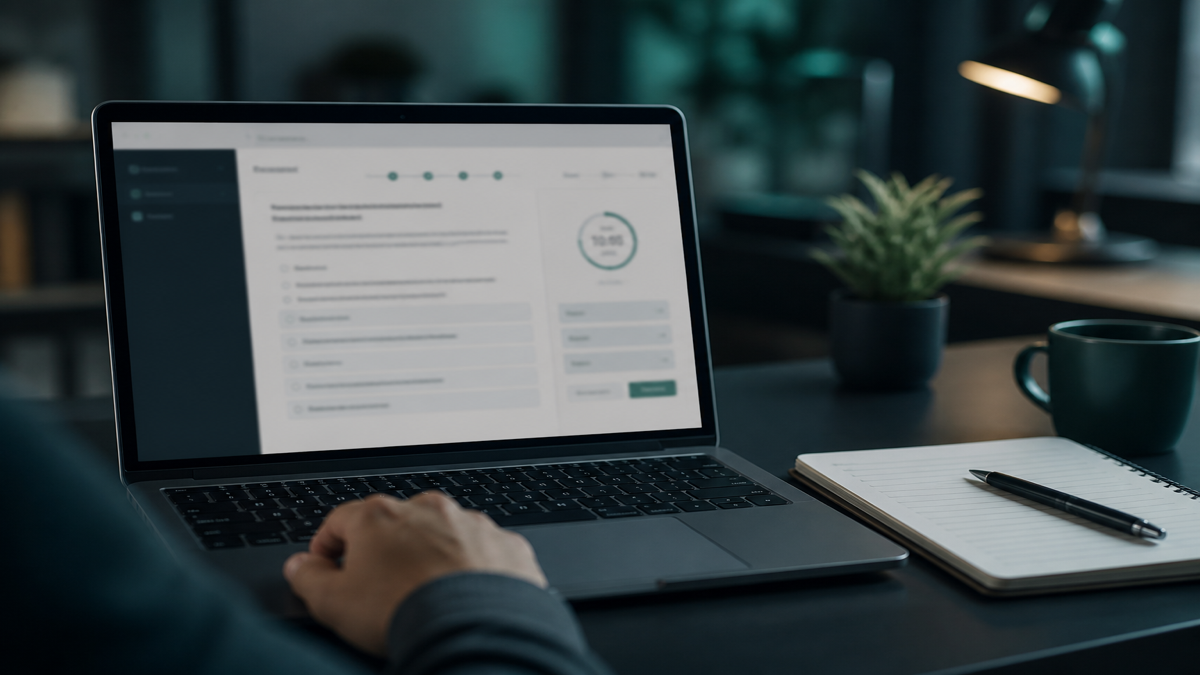
A skills assessment is a timed or structured exercise employers use to verify you can perform the work your resume describes—usually after your application passes ATS screening in systems like Greenhouse, Lever, or Workday, but before a final hiring decision. It is not a personality quiz; it is proof that your listed skills are real.
This guide explains the main assessment types you will see in 2026, where they fit in the hiring funnel, how to prepare without cheating yourself, and how to align your resume so you pass both keyword screens and live verification.
If you are returning to the job market after a break, refresh fundamentals before applying to assessment-heavy roles. A six-week skill tune-up beats failing three identical tests and burning bridges with the same employers.
Key Takeaways
- Assessments verify resume claims—they come after ATS, before or between interviews
- Common types: cognitive, technical, work sample, situational judgment, typing/data
- List only skills you can demonstrate under mild time pressure
- Block uninterrupted time; proctoring is common on remote tests
- Failing twice for similar roles means your resume may be overselling skills
What a skills assessment actually measures
Resume screening answers whether you look qualified on paper. Skills assessments answer whether you can execute baseline tasks without hand-holding. Employers adopted them heavily after remote hiring made it harder to trust interviews alone and after ATS keyword inflation flooded pipelines with overstated profiles.
A well-designed assessment maps directly to day-one job tasks: a customer support candidate might handle mock tickets; a data analyst might clean a small spreadsheet; a software engineer might fix a bug in a sandbox repo. Poorly designed assessments test trivia—but you still have to pass them to move forward. Vendor quality varies: some tests are validated occupational instruments; others are generic screens rebranded as skills tests.
Volume hiring programs sometimes auto-send assessments to every applicant who passes minimum keyword filters in the ATS. That means you might take a test before any human reads your resume. Treat the invitation as stage two of the same application, not a separate formality you can postpone indefinitely.
Platforms integrate assessments at different stages. Greenhouse and Lever often trigger automated invites via assessment vendors after a recruiter advances your stage. Workday deployments may embed questionnaires or link to third-party tests from the candidate profile. iCIMS bundles similar modules for enterprise clients.
Key Takeaway: treat assessments as proof-of-skill gates, not optional homework—the score often decides whether interviews continue.
Common skills assessment types in 2026
Knowing the category helps you prep efficiently. Most employers use one or two of these per role rather than all five.
Blue-collar and skilled-trades hiring increasingly uses video-based situational tests plus equipment knowledge quizzes before on-site trials. White-collar roles lean on cognitive screens and work samples. Hybrid roles—field service engineers, clinical liaisons—may stack both. Read the job description for clues about which bucket dominates.
- Cognitive and aptitude: logic, numeracy, reading comprehension under time limits—common for entry-level and high-volume roles.
- Technical skills: coding challenges, SQL queries, Excel exercises, design tool tasks, or equipment simulations for trades.
- Work samples: short projects mirroring real deliverables—a writing brief, a slide outline, a support email draft.
- Situational judgment: choose how you would respond to workplace scenarios; scored against employer values and compliance rules.
- Typing, data entry, and language: words per minute, accuracy, and basic formatting speed for admin and operations roles.
| Assessment type | Typical roles | Resume implication |
|---|---|---|
| Cognitive/aptitude | Retail, call center, graduate programs | Emphasize reliability metrics, not inflated leadership titles |
| Technical | Engineering, analytics, IT support | List only languages/tools you can use without documentation |
| Work sample | Marketing, design, communications | Portfolio links must match the quality you will produce live |
| Situational judgment | Management, healthcare, compliance-heavy jobs | Use ethical, policy-first framing in summary lines |
Key Takeaway: identify which category your target role uses and practice that format—not generic interview questions.
Align your resume with what will be tested
ATS systems rank keyword matches; assessments punish keyword stuffing. The fix is honest alignment: every skill line on your resume should survive a fifteen-minute practical test. If Python is listed, expect a small scripting task. If customer service is listed, expect tone-and-resolution scenarios.
Before (skills section): Excel, SQL, Python, Tableau, R, Power BI, Salesforce, HubSpot
After (skills section): Excel (pivot tables, VLOOKUP), SQL (joins, aggregations), Tableau dashboards—Python for basic scripting only
Before (experience bullet): Expert in data analysis and reporting.
After (experience bullet): Built weekly SQL reports for 12 KPIs; reduced manual Excel work by 6 hours per week for finance team.
Before (summary): Highly skilled communicator with advanced technical abilities.
After (summary): Operations analyst with 3 years SQL and Zendesk reporting; average handle time improved 18% after ticket taxonomy redesign.
Only list skills you can demonstrate under mild pressure. If Excel is on your resume and the assessment includes pivot tables, you should complete that task without a tutorial. Overselling skills is the fastest way to pass ATS and fail the human verification step.
Certifications listed on your resume may trigger vendor-specific exams—Salesforce, AWS, Microsoft, or Google badges sometimes require login verification or challenge labs. Expired certs should come off the resume before you apply to roles that test them.
Key Takeaway: pass ATS with relevant keywords, but never list a skill you would fail if tested tomorrow morning.
Upload your draft to HireFlow's free ATS checker to see parsing and keyword balance before you commit to an assessment-heavy application.
Preparation playbook for timed assessments
- Read the invitation email twice—note time limit, proctoring rules, allowed materials, and deadline timezone.
- Complete the practice questions if offered; they reveal question style and interface quirks.
- Recreate test conditions: quiet room, wired internet, charged laptop, ID ready if proctored.
- Drill fundamentals for three sessions spread across days—cramming the night before rarely fixes skill gaps.
- Prepare your workspace: clear desk, close unrelated tabs, disable notifications before the browser lock engages.
- Plan buffer time—start early in the window in case of login issues.
Coding assessments often use shared question banks—refresh data structures, SQL joins, and one language you list fluently. Excel tests frequently include pivot tables, XLOOKUP, and conditional formatting under time pressure. Customer service simulations score tone, policy adherence, and resolution speed simultaneously; rushing hurts multiple dimensions.
Ask recruiters which vendor powers the test when possible. Names like Criteria, SHL, HackerRank, Codility, and TestGorilla behave differently. Knowing the vendor helps you find legitimate practice materials instead of random brain-teaser sites.
| Do | Don't |
|---|---|
| Use the practice module first | Skip instructions to save time |
| Ask recruiter about accommodations if needed | Assume you can retake without permission |
| Flag technical issues immediately via support chat | Have a friend take the test for you |
| Answer situational questions with policy-safe choices | Pick edgy answers to stand out |
Key Takeaway: preparation is mostly logistics plus fundamentals— treat the invite like a exam with a hard start time.
What happens after you submit
Scores usually route back to the ATS record attached to your application. Recruiters see pass/fail flags, percentiles, or reviewer notes depending on the vendor. Strong scores rarely auto-generate offers; weak scores often auto-generate rejections without a phone call.
Some employers let hiring managers override a borderline score when your resume shows rare domain experience—think regulated industries, legacy systems, or niche certifications. That override is less common in high-volume recruiting where decisions are fully automated inside Greenhouse or Lever workflows.
If you are rejected after an assessment, wait before reapplying to the same company in the same quarter. Many systems flag duplicate profiles and prior scores. Improve the skill, update the resume, and target adjacent roles where the test emphasis differs.
Check your score interpretation if shared. A 65th percentile on a cognitive test might be fine for one employer and below cutoff for another. Percentiles are relative to the vendor norm group, not to your personal worth.
Understanding the full funnel helps. See how ATS really works and how to beat an ATS system for where assessments sit relative to parsing and recruiter review.
Key Takeaway: assessments usually auto-filter weak scores—fix skills or resume honesty before mass-applying to similar roles.
Accommodations, anxiety, and retakes
If you need extended time, screen-reader compatibility, or other accommodations, request them when you receive the invite—not after you start. US employers with fifteen or more employees generally must provide reasonable accommodations for assessments tied to hiring.
Neurodivergent candidates may benefit from extended time or alternative formats—request accommodations through HR, not through the generic test chat bot after you panic. ADA protections apply to pre-employment testing when the employer uses scores to make hiring decisions.
Hybrid and remote roles may include language assessments, written exercises, or async video responses scored by AI plus human reviewers. Read instructions about retakes, tab switching, and allowed notes before you begin—violations can void the attempt even if your answers were strong.
Government and defense contractors sometimes require citizenship-specific assessments or clearance paperwork before skills tests. Budget extra calendar time; security timelines are not negotiable because you have another offer deadline.
Sales and customer-facing roles may use role-play calls with managers listening live. Prepare a quiet room, wired headset, and notes you can glance at without rustling paper on mic. These are assessments even when they feel like informal conversations.
Retake policies vary. Some vendors allow one free retake after thirty days; others lock results to the application permanently. Never assume you can game the system with multiple accounts—employers match email, phone, and device fingerprints in iCIMS and Workday records.
If you need accommodations, email HR before clicking the assessment link. Retroactive accommodation requests after a failed attempt are harder to grant and may delay your candidacy while legal teams review.
Key Takeaway: ask for accommodations early and confirm retake rules in writing before you invest prep time.
Red flags: when to walk away from an assessment
Most assessments are legitimate hiring steps. A few are extraction schemes: unpaid multi-day spec work with no interview follow-up, proprietary code requests with no NDA, or tests unrelated to the posted role used to harvest work product. If scope exceeds what a reasonable employer would ask before an offer, decline politely and document the request.
Reasonable work samples are time-bounded—one to three hours—or paid trial projects with clear contracts. Unreasonable ones reuse your output commercially without compensation. Trust your gut when instructions feel like free consulting disguised as skills testing.
Accessibility barriers without accommodation paths are another walk-away signal. Legitimate enterprises provide alternate formats when asked. A vendor that refuses all accommodations for a timed test may create legal risk for the employer—and headache for you if hired into a rigid culture.
Keep PDF exports of completed assessments when the platform allows. Disputes about completion status or technical failures happen; timestamps and confirmation emails protect you if a recruiter claims you never submitted.
Team-fit assessments that ask repetitive personality questions are hard to game and easy to overthink. Answer consistently rather than trying to guess the perfect employee archetype. Wild swings between similar items flag inconsistency scores.
After you pass, thank the recruiter and confirm next interview steps in the same email thread. Assessments sometimes complete without automatic stage updates in Lever—nudge politely if you hear nothing within three business days.
Screenshot your completion confirmation page immediately. Some vendor portals expire access after submission, leaving you without proof if the ATS fails to sync your score overnight.
Key Takeaway: assessments should verify skills, not extract free labor—set boundaries and keep copies of what you submit.
Before and after (ATS-safe wording)
Key Takeaway: keep the same fact, add the tool name and a number.
| Before | After |
|---|---|
| Responsible for reports and team support. | Built weekly Workday headcount reports that cut manager follow-ups by 30%. |
| Used office software and helped customers. | Processed 40+ Greenhouse tickets/week in Zendesk with 96% CSAT. |
| Improved processes across the department. | Mapped the Taleo requisition workflow and cut time-to-post from 5 days to 2. |
Skills assessments are the reality check after ATS screening. Align your resume with what you can prove, prepare like it is proctored, and treat weak scores as a signal to upskill—not to apply harder with the same overstated profile.
Stress-test your resume before the next assessment invite: use HireFlow's free ATS checker or rebuild honestly with the free resume builder .
Frequently asked questions
A skills assessment is a structured test or exercise employers use to verify that you can do the work your resume claims—often after an ATS screens your application but before a final interview. It can include timed quizzes, work samples, coding challenges, situational judgment tests, or typing and data-entry drills depending on the role.
Most often after resume screening and a recruiter phone screen, but before or between panel interviews. Some companies send assessments immediately after you apply through Greenhouse or Lever; others wait until a hiring manager reviews your profile in Workday. The timing varies by employer and role urgency.
Sometimes, if the score is borderline and the rest of your candidacy is strong—but repeated failures on core job skills usually end the process. Treat assessments as pass/fail gates for baseline competence, not as suggestions. If you fail twice for similar roles, your resume may be overselling skills you need to build.
Many are. Proctoring can include webcam monitoring, browser lockdown, ID checks, and time limits that prevent looking up answers. Assume you are being recorded unless the employer explicitly says otherwise. Prepare as if it is closed-book.
Only list skills you can demonstrate under mild pressure. If Excel is on your resume and the assessment includes pivot tables, you should complete that task without a tutorial. Overselling skills is the fastest way to pass ATS and fail the human verification step.
Anywhere from fifteen minutes to several hours spread across days. Recruiters usually quote a time estimate in the invitation email. Block uninterrupted time, use a stable connection, and read instructions carefully—many candidates lose points by skipping the practice section.
No. They narrow the pool and reduce resume fraud. Interviews still evaluate communication, culture fit, and judgment. Think of assessments as proof-of-skill and interviews as proof-of-person.
Review fundamentals for the specific test type, complete one timed practice set per day for a week, and update your resume to reflect current skill level honestly. Use free tutorials for gaps, but do not apply until you can pass a practice version without help.