7 min read
This isn't a moral debate. It's a formatting choice with two audiences: parsers that tag degree lines and humans who sometimes do quick age math. You're deciding which signal helps you tonight without hiding a credential you need verified.
If you're worried about bias, you're not alone. Plenty of mid-career candidates drop the year and still list the MBA or bachelor's clearly. The goal isn't to trick anyone. It's to stop leading with a date that doesn't change the hire decision.
Before you change the education block, check your resume for free and confirm school and degree still extract when you remove the year. If the degree vanishes, fix layout first.
The comparison below walks include vs omit by career stage, then shows how to edit the line without breaking ATS import.
Include vs omit graduation year by career stage
Graduation year on a resume does two jobs. It helps recruiters place entry-level candidates and confirm a degree is complete. It also gives humans a rough age anchor they shouldn't use but sometimes do. Your stage decides which side weighs heavier.
| Career stage | Include year? | Why |
|---|---|---|
| Student or new grad (0 to 3 years) | Yes | Confirms degree timing when work history is thin |
| Early career (3 to 8 years) | Usually yes | Still helps cohort placement unless experience clearly senior |
| Mid-career (8 to 15 years) | Optional | Experience dates carry the story; year adds age signal |
| Senior or executive (15+ years) | Often omit | Degree still matters; year rarely changes hire decision |
When including the year helps
Postings that require a recent degree, campus recruiting, and internships all expect a year. Parsers map it to education end date fields some filters read. If you're switching fields and the degree is your main proof, the year shows the credential is current.
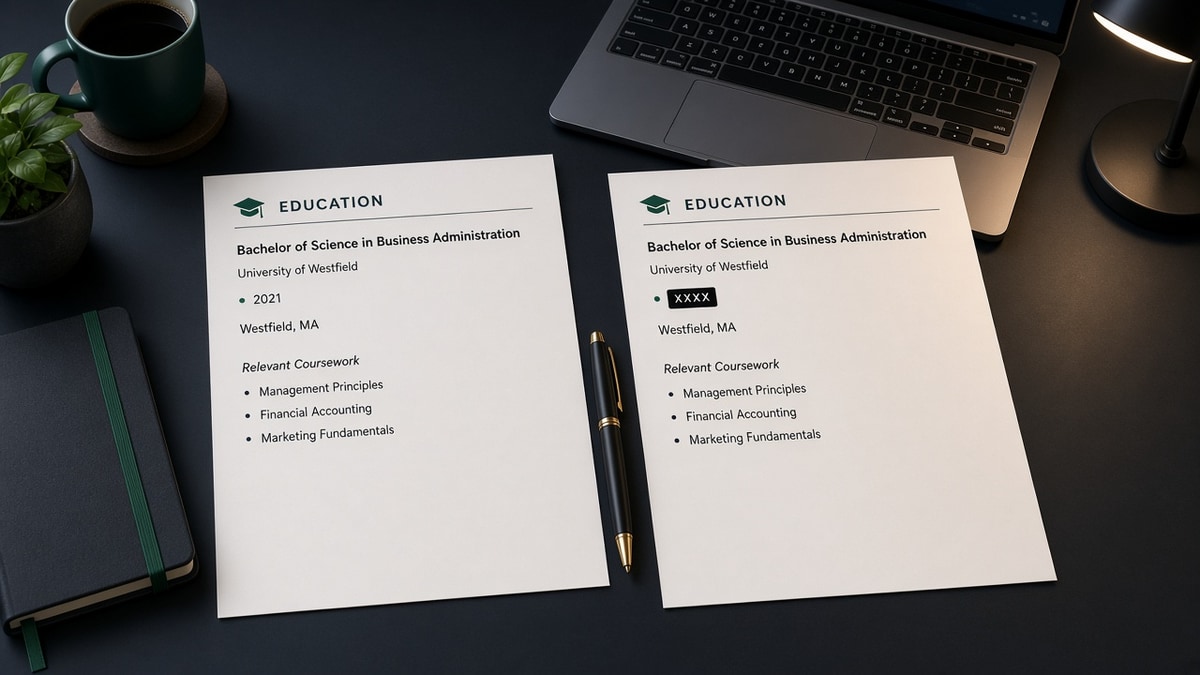
Before: Bachelor of Science in Computer Science, State University (no year, no graduation signal).
After: Bachelor of Science in Computer Science, State University, May 2025.
When omitting the year helps
Long work histories make the year redundant for capability proof. Some recruiters skim education once and spend time on recent roles. Omitting the year removes one age cue while keeping the school and degree searchable.
Before: MBA, Lakeside University, 1998 (anchors age more than value).
After: MBA, Lakeside University (degree retained, year removed).
Career changers and recent bootcamps
Include the graduation or completion year when the new credential is the main proof for the pivot. A 2025 data bootcamp line helps recruiters place you in junior pipelines even when your older roles were in another field.
Before: Certificate in Data Analytics (no year, unclear if finished).
After: Certificate in Data Analytics, Nexus Bootcamp, August 2025.
Advanced degrees after long careers
Show the year on the newer degree and omit it on older undergrad lines. That keeps the recent credential verifiable without stacking two graduation dates that both signal age.
Month year vs year only on resume dates covers how date detail affects experience sections, not just education.
Edit the education line without breaking parse
- Decide include or omit using the stage table above and the posting language.
- Keep degree, major, and school on plain lines under an Education heading.
- Place the year on the same line as the degree or on the line below, not in a sidebar.
- If omitting, delete only the year token. Don't remove school or degree names.
- Answer any separate portal field for graduation date even when the resume omits it.
- Re-run a plain-text paste test and confirm degree still appears before upload.
Copy-paste education lines:
With year (early career):
Bachelor of Arts in Economics, Portland State University, June 2024

Without year (mid-career):
Bachelor of Arts in Economics, Portland State University
I've seen strong mid-career candidates drop the year and keep a clean degree line while their experience section carried the timeline. Recruiters cared about the last two jobs, not when they finished undergrad.
If you earned a second degree recently while mid-career, include the year on that newer line only. Leave the older undergrad line without a year so the resume doesn't stack two age anchors.
International candidates should keep the degree name recognizable in the US market. Write the credential clearly, then add equivalency only when the posting asks. The year rule stays the same: include when recent, omit when experience carries the timeline.
High school lines usually drop off once you hold a college degree unless the posting targets roles where HS completion is explicitly required. When you keep HS, treat the year like undergrad: include when recent, omit when decades old.
Graduation year traps that backfire
- Removing the whole education block: loses degree filters when you only meant to hide age.
- Fake or rounded years: background checks compare to transcripts.
- Year in a text box or footer: parsers skip it and leave education date blank.
- Inconsistent story: omit year on resume but list a different year in the portal.
- Expected degree without year: write Expected May 2026 for in-progress degrees so status is clear.
Before: Education section deleted entirely to avoid age bias while an MBA is required on the posting.
After: MBA, Clearwater School of Business listed without year; experience shows leadership scope.
Don't move education above experience just to hide work history dates. Order still matters for parsers. Education belongs below recent jobs unless you're a current student with no paid roles yet.
Chronological vs functional resume 2026 explains why hiding dates across the whole file hurts more than trimming one education year.
Check parsed education before submit
Upload or paste into a checker and confirm school and degree still extract after you edit the year. Some portals show an education preview separate from work history. Read both.
Run the ATS check on your education block after you include or drop the year. Fix layout if the degree line disappears in plain text.
Generate a cover letter when a recent degree or bootcamp is central to the story the resume year line can't carry alone.
Match the year to what the reader needs
Should you include graduation year on your resume depends on stage, not superstition. Early career candidates benefit from the timestamp. Mid-career and senior candidates often drop it while keeping school and degree intact for parsers and degree filters.
Make the call once on your master file, then mirror separate application fields honestly. You'll avoid layout bugs, keep credentials searchable, and stop giving recruiters a number they don't need when your work history already tells the story.
When in doubt, ask what the posting emphasizes. Degree-required campus roles want the year. Senior individual contributor roles with fifteen years of experience rarely hinge on when you finished undergrad.
Law, medicine, and licensed fields may need completion years for bar or board timelines. Follow the license section rules on those posts before you drop education dates globally.
Read more
Frequently asked questions
Most parsers still capture school name and degree without a year. Automated degree-required filters look for the credential token, not always the date. If a portal asks for graduation year in a separate field, answer there even when you omit it on the resume line.
Yes in most cases. Recruiters use the year to confirm you finished the degree and to place you among entry-level cohorts. Hiding the year when you have little experience can look like you're obscuring timing rather than managing age bias.
Omitting the year is common once you have ten or more years of work history that proves seniority. Keep school, degree, and major. Let experience dates carry the timeline. Add the year back if you're applying to roles that explicitly ask for graduation date in the posting.
No. Work history dates still reveal career length. Omitting graduation year removes one age anchor, not every signal. The tradeoff is fewer clues for bias and fewer clues for recruiters verifying a fresh degree.