12 min read

Should You Attach a Cover Letter in 2026? The Complete Guide

HireFlow Editorial Team
July 19, 2026

Learn whether cover letters still matter in 2026. Discover when to attach them, how ATS reads them, and best practices to improve your job application success.

Should You Attach a Cover Letter in 2026? The Complete Guide

The question of whether to attach a cover letter has become more complex in 2026. With applicant tracking systems (ATS) screening millions of resumes daily and hiring teams overwhelmed by application volume, the traditional cover letter's relevance has shifted dramatically. Some employers now ignore them entirely. Others still view them as critical differentiators. Understanding the current landscape is essential to avoid wasting time or missing opportunities.

This guide reveals what's actually happening in modern hiring, when cover letters genuinely help your candidacy, and when they're better left out. You'll learn how ATS systems process cover letters, which industries still expect them, and the exact strategies that improve your chances of landing interviews.

What you'll discover:

  • Whether cover letters improve or hurt your ATS screening odds
  • Which job types and industries still require cover letters
  • How to write a cover letter that actually gets read
  • Common mistakes that eliminate your application
  • Step-by-step guidance on formatting and submission

Why Cover Letters Still Matter (and When They Don't)

The role of cover letters has fundamentally changed. In 2026, they're no longer a universal requirement—they're a strategic tool. Research shows that 50-60% of hiring managers still read cover letters, but only when the resume passes initial screening. This means your cover letter rarely determines whether you get filtered by ATS. Instead, it influences the human decision after your resume qualifies you.

The real value of a cover letter lies in personalization and storytelling. While your resume lists what you've done, a cover letter explains why you're interested in this specific role and how your experience solves the company's problems. For competitive positions where multiple candidates have similar qualifications, this narrative advantage can be decisive.

However, submitting a generic or poorly written cover letter actively hurts your chances. Recruiters interpret low-effort cover letters as a sign of low interest, which can move you down the ranking even if your resume is strong.

When Should You Attach a Cover Letter in 2026?

Always Attach When Explicitly Requested

If the job posting says "cover letter required" or "please include a cover letter," submit one. Ignoring this instruction signals carelessness and will likely result in automatic rejection. Some companies use this as a screening filter to identify candidates who follow directions.

Attach for Competitive or Senior Roles

For positions with high competition or senior-level roles, a strong cover letter can differentiate you. These roles typically have fewer applicants, meaning hiring managers spend more time on each file. Your cover letter has a higher chance of being read and appreciated. This is especially true for executive, specialized technical, or leadership positions.

Attach for Company Culture-Focused Positions

Startups, nonprofits, creative agencies, and mission-driven companies often value cultural fit and passion. These organizations are more likely to read cover letters because they care about why you want to work there, not just your technical qualifications. A well-written cover letter that demonstrates alignment with their values can significantly boost your candidacy.

Skip for High-Volume Roles and Entry-Level Positions

For entry-level jobs, customer service roles, or positions that receive 500+ applications, cover letters are rarely read. Large companies processing thousands of applications rely almost entirely on ATS screening and resume review. Spending 30 minutes on a cover letter for a high-volume role is inefficient. Focus your energy on optimizing your resume for ATS instead.

How ATS Systems Handle Cover Letters

Most ATS platforms can parse cover letters, but they don't weight them equally to resumes. The system typically extracts keywords and checks for required skills or certifications, but the resume remains the primary scoring document. How ATS screens cover letters depends on the system's configuration, but generally, a poorly formatted cover letter won't tank your application if your resume is strong.

However, cover letters can help in specific scenarios. If you're changing careers or have employment gaps, a cover letter allows you to explain these transitions in context. ATS systems can recognize narrative explanations that provide missing information from your resume. Additionally, if your cover letter contains job-description keywords naturally woven into storytelling, it can slightly boost your overall match score.

The critical point: never rely on your cover letter to compensate for a weak resume. What makes a resume ATS-friendly in 2026 remains the foundation of your application. Your cover letter is supplementary.

Common Cover Letter Mistakes That Reduce Interview Chances

  • Generic templates: Using a one-size-fits-all cover letter signals low interest. Recruiters immediately recognize template language. Customize at least the opening paragraph and specific examples to the company and role.
  • Repeating your resume: Your cover letter should not simply restate what's on your resume. Instead, provide context, explain your motivation, and highlight achievements that best align with the job description. Add new information.
  • Excessive length: Cover letters should be 3-4 short paragraphs or 250-400 words maximum. Anything longer tests the reader's patience and suggests you can't communicate concisely. Recruiters spend 30-60 seconds reviewing each cover letter.
  • Poor formatting: Inconsistent fonts, irregular spacing, or unprofessional headers damage your credibility. Use a clean, simple format with standard fonts like Arial or Calibri, 10-12pt size, and 1-inch margins.
  • Focusing on what the company can do for you: Avoid language like "I'm looking for growth opportunities" or "I want to learn new skills." Instead, focus on what value you bring and how you'll contribute to their success.
  • Ignoring the job description: Failing to reference specific requirements or company details makes your letter feel impersonal. Reference 2-3 specific job requirements and explain how your experience addresses them.

Best Practices for Cover Letters That Get Results

  1. Open with a hook: Start with a specific achievement or insight about the company rather than generic greetings. Example: "Your recent product launch in Q3 impressed me because..." This immediately demonstrates genuine interest.
  2. Mirror job description language: Identify 3-4 key requirements from the posting and weave them naturally into your letter. Use similar terminology without keyword stuffing. This helps both ATS parsing and human readers see your alignment.
  3. Tell a brief story: Use one concrete example that demonstrates your value. Instead of "I'm a strong problem-solver," write: "When our team faced a 40% drop in conversion rates, I led a redesign that recovered 65% of lost revenue within 6 weeks."
  4. Address employment gaps or career changes: If your resume has gaps or shows a career pivot, use your cover letter to explain the context. Be honest and forward-looking. Example: "After five years in sales, I completed a coding bootcamp because I wanted to build products rather than sell them."
  5. Keep it scannable: Use short paragraphs and clear structure. Recruiters scan rather than read deeply. Make your key points obvious within the first 15 seconds.
  6. Close with confidence: End with a clear call-to-action. Example: "I'm excited to discuss how my experience with API integration and React can accelerate your platform's development. I'm available for a call next week."
  7. Proofread ruthlessly: A single typo or grammatical error can eliminate you from consideration. Spell-check twice, read aloud, and have someone else review it.
  8. Use proper file naming: Save as "FirstName_LastName_CoverLetter.pdf" to match your resume naming convention. Avoid generic names like "Cover Letter.pdf."

Step-by-Step Guide: Writing and Submitting Your Cover Letter

  1. Step 1: Research the company and role: Spend 10-15 minutes learning about the company's recent news, products, and culture. Identify 2-3 specific details you can reference. This research informs everything that follows.
  2. Step 2: Extract key job requirements: List 4-5 core skills or experiences from the job posting. These will become your focus points in the letter.
  3. Step 3: Draft your opening paragraph: Reference the specific role and company. Include one detail that shows you've done research. Keep it to 3-4 sentences.
  4. Step 4: Write your middle paragraph(s): For each key requirement, provide one concrete example from your experience. Use metrics or outcomes. Aim for 2-3 paragraphs total, each 3-4 sentences.
  5. Step 5: Address gaps or transitions: If relevant, briefly explain any career changes or employment gaps. Keep this matter-of-fact and forward-focused.
  6. Step 6: Close with a call-to-action: Express enthusiasm and indicate your availability. Make it easy for them to contact you.
  7. Step 7: Format and save: Use a clean template with consistent formatting. Save as PDF to preserve formatting. Use standard fonts and 10-12pt size.
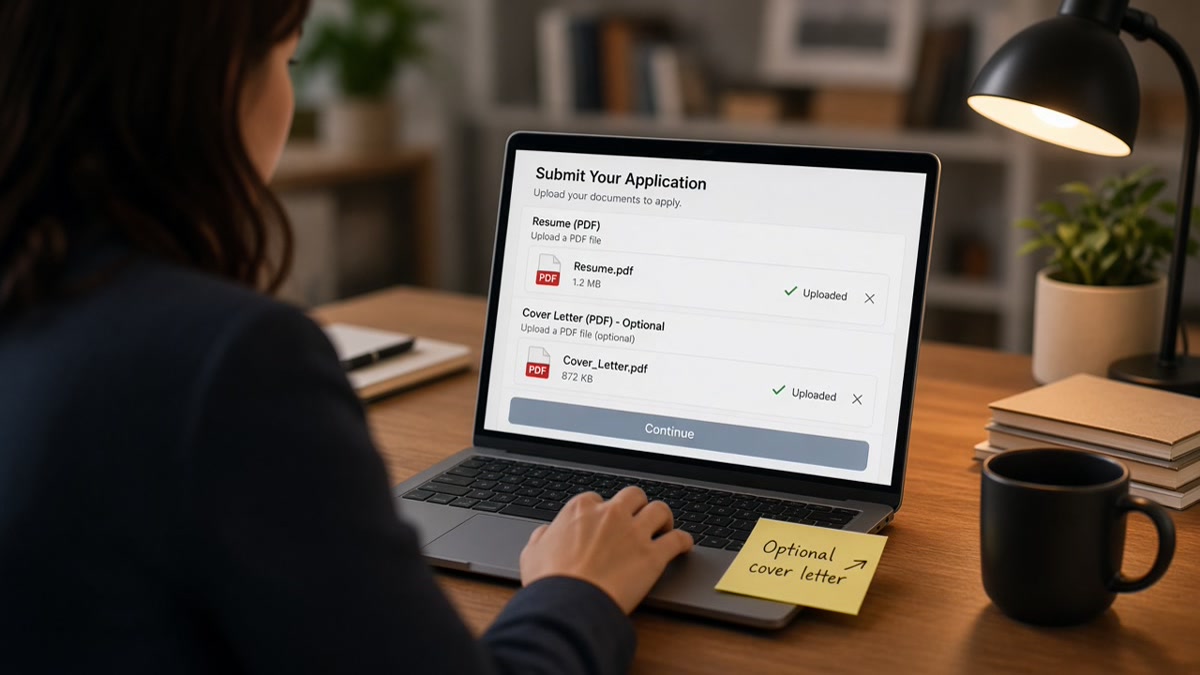
  8. Step 8: Submit correctly: Follow the job posting instructions exactly. If it says "attach cover letter," attach it as a separate file. If it says "paste in the application field," paste it. Never deviate from instructions.

Do Different Industries Expect Cover Letters?

Cover letter expectations vary significantly by industry in 2026. Academic and research positions almost always require cover letters—they're considered essential for demonstrating fit with institutional values. Law, consulting, and financial services firms still expect them for professional-level roles. Government and nonprofit positions frequently request them as part of formal application processes.

Tech and startup environments are more flexible. While some tech companies request cover letters, many explicitly state they're optional. Creative industries (design, marketing, advertising) value portfolios and work samples more than cover letters. Sales and customer service roles rarely require them due to high application volume.

The safest approach: if the posting doesn't mention cover letters, check the company's careers page or LinkedIn for guidance. When in doubt, a strong cover letter is a low-risk addition that can only help, not hurt.

Frequently Asked Questions

Do cover letters actually help you get interviews?

Cover letters help primarily after your resume passes ATS screening. Research suggests that 40-50% of hiring managers read cover letters, but only for candidates who've already qualified based on resume review. A strong cover letter can be the deciding factor when you're competing against other qualified candidates. However, a weak cover letter won't overcome a weak resume, and a missing cover letter won't disqualify you if your resume is excellent. Think of it as a tie-breaker, not a primary qualification filter.

Should I submit a cover letter if it's optional?

It depends on the role and your situation. For competitive positions, senior roles, or company culture-focused organizations, submit one. For high-volume entry-level roles, skip it unless you have a compelling reason (career change, significant gap). If you're already strong on paper and the position receives hundreds of applications, the time spent on a cover letter is better invested in tailoring your resume or applying to more positions. Quality over quantity applies here.

What file format should I use for my cover letter?

PDF is the safest choice for cover letters. It preserves formatting across all devices and operating systems, preventing layout issues that could make your letter look unprofessional. Word documents (.docx) are acceptable if the job posting specifically requests them, but avoid .doc format as it's outdated. Never submit as Google Docs unless explicitly requested. Always save with a clear filename: "FirstName_LastName_CoverLetter.pdf." Avoid generic names that make it harder for recruiters to organize your application.

How long should a cover letter be?

Keep your cover letter to 250-400 words or 3-4 short paragraphs. This length respects the recruiter's time while providing enough space to demonstrate genuine interest and relevant experience. Anything longer risks losing the reader's attention. Anything shorter may seem dismissive. Each paragraph should have a clear purpose: opening (why you're interested), middle (relevant experience and skills), and closing (call-to-action). Aim for density of meaning rather than word count.

Should I customize my cover letter for every application?

Yes, customization is essential. Generic cover letters are immediately recognizable and signal low interest. At minimum, personalize the opening paragraph with the company name and specific role, and reference one detail about the company or job posting. If you're applying to similar roles at different companies, you can reuse the middle section but must change the opening and closing. For highly competitive positions, invest 20-30 minutes in a fully customized letter. For volume applications, at least change the opening paragraph and one example to match the job description.

Can a cover letter hurt your chances if it's not good?

Yes. A poorly written, generic, or error-filled cover letter can actively damage your candidacy. Recruiters interpret low-effort cover letters as a sign of low interest or poor communication skills. Spelling mistakes, grammatical errors, or inconsistent formatting create a negative impression that can move you down the ranking even if your resume is strong. If you don't have time to write a quality cover letter, it's better to skip it than submit a mediocre one. Your resume alone is sufficient if it's well-optimized for ATS and clearly demonstrates your qualifications.

Final Verdict: Should You Attach a Cover Letter in 2026?

The answer is nuanced: attach a cover letter when it's explicitly requested, when the role is competitive or senior-level, or when you have a compelling story to tell (career change, gap explanation, or genuine passion for the company). Skip it for high-volume entry-level positions where your time is better spent optimizing your resume and applying to more roles.

The most important takeaway is that your resume remains the foundation of your application. What makes a resume ATS-friendly in 2026 directly determines whether you reach human reviewers. Only then does your cover letter have the opportunity to influence their decision.

When you do submit a cover letter, make it count. Customize it, tell a specific story, and demonstrate genuine interest in the role. A thoughtful, personalized cover letter can be the difference between a rejection and an interview invitation when you're competing against equally qualified candidates. In 2026, that strategic advantage is worth the effort.

Free Tools Available

Ready to Improve Your Resume?

Use HireFlow's free tools to check your resume, build an ATS-optimized CV, and create a compelling cover letter. Get past the filters and land more interviews.

ATS Optimized
100% Free
Instant Results

Done for you

Turn this advice into an interview-ready resume

Professional writers rebuild your resume for ATS + recruiters — unlimited revisions, interview guarantee.

Job match tool·Free builder

Tags

cover letter 2026should you attach a cover lettercover letter vs resumeATS cover lettersjob application cover letterwhen to submit cover lettercover letter requirements