11 min read
The three resume skill mistakes that lower your score are skill dumps with no proof bullets, tools listed without a dated use case, and wrong section order that puts a long Skills block above Experience. You don't need forty keywords. You need posting must-haves showing up where parsers and recruiters actually read.
If you're getting silence on roles you're qualified for, the Skills section is a common leak. You've probably been told to add more terms. That's backwards when the terms never appear in a bullet. Before you rewrite the whole file, check your resume for free against tonight's posting and see whether your must-haves live in Experience or only in a footer list.
This page covers why those three patterns tank ATS matching, when a short Skills block above Experience is fine, and what to change in the next twenty minutes. Job searching is draining enough without guessing whether your file even imported the skills you listed.
Quick Wins
- Highlight must-have tools in the posting and Ctrl+F each one in Experience, not only Skills.
- Cut your Skills block to twelve lines max for one application.
- Move Experience above Skills unless you're a new grad with thin work history.
- If the portal asks for a cover letter, draft one with the cover letter generator so it repeats skills you already proved in bullets.
Why the Skills block stops matching the posting
ATS tools don't read your Skills section like a human scanning a tag cloud. Workday, Greenhouse, Lever, and iCIMS extract fields, then compare overlap between the job description and your Experience text, Skills rows, and sometimes certifications. A term that only lives in a thirty-line dump often scores lower than the same term in your most recent bullet.
Skill dumps signal keyword stuffing even when you meant well. Parsers still index the words, but rankers weight repetition without context. Recruiters open the profile, see Salesforce nine times in Skills, zero times under your last title, and move on.
No proof bullets are the second hit. The posting asks for SQL and Looker. Your Skills row says both. Your Experience bullets say managed reports and worked with data. The parser may flag partial match. The recruiter sees a list, not evidence.
Wrong section order pushes proof below the fold. A two-column template with Skills in a left rail, or a full page of tools before your current job, buries the dated lines parsers weight highest. Your best bullet might be on page two while the posting's top must-have never appears in the first screen of plain text.
I've screened stacks of these in Workday and Greenhouse, and the file that wins is boring on layout: Experience up top, a short Skills block, and the same tool name in both places when the posting marks it required.
The contrast most people miss: the Skills list doesn't get you screened in. The bullet that repeats the skill with a month, a tool, and an outcome does.
Read why your resume never reaches a human when parsing breaks before keyword scoring even runs.
Resume skill mistakes that lower your score in the parser
Mistake 1: The skill dump
You copied every tool from the posting, added every tool you've touched since college, and called it comprehensive. The block runs twenty-five lines. Half the terms never show up under a job title.
Before: Skills: Python, SQL, R, Excel, Tableau, Power BI, Looker, Snowflake, AWS, GCP, Azure, Docker, Kubernetes, Jira, Confluence, Agile, Scrum, stakeholder management, communication, leadership, data visualization, machine learning, TensorFlow, PyTorch, NLP, Spark, Hadoop.
After: Skills (posting-aligned): SQL, Python, Looker, Snowflake, stakeholder updates. Each term also appears in a 2024 to 2026 bullet on the same file.
Composite data analyst: posting requires SQL, Looker, and monthly forecasting. Dump version lists every BI tool you ever opened a tab for. Fixed version keeps five tools, moves forecasting into the top bullet: Built Looker dashboards from SQL models for finance close, cutting manual forecast prep from six hours to ninety minutes.
Mistake 2: Skills with no proof bullets
Listing Tableau in Skills while every bullet says improved reporting tells a recruiter you might have clicked through a tutorial. The ATS sees the word. It does not see scope, dates, or outcomes tied to that word.
Before: Skills: Epic, patient safety, ACLS. Experience bullets: Provided compassionate care on busy unit. No system name, no census, no certification date.
After: Documented care in Epic on 32-bed med-surg unit; maintained ACLS certification through 2026; led fall-prevention huddles that cut unit incidents 14% in Q2.
Composite customer support lead: posting wants Zendesk, CSAT, and WFM. Skills-only version lists all three. Proof version: Zendesk, Salesforce Service Cloud, CSAT 96%, WFM adherence 98% in the bullet, not as a comma list with no story.
Mistake 3: Skills above Experience on the wrong profile
Templates marketed as modern put Skills under the summary and push jobs to page two. For a mid-level operator with six years of work, that's backward. Parsers and recruiters weight recent Experience first. Your Skills header becomes the wall they bounce off.
Before: Summary, two-page Skills, then one short job from 2022. Posting must-haves only appear in the footer.
After: Summary, Experience with three bullets on the current role in the first half of page one, Skills trimmed to eight posting terms below.
Composite project coordinator: posting lists Jira, Agile, cross-functional delivery. Wrong order hides a 2025 bullet about sprint planning under a skills grid. Right order puts that bullet directly under the summary with Jira in the first eight words.
What to change on your file tonight
Step 1: Pull must-haves from one posting
Open the job description. Highlight required tools, systems, and methods. Ignore nice-to-haves until must-haves each have a home in Experience or Skills. That list is your trim guide, not a license to paste the whole req.
Step 2: Audit Skills against Experience
For every line in Skills, search the rest of the file. No hit? Delete the line or add a bullet that proves it. If you can't prove it, don't list it for this application.
Copy-paste skills audit: Must-have from posting → Ctrl+F in Experience → Y/N proof bullet → Keep, move to bullet, or cut.
Step 3: Rewrite two bullets on your current role
Put the top two posting tools in the first eight words of separate bullets. Add a month or quarter and one outcome number inside the bullet text as illustration, not as a claim about hiring markets.
Example skeleton you can paste and fill: [Tool] + [task] + [metric] + [timeframe]. Built weekly churn dashboards in Looker, cutting reactive tickets 11% in Q3.
Step 4: Reorder sections for your career stage
Default order for most US corporate PDFs: Summary, Experience, Skills, Education, Certifications. New grad with one internship? Skills can sit above Education if every line ties to coursework or projects. Six-plus years? Experience stays on top.
Step 5: Cap the Skills block
Twelve lines is a practical max for one application. Group tools by category only if the posting is technical and the list stays scannable. No paragraph skills. No rating bars. Plain text, single column, 11-point Calibri or Arial.
Sort Skills in the same order must-haves appear in the posting when you can. Recruiters scanning a Greenhouse profile often compare your list to the req line by line. Random alphabet soup forces them to hunt, and many won't.
Soft skills that the posting never names can leave the Skills block entirely. Put communication and leadership inside team bullets instead. That keeps the footer for tools parsers can index without wasting lines on traits every candidate claims.
Edge case: career change with thin direct titles
You're moving from retail management to project coordination. Posting wants Jira and Agile. Add a Projects section with two dated lines that name those tools in outcomes. Keep honest job titles. Skills can list Jira only after a project bullet mentions it.
Edge case: two-column template trap
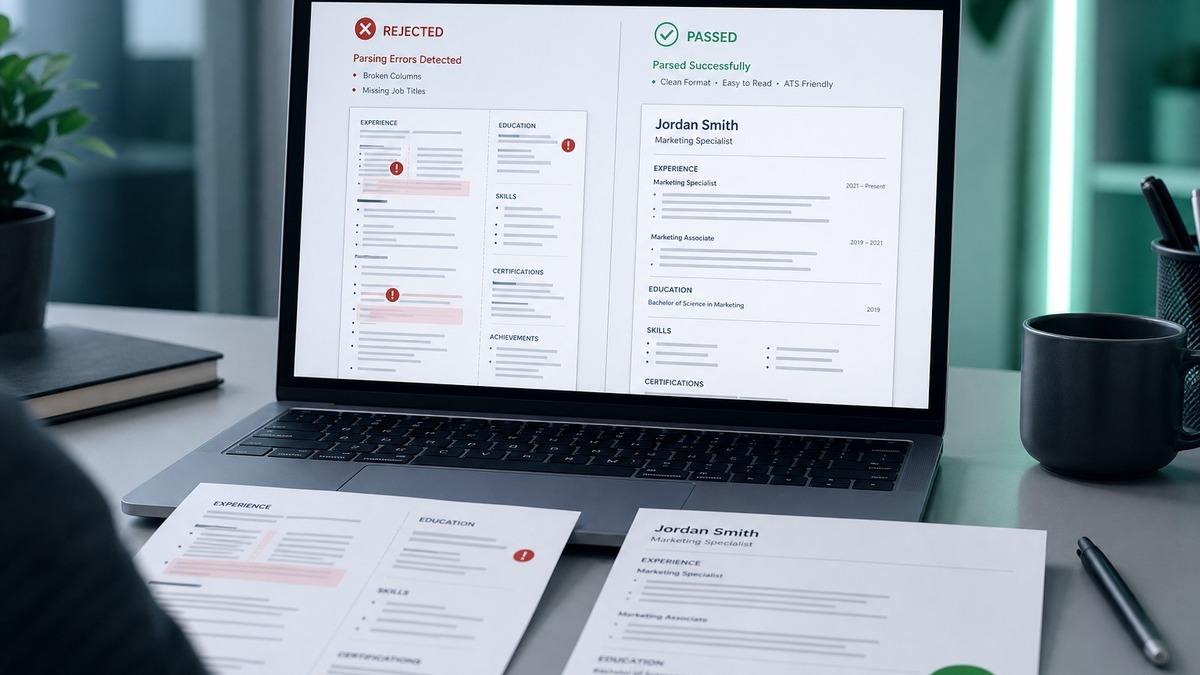
Skills trapped in a left sidebar often parse after Experience or merge into one run-on line. Export a single-column plain PDF before upload. Read how resume file type impacts screening if the portal preview scrambles your sidebar.
Edge case: acronym mismatch
Posting says CRM and you only wrote Salesforce. Use both once when space allows: Salesforce CRM in a bullet, not six synonyms in Skills.
The same rule applies to BI, ETL, and PM shorthand. If the req spells out business intelligence, mirror that phrase once in a bullet even if you normally write BI in Slack.
Exceptions: when Skills can sit higher
New grad with two internships and a projects block: a short Skills list under the summary helps scanners when Experience is thin. Licensed clinical roles where the posting leads with Epic or Cerner: certification and system lines can follow the summary if every system also appears in a clinical bullet. Everyone else should default to Experience first.
Read why weak bullet points get ignored when your Skills are fixed but bullets still read like job duties.
Check matching before you upload again
Guessing which skills matched is slower than measuring. Upload your tailored PDF and paste the posting into HireFlow's free ATS resume checker . You'll see which must-haves only appear in Skills, which repeat too often, and whether the file parses as a single readable column.
After you trim the dump and move two terms into bullets, run job match score on the same posting. That tells you if one more bullet rewrite is worth ten minutes or if you're ready to apply.
Do this now: Paste tonight's posting, upload your PDF, and fix the first skill that shows up only in the footer list.
What to do with your Skills section next
Resume skill mistakes that lower your score usually come down to volume without proof and order without strategy. Trim the dump, tie each must-have to a dated bullet, and put Experience where parsers expect it.
- Twelve Skills lines max per application, each searchable in Experience.
- Two rewritten bullets on your current role with posting tools in the first eight words.
- Experience before Skills unless you're a new grad or the posting leads with licensed systems.
Open the role you want most tonight. Run a free ATS check , fix the first skill that only lives in the footer, and submit one tailored file. That's the difference between a list that parses and a profile that matches.
Read more
Frequently asked questions
A long list without proof rarely helps. Parsers in Workday and Greenhouse map terms to searchable fields, but match scores weight skills that also appear in dated Experience bullets. Forty tools in a footer with no bullet mention often scores lower than twelve posting terms repeated once in your current role.
For most US corporate roles, put Experience before Skills. Parsers and recruiters read the top third first. A two-page Skills dump above your last job pushes proof down the page. Career changers and new grads can move a short Skills block higher only when Experience is thin and every listed skill has a project or internship bullet.
Cover every must-have from the posting once, plus tools you can defend in an interview. That is usually eight to fourteen lines for mid-level roles, not thirty. Trim anything you cannot tie to a bullet, project, or certification row on the same file.
List it only if you used it on real work, coursework with deliverables, or a client project you can describe. Learning on a tutorial alone belongs in a training line, not next to production tools the posting marks as required. Mislabeled proficiency hurts you when the phone screen starts with that tool.
Only when the posting names them as filters. Communication and stakeholder management work better inside bullets with a meeting, deck, or outcome. A Skills row that says teamwork with no dated proof gets ignored after parsing.