12 min read
You're applying on both sides of the Atlantic and you're not sure which file to send. UK CVs expect two pages and no photo pressure on US portals. US resumes want one page and Month Year dates. Mixing formats doesn't make you international. It makes parsers drop your dates and recruiters skim the wrong layout.
I've opened UK exports in US Workday reqs where day-month-year dates scrambled the timeline and a headshot block ate the summary field. The candidate wasn't unqualified. The file was built for a different market. Resume and CV differences for UK and US job seekers come down to length, dates, photos, and how much context belongs above the fold.
Before you duplicate content into two templates, check your resume for free on the market you're targeting today. This procedure walks six steps, two edge cases, and the mistakes that kill parsing on both sides of the pond.
Quick Wins
- US upload: one page, no photo, Month Year on every role.
- UK upload: two pages OK, fuller bullets, drop US-style cramped summary.
- Never mix DD/MM/YYYY with March 2022 on the same file.
- Keep one content doc; export two market-specific layouts.
Resume and CV differences UK and US recruiters expect
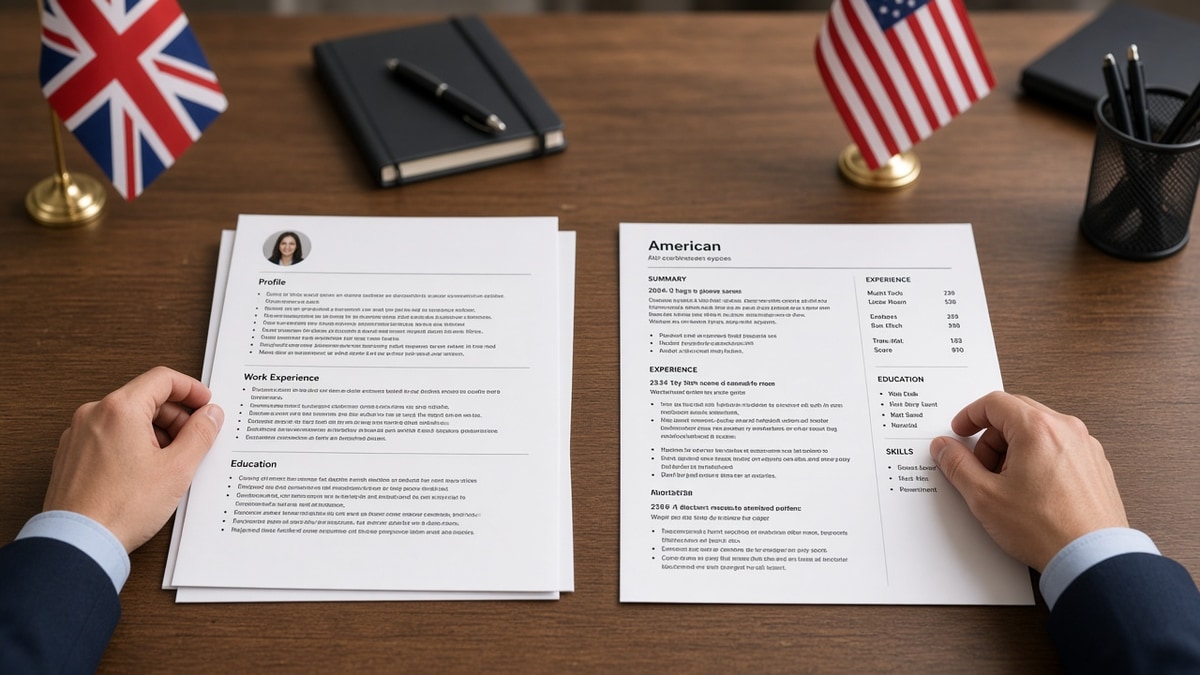
A CV in the UK is still a curriculum vitae in spirit: fuller employment narrative, education detail, sometimes publications or board roles. A US resume is a marketing one-pager for corporate ATS: tight bullets, standard headings, no photo, Month Year dates.
UK CV norms: two pages for mid-career professionals is normal. Photos appear in some traditional sectors but are fading. Dates may use day-month-year. Education can sit higher when recent. Spelling follows British English when applying in the UK.
US resume norms: one page through roughly ten years unless heavy technical scope needs two. No photo. Month Year dates only. Summary optional and short. Skills as a plain comma line echoing Experience bullets.
Before: UK CV with photo, three pages, referees on page one, day-month-year dates throughout.
After (US export): One page, no image blocks, Month Year dates, city and state only in contact, metrics in top three roles, referees removed.
Transatlantic candidates often keep one master content doc in Google Docs or Word. That's smart. The mistake is exporting once and uploading everywhere. Build a US stylesheet: tighter margins, smaller education block, American spelling. Build a UK stylesheet: fuller narrative, British spelling, two pages when you've got eight-plus years of scope to show.
When you optimize your application for each market, you're not lying twice. You're choosing what each reader scans in the first thirty seconds. Read chronological vs functional resume in 2026 when you're deciding whether a skills block belongs on the US export at all.
How to optimize your application for each market: six steps
Work these in order per target country. Do not merge steps across markets on one upload.
Step 1: Pick the market before you open Word
Read the posting domain, portal, and spelling. A London role on a UK board gets the two-page CV export. A US corporate req on Workday gets the one-page resume. Dual-national candidates still send one format per application, not a hybrid.
Before: One Europass-style CV with photo uploaded to a US SaaS req.
After: US export: single column, no image blocks, Month Year dates, one page with the strongest three roles.
Step 2: Set length to local norms
Trim the US file to one page by cutting older role bullets to one line each. Expand the UK file to two pages by adding context bullets recruiters expect: team size, budget order of magnitude, stakeholder types.
Before: Three-page UK CV shrunk to one page for all applications.
After: UK CV page two holds 2016 to 2019 roles with full bullets. US resume keeps only 2019 to Present with three metric lines per recent role.
Step 3: Fix dates for the parser
US Workday and Greenhouse want Month Year: January 2021 to March 2024. UK boards vary, but mixing 15/03/2021 on one line and March 2021 on another breaks US imports. Pick one format per export and stay consistent.
Step 4: Remove or keep photos by market
Strip headshots from US uploads. Image blocks can push contact lines into the wrong field after parsing. UK applications may still tolerate photos in some sectors; when unsure, omit. A missing photo never blocked a US screen. A present photo often raises compliance flags.
Before: Headshot in top-right corner of a two-column template.
After: US file: photo deleted, single column contact line with city, state, phone, email, LinkedIn URL spelled out.
Step 5: Align spelling and title strings
UK: organise, programme, licence when applying in Britain. US: organize, program, license for American reqs. Mirror the posting title on line one of your current role when scope fits: Analyst vs Analyst (UK) is less important than matching the employer's exact string.
Before: Programme Manager on a US posting that says Program Manager.
After: Program Manager | Employer | dates. British spelling stays in UK exports only.
Step 6: Run a market-specific paste test
Select all, paste into Notepad. Employers should read newest to oldest. Dates should stay attached to titles. No image placeholders. Upload the export that passes for the country on the posting, not the other version.
Copy-paste block: Atlantic application split
- Target market today: UK / US
- Page count for this export: ___
- Photo removed for US? Y / N
- Date format locked: Month Year / DD-MM-YYYY
- Spelling set: British / American
- Posting title mirrored on current role? Y / N
- Notepad paste: employers in order? Y / N
Edge case: US citizen applying in London
Send the two-page UK CV unless the employer is a US firm with a US HR stack. Ask the recruiter which format they file in Workday. When they say CV, expand. When they say resume, trim.
Edge case: UK grad applying to US campus recruiting
US campus portals enforce one page and US date norms. Convert degree lines to US style: Bachelor of Science, University Name, May 2025. Drop A-level detail unless the posting asks. Keep metric bullets from internships.
Before/after: finance analyst, London to New York
Before: CV lists every university society, photo in header, dates as 01/09/2019 to 30/06/2022.
After (US): Financial Analyst | BankCo | September 2022 to Present. Bullet: Built weekly liquidity model in Excel for $2.1B book; flagged rate exposure that saved $180K in hedging costs in Q2 2025. Education one line at bottom.
Before/after: software engineer, US to UK
Before: One-page US resume with no degree classification, no notice period context.
After (UK): Two pages. Page one: Senior Software Engineer bullets with team size and on-call scope. Page two: earlier roles plus MSc grade and relevant modules. British spelling throughout. No photo unless the sector still expects it.
When you're unsure which export to send, read the application footer. US Workday tenants almost always want the one-page Month Year file. UK boards and direct employer portals often tolerate two pages and fuller education. If the form says CV, don't upload your US resume without expanding context. If it says resume, don't upload your UK three-pager without trimming.
Read PDF vs Word for ATS before you export the US one-pager. DOCX from Word usually beats a designed PDF after upload.
Resume and CV differences: mistakes that kill parsing
Mixing UK and US formats does not make you look international on a ten-second skim. It makes Workday read your dates wrong and UK hiring managers wonder why your CV looks like a US handout. Resume and CV differences for UK and US job seekers matter most at upload time, when parsers lock field order and recruiters run their first filter pass.
One hybrid file for every country. Photos, length, and dates fight each other. Fix: two exports from one content source.
UK three-pager on US one-page culture. Recruiters stop reading. Fix: strongest three roles on page one for US uploads.
Mixed date formats. 06/2023 beside June 2023 scrambles Workday. Fix: Month Year everywhere on US files.
British titles on US filters. Programme Manager won't match Program Manager searches. Fix: mirror the posting string per market.
Personal data UK employers expect but US law discourages. Age, marital status, full address on US files. Fix: city and state only for US contact blocks.
References on page one. UK CVs sometimes list referees. US resumes use references available on request or omit. Fix: move referee names to a separate sheet for UK only.
Before: National Insurance number and full street address on a US tech resume.
After: City, state, phone, email, LinkedIn URL. Leave NI and full address off US corporate uploads unless the form requires them in a separate field.
Before: US one-pager sent to a UK civil-service-style posting expecting full employment history.
After: Two-page UK CV with complete timeline, fuller education, and no photo if the department guidance says to omit.
Check the export you'll actually submit
Upload the US or UK version to HireFlow's free ATS resume checker with the posting pasted in. Confirm dates, headings, and employer order survived the layout you picked for that market.
When a US firm asks for a short note or a UK board wants a covering letter, draft from the same job description with the free cover letter generator . Match spelling to the market and repeat the metric from bullet one.
Export checklist for UK and US job seekers
Resume and CV differences for UK and US job seekers are not cosmetic. Length, photos, and date format change what parsers import and what humans skim. You can hold one career story. You need two disciplined exports.
- Pick the market before you format.
- US: one page, Month Year, no photo.
- UK: two pages when depth helps, British spelling locally.
- Paste test each export before upload.
Open tonight's target posting. Name the country. Export the right file. Run a free ATS check on that version only. Mixing Atlantic formats is how qualified candidates look unreadable on both sides.
Save both exports with clear filenames: LastName_Resume_US.docx and LastName_CV_UK.docx. When a recruiter forwards your file internally, the name should signal which market you built for. That small habit prevents the wrong version from landing in a Workday req you cared about. Review the UK file once a quarter; review the US file before every batch apply week.
Read more
Frequently asked questions
Only when the employer explicitly asks for a US format or the posting is on a US portal with a one-page limit. UK hiring managers often expect a two-page CV with fuller role context. Sending a cramped one-page US file to a London corporate role can read as under-detailed even when the parser accepts it.
No. US recruiters treat photos as a compliance risk and many ATS importers drop image blocks. UK CVs sometimes include photos in traditional sectors, but US corporate applications should omit headshots entirely.
Month Year on every role: March 2022 to Present. UK CVs often use day-month-year on older entries. Mixing 03/2022 on one job and March 2022 on another breaks US timeline fields in Workday.
Keep one content source, export two layouts. US: one page, no photo, Month Year dates, tighter bullets. UK: two pages, fuller role narrative, education detail as local norms allow. Never upload the UK export to a US Workday req without trimming.