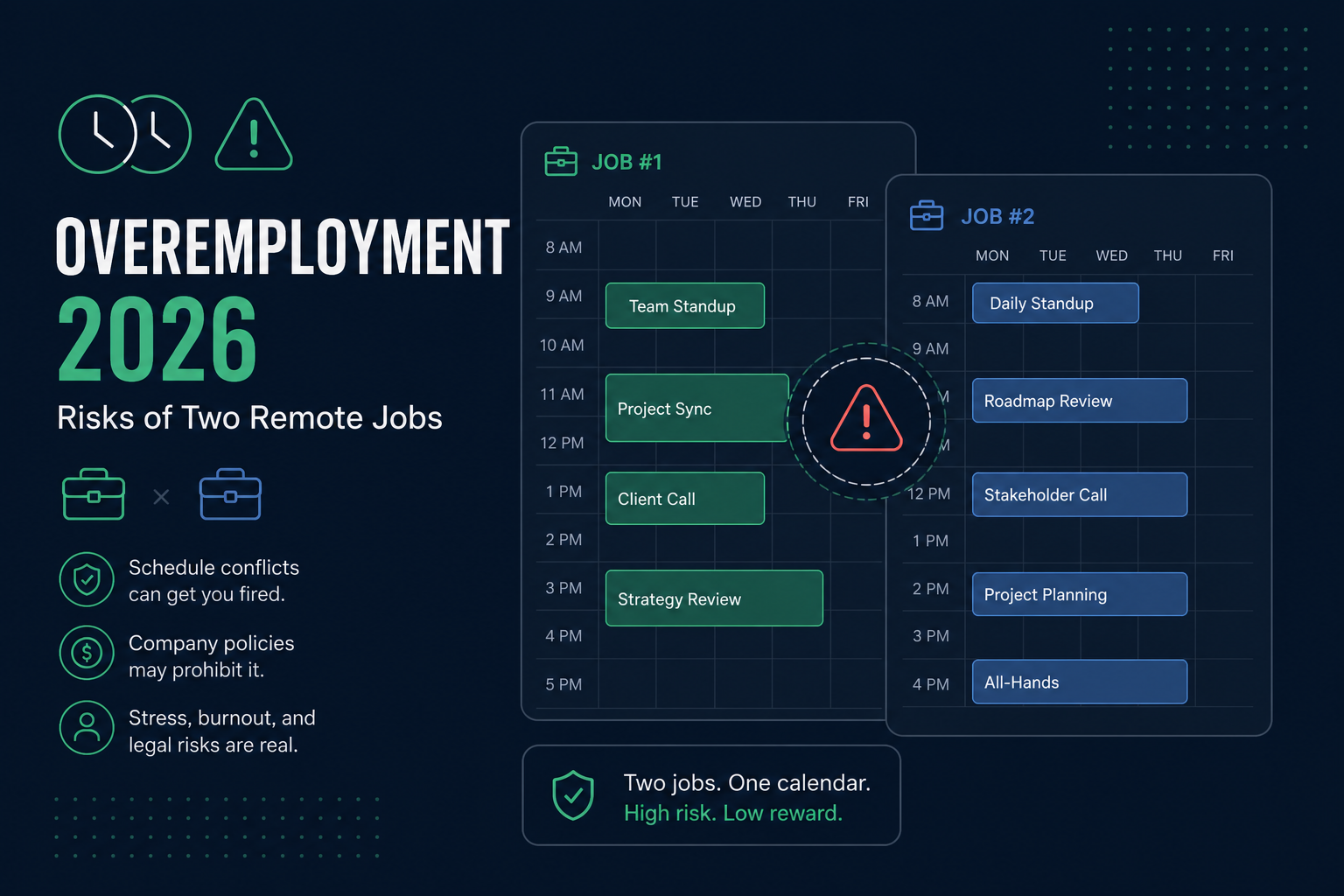
Overemployment—holding two or more full-time remote jobs simultaneously without disclosing either to the other employer—grew sharply during the remote-work boom of the early 2020s. Online communities dedicated to the practice numbered in the hundreds of thousands. In 2026, the landscape has shifted: activity-monitoring tooling has matured, payroll data matching has expanded in several jurisdictions, and enough high-profile terminations have made it into the press that employers have become meaningfully more alert to the signals.
This guide is not a moral argument for or against the practice. What it is, is a clear-eyed look at how detection actually works in 2026, what the real legal and financial exposure is (as distinct from what people assume it is), and what lower-risk alternatives exist if the underlying goal is simply earning more from your skills. The information here is general in nature and not legal advice—employment law varies significantly by jurisdiction and by the specific language in your contract.
One thing worth establishing upfront: the risk profile of overemployment in 2026 is not uniform. It varies substantially based on your industry, your specific employment contract, the monitoring sophistication of your employer, and the overlap between the two roles in question. Someone in a well-monitored financial services firm with an explicit exclusivity clause, working a second role for a company in the same industry, faces a categorically different situation than someone in an unmonitored startup doing consulting work for clients in an entirely different sector. The sections below will help you understand which factors matter most and why.
Key Takeaways
- Detection increasingly happens through automated activity and calendar monitoring, not just an observant manager.
- The core legal exposure comes from your own signed contract's exclusivity clause, not from a general law against dual employment.
- Termination for cause can also trigger forfeiture of unvested equity and complicate tax and benefits filings.
- Disclosed consulting, a negotiated raise, or a fractional-work structure often achieve similar income with far less risk.
- Risk varies enormously by industry, contract language, and employer monitoring maturity — there is no single universal answer.
Here is what this post covers:
- How companies actually detect overemployment in 2026
- The real risks beyond just getting fired
- Where the legal line actually is—and why it is usually your contract, not the law
- Lower-risk alternatives if extra income is the goal
- Frequently asked questions
How companies actually catch it in 2026
Key Takeaway
Many detection signals now generate automated alerts — activity monitoring, calendar overlap, and device fingerprinting — rather than depending on a manager happening to notice something unusual.
The detection picture in 2026 is meaningfully different from 2021. Employers who are alert to the risk now have a broader range of signals to work from, and several of those signals generate automated alerts rather than requiring any individual to notice a pattern manually. The table below covers the most common detection pathways and how each one surfaces.
| Signal | How it gets noticed |
|---|---|
| Activity monitoring software | Tools that log active keyboard and mouse time can reveal overlapping working hours across two devices. A pattern of low or zero activity during supposed core hours—while calendar blocks show meetings—flags as an anomaly in automated dashboards and can trigger a manager review without any individual specifically watching the employee. |
| Calendar and meeting overlap | Calendar software integrated with video-conferencing tools can surface patterns of consistently declined or last-minute-cancelled meetings that correlate with the same recurring time slots across weeks. A direct manager who notices camera-off sessions or late joins every Tuesday and Thursday afternoon may or may not raise it—but a pattern flagged in a team-health dashboard often escalates automatically. |
| Tax or payroll data matching | In some jurisdictions, tax authorities receive simultaneous full-time withholding from two employers for the same individual and flag the situation for review. The employer itself is not usually directly notified, but the filing complication can surface during the employee's own tax filing and—in some situations—during employer payroll audits in states with stricter reporting requirements. |
| Video-call background and habit patterns | Small, consistent details—a distinctive item visible on a shelf, an audio signature, an unusual camera angle that repeats exactly across calls—can catch the attention of a coworker who also knows someone at the other employer. This is low-probability per call but compounds over time. The risk rises sharply in smaller industries where professional networks overlap significantly. |
| Shared coworker or LinkedIn connection | A mutual connection who sees both employment entries appear on LinkedIn—even briefly before a privacy update—can surface the situation to one or both employers. The same risk applies when a former coworker joins the other employer and recognizes the name on an internal directory or an all-hands attendee list. |
| VPN and device-fingerprinting flags | Corporate IT security tools increasingly flag unusual patterns: a device connecting from two geographically inconsistent locations in quick succession, or a personal device authenticated against a corporate network at the same timestamp that corporate-issued hardware is also active on the same account. Security tooling designed to detect insider-threat patterns can surface these anomalies without any human actively looking for them. |
The most important shift from earlier years is that many of these signals now generate automated alerts rather than depending on a manager noticing something unusual. That changes the risk calculus significantly: in 2021, the risk was roughly proportional to how observant your manager was. In 2026, it is at least partly proportional to how many automated systems your employer has deployed—and that number has grown steadily across industries since 2022.
It is also worth noting that detection is not symmetric across employers. A 50-person startup with no formal HR function and no device management software presents a very different exposure surface than a publicly traded company with a dedicated security operations center and mandatory endpoint monitoring on all corporate hardware. The industry matters too: financial services, defense, and healthcare organizations tend to have more comprehensive monitoring than most, partly because they face regulatory requirements around data access and insider risk that make those investments mandatory rather than optional. The practical implication is that the detection risk is highly employer-specific—and most people do not have a clear picture of how comprehensive their current employer's monitoring actually is.
The real risks, beyond just getting fired
Key Takeaway
Contract breach exposure, tax underpayment penalties, benefits eligibility problems, and reference damage can all persist well after the termination itself — the risk does not resolve cleanly when the job ends.
Termination is the obvious outcome, but it is worth being specific about the other exposure that often comes with it—because some of these consequences persist well after the employment relationship ends.
Breach-of-contract exposure from exclusivity or conflict-of-interest clauses. Exclusivity clauses—sometimes framed as "full-time commitment" language or conflict-of-interest policies—are far more common in employment agreements than most employees realize. Many people sign them at onboarding without reading them closely, because the offer letter salary and title are what capture attention. These clauses do not always require the employer to prove financial harm to enforce; some are framed broadly enough that simply working for any company in the same sector during your employment constitutes a breach. The exposure varies significantly by jurisdiction and by the specific clause language, which is why reading your actual contract is the necessary starting point before assuming any general rule applies.
Tax filing complications from simultaneous full-time withholding. When two employers both withhold taxes at full-time rates, the combined withholding often exceeds the amount owed at filing time—which creates a refund rather than a penalty in many cases. The more significant complication arises when the combination of two full salaries pushes total income into a higher effective bracket than either employer's withholding was calibrated to match, resulting in a meaningful underpayment if quarterly estimated payments were not made to close the gap. Discovering this at filing time rather than during the year creates both a tax bill and potential underpayment penalties.
Health insurance and benefits eligibility problems. If you enrolled in benefits at both employers under representations that each was your sole full-time employer, and that representation was part of the enrollment process, the eligibility question becomes more complex than simple coordination of benefits. Some plans include explicit language about primary employment status. Misrepresenting that status at enrollment can in some cases affect coverage validity retroactively—an outcome that is difficult and expensive to resolve after a claim has already been filed.
Reputational and reference damage if the situation becomes public. In a small or specialized industry, word travels. A termination for cause related to undisclosed dual employment does not show up on a standard background check as a specific labeled category, but it shapes the reference you receive—and a noticeably cooler or shorter reference from a prior employer raises questions that a hiring manager may or may not ask directly. The narrower the professional field, the higher this risk and the harder it is to manage after the fact.
What makes these risks collectively different from most employment risks is that they do not resolve cleanly when the employment relationship ends. A contract breach exposure, an underpayment penalty, a retroactive benefits question, and a damaged reference can all persist or surface months after the termination itself. That persistence is worth factoring into any honest assessment of the tradeoffs—not as a reason to never take any risk, but as a reason to make sure the risk is genuinely understood before the decision, rather than discovered gradually after.
Where the legal line actually is
Key Takeaway
Holding two jobs is not generally illegal on its own. The real exposure comes from exclusivity or conflict-of-interest clauses in your own signed contract — read that document before assuming a general rule applies.
One of the most common misconceptions about overemployment is that the legal risk comes from the practice being illegal as a general concept. In most jurisdictions, it is not. Holding multiple jobs simultaneously—including multiple full-time jobs—is not inherently illegal under federal law in the United States, and a number of states have moonlighting protections that explicitly limit an employer's ability to restrict outside employment in unrelated fields. The practice itself, absent any other factor, is generally a civil employment matter rather than a criminal one.
The real legal exposure for most people comes from a much more specific place: the signed employment agreement they are already bound by. Exclusivity clauses, non-compete provisions, conflict-of-interest policies, and intellectual property assignment agreements can all create enforceable obligations that are specifically violated by undisclosed dual employment—even when the two jobs are in completely different industries. These clauses vary enormously. Some are broadly worded and difficult to enforce in certain states. Others are narrow and quite specific. Some require the employer to demonstrate financial harm to pursue damages; others do not.
The practical implication is straightforward: the most important first step for anyone thinking about this situation is to actually read their own employment contract rather than assuming a blanket rule applies. This is not a dramatic legal operation—it is a review of a document you already have. If you signed an exclusivity clause and your second role is at a direct competitor, your exposure is meaningfully different than if you are in a completely different sector under a contract with no such clause. Treating those two situations as equivalent because "overemployment" sounds like a single category is a mistake with real consequences.
To make this concrete, consider the spectrum of situations: someone working two fully remote roles in unrelated industries, under contracts that contain no exclusivity language and that were signed in a state with strong moonlighting protections, has almost no legal exposure specific to the arrangement itself— the risk is primarily employment-relationship and reputational. Someone working two roles where one employer is a direct competitor of the other, under a contract with an explicit exclusivity and non-compete clause, in a state that regularly enforces such clauses, faces materially different exposure. The phrase "overemployment" is the same in both cases. The legal situation is not.
None of this is legal advice. Employment law varies significantly by state and country, and the enforceability of specific contract clauses depends on jurisdiction, industry, and the particular facts of each situation. If you have questions about your specific contract, a consultation with an employment attorney in your jurisdiction is the appropriate next step.
Lower-risk alternatives if you want more income
Key Takeaway
Disclosed consulting, a negotiated raise backed by a competing offer, and formally structured fractional work all achieve additional income without the detection and contract risk that undisclosed dual employment carries.
If the underlying goal is earning more from your skills, there are approaches that achieve the same outcome without the detection and contract risk that undisclosed dual employment carries. The three options below are not hypothetical— each represents a real structure that working professionals use in 2026.
Disclosed part-time or consulting work where both parties know the arrangement. Many employment contracts explicitly allow outside consulting or part-time work in non-competing sectors, or can be amended to do so with a direct conversation. Some employers are willing to formalize a side consulting arrangement—especially when the field is clearly distinct from the primary employer's business—because it removes ambiguity on both sides. The conversation feels uncomfortable, but it eliminates the core risk entirely. The arrangement is slower to establish than simply taking a second job, but it generates none of the legal or reputational exposure described above.
Using a competing offer to negotiate a raise at your current employer. A significant fraction of people drawn to overemployment are motivated primarily by the gap between their current pay and what the market rate actually is. A job search and a concrete offer will quantify that gap precisely. Using the offer as negotiating power to secure a raise at your current employer is often a faster path to the same income increase, without any of the logistics or risk of managing two roles. This works best when you are genuinely willing to leave if the negotiation fails, and when you have the offer in writing before the conversation.
Fractional or portfolio work as a legitimately structured alternative. A growing number of senior professionals are now openly structured as fractional employees or portfolio workers—formally splitting their professional time across two or three clients or part-time employers with full transparency on all sides. This model is more common in finance, marketing, HR, and operations than it was even two years ago, and it achieves the same underlying goal—multiple income sources from a single set of skills—without requiring any concealment. Structuring a resume for this kind of arrangement takes some care, since conventional resume formats were not designed for portfolio careers, and it also needs to parse cleanly through an ATS: Workday and Greenhouse both tend to read overlapping date ranges under separate employer entries as a red flag unless the summary or a role-context line explicitly states the arrangement is a disclosed, concurrent part-time structure rather than a scheduling error. There is a full guide to doing this well linked in the closing section below.
Before — reads as an error or a gap
Marketing Consultant, Client A — Jan 2024–Present
Marketing Consultant, Client B — Mar 2024–Present
After — reads as a deliberate structure
Fractional Marketing Consultant (two concurrent part-time clients) — Jan 2024–Present
Client A (15 hrs/week): Led lifecycle email strategy...
Client B (20 hrs/week): Rebuilt paid social funnel...
The second version tells an ATS and a human reader the same thing in one line: these are not duplicate or conflicting entries, they are a disclosed portfolio structure. That single clarifying phrase resolves the overlap flag before a recruiter has to ask about it.
None of these alternatives is as immediately lucrative as simply collecting two full salaries simultaneously—that is an honest acknowledgment, not a reason to dismiss them. The relevant comparison is not "overemployment versus disclosed consulting on paper." It is "overemployment with its full risk profile versus a disclosed arrangement with its smaller income and no legal exposure." Framed that way, the alternatives often look meaningfully more attractive, particularly over a multi-year horizon where a single overemployment discovery can set back a career in ways that take years to recover from.
Where to take this next
If you are primarily drawn to the idea of overemployment because you want meaningful income from multiple sources without the risk profile described above, the fractional and portfolio career model is worth exploring in detail. The structure is real, it is growing, and it achieves the same underlying goal through a transparent arrangement. Our full guide to building a resume for fractional and portfolio careers in 2026 covers how to present multiple simultaneous engagements clearly without triggering the concerns that an unconventional format raises with recruiters.
If you are adding disclosed consulting or side work income alongside a primary role, presenting that clearly on a resume without confusing hiring managers takes some care. Our guide on how to list side hustles without confusing recruiters walks through the formatting and framing decisions that make the difference. And for any resume you are actively sending, a free scan on HireFlow will flag any parsing or ATS compatibility issues before they cost you an application.
Frequently asked questions
Yes, meaningfully so. In-office and hybrid roles impose physical presence constraints that make simultaneous full-time employment logistically difficult or impossible for most people. Fully remote roles remove that constraint, which is why the overemployment communities that emerged in the early 2020s were almost entirely populated by people in remote-first jobs. The short version: remote work makes it physically possible in a way that office work generally does not, which is why the two topics are so closely linked in discussion. The risk of detection is also lower in remote-only environments when activity monitoring is less comprehensive—though that gap has narrowed as monitoring tooling has become more widespread.
Generally, no. An employer's monitoring authority extends to company-issued hardware, employer-managed accounts, and networks the employer controls. They cannot legally access your personal device, personal email, or activity on a separately issued device from another employer. What they can monitor is activity on their own hardware and accounts, and that is usually sufficient to surface the patterns described in the detection section above without needing to touch anything outside their own systems. The practical implication: keeping the two roles completely separated by device does reduce one detection surface, but it does not address the calendar, behavioral, or human-network detection pathways.
Not directly. Standard employment background checks verify employment history that the applicant self-reported and may include reference checks with prior employers. They do not independently surface undisclosed simultaneous employment from prior periods. However, if you were terminated for cause related to overemployment, a reference check may surface a negative or noticeably brief characterization from a prior employer even if the specific reason is not stated outright. Some employers also ask directly on background authorization forms whether simultaneous employment existed during a prior period, which creates a separate disclosure question for the applicant.
A termination for cause—which is how most overemployment discoveries are classified internally—typically triggers forfeiture of unvested equity under standard equity plan agreements. Vested equity is generally treated differently and may be retained depending on the plan terms and jurisdiction, but unvested grants, unvested RSUs, and unvested options are commonly forfeited upon termination for cause. The specific outcome depends on the equity plan documents and the circumstances of the termination. This is one of the higher-stakes financial consequences that is easy to underestimate in the abstract—particularly for employees with large unvested grants near cliff dates, where the timing of discovery can matter as much as the discovery itself.
Yes, significantly. Independent contractors classified as 1099 workers are generally not subject to the same exclusivity expectations as W-2 employees, and working for multiple clients simultaneously is often the expected and explicitly understood structure of a 1099 engagement. The key question is whether a specific 1099 contract includes an exclusivity clause—some do, particularly in competitive or specialized fields—and whether any of the clients are direct competitors of each other. For genuine 1099 contractors, the overemployment framing often does not apply in the same way; the risk shifts to contract-specific restrictions rather than general employment norms. The tax situation also differs: 1099 workers are responsible for self-employment taxes and quarterly estimated payments regardless of how many clients they have, so the withholding complication described above for W-2 workers does not arise in the same form.
Based on reports from overemployment communities and cases that have surfaced publicly, the most common actual discovery path is a human connection—a shared coworker, a mutual LinkedIn contact, or a direct manager who notices a behavioral pattern and asks a direct question. Automated detection tools do surface cases, but the majority of publicly discussed discoveries involve a person making a connection and acting on it. The second most common path is calendar and meeting conflicts becoming visible enough over time to prompt a direct conversation. Technical detection through VPN anomalies or device fingerprinting appears to account for a smaller fraction of actual cases so far, though this balance may shift as security tooling continues to mature and more organizations deploy insider-threat monitoring at scale.