6 min read
You're qualified for the role but live three states away. Recruiters still have to solve logistics before they schedule you. A clear phrase saves them a round of email and keeps your file in the maybe pile instead of the pass pile.
You don't need to sound eager. You need to sound planned. Specific metros plus a start window read like someone who's already thought through the move, not someone who'll ghost after the first onsite.
Before you finalize wording, check your resume for free so the relocation line parses as plain text, not text trapped in a graphic badge.
Follow the timeline below in order: pick language, place it, then align the portal and LinkedIn so nothing contradicts your story.
Quick Wins
- Write one sentence with city, window, and funding note.
- Mirror the same cities on the application location question.
- Update LinkedIn headline to match the resume line tonight.
What recruiters need from a relocation phrase
Relocation language is a logistics signal. Hiring teams need to know you can start where the job sits on a timeline they can plan around. Willingness without geography or dates forces guesswork they won't do on a full req.
Before: Open to relocation.
After: Relocating to the Denver metro by November 2026; self-funded move, no assistance required.
Before: Flexible on location.
After: Open to Texas metros (Austin, Dallas); available to start within 30 days of offer.
For work authorization paired with moves, see work authorization on your resume .
If you need relocation assistance, state openness to discussing support. You aren't negotiating on the resume. You're flagging the topic for later so recruiters don't assume you're self-funded when you're not.
Timeline: phrase, placement, portal, LinkedIn
Phase 1: Draft the sentence (ten minutes)
Pick two or three realistic metros or one region. Add a start window you can keep if you get an offer. State self-funded relocation or open to discussing support as a fact, not a plea.
Phase 2: Place it in the file (five minutes)
Header under phone and email, or closing summary sentence. Keep it once. Repeating relocation three times reads like padding.
Phase 3: Match the application form (before submit)
In Workday, structured location fields often drive filters. Resume prose does not override a blank willing-to-relocate answer. Fill the form to match your sentence.
Phase 4: Align LinkedIn (same day)
Recruiters open both tabs. Mismatch creates doubt faster than a weak bullet.
Update headline or open-to-work preferences with the same cities you named on the resume. If you're keeping a current city for now, say relocating to [metro] by [window] so the story isn't contradictory.
Cover letters can repeat the same sentence once. Don't rewrite a novel. One line in paragraph two is enough when the header already states the plan.
Copy-paste block: phrase templates
Copy-paste lines
Relocating to [metro] by [month year]; self-funded relocation.
Open to [state/region] metros ([City A], [City B]); start within [range] of offer.
Nationally mobile for [role type]; full relocation within 60 days of offer.
I've screened relocation candidates in Greenhouse where the resume said Denver but the profile location still showed Boston because Lever parsed the header city first. Keeping the phrase next to contact lines reduced that mismatch.
Spouse or lease constraints belong in the same sentence when they're real: Relocating to Phoenix by Q2 2027 after lease ends; self-funded. Honesty early beats surprises after an offer.
Field roles that require travel should say travel percent plus relocation window in one line so onsite and road expectations don't get confused.
Phrases that cost interviews
Will move anywhere for the right role. Reads unfocused. Pick a region or say nationwide for a defined role family.
Promising a 30-day move you cannot fund. Offers get extended based on what you wrote.
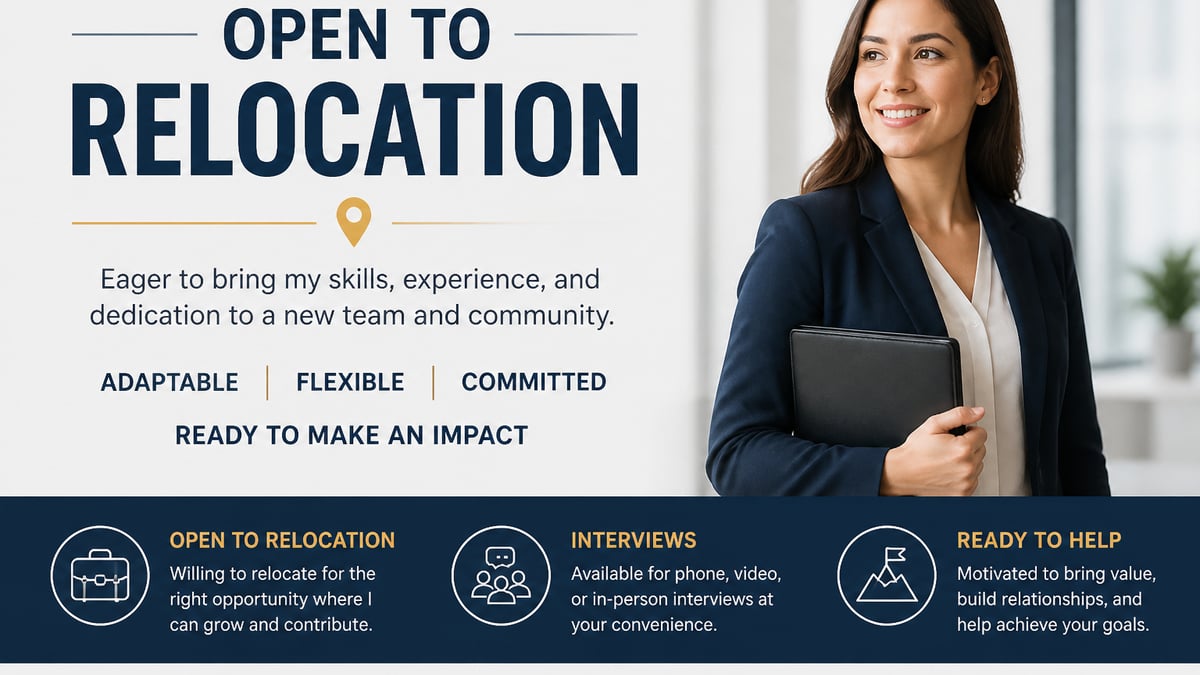
Before: Relocation line in a footer badge on a Canva resume.
After: Same line typed under email in the header; paste test shows the full sentence.
Remote plus relocation with no explanation. Pick a primary work model. See remote and onsite resume lines that fit .
Confirm the line parses
Run the export through a checker preview after you add the phrase. Footer and badge text often disappears on import.
Run a free ATS check on the header block. If the posting asks for a letter, generate a cover letter that repeats the same metro and start window in sentence two.
One sentence, then submit
An open to relocation resume phrase that gets more interviews reads like a plan: where, when, and on what terms. Write it once in the header, mirror the portal, update LinkedIn, then move on to bullet one.
If your timeline isn't firm yet, use a range tied to offer date. You don't owe a fake exact day you'd have to walk back on a call.
After the phrase is set, don't rewrite it for every req unless the metro list truly changes. Consistency across uploads beats a new vague line each time.
Read more
Frequently asked questions
Put it in the header under contact lines or as the last sentence of a three-line summary. Both sit in the main text stream parsers read. Avoid footers and badge graphics.
Name two or three metros or one region. Long city lists read indecisive. For nationwide field roles, say nationwide for that role type instead of twelve cities.
No. Remote-only files should not also say open to relocation unless you explain hybrid travel. Mixed signals slow screening.
No. Workday and similar systems store location twice: resume text and structured form answers. Fill both honestly. Recruiters often filter on the form field first.