11 min read
You're not failing federal screens because you lack the work. You're failing because the builder asks for specialized experience the way OPM defines it, and most private-sector bullets describe work you watched or supported, not work you owned. HR doesn't score vibes. They match performed duties to the announcement, then spot-check hours per week and supervisor contacts before they mark you qualified.
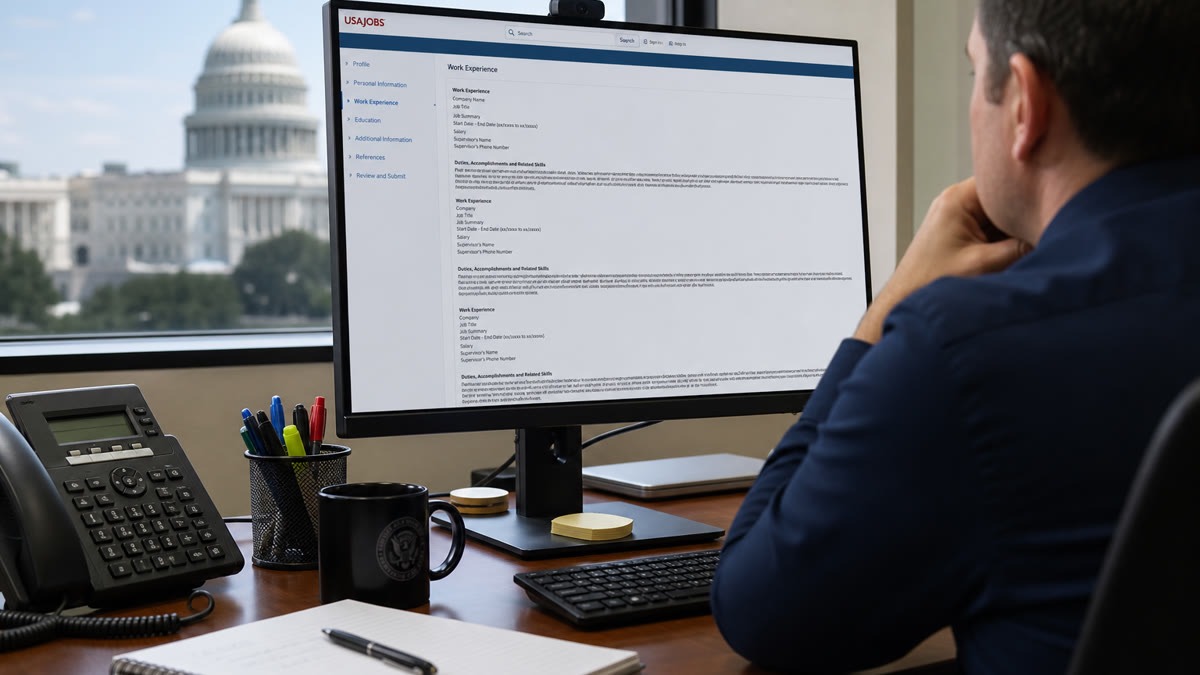
Check your resume for free against one USAJobs posting this week. You'll often see announcement verbs sitting in a Skills list while Experience still opens with generic coordinator language. That's not a keyword gap. It's a placement and proof gap. Job searching is already draining. This page walks you through five steps so each duty row shows performed work with fields HR can verify.
Below is a procedure, not a template dump. Quick wins first, then five steps with before/after rewrites across four roles, edge cases, mistakes HR sees in USAJobs blocks, two tools, and a copy-paste row you can fill tonight.
Quick Wins
- Copy the Specialized Experience block from Qualifications into a working doc before you edit the builder.
- Rewrite observer verbs (assisted, supported, exposed to) into performed verbs (analyzed, issued, adjudicated).
- Fill hours per week and supervisor contact on every job row, even old ones. Blank fields stall certificate checks.
- Ctrl-f each announcement duty inside dated Experience rows, not inside Skills alone.
Performed duty, not shadow work: what OPM counts
Specialized experience on a federal resume is not general background. It's the work you personally performed that matches the grade and duty language in the announcement. OPM draws a hard line between performing a task and being near it. Sat in on budget meetings is not specialized budget analysis. Ran the variance report and briefed the branch chief is.
Three fields HR actually verifies after you click Apply. Duty bullets that map to the questionnaire, average hours per week for that job period, and a supervisor name plus phone or email they can reach. USAJobs builders hide these in separate boxes. Missing any one slows referral or kills Best Qualified before a hiring manager opens your file.
A composite program analyst lists "budget execution" in Skills because the team touched budgets. Questionnaire asks for experience preparing execution reports. HR finds no dated bullet where the candidate prepared the report. File gets Not Qualified even though the person sat three rows from the analyst who did. That's the gap this post closes.
Edge case: shared team duty where you weren't primary. You can count it only when you personally performed the task on a recurring basis, not when you backed up someone twice. Split the duty across roles or downgrade the verb until it's honest. Edge case: military title strings that don't match civilian posting language. Translate the performed duty into posting verbs on a civilian-dated row with hours and supervisor contact, then put the MOS acronym in parentheses once if HR needs context.
Read how to format dates on a resume for ATS for Month Year rules that keep federal rows parser-clean. This page is the duty question: what you performed, where it lived on the timeline, and who confirms it.
How to write specialized experience on a federal resume: five steps
Work in order. Skipping the announcement pull and jumping to bullet polish is how Skills sections fill up while Experience stays private-sector vague.
Step 1: Pull the specialized experience block from the announcement
Open Qualifications on USAJobs. Copy everything under Specialized Experience and Minimum Qualifications into a doc. Highlight verbs and tools: prepares, analyzes, certifies, Salesforce, Oracle, NIST. Those strings become your ctrl-f checklist later.
Note the grade and months required at that level. GS-9 rows won't satisfy GS-11 language even if the duty sounds similar. You need performed work at the stated level for the stated duration. Save the doc beside the builder tab so you don't lose the exact wording when the announcement closes.
Step 2: Map each duty to a dated job row where you performed it
Make a two-column table: announcement duty on the left, employer plus Month Year dates on the right. If a duty has no home, you have a gap to fill with honest scope or a different target announcement. Don't park orphan duties in Skills.
Before: Skills list: "Budget execution, stakeholder management, Microsoft Excel." Experience opens with "Supported team operations and special projects."
After: Same Skills trimmed to tools only. Experience row: Budget Analyst, City of Riverside | March 2021 to Present | 40 hours/week | Supervisor: Jane Ortiz, Finance Director, 555-0142.
Step 3: Write bullets as performed duties with scope and tools
Each bullet answers: what did you perform, at what scope, with which system, with what result. Drop "responsible for" openers. Lead with the verb the announcement uses when it's accurate.
Before: "Assisted with network security and monitored systems."
After: "Configured Cisco ASA firewall rules and Splunk alerts for a 400-seat network, containing three unauthorized access attempts in Q2 without production downtime."
Before: "Helped HR with hiring."
After: "Posted 12 USAJobs announcements, screened 180 applications monthly against qualification standards, and scheduled panel interviews that cut time-to-certify from 62 to 41 days."
Before: "Conducted environmental work and reports."
After: "Collected soil and groundwater samples under EPA Method 5035, analyzed results in a certified lab, and wrote remediation memos that closed two Superfund sites under state oversight."
Step 4: Add hours per week and supervisor contact on every row
Enter the average weekly hours for that employment period. Part-time rows get real averages, not 40 by default. Salary fields, when requested, should match W-2 or SF-50 history for that period, not today's pay.
Supervisor contact means someone who can confirm duties and dates. A departed manager's name plus agency HR switchboard beats a blank. Invented names fail background checks fast. For contract roles, list the client-side government supervisor when your payroll employer was a vendor firm.
Before: Contract Analyst | 2019 to 2021 | duties only, no hours, no supervisor.
After: Contract Analyst, Apex Consulting | January 2019 to June 2021 | 32 hours/week | Supervisor: Marcus Lee, Program Director, [email protected], 555-0198.
Step 5: Run a plain-text check against the questionnaire language
Preview or export the builder output. Ctrl-f each specialized experience phrase from the announcement. Hits should land inside dated job bullets, not only in Skills or Summary. Misses mean rewrite or retarget. Run the same check on the self-assessment questionnaire after you fix Experience so your Expert answers still match the bullets.
Read each hit aloud. If you wouldn't defend it in a structured interview, soften the verb until you would. Padding breaks on verification, not on grammar. Keep a screenshot of the Qualifications tab in your doc folder in case the posting closes before HR finishes review.
Copy-paste federal experience row
Announcement duty: [paste one line from Specialized Experience]
Employer row: [Job Title], [Agency or Company] | [Month Year] to [Month Year]
Hours/week: [average for that period]
Supervisor: [Name], [Title], [phone or email]
Bullet 1: [performed verb] [scope] using [tool from posting], [outcome from real work]
Bullet 2: [second duty mapped to same row if performed there]
Ctrl-f check: announcement phrase appears inside this dated block
Questionnaire check: you can defend bullet 1 in a five-minute screen
Paste the block into a doc, fill it against one posting, then transfer lines into USAJobs or your master federal file. Read resume formatting rules recruiters never tell you before you export a PDF that drops hours or supervisor fields on upload.
Where USAJobs specialized experience rows get rejected
Observer language dressed as specialized experience. Assisted, supported, shadowed, and exposed to don't meet performed-duty standard. HR reads them as trainee scope. Rewrite or move the row.
Skills list doing the job of Experience. Posting keywords stacked in Skills with thin dated bullets is the most common Not Qualified pattern I've seen in certificate review. Skills holds tools. Experience holds proof. When every announcement verb lives in Skills alone, raters never find performed duty inside a dated row.
Default 40 hours on every row. Part-time, seasonal, and term rows with inflated hours mismatch payroll. HR adjusts equivalent experience downward and you lose months you thought you had.
Missing or dead supervisor contacts. Blank supervisor fields pause referrals. Bounced emails during verification get treated as misrepresentation even when the work was real.
Copy-pasting the announcement with no dated proof. Questionnaire raters notice posting language with no scope. One matched phrase plus a defensible bullet beats a paragraph lifted from USAJobs.
Score duty match before you certify
Run the updated file through the free ATS checker with the announcement pasted in. You want specialized experience verbs showing under Experience, not only in Skills. If duty phrases still miss dated rows, fix bullets before you answer self-assessment questions as Expert.
Use job match score on a second posting at the same grade band. If score moves when you remap duties to honest rows, you're aligned. If score only jumps when you inflate verbs you can't defend, roll back and retarget.
When the posting asks for narrative examples and your duty story changed, draft structure with the cover letter generator, then replace generic lines with the same performed-duty proof you put in bullet one.
Certify with proof, not padding
How to write specialized experience on a federal resume comes down to OPM's performed-duty rule, not prettier adjectives. Mirror announcement language inside dated rows where you actually did the work. Fill hours per week and supervisor contacts HR can verify. Drop observer verbs and Skills-only keyword stacks.
Open the announcement you want most. Pull the Specialized Experience block. Map each line to a job row. Rewrite three bullets tonight. Run the checker once. Certify only what you'd defend if HR calls your supervisor tomorrow.
You don't need a longer file. You need performed duties in the right fields so certificate staff can mark you qualified without a follow-up email chain.
Read more
Frequently asked questions
No. OPM specialized experience means work you personally performed, not work you observed, assisted with occasionally, or trained on once. If the announcement asks for budget analysis and you only sat in on meetings, that row does not count until you rewrite it as performed duty or move it to a different job where you owned the task.
List the average hours you actually worked during that employment period, not a full-time default. A 20-hour part-time analyst row should say 20 hours per week with accurate Month Year dates. HR specialists convert hours when they compute equivalent experience. Inflating every row to 40 hours creates a mismatch when payroll or SF-50 records show otherwise.
Yes when the duties match the announcement and you personally performed them at the required level. Military rows still need civilian duty language, dates, hours per week, and a supervisor contact HR can reach. Translate MOS tasks into the same verbs the posting uses, then prove scope in the bullet, not in a jargon stack.
Mirror the duty concepts and required skills, but write bullets from your actual work. Pasting the announcement text with no proof reads as keyword stuffing in questionnaire review. One matched duty phrase plus a dated bullet with scope, tool, and outcome beats a paragraph copied from the posting.
List the best reachable reference for that job: a later manager, HR records contact, or agency switchboard with a note that the named supervisor departed. Blank supervisor fields stall certificate checks. Never invent a name. A reachable alternate beats a dead email that bounces during verification.