12 min read
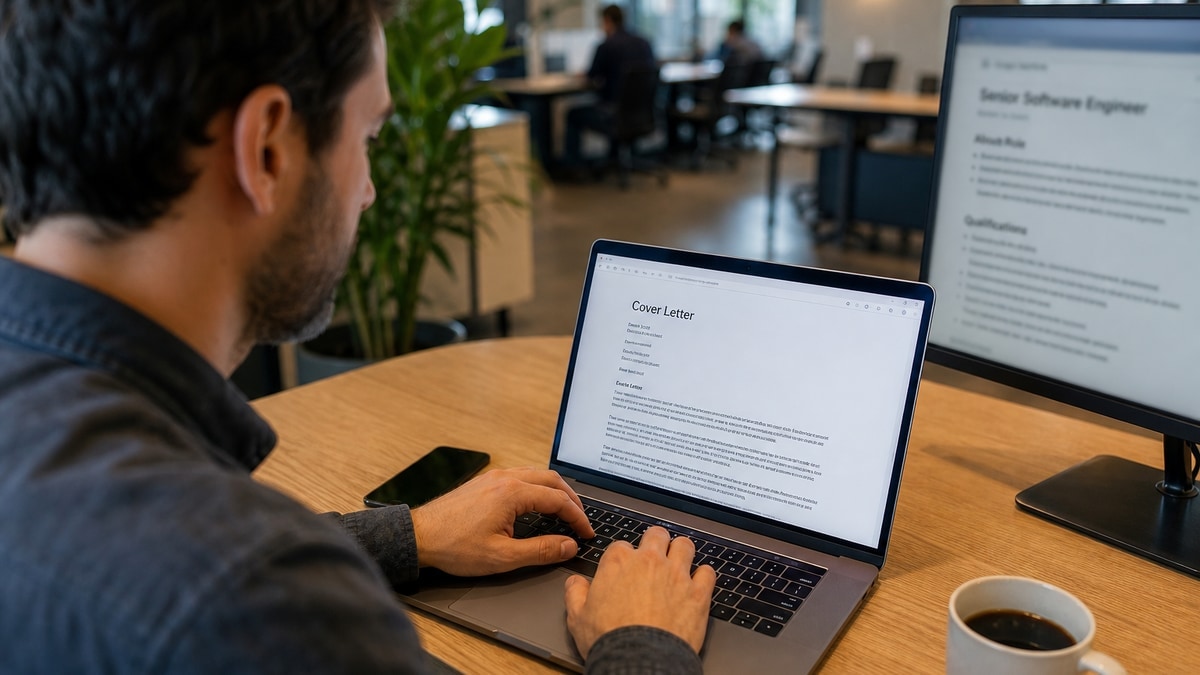
You've got a strong resume and you're staring at a blank cover letter field in Greenhouse. Big tech doesn't want your life story. They want one proof point tied to their req that your resume header can't carry. Most letters I see fail because they praise the company for three paragraphs and never name the role.
Before you paste anything, check your resume for free against the same posting. Your letter should echo scope the resume already proves, not introduce new claims you can't defend in a phone screen.
This teardown shows how to write a US cover letter for big tech roles across software engineering, product, and data tracks. You'll judge weak templates against strong ones, copy a skeleton you can fill tonight, and skip the openings that get skipped in the first ten seconds.
Quick Wins
- Open with exact role title plus one metric from the posting's stack or duty list.
- Spend paragraph two on proof the resume bullet truncates, not company history.
- Close with one sentence on what you want next: a screen, not "the opportunity."
What a big tech cover letter must do in thirty seconds
Recruiters batch-read cover letters after the resume passes the parser. They're not grading prose. They're answering three questions: did you apply to the right req, do you have one proof tied to this team, and did you waste their time with filler. A letter that passes names the role in line one, cites one number or scope line, and stops at one page.
The resume holds facts. The letter holds framing. Your SWE resume lists microservices and latency wins. The letter explains why that work maps to this team's backend charter. Your PM resume shows roadmap ownership. The letter connects one launch to the product area in the job description. Without framing, the recruiter guesses. Guessing usually means pass.
Big tech portals often store the letter as plain text. Fancy columns and icons don't help. Short paragraphs, standard greetings, and keywords pulled from the posting (Kubernetes, experimentation, trust and safety) parse cleanly and match what the hiring manager ctrl-f's later.
Optional cover letter fields tempt you to skip. Don't, when you have a referral or a metric the resume truncates. Required fields punish generic paste. Either way, thirty seconds of recruiter time is the budget. Line one earns line ten.
US big tech also runs parallel reqs with overlapping titles. Infrastructure backend and product backend differ. Your letter must mirror the exact string from the portal, not the shorthand you use on LinkedIn. Wrong bucket, wrong team, wrong pass.
Read how to make a cover letter stand out when you need the thirty-second recruiter scan rubric before you tailor for FAANG-scale volume.
Cover letter teardown: before and after by role
Judge every draft against these pairs. Weak versions sound fine out loud. Strong versions name the req, one metric, and a team-specific hook in under six lines.
Software engineer (backend)
Before: I am passionate about technology and excited to join your innovative company. I have strong coding skills and work well in teams. I believe my experience makes me a great fit for your organization.
After: I'm applying for Backend Engineer, Infrastructure (Req 88421). At my current role I cut p99 API latency from 340ms to 118ms by splitting a monolith payment service into four Go microservices on GKE. That maps directly to your posting's focus on distributed payments and SLO ownership.
Product manager (growth)
Before: Your company's mission inspires me. As a PM I have delivered many successful products and would love to contribute to your user-centric culture.
After: Re: Product Manager, Activation (Req 44290). I ran a six-week experiment ladder that lifted D7 retention 9 points on a 2.1M-user mobile app by reordering onboarding, not by adding features. Your req calls for funnel diagnostics; that's the work I did last quarter with Amplitude and SQL cohort pulls.
Data scientist (trust and safety)
Before: I am a data-driven professional with expertise in machine learning and analytics. I am eager to bring my skills to your world-class data team.
After: Applying for Data Scientist, Integrity Signals. I built a gradient-boosted classifier that flagged 34% more policy-violating listings at 1.2% false-positive rate, using features your posting lists: graph edges, text embeddings, and human-label feedback loops. Happy to walk through precision-recall tradeoffs on a 30-minute screen.
Engineering manager
Before: I have ten years of leadership experience and excel at building high-performing teams. I would be honored to lead engineers at your company.
After: Engineering Manager, Ads Ranking (Req 77102). I coach eight engineers across two squads; last year we shipped a bidding model refresh that improved revenue per mille 6% without growing headcount. Your req emphasizes cross-functional delivery with sales and finance; that's the operating rhythm I run weekly in QBRs and sprint reviews.
Site reliability engineer
Before: I have experience with on-call rotations and monitoring tools. I am a fast learner who thrives in dynamic environments.
After: SRE, Core Platform (Req 55118). I led incident response for a payments shard with 99.97% monthly uptime over four quarters; reduced mean time to recovery from 47 minutes to 19 minutes by adding runbooks and Grafana dashboards the posting lists under observability ownership.
Technical program manager
Before: I enjoy coordinating stakeholders and driving programs to completion. Your company's focus on innovation aligns with my career goals.
After: TPM, Developer Platform (Req 90344). I ran a twelve-team migration off a legacy build system with zero customer-facing outages across eight weeks; that matches your req's emphasis on cross-org execution and executive status reporting.
Closing paragraph pair
Before: Thank you for your time and consideration. I look forward to the opportunity to discuss how I can contribute to your success.
After: I'd welcome a 30-minute recruiter screen to walk through the GKE migration and how it maps to your infra roadmap. I'm authorized to work in the US and can start after a standard two-week notice.
Copy-paste skeleton
Copy-paste block for tonight's draft:
Dear Hiring Manager,
I'm applying for [Exact Title] (Req [ID if listed]). [One sentence: metric + tool from posting]. [One sentence: why that maps to a duty in the ad].
[Second paragraph: one project story the resume bullet truncates. Name team size, timeline, or constraint. No company history lecture.]
[Optional third paragraph: referral name, relocation, or work authorization only if the portal asked.]
I'd welcome a [recruiter screen / technical phone screen] to discuss [specific topic from posting]. Thank you for your time.
[Name]
Edge case: internal transfer or former intern reapplying. Lead with prior team and project code name if public, plus what's new since you left. Don't pretend you're cold when the recruiter can see your badge history.
Edge case: career pivot into big tech from adjacent industry. Paragraph one states the bridge: "Four years running fraud ops queues maps to your Trust Analyst req because I already built the labeling rubric your ML team needs." One metric from the old field, one noun from the new posting.
Edge case: new grad with internship only. Name the team you interned on, one shipped feature or experiment, and the stack from the full-time req. Don't write "eager to learn" without a proof line from the internship bullet.
When you're unsure which proof to lead with, open the job description and highlight three duties. Pick the one your resume already proves with a number. That's paragraph one. The other two duties can wait for the phone screen.
Keep the salutation boring. Dear Hiring Manager beats a wrong name. If a employee referral gave you a name, use it and mention the referral in paragraph two, not paragraph four where it looks bolted on.
What weak big tech cover letters share
Mission paragraphs before proof. Recruiters already work there. They don't need the Wikipedia summary. They need to know you read their req.
No req ID or exact title. Big tech runs parallel reqs with similar names. "Software Engineer" without infra vs full-stack vs mobile is a wrong bucket. Copy the title from the portal.
Resume repetition. If paragraph two lists the same bullets as page one of your PDF, the letter adds zero information. Use the letter for context: why this team, why now, what the bullet left out.
Buzzword soup without numbers. "Scalable, innovative, passionate" parses as noise. One latency number, one retention point, one precision rate beats five adjectives.
Creative PDF layouts. Some portals strip formatting. A two-column letter breaks the same way a two-column resume does. Plain paragraphs upload everywhere.
Attaching a letter when the field is plain text. Uploading a designed PDF into a text box sometimes strips everything after paragraph one. Paste plain text unless the portal explicitly asks for a file upload.
Salary or clearance in paragraph one. Work authorization belongs near the close when the portal didn't ask upfront. Leading with visa status before proof makes recruiters think you have nothing else to say.
Name-dropping products you never shipped. Big tech engineers read letters. Vague "I love your cloud platform" without a feature or team name reads as template mail. One product area from the req beats three brand names.
See how to include salary requirements in a cover letter when the big tech portal forces a compensation field you didn't plan for.
Draft the letter after the resume matches
Run the same posting through HireFlow's free ATS resume checker first. Your cover letter should cite proof that's already on the resume file recruiters will open next.
Use the cover letter generator to draft paragraph one and two from your top two bullets, then edit in the req ID and team hook by hand. Models miss req numbers; you won't.
Workflow that works: export resume PDF, run checker, fix bullets, then write letter from the fixed bullets only. Never draft the letter from memory of projects you haven't put on the resume yet. Phone screens reconcile both files.
Save one master letter skeleton per target company with blanks for req ID and team hook. Swap those two lines per application. Everything else stays proof-based and short. You'll apply faster without sliding back into mission paragraphs.
Ship one letter tonight, not five generic ones
Learning how to write a US cover letter for big tech roles comes down to one metric in line one, one story in line ten, and a close that names the next step. Tear down your draft against the pairs above. If paragraph one could swap company logos without edits, rewrite it before you upload.
Big tech volume is brutal. A boring, specific letter tied to one req beats a polished template sent to twelve teams. You've already done the hard part on the resume. Spend twenty minutes on framing and submit. Save the letter as plain text in the same folder as the resume PDF so you upload the matching pair every time.
- Exact title and req ID in the opening line.
- One metric mapped to a posting duty.
- Plain text, one page, no mission essay, no fluff.
Open the posting, paste the skeleton, and run the free resume check so letter and PDF tell the same story before Greenhouse saves your file. Set a twenty-minute timer. Done beats perfect when the req has been open two weeks already.
Read more
Frequently asked questions
When the field is required or you add new proof, recruiters scan it fast. Optional generic letters get skipped. A one-page letter with a posting-specific metric in paragraph one earns a second look because it answers a question the resume bullet truncates.
No. The resume holds timeline and skills. The letter frames one proof with context: why you picked this team, how a project maps to their stack, or a referral name the resume header does not carry. Repeating bullets wastes the only file where you get a full sentence of story.
Three to four short paragraphs on one page. Big tech recruiters batch-read hundreds of applications. Open with role title and one metric, spend two paragraphs on proof tied to the posting, close with a clear next step. Half a page of specifics beats a full page of mission praise.
Use the name when the posting or referral gives you one. Dear Hiring Manager is fine when the req lists a team instead of a person. Never guess a name from LinkedIn if the application portal says leave blank. Wrong names signal you did not read the instructions.