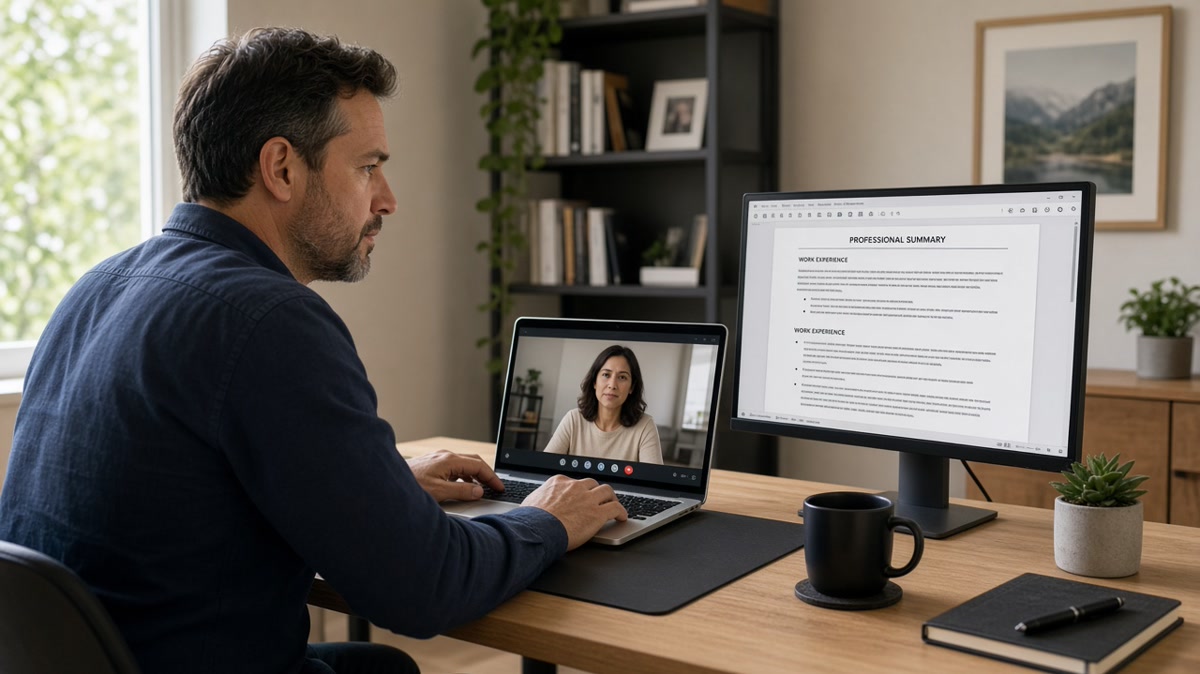
Remote work has fundamentally changed how companies hire and how candidates present themselves. When you're applying for remote positions, your resume faces unique challenges: it must pass automated screening systems, demonstrate self-management capabilities, and communicate across geographic and cultural boundaries—all without the benefit of face-to-face interaction.
How to write a resume for remote jobs requires understanding what remote employers actually prioritize. Unlike traditional office roles, remote positions demand proof of accountability, communication skills, and the ability to work independently. Your resume must signal these qualities while remaining ATS-compliant and compelling to human readers.
This guide covers everything you need to know:
- Structuring your resume for remote job applications
- Highlighting remote-specific skills and experience
- Optimizing for ATS systems used by remote employers
- Avoiding common mistakes that cost remote job interviews
- Best practices that improve your screening rate
- Step-by-step instructions to build your remote-ready resume
Why Remote Resume Strategy Matters
Remote positions attract significantly more applicants than comparable office roles. Remote hiring is more competitive because geographic barriers disappear—a single job posting reaches candidates worldwide. This means your resume competes against hundreds or thousands of applicants, not dozens.
Remote employers rely heavily on automated resume screening because manual review becomes impossible at scale. Remote hiring has changed resume screening rules. These systems prioritize specific keywords, formatting consistency, and clear demonstration of remote-relevant skills. A resume optimized for remote positions increases your chances of passing initial filters and reaching human reviewers.
Additionally, remote employers evaluate candidates differently. They can't assess your communication style or work ethic through office observation, so your resume must explicitly demonstrate these qualities through concrete examples and strategic language choices.
Key Elements of a Remote-Focused Resume
Professional Summary Tailored to Remote Work
Your professional summary should immediately communicate your remote work qualifications. Rather than generic statements, include specific remote competencies: "Results-driven marketing professional with 6+ years remote experience managing distributed teams and delivering projects across 8+ time zones." This tells employers you understand remote work challenges and have proven success in that environment.
Mention relevant remote achievements early: successful virtual team leadership, self-directed project completion, or cross-timezone collaboration. Keep it 2-3 sentences maximum. Remote employers scan resumes quickly, so front-load your most relevant remote credentials.
Remote-Specific Skills Section
Create a dedicated skills section that emphasizes remote work capabilities alongside technical skills. Include both hard skills (your core competencies) and soft skills critical for remote success: time management, async communication, self-motivation, independent problem-solving, and digital collaboration tools.
List tools explicitly: "Slack, Asana, Zoom, Google Workspace, GitHub, Figma." Remote employers want to see familiarity with their likely tech stack. Order skills by relevance to the job description, with remote-critical skills near the top. ATS systems read skills sections carefully, so use exact terminology from the job posting.
Experience Bullets Demonstrating Remote Capabilities
Rewrite your experience bullets to highlight remote-relevant achievements. Instead of "Managed team projects," write "Led distributed team of 5 across 3 time zones, implementing async workflow system that reduced project delays by 30%." Show measurable outcomes from remote work scenarios.
Include evidence of: independent decision-making, communication across distance, self-directed productivity, and ownership of outcomes without constant supervision. Use action verbs specific to remote environments: "coordinated," "facilitated," "collaborated," "communicated," "delivered independently." Each bullet should demonstrate both competence in your field and capability to work remotely.
Formatting for ATS and Remote Screening
Remote employers rely on ATS systems to screen applications at scale. Use standard formatting: single column layout, clear section headers, consistent bullet points, and simple fonts (Arial, Calibri, or Helvetica). Avoid graphics, colored text, tables, and creative formatting—these break ATS parsing and reduce your screening score.
Use .docx or .pdf format as specified in the job posting. Save your file with a professional name: "FirstName_LastName_Resume.pdf" rather than "Resume_Final_v3.pdf." Include relevant keywords from the job description naturally throughout your resume, particularly in your summary, skills section, and experience bullets.
Common Mistakes to Avoid
- Ignoring remote-specific keywords: Using generic resume language costs you screening points. Remote employers search for specific terms: "remote," "distributed," "async," "self-directed," "timezone." Include these naturally where they apply to your experience.
- Failing to highlight independent achievements: Remote employers need proof you deliver without constant oversight. Avoid passive language like "participated in" or "was involved with." Use "led," "owned," "delivered," and "drove" to show autonomous contribution.
- Overloading with irrelevant office skills: If you're applying for remote roles, de-emphasize office-specific skills like "in-person presentation" or "office management." Focus on transferable skills that matter for remote work: written communication, async collaboration, time management.
- Poor formatting that breaks ATS parsing: Creative resume designs, unusual fonts, graphics, and complex layouts cause ATS systems to misread your information. Formatting errors break ATS parsing. Use simple, clean formatting that any system can read.
- Vague experience descriptions: "Worked on projects" or "contributed to team" tells remote employers nothing about your actual capabilities. Every bullet should include context, action, and measurable outcome: "Reduced customer response time by 40% by implementing automated email workflows across distributed support team."
- Omitting remote work history: If you have freelance, contract, or previous remote experience, highlight it prominently. Remote employers want to see you've succeeded in this environment before.
Best Practices for Remote Job Resumes
- Match the job description precisely: Read the job posting carefully and mirror its language throughout your resume. If they emphasize "async communication," include that phrase in your summary or experience. ATS matches resumes to job descriptions using keyword matching, so alignment matters significantly.
- Quantify remote achievements: Numbers make your accomplishments credible. Instead of "improved team efficiency," write "improved team efficiency by 35% through implementation of async project management system." Remote employers evaluate candidates on measurable outcomes since they can't observe your work directly.
- Emphasize communication skills: Remote work depends entirely on clear communication. Highlight writing skills, presentation abilities, and cross-functional collaboration. Include examples of communicating complex ideas to diverse audiences or managing projects with stakeholders across time zones.
- Keep it concise and scannable: Remote hiring managers review dozens of resumes daily. Use short paragraphs, clear headers, and bullet points. Limit your resume to one page if you have less than 5 years of experience, two pages maximum for more experience. Make key information immediately visible.
- Include timezone and location info strategically: If you're in a favorable timezone for the company, mention it. If not, don't emphasize it. Some companies prefer candidates in specific regions; others welcome global talent. Let the job description guide whether to include your location.
- Highlight relevant remote tools and platforms: List specific software you've used: project management (Asana, Monday.com), communication (Slack, Teams), design (Figma), development (GitHub), or industry-specific tools. Remote employers want to see you're already familiar with their likely tech stack.
- Show proof of self-management: Include examples of independent projects, self-directed learning, or situations where you took initiative without being asked. Remote work rewards proactive, self-motivated professionals.
- Use action verbs specific to remote environments: Choose verbs that demonstrate remote competence: "coordinated," "facilitated," "communicated," "collaborated," "delivered," "managed," "led," "drove," "owned," "implemented." Avoid passive language that suggests you followed rather than led.
Step-by-Step Guide to Building Your Remote Resume
- Start with a professional summary: Write 2-3 sentences highlighting your years of experience, key remote competencies, and major achievements. Include the phrase "remote work" or "distributed teams" if applicable. Example: "Results-driven product manager with 8 years of experience leading remote-first product teams. Proven track record delivering enterprise SaaS products across distributed, async-first organizations. Expertise in cross-timezone collaboration and self-directed project ownership."
- List your technical and remote skills: Create a skills section with 15-20 relevant skills, ordered by importance. Include both domain expertise and remote-specific capabilities. Separate into categories if helpful: "Technical Skills," "Remote Collaboration," "Project Management Tools."
- Rewrite your experience section: For each role, write 4-6 bullet points. Start with action verb, include context, describe your specific contribution, and end with measurable outcome. Focus on remote-relevant achievements: independent projects, async collaboration, timezone management, or distributed team leadership.
- Optimize for the specific job: Read the job description and identify 5-10 key requirements. Ensure your resume addresses each one. Use exact terminology from the posting in your summary, skills, and experience bullets.
- Format for ATS compliance: Use standard formatting: single column, simple font (Arial, Calibri, Helvetica), consistent bullet points, clear section headers. Save as .docx or .pdf. Test your formatting by opening it in multiple programs to ensure it displays correctly.
- Proofread thoroughly: Check for typos, grammatical errors, and formatting inconsistencies. Have someone else review it. Remote employers often filter candidates with spelling or grammar errors because written communication is critical.
- Customize for each application: Don't use the same resume for every remote job. Adjust your summary and experience bullets to emphasize relevant skills for each position. This takes 15-20 minutes per application but significantly improves your screening rate.
Conclusion
Writing an effective resume for remote jobs requires understanding how remote employers screen candidates differently. Your resume must demonstrate remote-specific competencies, pass ATS screening, and communicate your value across geographic distance. Focus on concrete achievements, quantifiable results, and clear evidence of self-direction and communication ability.
The most successful remote resumes combine ATS optimization with human-focused storytelling. Include relevant keywords and proper formatting to pass automated screening, but write compelling achievement statements that convince hiring managers you're the right fit. Customize your resume for each position, emphasize remote-relevant skills, and remove anything that doesn't strengthen your candidacy.
Start by reviewing the job description, identifying key requirements, and tailoring your resume accordingly. Spend extra time on your professional summary and experience bullets—these are where remote employers determine if you understand remote work and can deliver results independently. With a well-optimized, remote-focused resume, you'll significantly improve your interview rate and land the remote position you're targeting.
Frequently asked questions
No. Instead, emphasize transferable skills that apply to remote work: self-motivation, written communication, independent problem-solving, and time management. If you lack remote experience, highlight relevant achievements from office roles that demonstrate these capabilities. For example, "Led independent research project with minimal supervision" shows self-direction. You can address your remote work status in a cover letter if needed, but your resume should position you as capable regardless of prior remote experience.
One page for candidates with less than 5 years of experience; two pages maximum for those with more. Remote employers scan resumes quickly and appreciate conciseness. Every line should add value—remove generic statements, outdated skills, or irrelevant experience. Prioritize remote-relevant achievements and recent experience. If you're over two pages, cut the oldest or least relevant positions.
Include your timezone only if it's favorable for the company or if the job posting specifically asks. If you're applying to a US-based company and you're in Europe, mentioning your timezone shows you understand the challenge and have likely managed it before. If your timezone creates significant overlap challenges, address it in your cover letter or during the interview. Let the job description guide your decision—some companies prefer candidates in specific regions; others actively seek global talent.
Yes, if relevant to your field. Include links to your portfolio, GitHub, LinkedIn, or relevant work samples. Use short URLs or bit.ly links if needed. For remote positions, a portfolio demonstrates your work quality better than descriptions alone. However, ensure all links work and lead to professional content. Test every link before submitting. If you include links, make them clickable in your PDF resume for easy access by hiring managers.
Critical. Remote roles increase resume rejections because high application volume forces reliance on automated screening. Remote employers use ATS systems more heavily than traditional companies because they receive 5-10x more applications per position. Your resume must pass ATS filtering to be seen by humans. Use standard formatting, include relevant keywords from the job description, and avoid creative designs that break parsing.
No. Customize your resume for each position by adjusting your summary and emphasizing relevant experience. Spend 15-20 minutes tailoring your resume to match the job description's language and priorities. This customization significantly improves your ATS score and makes your application more compelling to human reviewers. Generic resumes get filtered out quickly in competitive remote job markets.