11 min read
To tailor your resume for job match scores in US healthcare jobs, move RN license, BLS, ACLS, and Epic or Cerner proof out of Skills and into dated clinical bullets under the hospital where you used them, then re-score with the full posting pasted. Don't chase a higher percentage while bullet one still says provided patient care in a hospital setting.
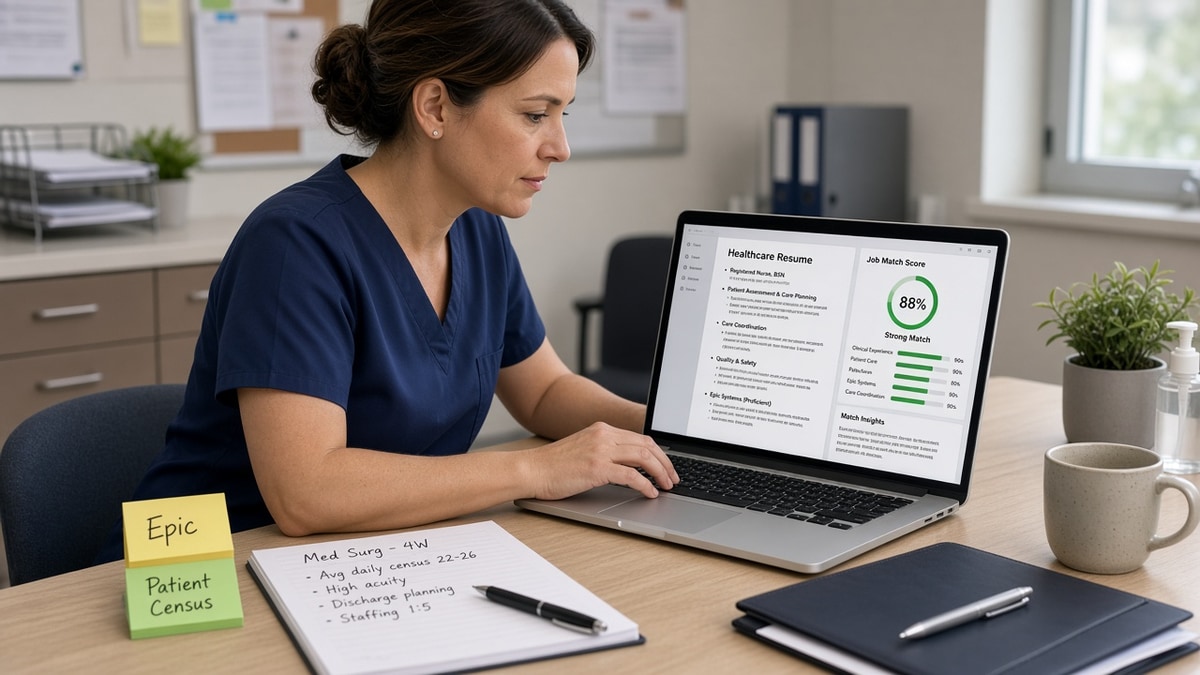
You've got the license and the charting hours. The match score still flags Epic because it's only in Skills while your ICU scope never left a generic duty line. That's not a missing credential. It's a bullet placement problem. Before you add a fourth synonym for patient-centered care, check your resume for free with the hospital req pasted in. You'll see whether ACLS and unit type show up under a Month Year employer row or only in a list the parser barely weights.
US healthcare hiring across hospital systems, clinics, and health IT vendors is still noisy. You can't control how many reqs open in your metro. You can stop sending the same master file when the gap list repeats license, EHR, and unit terms three applies in a row. This page gives you the direct answer, the exceptions that change it, and what you'll run tonight.
Pull up the role you care about. Don't start in Skills. Start with bullet one under your current facility and ask whether a tired recruiter would see license state, unit, patient load, and EHR in the first line without opening the attachment. If they're not there, the score isn't lying. Your proof is in the wrong section.
Quick Wins
- Put RN license with state on line one under your name.
- Rewrite bullet one with unit, patient load, and EHR in the first eight words.
- Paste the full job description into job match score, not a URL skim.
- Parse-check the exact PDF or DOCX you'll upload to Workday or Taleo.
Why healthcare job match scores flag Skills before Experience
A job match score compares your resume text to the hospital posting and returns gaps: terms in the req that never appear in your file, or terms stuck in Skills while clinical bullets stay generic. It is not a hiring decision. It is an edit list so you know which bullet to touch first.
The pattern that loses: green on Epic, Cerner, ACLS, and med-surg in Skills while bullet one under your current hospital still reads like a template copied from school. Recruiters ctrl-f inside Experience and find nothing dated. Parsers weight Month Year employer lines higher than undated skill clouds. Both views mean proof lives where screeners look last.
US healthcare reqs repeat a short must-have list: license state, unit type, patient acuity, EHR name, cert set, sometimes bilingual or float requirement. I've screened stacks of these in Workday and Taleo, and the file that fails has those words somewhere on page one in Skills while the clinical story never left provided compassionate care language.
Match score tells you what's missing. Placement tells you whether anyone believes you. When license and EHR sit in Skills only, the score may tick up if you add synonyms. The recruiter still sees a duty bullet with no unit, no load, and no charting system in line one.
Read how many keywords a resume should have in 2026 after you fix placement. Healthcare files need fewer repeated terms than candidates think. They need each must-have once in a dated bullet before Skills echoes it.
Postings and roles that change how you tailor
The direct answer in the intro holds for most staff RN, LPN, MA, and allied health applies on major US hospital ATS. These exceptions change which terms you lead with and where license detail must sit.
ICU and step-down versus med-surg float
ICU reqs want acuity, vent experience, and drip protocols in bullet one. Med-surg postings want patient ratio, admission/discharge volume, and wound care or telemetry scope. Don't paste ICU language into a med-surg apply because the words match a template you saved last month.
Edge case: float pool role listing three units. Pick the unit named first in the posting for bullet one. Mention float coverage in bullet two with Month Year dates, not as a Skills tag only.
Travel nurse and compact license
Travel reqs lead with active license states, compact status, and weeks per assignment. Put RN (TX) · Compact on the contact line when true. Bullet one should name the last travel facility, charting system, and unit with assignment dates. A generic travel nurse summary without facility names reads empty on human review even when Skills lists every cert.
Clinical informatics and health IT
Epic analyst and clinical informatics roles want implementation scope, module names, and go-live support in bullets, not only Cerner in Skills. If you're pivoting from bedside to IT, lead with the project where you built order sets or trained floor staff, with dates and hospital name on the same line.
Edge case: you're bedside RN applying to a super-user role. One bullet on training peers during Epic upgrade belongs above older med-surg duty lines. Match score should see Epic in Experience, not only in a sidebar.
New grad and residency programs
Clinical rotations count as Experience with facility name, unit, and hours when the posting asks for student clinical scope. Preceptorship bullets beat a Skills line that says clinical rotations. License pending belongs with expected NCLEX date in Education or Licensure, not as RN before you're licensed.
Where tailoring still breaks after keywords move
Two-column nursing templates with cert icons in a left rail. Scoring a DOCX but uploading last week's Canva PDF. Listing BLS without renewal Month Year when the posting asks for current cert. Chasing ninety on match while bullet one never names patient load. Applying compact license detail only in a footer the parser drops.
Tailor resume for job match scores in US healthcare jobs: four edits
Work in order. Don't open Skills until bullet one under your current facility carries license context, unit, load, and EHR from the posting.
Edit 1: Fix the license and cert header
Line under your name: full name, RN (state), phone, email, city. Certifications section after Experience lists BLS, ACLS, PALS with renewal Month Year when you have it. Skills echoes terms already proven in bullets.
Before: Skills: RN, BLS, ACLS, Epic, patient care, teamwork.
After: Maria Santos, RN (FL) · BLS (renewed Mar 2025) · ACLS (renewed Jan 2025). Bullet one names Epic and unit below.
Edit 2: Rewrite bullet one with clinical scope
Lead with verb, unit, patient load, EHR, then one outcome or protocol from the posting. Cut provided patient care and assisted with treatments. If you cannot name load, name shift type, bed count, or procedure volume.
Before: Provided nursing care to patients in a fast-paced hospital environment.
After: Managed care for 5 ICU patients per shift in Epic at Bayview Medical Center; titrated drips and vent settings per ACLS protocols, Jan 2022 to present.
Edit 3: Run job match score with the posting pasted
Upload the resume and paste the full job description into Score your job match . Read the gap list as location hints. Skills-only green with Experience gaps means Edit 2 isn't done. Missing terms you truly lack means pass or upskill, not fabrication.
Before: Gap list shows Epic, med-surg, and BLS as matched in Skills only; Experience gaps for unit and patient ratio.
After: Same terms appear in bullet one under County Hospital with Month Year dates; gap list shrinks on Experience rows first.
Edit 4: Mirror posting phrases once, then re-score
Copy exact spelling from the hospital req: medical-surgical versus med-surg, EMR versus EHR, registered nurse versus RN if they wrote it out. One mirror in bullet one is enough. Do not repeat the same phrase twelve times in Skills.
Before: Assisted physicians and collaborated with interdisciplinary team on patient outcomes.
After: Coordinated discharge planning for 12 medical-surgical patients per shift in Cerner; cut average length of stay 0.4 days over Q2 2024 on the 4 West unit.
Copy-paste clinical must-have scratch column
Copy-paste scratch column
Posting must-have | Where it lives now | Target bullet (facility + Month Year)
RN license (state) | Footer or Skills   | Line under name: RN (TX)
Epic              | Skills only        | Current hospital bullet 1
ACLS              | Skills only        | Current hospital bullet 1 or Certifications
med-surg ratio    | Missing            | Current hospital bullet 1

Rule: no clinical must-have stays Skills-only after tailoring.
Edge case: per-diem and PRN roles across two facilities in one year. Two bullets max per employer block so dates stay readable. Another edge case: military medic to civilian RN. Translate scope to civilian unit language the posting uses and name the civilian facility where you clinical'd or worked after licensure.
For phone screen prep after you apply, see how to prepare for a recruiter screening call . Match score gets you past the first filter. Bullet one is what you defend on the call.
Score, then parse-check the upload file
Paste the hospital posting and your edited resume into Score your job match . Work the gap list top to bottom: Experience first, Skills echo second, pass on units or systems you cannot prove.
When match gaps shrink but you're unsure the portal will read license and EHR lines cleanly, run HireFlow's free ATS resume checker on the same single-column DOCX or PDF you'll attach. Confirm current facility imports on top and Epic or Cerner appear in body text, not only in a margin the parser dropped.
Do this now: License line, bullet one rewrite, match score, plain-text paste, then upload the scored file without swapping exports.
Run the gap list tonight
To tailor your resume for job match scores in US healthcare jobs, treat license, certs, unit, load, and EHR as proof that belongs in dated clinical bullets first. Skills supports bullets. It does not replace them. Score the posting, fix Experience gaps, parse-check the export, then apply with the same file you tested.
- Put RN (state) on the contact line under your name.
- Rewrite bullet one with unit, patient load, and Epic or Cerner in line one.
- Run match score with the full hospital description pasted.
- Lock the file name before you hit apply on Workday or Taleo.
Open the req you're targeting. Run a free ATS check on the file in the system. If the hospital asks for a cover letter, use the cover letter generator with the same unit and EHR from bullet one so the letter matches the resume they'll open next.
This won't fix applying to units where you lack the license, cert, or acuity the posting requires. It stops qualified clinical files from dying because Epic lived in Skills while bullet one still said provided patient care in a hospital setting.
Read more
Frequently asked questions
Yes when the posting names a unit, EHR, license state, or certification you hold. You do not rewrite ten pages nightly. Keep a master clinical resume, then move three to five must-haves from the req into dated Experience bullets for that employer block. Run the match score again. If Epic, Cerner, or ACLS keeps flagging as Skills-only across three applies, fix the master layout once instead of adding synonyms to a sidebar.
License on one line under your name with state: RN (CA) or RN (TX). BLS and ACLS belong in Certifications with Month Year renewal when you have it, and inside clinical bullets where you used them. Write Managed 16 med-surg patients per shift under Epic at County Hospital, Jan 2023 to present instead of listing Epic twelve times in Skills alone. Recruiters ctrl-f the EHR inside employer lines. Parsers weight Month Year rows higher than undated skill tags.
Treat the score as a gap list, not a pass mark. A strong file can sit in the low seventies when the req asks for a niche unit you covered once on float. Fix missing must-haves you can prove with license, cert, or patient scope. Do not invent systems to chase ninety. If bullet one still reads Provided patient care and Skills carries every keyword, a high percentage is noise. Rewrite proof placement first, then re-score.
The workflow is the same. Travel reqs lead with license compact status, charting system, and assignment length. Staff roles may emphasize unit tenure and preceptor hours. Mirror the posting's exact phrases: med-surg versus medical-surgical, EMR versus EHR. Keep Month Year dates spelled out. Never park compact license detail only in a footer grid the parser reads last.
Only if you did not edit a different file locally afterward. Lock the DOCX or PDF you scored, note the file name, and submit that exact export. If you fixed clinical bullets in Word but upload last week's designed PDF, the recruiter opens what the portal stored, not what you tested. Run one final parse check on the upload copy right before submit.