7 min read
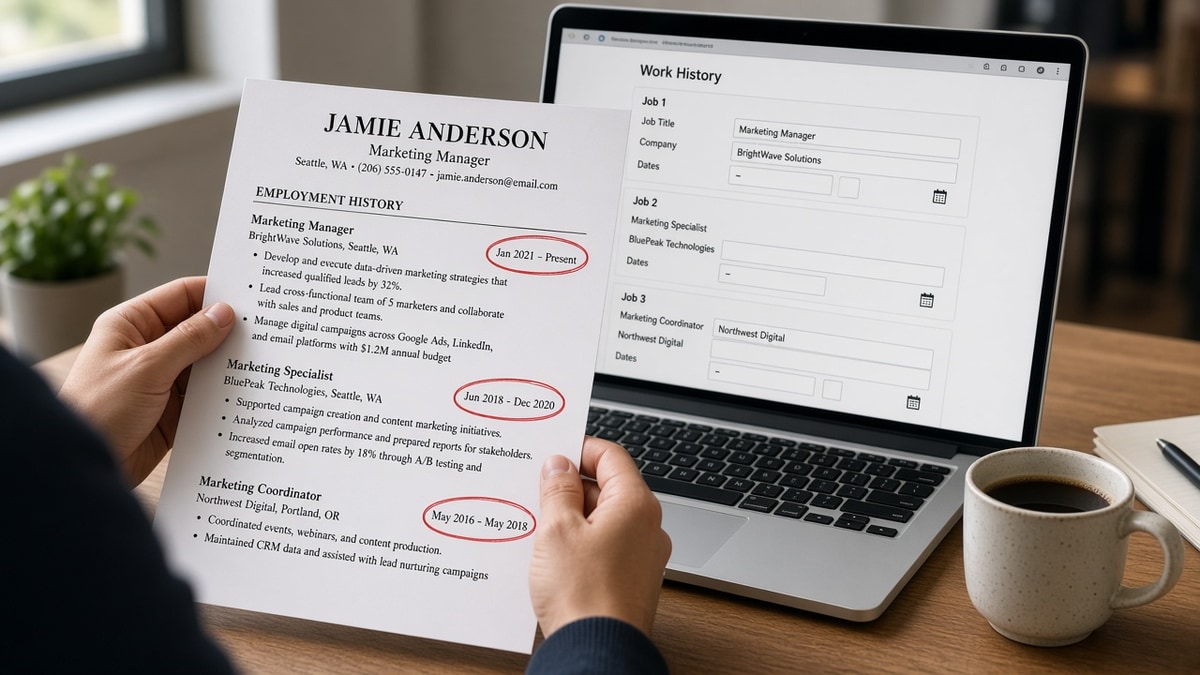
Your PDF looks fine. The application preview shows scrambled dates, a blank third job, and a title that's merged with the company name. That's a continuity failure, not a mystery rejection.
Parsers don't read intent. They read order. When your timeline breaks, ranking treats you like you've got holes recruiters didn't ask for. The fix is presentation, not fiction.
Check your resume for free and compare the extracted work history to what you meant to show. If rows are missing, continuity fixes come before keyword tweaks you'll chase later.
Below: symptoms, causes, how to tell which break you have, and the fix for each.
Quick Wins
- Use Month Year to Month Year on every role, including Present for current jobs.
- Put market titles on the line; keep internal labels in parentheses.
- Label gaps in one honest line instead of deleting months.
Symptoms of a broken timeline in the ATS preview
Symptom: Work history shows fewer jobs than your PDF.
Likely cause: Table or column layout merged entries.
Quick test: Paste into Notepad. If employers run together, the parser will too.
Symptom: Years of experience filter says you're junior when you're not.
Likely cause: End dates parsed as start dates or vice versa.
Quick test: Open the portal preview right after upload. Compare each date field to your source file.
Symptom: Rank sort puts you below peers with similar bullets.
Likely cause: Title string does not match the posting family, so relevance sort underweights your row even when skills match.
Quick test: Search your own title in the posting language. If you would not appear, rewrite the headline line.
Before: Jan 2020, 01/2021, and Spring 2022 mixed on one page.
After: January 2020 to March 2021, April 2021 to Present, same pattern every block.
How resume continuity affects ranking starts at import. A clean timeline lets years-of-experience filters and title searches include you. A broken one leaves you out before a human compares bullets.
Causes and fixes that restore continuity
Cause 1: Inconsistent date formats
Parsers expect a pattern. When every job uses a different style, end dates detach from employers. The system sees overlap or empty months and downranks the profile in sort views that trust tenure math.
Fix: Pick Month Year to Month Year everywhere. Write Present for current roles. Put dates on the same line as the employer or directly under the title, not in a footer.
Before: 2020-2022 under one job and Mar '21 to now under the next.
After: March 2020 to February 2022, then March 2022 to Present on the following block.
Cause 2: Title jumps without a searchable string
Career changes are normal. Parsers are literal. Analyst to Coordinator to Engineer reads as three unrelated strings unless bullets bridge the skills. Rank features compare title tokens to the req. Missing tokens mean lower position even when you are qualified.
Fix: Lead with the market title. Add one bullet that names the transferable tool. Do not invent seniority. Align language with the posting header.
I've seen Workday drop strong files because the headline said Client Happiness Lead while the req searched Customer Success Manager. Same work, different string, invisible row.
Cause 3: Gaps presented as blanks
Deleting months creates a hole the parser flags. Overlapping freelance lines without dates create duplicate employers. Both break continuity scoring.
Fix: One line for the gap: Career break, January 2023 to June 2023. Or list contract work with real Month Year spans. Transparency parses cleaner than omission.
Symptom: You trimmed a parental leave and now two jobs show a two-year unexplained hole.
Fix: Add Parental leave, August 2021 to February 2022 as its own line. Recruiters expect life events. Parsers expect continuous Month Year chains.
Cause 4: Overlapping roles without structure
Side gigs stacked on full-time jobs confuse tenure math. Two Present end dates on one page can make the system think you're still at four employers.
Fix: Mark the side project Consulting, nights and weekends, with real start and end months. Keep the full-time job as Present. One primary timeline, one secondary line.
Before: Three concurrent roles, all labeled Present, no hours noted.
After: Full-time role Present; contract gigs dated and closed before the current job started.
Copy-paste block: continuity rewrite skeleton
Copy-paste one job block
Customer Success Manager | Apex Logistics | Remote
March 2022 to Present
• Owned renewal queue for 40 accounts; cut churn on late invoices in Q2
• Translated ticket themes into product notes for the roadmap team

Earlier: Client Happiness Lead (official title), same employer, same dates if promotion
Layout still matters. Resume formatting errors that break ATS parsing covers tables and columns that snap timelines even when dates look fine on screen.
For how parsers read growth over time, see how ATS interprets career progression .
Continuity traps that look like clever fixes
Trap: Functional format to hide a gap.
Why it fails: Greenhouse and Workday expect reverse-chronological blocks. Skills-first layouts scramble dates and drop tenure filters entirely.
Trap: Stretching end dates by a few months.
Why it fails: Background checks use payroll records. A polished lie breaks on the reference call, not in rank.
Trap: Stuffing every title you ever held into one headline.
Why it fails: Search token dilution. The parser picks the first chunk; recruiters see noise.
Before: Deleted a four-month role to avoid job-hopping optics.
After: Kept the role, one bullet on deliverable shipped, dates intact.
Continuity is not about looking uninterrupted. It's about making the machine read the same story you'll tell on a screen call. Honest gaps with clean dates rank above clever blanks every time.
If you're tempted to merge two employers because both were short, list them separately with dates instead. Merged blocks look like one confused stint. Separate rows preserve searchability for each title string you earned.
Parse-test before you rank-chase
Upload your file to the ATS checker and read the work history table like a Greenhouse import screen. Every missing month is a rank hit waiting to happen.
Rebuild broken blocks in the free resume builder with standard Experience headers, then export one PDF for apply and one DOCX for portals that prefer Word.
Need a letter that repeats the same titles and dates? Generate a cover letter after the timeline parses cleanly so human readers do not see one story in the resume and another in the note.
Present the timeline you already have
How resume continuity affects ranking is not a moral test about gaps. It's a parsing test about order. Align dates, titles, and employers so the database can count your years and match your level.
Fix format first. Bridge real pivots with one bullet of proof. Label breaks instead of shaving months. Then tailor keywords. Rank features only help when the underlying row is whole.
You cannot control every sort algorithm. You can control whether Workday shows three jobs or one mangled block. Start there tonight.
Read more
Frequently asked questions
A visible gap is better than a missing row. Parsers flag holes when end dates on one job sit months before start dates on the next with nothing between. Label the gap in plain text or keep Month Year formatting consistent so the timeline imports as one chain. Hiding dates creates a worse parse than honesty.
Removing roles often creates new gaps the parser reads as unemployment. Keep short stints if they explain a title change. One line with Month Year dates beats a blank year recruiters will question on a call.
Usually a table, sidebar, or centered layout pushed employer and title onto the same line. Workday and Greenhouse assign fields by position. When position breaks, two jobs become one blob and years of experience math fails.
Explain in bullets, but lead with a market title the ATS can search. Internal labels like Partner Success Guru do not map to filters recruiters run. Put the official title in parentheses if you need both.