11 min read
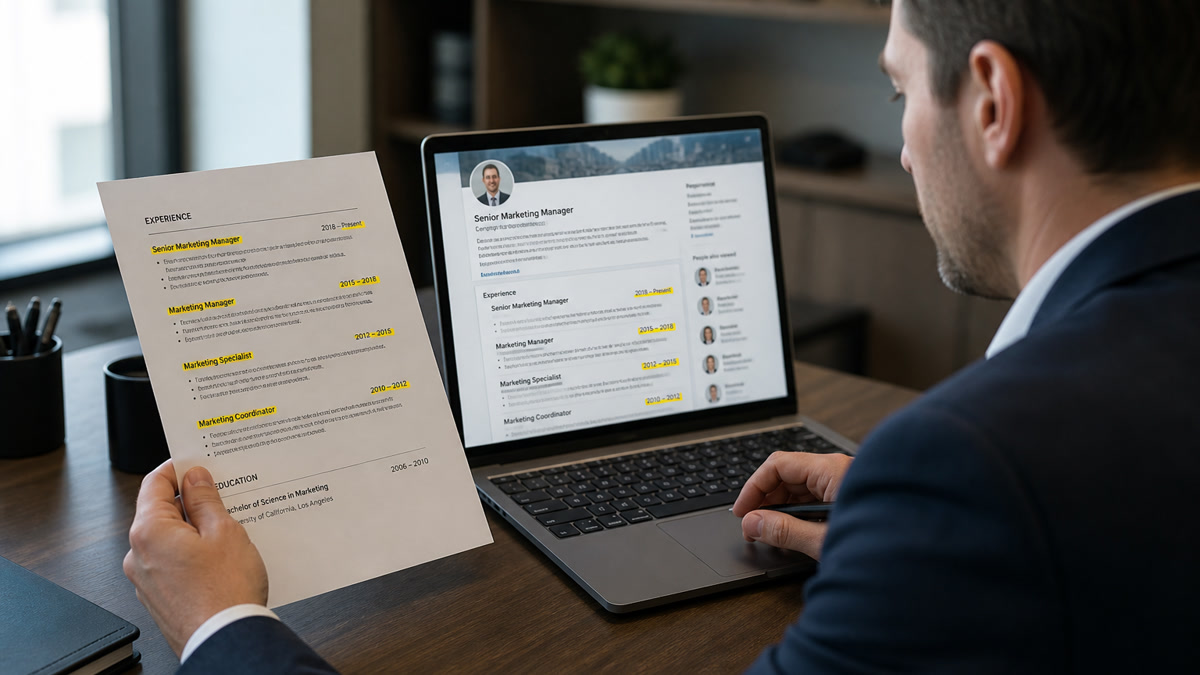
Your resume cleared the parser. Then the recruiter opened your profile in another tab. That's where screens stall when titles, employer names, or month-year ranges don't line up. How recruiters validate experience on LinkedIn in the US isn't a deep background investigation on day one. It's a side-by-side cross-check before anyone puts time on your calendar.
Before you tweak your headline again, check your resume for free against the posting. You'll see whether your current title and employer strings match what recruiters will search in Workday or Greenhouse first.
This teardown walks through what passes, what gets paused, and the before-and-after fixes across four roles. You'll get copy-paste alignment blocks you can run tonight with your resume open on the left and your profile on the right.
Quick Wins
- Copy employer legal names from your resume into every LinkedIn experience row.
- Match Month Year start and end dates on your two most recent roles.
- Put your searchable req title in the LinkedIn headline, not an internal nickname.
- Remove Present on the resume if LinkedIn already shows an end month.
- Spell acquisitions the way the resume does: one parenthetical once, same everywhere.
What recruiters compare before they schedule you
The validation pass takes under two minutes when nothing is wrong. Recruiter opens ATS row, opens public profile, scans current employer, title level, and the last two date ranges. They're not reading your About section yet. They're checking whether the same job history appears on both sides.
The three fields that matter most: employer legal name, title at the level the req searches, and Month Year ranges that do not contradict. Skills, endorsements, and activity posts come later. Basics first.
Contract and consulting work trips people up. Agency name on the resume, client name only on LinkedIn, or the reverse, looks like two different jobs. Pick one convention and mirror it on both documents.
Acquired companies create the same noise. Resume says OldCo (acquired by NewCo). Profile lists only NewCo with different dates. Recruiters do not assume you made a mistake. They assume you have not updated one file.
Read how recruiters decide which resumes to read first for the ATS sort that happens before anyone opens a profile tab.
Greenhouse and Lever often show a profile link beside the resume when candidates apply with one-click import. Workday may not auto-link, so recruiters search your name manually. Either way, the comparison is the same: does this person work where they say they work, at the title level they claim, for the months listed.
Education rows matter less on the first pass unless the req requires a specific degree or license. Experience alignment is the gate. Fix employment rows before you rewrite your summary paragraph.
Location mismatches can follow. Resume says Austin, profile says open to remote only with no city. That won't kill you alone, but it adds a question when the req is on-site three days a week.
How recruiters validate experience on LinkedIn: teardown pairs
These pairs show what passes a fast US corporate screen. Weak versions share vague titles, mismatched months, and employer strings that do not search the same way.
Pair 1: Operations manager
Before: Resume lists Ops Lead at BrightPath Logistics, Jan 2022 to Present. LinkedIn headline says Supply Chain Enthusiast. Experience row shows Brightpath LLC ending Aug 2024.
After: Both say Operations Manager at BrightPath Logistics, January 2022 to Present. Headline: Operations Manager | Fulfillment and WMS. Same spelling, same months.
Pair 2: Registered nurse
Before: Resume shows Registered Nurse at City Medical Center, March 2021 to Present. LinkedIn lists RN at City Med with no end date on a prior travel contract that overlaps.
After: Resume and profile both show Registered Nurse, City Medical Center, March 2021 to Present. Travel contracts listed separately with agency name and facility on each line.
Pair 3: Software engineer
Before: Resume title Senior Software Engineer at DataStack Inc. LinkedIn says Staff Engineer at Datastack with start month June 2020 while resume says March 2019.
After: Both documents: Senior Software Engineer, DataStack Inc., March 2019 to Present. Promotion to Staff noted in a bullet, not as a conflicting title row unless dates split cleanly.
Pair 4: Marketing director
Before: Resume lists Director of Demand Generation at Northwind Apps. LinkedIn experience says Marketing @ Northwind with no months and a freelance block covering the same years.
After: Director of Demand Generation, Northwind Apps, April 2020 to Present on both. Freelance work moved to its own dated row or removed if it duplicates full-time tenure.
Pair 5: Financial analyst
Before: Resume shows Financial Analyst at Meridian Capital Group. LinkedIn lists Analyst II at Meridian with end date last month while resume still says Present.
After: Both updated to Financial Analyst, Meridian Capital Group, with the same end month if the role ended, or Present on both if still employed. No split signals.
Pair 6: Project manager
Before: Resume uses client names for consulting gigs. LinkedIn lists only the staffing agency with overlapping full-time employer dates.
After: Consulting: Project Manager (Client: Apex Health), Jan 2023 to Jun 2023 on resume and profile. Full-time employer rows do not overlap the same months.
Copy-paste LinkedIn experience row
Title: Operations Manager
Company: BrightPath Logistics
Dates: January 2022 – Present
Description:
- Own inbound SLA reporting for a 220k sq ft fulfillment site.
- Cut mis-pick rate 8% by standardizing WMS scan steps on second shift.
Copy-paste resume line to mirror
Operations Manager | BrightPath Logistics | January 2022 to Present
- Own inbound SLA reporting for a 220k sq ft fulfillment site.
- Cut mis-pick rate 8% by standardizing WMS scan steps on second shift.
Edge case: promotion mid-year
Split the promotion on both documents with two rows and non-overlapping months. Same title bump on resume only reads like you hid a demotion on the profile.
Edge case: career break
A gap on the resume with no LinkedIn row is fine. A freelance or caregiving row on LinkedIn with no resume mention looks like missing experience. Add one honest line on both or neither.
What recruiters ignore on the first pass
Banner photos, volunteer sections from ten years ago, and skill endorsement counts rarely decide whether you get a screen. Do not spend an hour on aesthetics while your current employer still shows the wrong end month.
Activity posts help after alignment. A thoughtful comment on an industry thread does not override a title that says Manager on the resume and Individual Contributor on the profile.
Contract-to-hire and W-2 transitions
Before: Resume shows Consultant at Apex via TalentBridge, Jan 2024 to Jun 2024, then W-2 at Apex from Jul 2024. LinkedIn lists only Apex with start Jan 2024 and no agency row.
After: Two rows on both files: Consultant (Apex via TalentBridge), Jan 2024 to Jun 2024; Software Engineer, Apex Systems, July 2024 to Present. Recruiters see the conversion without overlapping W-2 and 1099 months.
International employer names
US reqs search the US legal entity spelling. If your resume says Acme GmbH and your profile says Acme Inc., pick the name on your W-2 or offer letter and use it everywhere. Add the other spelling in parentheses once if needed for search.
Ten-minute alignment workflow
Open your resume PDF and profile in split screen. Start with your current role. Copy employer string from resume to profile headline and experience title. Copy Month Year start and end. Repeat for the prior role. Stop after two roles unless you see a visible gap.
Screenshot both sides when done. If you apply to five similar reqs this week, you won't second-guess whether you already fixed the dates.
When a recruiter sends a clarification note
Reply with the corrected dates and offer to send an updated resume PDF. Do not argue internal title policy. Do not send a long story about HR systems. One paragraph, both documents attached or linked, move on.
Most clarification threads convert to screens when the fix is factual and fast. Slow or defensive replies signal you'll be hard to schedule even when the mismatch was minor.
What weak LinkedIn profiles share with strong resumes
Creative headlines without searchable titles. Brand Builder tells a recruiter nothing. Director of Product Marketing tells them where to sort you.
Present on one file, end date on the other. Fastest way to get a clarification email instead of a screen invite.
Employer nicknames. City Med vs City Medical Center fails a ctrl-F check in five seconds.
Duplicate overlapping roles. Full-time job and side contract with the same months looks like double billing, not hustle.
Skills without experience proof. Fifty endorsements do not fix a title that does not match the req. Put the skill inside a dated bullet on both sides.
Recommendations before alignment. Ask for recommendations after titles and dates match. A reference to the wrong job title makes the mismatch louder.
I've paused strong resumes when the profile still showed an old employer as current. Fix the basics before you optimize keywords.
Hidden concurrent jobs. Full-time role plus undisclosed advisory board seat with overlapping months raises conflict questions on regulated industry reqs.
Academic titles on industry profiles. Adjunct Instructor on the profile while the resume shows only corporate roles makes recruiters wonder which track you're pursuing.
Outdated headline after a layoff. Still Employed at Company X in the headline while the resume shows end date last quarter is worse than a gap explained honestly on both sides.
Align resume and profile before the next application
Paste your resume and the posting into HireFlow's ATS resume checker and confirm title and employer strings parse where recruiters search.
Use job match score on reqs where your aligned title already hits required level language. When a portal allows optional text, pull one paragraph from the cover letter generator that names the same employer and title strings you fixed on your profile.
Keep a simple two-column log: resume string, profile string, fixed Y/N. Three rows in and you'll spot your own repeat mismatch pattern.
Run the two-tab check tonight
How recruiters validate experience on LinkedIn in the US comes down to employer names, title level, and month-year ranges that match your resume. Fix those three before you polish bullets or chase endorsements.
A clean cross-check does not replace being qualified. It stops a qualified file from getting a pause email instead of a calendar invite.
Open both tabs, fix the last two roles, then run the free resume check on the req you're targeting next.
Save a dated PDF after each alignment pass. If a recruiter asks which version is current, you'll send the same file that's already on your profile.
- Match employer legal names on your two most recent roles.
- Align Month Year ranges before you request recommendations.
- Re-run the ATS check after any title or date change.
Read more
Frequently asked questions
Not every file on every req, but mid-level and senior US roles get a profile glance often. The check is fast: current title, employer spelling, and start or end months against the resume. Mismatches pause the screen even when the resume alone looks strong.
End month on the most recent role. A resume that says Present while LinkedIn shows an end date six months ago reads as outdated or careless. Same employer with different start months also triggers a follow-up before anyone schedules time.
Employer name and core title level should match. Internal nicknames belong in parentheses once on the resume, not as the only LinkedIn headline. If the req searches Senior Product Manager, both documents should surface that phrase, not Growth Ninja.
No. Recommendations help after basics align. Recruiters still compare employer names, title levels, and month-year ranges first. A glowing paragraph does not fix a company name spelled two different ways.
Open resume and profile side by side. Copy employer legal names, standard titles, and Month Year ranges from the resume into LinkedIn experience rows. Run a free ATS check on the resume so keywords in both places tell the same story.