8 min read

How ATS Identifies Experience Blocks: A Complete Guide for Job Seekers

September 2, 2026

Learn how ATS identifies experience blocks on resumes. Discover what recruiters see, common mistakes, and best practices to improve your screening results.

When you submit a resume online, it doesn't go directly to a hiring manager's inbox. Instead, it passes through an Applicant Tracking System (ATS)—software designed to parse, organize, and rank applications before humans ever see them. Understanding how ATS identifies experience blocks is critical to getting past the automated screening phase and into the hands of recruiters.

Experience blocks are the sections of your resume that detail your work history, job titles, companies, dates, and accomplishments. ATS systems analyze these blocks to determine whether you meet the core requirements of a job posting. If your experience isn't formatted and structured correctly, the ATS may misinterpret your qualifications—even if you're genuinely qualified.

In this guide, you'll learn:

  • How ATS systems parse and identify experience blocks
  • Key structural elements ATS looks for in work history
  • Common formatting mistakes that confuse ATS parsing
  • Best practices to make your experience blocks ATS-friendly
  • How to structure experience to improve your resume score

Why How ATS Identifies Experience Blocks Matters

Your experience section is one of the most heavily weighted components in ATS scoring. While keywords matter, ATS systems prioritize clear, structured experience blocks because they reveal your career progression, tenure, skill application, and relevance to the role. When ATS cannot properly parse your experience section, it cannot accurately assess your fit.

Recruiters rely on ATS scores to manage high application volumes. A poorly formatted experience block can result in a low ATS score, causing your resume to be ranked below more structurally sound applications—even if you're more qualified. Understanding this process allows you to format your experience in a way that both ATS systems and human recruiters can easily interpret.

Key Elements ATS Uses to Identify Experience Blocks

Job Title and Company Name

ATS systems first identify experience blocks by locating job titles and company names. These are anchor points that signal the beginning of a new work experience entry. The system looks for patterns: a company name followed by a job title, or vice versa. If your job title and company name are buried in body text or formatted inconsistently, ATS may fail to recognize them as separate experience blocks.

Best practice: Place your company name and job title on separate lines or clearly separated. Use consistent formatting across all experience entries. Avoid abbreviations or non-standard naming conventions that might confuse the parser.

Employment Dates and Duration

ATS systems extract employment dates to calculate tenure and assess career progression. The system looks for date patterns (Month Year – Month Year or similar formats) to understand how long you held each position. This information helps ATS determine seniority level and whether you have sufficient experience in relevant roles.

Consistent date formatting is critical. Using "Jan 2020 – Dec 2022" across all entries helps ATS parse dates accurately. Inconsistent formats like "January 2020 to December 2022" or "2020-2022" may cause parsing errors or lower accuracy scores.

Bullet Points and Accomplishments

ATS systems analyze bullet points within each experience block to extract keywords, skills, and achievements. The system scans these bullets for job-specific terminology that matches the job description. However, ATS doesn't just count keywords—it evaluates context and relevance.

Formatting matters here too. Standard bullet points (•, -, *) are recognized by most ATS systems. Decorative symbols or unusual formatting may not parse correctly, causing the system to misread or skip important accomplishment details.

Location and Employment Type

Some ATS systems extract location information and employment type (full-time, part-time, contract) from experience blocks. This helps recruiters filter candidates based on geographic or employment preferences. While not always required, including this information in a clear format can improve parsing accuracy and help your resume match location-specific job requirements.

How ATS Systems Parse Experience Block Structure

ATS parsing follows a hierarchical approach. The system first identifies the "Experience" or "Work History" section header, then scans downward for patterns that signal individual experience entries. It looks for:

  • Section headers: "Experience," "Professional Experience," "Work History," or similar labels
  • Entry delimiters: Line breaks, spacing, or visual separation between jobs
  • Data fields: Company name, job title, dates, location, and bullet points
  • Keyword density: Relevant skills and accomplishments within each block

Modern ATS systems use machine learning to recognize experience blocks even with slight formatting variations. However, they still struggle with unconventional layouts, merged entries, or missing standard elements. The more your resume follows a predictable, clean structure, the higher the parsing accuracy.

Common Mistakes That Confuse ATS Experience Parsing

  • Inconsistent date formats: Mixing "Jan 2020," "January 2020," and "1/2020" in different entries confuses parsing. Use one format consistently across your entire resume.
  • Merged or combined entries: Listing multiple roles at the same company in one block without clear separation makes it difficult for ATS to identify distinct positions and calculate accurate tenure.
  • Missing or unclear job titles: Vague titles like "Team Member" or "Staff" without context reduce matching accuracy. ATS needs clear, searchable job titles to assess relevance.
  • Decorative formatting: Symbols, icons, or unusual bullet styles (◆, ►, ★) may not parse correctly. Stick to standard bullets (•, -, *).
  • Dates in the wrong position: Placing dates at the end of bullet points instead of near the job title and company name disrupts the parsing hierarchy.
  • Narrative paragraphs instead of bullets: ATS systems are optimized for bullet points. Long paragraphs reduce keyword extraction and lower matching scores.

Best Practices for ATS-Friendly Experience Blocks

  1. Use a clear hierarchy: Company Name (bold) → Job Title (bold) → Dates → Location → Bullet points. This structure is universally recognized by ATS systems.
  2. Standardize date formatting: Use "Month Year – Month Year" (e.g., "January 2020 – December 2022") or "MM/YYYY – MM/YYYY" consistently throughout.
  3. Keep job titles specific: Use industry-standard titles like "Senior Software Engineer" or "Marketing Manager" rather than internal titles or generic terms.
  4. Include relevant keywords naturally: Weave job description keywords into your bullet points, but avoid keyword stuffing. Focus on accomplishments that demonstrate skill application.
  5. Limit to 3-5 bullets per role: More bullets don't improve ATS scores. Focus on high-impact achievements that match the target job.
  6. Use standard formatting: Stick to basic fonts (Arial, Calibri, Helvetica), standard bullet styles, and consistent spacing. Avoid tables, text boxes, or graphics within the experience section.
  7. Include metrics and results: ATS systems recognize quantifiable outcomes. Use numbers to describe impact: "Increased sales by 25%" or "Reduced processing time by 40%."
  8. Separate distinct roles clearly: Use line breaks or subtle spacing to distinguish between different positions, especially at the same company.

Step-by-Step Guide to Structuring Experience for ATS

  1. Start with the section header: Use "Professional Experience" or "Experience" at the top. Keep it simple and clearly labeled.
  2. List jobs in reverse chronological order: Most recent position first. This is the standard format ATS systems expect.
  3. Format each entry consistently: Company Name (bold) on the first line, Job Title (bold) on the second line, Dates and Location on the third line.
  4. Add 3-5 achievement bullets: Begin each bullet with an action verb. Include relevant keywords from the job description.
  5. Use quantifiable results: Where possible, include metrics, percentages, or concrete outcomes.
  6. Avoid special characters in bullets: Use standard dashes or asterisks. Avoid decorative symbols.
  7. Review for consistency: Check that all dates follow the same format, all job titles are capitalized consistently, and spacing is uniform.
  8. Test with an ATS parser: Use free ATS resume checkers to verify that your experience blocks parse correctly.

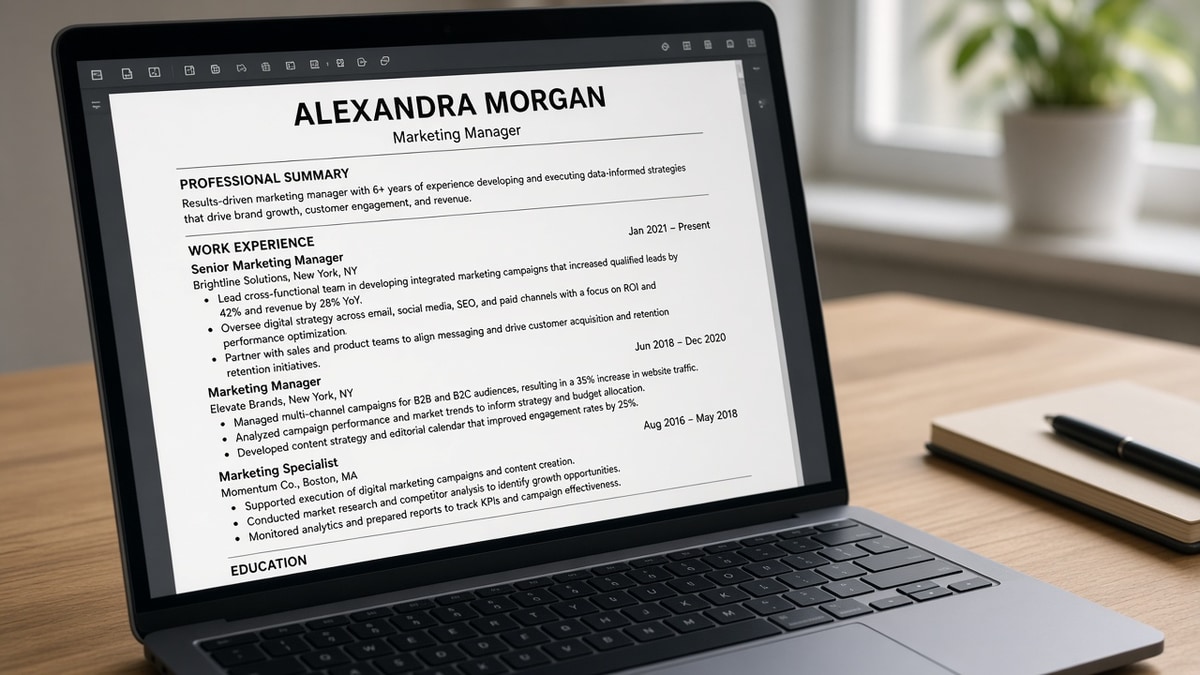
What a Well-Structured Experience Block Looks Like

Here's an example of an experience block formatted for optimal ATS parsing:

Acme Corporation
Senior Marketing Manager
January 2020 – December 2022 | New York, NY

• Developed and executed integrated marketing campaigns that increased lead generation by 45% and contributed $2.3M in new revenue
• Managed cross-functional team of 8 marketing professionals, overseeing budget allocation and campaign performance metrics
• Implemented marketing automation platform that reduced email campaign turnaround time by 60% and improved open rates to 32%
• Collaborated with sales team to create targeted content strategy, resulting in 28% improvement in sales conversion rates

This format is clean, consistent, and ATS-friendly. The company name and job title are clearly separated, dates follow a standard format, and each bullet includes keywords and quantifiable results.

Final Thoughts: Optimizing Your Experience Blocks for ATS Success

Understanding how ATS identifies experience blocks is a game-changer for your job search. When you structure your work history with clear hierarchies, consistent formatting, and relevant keywords, you dramatically improve your chances of passing the initial screening phase. Remember: ATS systems are tools designed to help recruiters manage volume, not to reject qualified candidates. By making your resume easy for ATS to parse, you're also making it easier for human recruiters to quickly assess your fit.

The key takeaways are simple: use standard formatting, maintain consistency, include quantifiable results, and structure your experience blocks in a way that mirrors how ATS systems expect to find information. Test your resume with ATS parsers, review for common mistakes, and continuously refine based on feedback. When your experience blocks are ATS-optimized, you remove a major barrier between you and the interview.

Ready to take your resume further? Explore how to write resume experience ATS understands and discover additional strategies for improving your overall application strength.

Frequently asked questions

Not exactly. ATS systems scan for keywords and phrases relevant to the job description, but they don't read every word with equal weight. The system prioritizes keywords near the beginning of bullets and those that match job description terminology. However, context matters—ATS evaluates whether keywords appear in a relevant context. For example, "managed" in "managed a team of 10" is more valuable than "managed" in "managed expectations." Write naturally and focus on impact rather than keyword density.

Include all jobs from the past 10-15 years, even if they seem unrelated. ATS systems evaluate your complete career timeline to assess experience level and career progression. However, you can briefly describe less relevant roles and focus more detail on positions that align with the target job. If you have significant gaps, you can use year-only dates (e.g., "2018 – 2019") rather than month-year to reduce emphasis. Omitting jobs entirely can raise red flags during background checks.

Yes, but strategically. If your company used vague internal titles (like "Team Member" or "Associate"), you can use a more descriptive, industry-standard equivalent in parentheses or as your primary title. For example, if you were titled "Associate" but performed marketing duties, list it as "Marketing Associate" or "Associate – Marketing." This helps ATS match your experience to relevant job descriptions. However, don't misrepresent your role—use titles that accurately reflect your responsibilities.

ATS systems identify employment gaps by analyzing the timeline between job end dates and start dates. While gaps don't automatically disqualify you, they are flagged for recruiter review. Career gaps are not always bad , especially if you can explain them (education, health, caregiving). If you have gaps, consider adding a brief explanatory line or addressing them in your cover letter. ATS won't penalize you for gaps, but recruiters may ask about them later.

Absolutely. ATS systems recognize self-employment, freelance work, and contract positions as valid experience. List your business name or "Self-Employed" as the company, your role as the job title, and include dates and accomplishments just as you would for traditional employment. This is especially important if freelance work is relevant to the position you're applying for. Make sure to use clear, professional language and quantifiable results.

Yes. ATS systems weight information at the beginning of each section more heavily. Place your most relevant and impactful accomplishments in the first 1-2 bullets of each role. This ensures that even if ATS truncates the experience block or prioritizes early content, your strongest qualifications are captured. Additionally, lead with accomplishments that directly match the job description keywords.

Tags

ATS experience blocksresume parsingATS resumejob application screeningexperience section ATSresume optimizationhow ATS reads resumes