10 min read
Put one neutral work-authorization line under your contact info. Do not lead with H1B in the summary. That's the US-safe answer for H1B on resume wording, and it's the line that parses cleanly in Workday and Greenhouse without eating bullet space you need for proof.
You're not hiding status. You're separating what recruiters need at a glance from what immigration compliance needs on the form. Check your resume for free after you add the line. Parser errors in Experience still kill files before anyone reads your visa note.
Below: where to place the line, exact phrases, before-and-after examples, portal knockout rules, and mistakes that waste interviews at sponsors who would've said yes.
Quick Wins
- Add one line under email: Authorized to work in the US; requires employer sponsorship.
- Match the same phrase on LinkedIn and the portal knockout field.
- Remove H1B from skills lists and summary paragraphs.
- Answer sponsorship questions on the form honestly even if the resume line is neutral.
Why H1B on resume belongs in one contact line, not the summary
US recruiters read visa status in two places: your contact block and the application form. The summary should sell fit for the role in the first eight words of bullet one, not immigration category. When H1B appears in a headline, parsers sometimes dump it into Skills or drop it entirely, and humans assume the candidate leads with constraints instead of outcomes.
The line that works: Authorized to work in the United States. Requires employer sponsorship for visa transfer or extension. That's accurate for most H1B holders changing employers. It does not name the visa class on the resume, which reduces keyword clutter, while the portal question captures H1B explicitly where HR systems expect it.
Exception: the job posting says we do not sponsor and you still want to apply because you are close to green card adjustment or have a portable approval. You might skip the resume line and answer only on the form. That's a narrow case. Default to transparency on both file and form when transfer is required.
Exception: you are on cap-gap or pending extension with the same employer. Wording shifts: Authorized to work in the US; H1B extension pending with current employer. One line, still under contact info. Do not write a paragraph about USCIS timelines on page one.
Recruiters at sponsor-friendly tech firms scan authorization in under two seconds. They are not reading for drama. They want to know if legal can start payroll on your target date. Pair the line with a bullet showing you shipped production code last quarter, not last decade.
Dual-intent and green card conversations belong in recruiter calls, not resume headers. If you have an approved I-140, the AC21 line helps HR plan retention. If you are early in PERM, saying green card pending adds noise without changing sponsor math.
International students sometimes copy European CV habits and list nationality beside the phone number. US corporate resumes skip nationality. Work authorization line replaces it. Nationality in a US application adds no value and can trigger unconscious bias before skills get read.
Read Workday resume format when your authorization line disappears after upload. Contact blocks in headers often fail to parse.
US-safe H1B resume wording you can paste tonight
Pick one phrase. Mirror it on LinkedIn. Mirror it on the Greenhouse or Workday sponsorship question. Change all three the same week your status changes.
Active H1B, open to transfer
Before: Professional Summary: H1B visa holder seeking sponsorship from innovative employer who values diversity and global talent with 5+ years...
After: Contact block line only: Authorized to work in the US; requires employer sponsorship for H1B transfer. Summary leads with stack and revenue impact instead.
The before version burns forty words before a single metric. The after version lets bullet one open with a shipped feature or cost saved. Recruiters remember the metric. They already saw sponsorship need in the contact block.
H1B with approved I-140, portability
Some candidates add: Green card petition approved; AC21 portability eligible. Keep it one line. HR knows what that means. Do not explain PERM on the resume.
STEM OPT moving toward H1B
Before: Skills: Python, AWS, H1B eligible, seeking sponsor, CPT, OPT, work authorization, visa...
After: Authorized to work under F-1 STEM OPT through July 2027; H1B cap-subject registration completed for FY2027. Skills list holds tools only.
Copy-paste contact block layout
[Your Name]
[City, ST] · [phone] · [email] · [LinkedIn URL]
Authorized to work in the United States; requires employer sponsorship for visa transfer
Portal knockout alignment
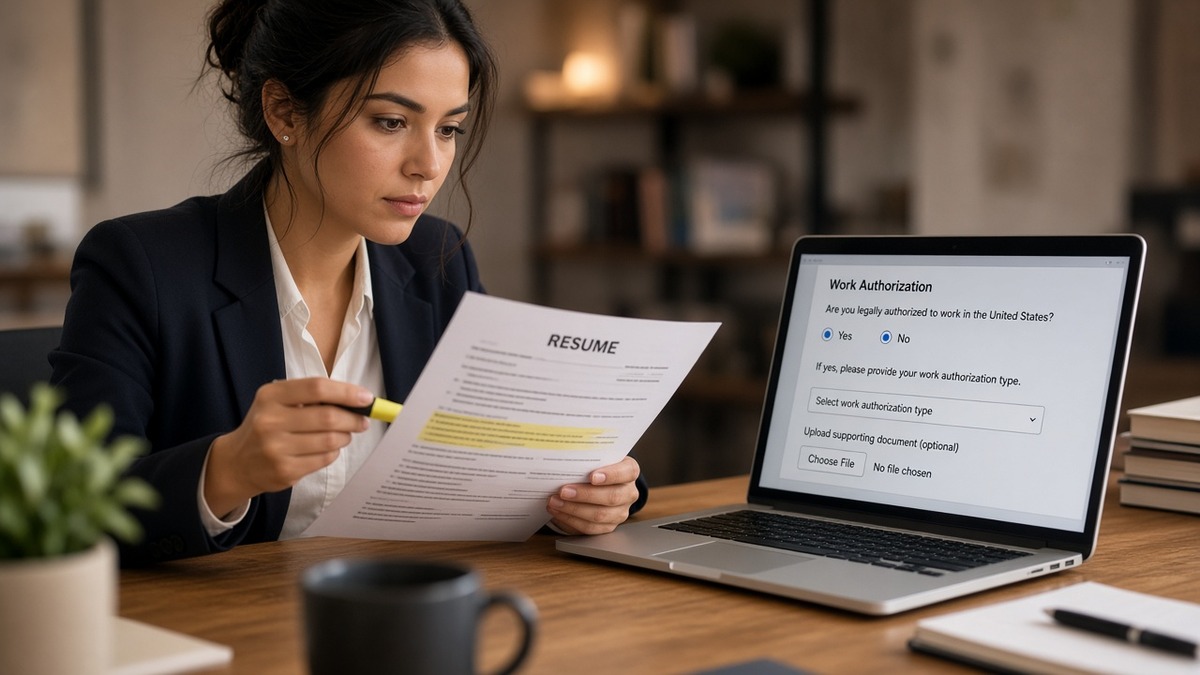
Workday and iCIMS forms ask: Will you now or in the future require sponsorship? Answer Yes when transfer is needed. Do not answer No because the resume line was vague. Background checks compare answers. A composite data engineer lost an offer when resume said authorized to work and the form said no sponsorship required.
If the form has a free-text work authorization field, paste the same sentence from your resume. If it asks visa type, write H1B there, not in your summary paragraph.
Cover letter optional fields tempt long explanations. Resist. Two sentences on role fit, zero paragraphs on immigration law. HR already has a compliance team. Your job is to show you can do the work in bullet one.
When a posting says must be authorized to work without sponsorship, treat it as a filter, not a negotiation opening. Spending forty minutes tailoring a file for a company that will not transfer wastes the same night you could spend on three sponsor-friendly reqs.
Cap-subject candidates sometimes ask whether to mention lottery registration on the resume. Only if you hold an approval notice and the dates matter for start timing. Otherwise keep lottery talk for the recruiter call after screen.
Spouse and dependent visa status almost never belongs on a US resume unless the role is immigration-adjacent compliance work. One line about your own authorization is sufficient. HR will collect family details on forms after offer if needed.
Read resume rejected by ATS when silence hits before anyone discusses sponsorship. Format usually fails first.
H1B resume wording that burns trust fast
Visa paragraph in the summary. Three sentences on USCIS policy eat space meant for proof. One contact line is enough.
H1B repeated in Skills. Parsers do not rank you higher. Recruiters read it as stuffing.
Authorized to work with no sponsorship hint. Saves a phone screen at non-sponsors, then wastes yours when HR discovers transfer need at offer stage.
Resume says one status, LinkedIn says another. Common after extension. Update both the same day.
Authorization line in a footer or text box. Workday often skips footers. Put the line in the body under your name.
Claiming no sponsorship needed when you need transfer. Compliance issue, not a wording trick. Answer forms honestly.
I've passed on strong technical files when the resume said no sponsorship required and the Workday form said yes three screens later. The mismatch reads as dishonesty, not optimization.
Confirm the line parses before you mass apply
Run the file through the free ATS checker with the posting pasted in. Authorization text in a header table sometimes vanishes on import. If your line does not appear in the parsed preview, move it directly under your name in the body.
Use the job match score tool on roles that explicitly mention visa transfer or international candidates. Match technical terms in Experience first. Sponsorship policy is binary; skills alignment still wins the screen.
If a cover letter field is optional, the cover letter generator can draft a short paragraph on role fit. Do not repeat H1B there unless the posting asks. One line on the resume plus an honest form answer beats a defensive letter.
Batch applying through aggregators still sends your PDF to each company's ATS. A single master authorization line travels with every upload. Update that master the day your EAD or approval notice arrives, then re-export every tailored version from the same source file.
When Lever or Greenhouse previews show your contact block scrambled, rebuild the header as plain stacked lines in Word or Google Docs. Tables and text boxes that center your name often drop the authorization line entirely on import.
Your H1B resume line tonight
H1B on resume comes down to one neutral sentence under your contact info, honest portal answers, and proof bullets that stand on their own. You are not tricking anyone. You are putting immigration facts where HR systems expect them and keeping the summary for work you have already done.
Open your file now. Delete H1B from Skills. Paste the authorized-to-work line. Match LinkedIn. Run the checker. Then apply to reqs that actually sponsor transfers.
Sponsorship conversations go better when your file already cleared technical screen. Spend seventy percent of tonight on bullet rewrites and thirty percent on authorization wording. A perfect visa paragraph cannot rescue a duty-list Experience section.
Save two PDF versions if you are testing the market quietly: one with the authorization line for sponsor-friendly postings, one identical minus the line for internal referrals where HR already knows your status. Never send the wrong version to a portal that logs uploads permanently.
When your extension or transfer approval lands, update the line before you tell your network you are open. Recruiters move fast on warm intros. Stale authorization text on a fresh referral wastes goodwill in one forwarded email.
Keep a screenshot of your parsed Workday profile after upload once a month. Authorization lines are the first thing to vanish when templates shift. Catching drift early beats discovering it after twenty silent applications. Fifteen minutes of maintenance saves weeks of guessing why strong applications went quiet without a single callback ever.
Read more
Frequently asked questions
Usually no in the headline or summary. Put one neutral line under your contact block: Authorized to work in the US; requires employer sponsorship for future visa transfer. Save the exact visa class for the Workday or Greenhouse knockout question, where HR expects it. Repeating H1B six times in a skills list looks like keyword stuffing and does not change sponsor policy.
Directly under phone and email, same font size as contact lines. One line only. Do not bury it in a footer or skills column. Recruiters scanning on mobile see the top third first. If the portal asks separately, match the resume line word for word so your file and form do not contradict each other.
Some employers filter on sponsorship need before a human reads anything. That filter runs on the application form more often than on resume text. Hiding sponsorship on the resume does not remove the knockout question. Honest alignment early saves wasted interviews at companies that will not transfer visas. Target employers who already sponsor or state they consider transfers.
Use the status you actually hold. Example: Authorized to work in the US under F-1 OPT through Month Year; STEM OPT extension eligible. Do not write H1B if you are not on H1B yet. Wrong labels create compliance headaches when HR verifies I-9 documents. Update the line the week your status changes.
Yes. Same one-line authorization phrase in the LinkedIn About section or headline area. Recruiters compare profiles to uploads. Mismatched visa language triggers manual review or a pass. Keep both documents on the same status after any extension or employer change.