11 min read
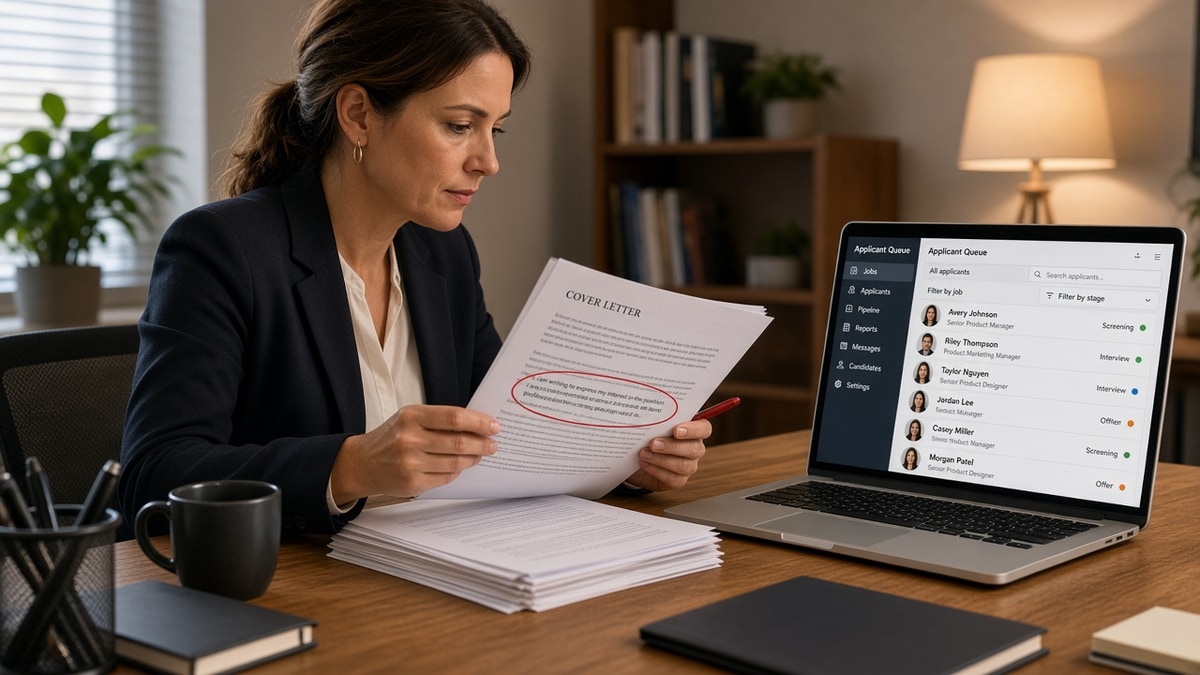
You're applying through Workday again, the cover letter box is required, and you've got a Word file you've sent forty times. It reads fine to you. To a recruiter who's opened two hundred letters this week, it reads like wallpaper.
That's not because cover letters are dead. It's because generic cover letters train recruiters to stop reading. They don't have time to hunt for why you picked this req.
Check your resume for free first if the resume still has layout issues. A sharp letter on top of a scrambled PDF won't save the screen. When the resume parses clean, the letter's job is to prove you read the posting.
Job searching is draining when every portal wants another upload. This page shows what recruiters delete on sight, a short procedure to rewrite one letter tonight, and copy-paste openings you can edit without sounding like a mail merge.
If your resume bullets still need work, fix those with impact-first resume bullets US hiring teams prefer before you paste the same weak lines into a letter.
Quick Wins
- Name company and exact job title in sentence one.
- Carry one metric from resume bullet one into paragraph two.
- Delete any sentence that fits a different industry unchanged.
- Skip optional letters when you'd reuse yesterday's file.
Why generic cover letters lose US recruiter screens
Recruiters use cover letters as a speed filter, not as a second resume. They want proof you opened their req, not proof you own a thesaurus.
The skip happens in the first eight seconds. If paragraph one could swap Company A for Company B with a find-and-replace, they'll assume the resume is generic too.
Greenhouse and Lever often show the letter beside the resume preview. Workday sometimes buries it on tab two. Either way, humans scroll until something specific appears. Company name, product line, location, or a tool named twice in the job description counts as specific.
Generic cover letters also repeat the resume line for line. That doubles reading time without adding evidence. The letter should explain one decision you made on a project, not restate every employer since 2019.
Optional letters tempt people to upload a template just in case. On high-volume reqs, that optional upload becomes a negative signal. The recruiter now knows you didn't customize either document.
Cover letters rarely fix a level mismatch. They won't turn a coordinator resume into a director screen. They can nudge a maybe candidate when the resume is close and the letter shows domain fluency.
For portal quirks, see do cover letters matter for ATS so you know when the text field is stored for humans only.
Internal transfers and employee referrals still get skimmed. The letter should name the hiring manager if known, cite the internal job ID, and explain why the move is lateral or promotional with one proof line from your current team.
Career changers feel pressure to over-explain in the letter what the resume already shows. Keep the pivot story to two sentences and let Experience dates carry the heavy lift. The letter adds one project that proves the new field, not your entire life narrative.
Government and cleared roles sometimes require longer narrative letters. Corporate tech and finance seats rarely do. Match length to sector norms by reading two posted PDFs from that employer if they publish offer letters or campus guides.
Five steps to replace a generic cover letter
Work on one posting tonight. You'll reuse the skeleton tomorrow with different nouns. Each step ends with a line you can paste into a blank doc.
Step 1: Open the posting and highlight three concrete nouns
Copy the official title string, one product or team name, and two tools from the requirements block. Paste them at the top of your draft doc. Those words must appear in paragraph one or two.
Before: Dear Hiring Manager, I am excited to apply for your open position.
After: I am applying for the Senior Analyst, Revenue Operations role at Northwind Software, focused on Salesforce reporting and quote-to-cash hygiene.
Step 2: Draft paragraph one with role, company, and hook
Two sentences max. Sentence one states the application. Sentence two ties your last role to a problem the posting mentions, without flattery about culture or mission unless you cite something factual from their site.
If the req mentions a recent launch, earnings call theme, or public roadmap item, reference it once with a neutral clause. Do not pretend insider knowledge. Public facts show you read beyond the title.
Edge case: staffing-firm posts that hide the end client. Name the recruiting firm and the client industry if disclosed. If the client is confidential, reference the industry noun from the ad instead of pretending you know the logo.
Edge case: re-applicants who interviewed before. Acknowledge prior process in one clause if policy allows, then pivot to new proof since last cycle. Do not guilt the reader about silence.
Step 3: Tie one resume bullet to one requirement in paragraph two
Pick bullet one under your current job on the resume. Rewrite it as prose with the same platform and number. That alignment is what stops the letter from feeling generic.
I've screened stacks of these in Greenhouse, and the letter that survives is boring on purpose: correct title, correct company, one metric copied from a real bullet.
Before: I have extensive experience driving results across cross-functional teams.
After: At my current employer I rebuilt pipeline stages in Salesforce for a 12-person sales team, cutting stale-opportunity volume 19% in two quarters.
Copy-paste block: four-paragraph cover letter skeleton
Copy-paste letter skeleton (edit every bracket)
[Your Name]
[City, ST] | [Phone] | [Email]

[Month Day, Year]

[Hiring Manager Name or Recruiting Team]
[Company Name]

Dear [Name or Team]:

I am applying for the [Exact Job Title] role at [Company]. Your posting emphasizes [tool or problem from req], which matches the [function] work I have done for [current or last employer].

In my current role I [verb] [system] for [team or scope], [metric illustration from resume bullet one]. That project required [second req noun], the same stack your team lists for this seat.

I would welcome a short conversation about how that work maps to [team or product from posting]. Thank you for reviewing my application.

Sincerely,
[Your Name]
Step 4: Close with logistics and match the resume file name
Paragraph three invites a screen. Paragraph four is sign-off plus contact lines mirrored from the resume header. Use plain text if the portal strips bold or bullets.
Edge case: referrals. Add one sentence naming the referrer and how you know them. Keep it factual. Recruiters verify referral paths quickly.
Step 5: Run a generic-cover-letter self-test before upload
Read aloud. Circle any sentence that still works if you delete the company name. Rewrite or cut those lines. Search for excited, passionate, and dynamic. Replace with a noun from the req.
Save the file as Firstname_Lastname_CoverLetter_Company.docx when uploads allow attachments. Match the resume naming pattern so downloads sort together in the recruiter folder.
When a posting says cover letter optional and you're out of time, leave it blank. A rushed generic upload is worse than none on optional fields.
This won't fix applying to roles you're not qualified for. It stops a qualified file from dying because the letter announced you didn't read the req.
Pair for marketing applicants: swap I am a creative storyteller for In my last role I owned lifecycle email in Braze for a freemium cohort, lifting week-one activation on a feature launch series tracked in Mixpanel.
Pair for operations applicants: swap detail-oriented professional for I rebuilt intake SLAs in Zendesk for a 24-agent support pod, holding first-response time under four hours through Q2 volume spikes.
When the posting lists salary expectations in the letter, answer in one sentence with a range you researched, not a manifesto on worth. Recruiters treat salary essays in cover letters as noise unless the req demands them.
Keep pronouns consistent with how you present on the resume. Switching they/them in one file and she/her in the letter creates admin friction for teams updating ATS profiles before a screen.
If you attach both PDF and paste into a text box, paste the plain-text version without smart quotes. Curly characters sometimes render as junk in Greenhouse preview panes.
Template habits that waste a good resume
Mail-merge openings. To Whom It May Concern and Dear Hiring Manager without a company name signal bulk apply. Use a team name from the posting or Recruiting Team at Company.
Resume reprints. Pasting three bullets from the resume into the letter adds length, not insight. Keep one bullet, add one sentence on context parsers cannot see.
Before: As you can see from my resume, I have ten years of experience.
After: Last year I led a Workday implementation slice for payroll cutover, the same HCM scope your req lists under project examples.
Skill laundry lists. Letters that enumerate soft skills without tools read generic instantly. Name Salesforce, SQL, Python, or whatever the req repeats, tied to one outcome.
AI tone without facts. Polished paragraphs that never name a metric feel generated. Swap one adjective for a number you can defend on a phone screen.
Wrong company left in the file. Triple-check find-and-replace after batch edits. Nothing kills trust faster than a letter thanking Company B while applying to Company A.
Attachments recruiters cannot open. Some portals strip PDF cover letters or virus-scan them slowly. When a plain-text box exists, paste the letter there even if you also attach a file.
Over-formatted headers. Logos, tables, and text boxes in Word letters import poorly into Taleo and iCIMS free-text fields. Keep structure to line breaks and one blank line between paragraphs.
Remote roles still deserve a line on time zone or travel comfort when the posting asks. One sentence beats a paragraph on loving remote work without naming how you collaborate across Slack and Zoom.
Draft faster without going generic again
Tailoring still beats speed when the field is required. Tools should force nouns from the posting, not recycle yesterday's adjectives.
Paste the job description into score your job match and note which tools surface on both resume and letter. Add terms only where Experience dates support them.
Use generate a cover letter with the same company and title strings you put in paragraph one, then edit every bracket until the proof line matches resume bullet one.
Do this now: Pick one live req, highlight three nouns, rewrite paragraph one and two, read aloud, upload with the resume you already parsed.
Send one letter worth ten seconds
Generic cover letters train US recruiters to skip the attachment. A tailored letter is short, named, and tied to one real bullet. That's enough when the resume already matches the band.
- Lead with exact title and company from the req.
- Prove one win with the same metric as the resume.
- Cut any sentence that survives a company name swap test.
- Skip optional uploads when you'd mail-merge anyway.
Run a free ATS check on the resume file before you pair it with a new letter. Clean imports keep recruiters on your content instead of your formatting.
And when you're done tonight, save the skeleton doc with posting URLs in the footer. Tomorrow's apply session gets faster without going generic again.
Job searching while you're still employed means drafting letters after hours. Block thirty minutes, one req, one letter. Batch-writing ten generic letters feels productive and rarely produces interviews.
Celebrate small wins: one letter where paragraph one names the right product is enough to hit submit. You can refine paragraph two on the next apply once the skeleton is warm.
Store a version history in the doc comments if you collaborate with a friend for edits. Track which posting each paragraph supported so you do not accidentally recycle stale product names.
Read more
Frequently asked questions
Many read them when the field is required or when the resume is borderline. They skim the first paragraph for company name, role title, and one proof line. If those three items are missing, they move on without opening the resume attachment again.
Aim for four short paragraphs or about 250 to 320 words. Opening names the role and company. Middle ties one resume bullet to a posting requirement. Close asks for a conversation and repeats contact details already on the resume. Longer letters rarely earn more time.
Send a tailored letter only if you can name the team, product, or tool from the posting. Skip optional uploads when you'd paste the same letter you used yesterday. A generic optional letter can hurt more than silence because it signals low effort on a high-volume req.
Some portals store cover letter text in a separate field. Parsers read plain text order; they do not reward adjectives. Mirror the same tools you listed in Experience bullets so human reviewers see consistency. A keyword-stuffed letter without dated proof on the resume still fails the human pass.