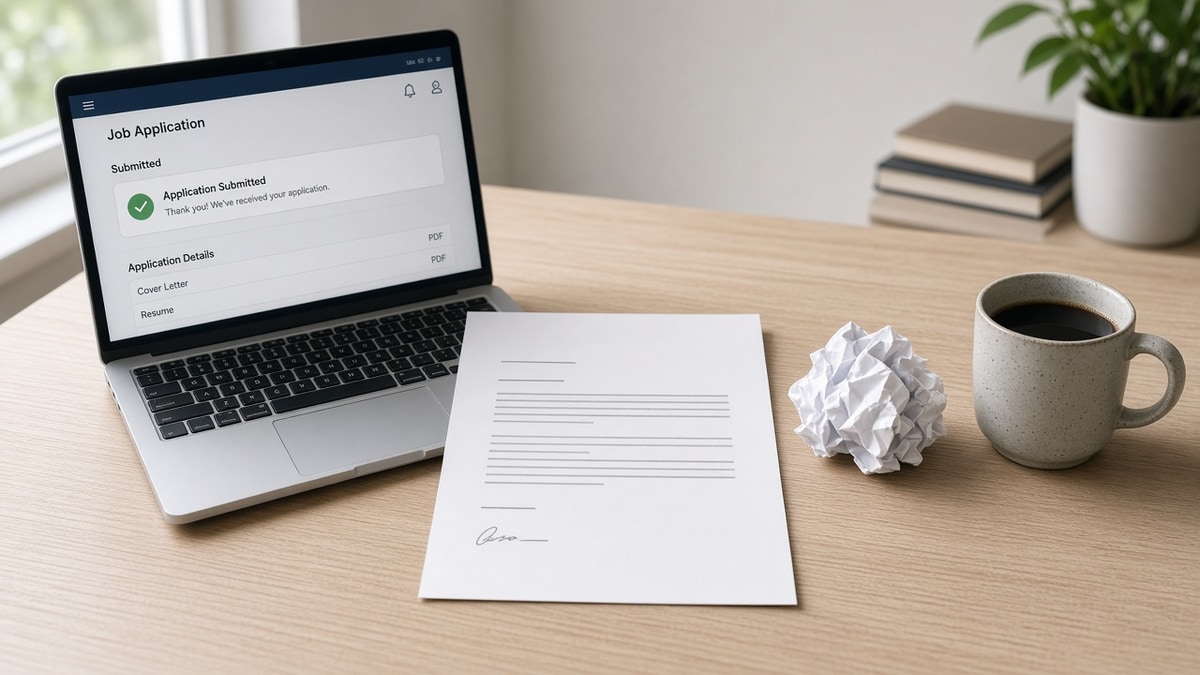
Your resume might be flawless, but a poorly written cover letter can torpedo your job application before a hiring manager even glances at your qualifications. Common cover letter mistakes that get you rejected often happen because candidates don't understand what employers actually want—or they treat the cover letter as an afterthought.
The truth is simple: hiring managers spend an average of 6 seconds reviewing a cover letter. In that brief window, they're looking for three things: relevance to the job, genuine interest in the company, and clear communication. Miss any of these, and your application joins the rejection pile.
This guide reveals the exact mistakes that cost you interviews and shows you how to fix them. By the end, you'll understand:
- Why generic cover letters fail every time
- How formatting errors trigger automatic rejection
- What tone and language actually impress hiring managers
- How to customize your cover letter without wasting hours
- Why your achievements aren't landing the way you think they are
Why Cover Letters Still Matter in Modern Hiring
Many job seekers assume cover letters are dead. They're not. While some companies skip them entirely, most mid-to-large organizations still require them, and hiring managers at competitive companies use them as a differentiator when multiple candidates have similar qualifications.
A strong cover letter answers the question hiring managers actually care about: "Why does this person want *this* job at *this* company?" Your resume shows what you've done. Your cover letter shows why you're genuinely interested and how you'll add value. When both align, you move to the interview stage. When your cover letter reveals careless mistakes or generic enthusiasm, you're rejected—even if your resume is strong.
The Most Damaging Cover Letter Mistakes
1. Using a Generic Template for Every Application
This is the #1 reason cover letters fail. Hiring managers can spot a template in seconds. Generic opening lines like "I am writing to express my interest in the position" or "I believe I am an excellent fit for your team" tell them you didn't spend time on their specific role.
Instead, reference something specific: the company's recent product launch, a specific challenge mentioned in the job description, or a mission statement that genuinely aligns with your values. This takes 5 minutes per application but dramatically increases your chances.
2. Repeating Your Resume Word-for-Word
Your cover letter should complement your resume, not duplicate it. Hiring managers already have your resume. They read your cover letter to understand your motivation, personality, and how you think about problems—not to re-read your job titles and bullet points.
Use the cover letter to tell a story: Why did you leave your last role? How does this job fit your career trajectory? What excites you about this company specifically? These narratives don't belong on a resume, but they belong in a cover letter.
3. Focusing on What You Want Instead of What You'll Give
Weak cover letters say things like "I'm looking for a role where I can grow" or "This position will help me develop new skills." Hiring managers don't care about your growth. They care about solving their problems.
Reframe every statement around value delivery. Instead of "I want to work with a talented team," write "My experience scaling operations at [Company] will help you streamline your onboarding process, which I noticed is a current bottleneck based on your job description." This shift—from what you want to what you'll contribute—is the difference between rejection and an interview.
4. Poor Formatting and Presentation
A cover letter with inconsistent spacing, misaligned text, or unprofessional fonts signals carelessness. Use a clean, simple format: standard font (Arial, Calibri, or Times New Roman), 10-12 point size, single spacing, and 1-inch margins. Keep it to one page maximum.
If you're submitting as a PDF, test it first to ensure it renders correctly. Formatting errors are an easy rejection reason because they suggest you don't pay attention to detail—a red flag for any employer.
Common Mistakes to Avoid Immediately
- Spelling and grammar errors: Even one typo can trigger rejection. Use Grammarly or Hemingway Editor, then read aloud twice. Hiring managers assume writing quality reflects work quality.
- Addressing the wrong person or company: "Dear Hiring Manager" is acceptable, but "Dear [Previous Company Name]" is a death sentence. Copy-paste errors happen—build in a final check step.
- Making excuses or explaining gaps: A cover letter isn't the place to explain why you were fired or had a career gap. Save that conversation for the interview if asked directly.
- Using overly formal or stiff language: "It is with great enthusiasm that I submit my candidacy" sounds robotic. Write like a professional human, not a corporate robot. Use active voice and conversational tone.
- Lying or exaggerating: Don't claim skills you don't have or invent reasons for wanting the job. Hiring managers verify claims, and dishonesty disqualifies you immediately.
- Writing more than one page: Hiring managers skim. Longer letters get skimmed harder. Aim for 3-4 short paragraphs (250-400 words total). If you can't make your case in one page, you don't have a strong case.
Best Practices for Cover Letters That Work
Follow these proven strategies to increase your interview rate:
- Open with a specific hook: Reference something about the company, role, or hiring manager that shows genuine research. "I saw your recent announcement about expanding into European markets—my experience scaling B2B SaaS in that region directly applies" beats generic enthusiasm every time.
- Match the job description language: If the job posting emphasizes "cross-functional collaboration," use that phrase in your cover letter. This helps both human readers and ATS systems recognize alignment. ATS systems do screen cover letters, so keyword matching matters.
- Show, don't tell: Instead of "I'm a problem-solver," demonstrate it: "When our customer churn spiked 15% last quarter, I led a cross-team audit that identified the root cause and implemented a solution that reduced churn by 8% within 60 days."
- Keep paragraphs short: Use 2-3 sentences per paragraph maximum. White space makes your letter more readable and respects the hiring manager's time.
- End with a clear call-to-action: Don't end with "I look forward to hearing from you." Instead: "I'd welcome the chance to discuss how my experience scaling product teams can help you hit your Q3 growth targets. I'm available for a call Tuesday or Wednesday afternoon." This shows initiative and removes friction.
- Customize the closing: Research the hiring manager's name on LinkedIn. "Dear [Name]" is far more effective than "Dear Hiring Manager." If you can't find a name, "Dear [Company Name] Hiring Team" works.
- Use numbers and specifics: Vague claims get rejected. Specific results get interviews. "Improved efficiency" becomes "Reduced processing time by 40%, saving the company $200K annually."
- Proofread ruthlessly: Read your letter three times: once for content, once for grammar, once aloud. Have someone else read it. Typos are automatic rejections.
How to Write a Cover Letter That Gets Interviews
Follow this simple 5-step process:
- Research the company and role (10 minutes): Read the job description carefully. Visit the company website. Check their LinkedIn and recent news. Identify 1-2 specific things that genuinely excite you or align with your experience.
- Identify the hiring manager (5 minutes): Search LinkedIn for the company and role. Find the hiring manager or team lead. Use their name in your greeting. If you can't find a name, use "Hiring Team."
- Write your opening (5 minutes): Start with a specific reference to the role or company. Example: "Your recent expansion into AI-powered customer service caught my attention—I've spent the last three years building exactly this type of product at [Previous Company]."
- Write your middle section (10 minutes): Use 1-2 paragraphs to explain why you're interested and what value you bring. Focus on the employer's needs, not your desires. Use specific examples from your experience that directly relate to the job description.
- Write your closing (3 minutes): Summarize your interest, include a specific call-to-action, and thank them for their consideration. Keep it brief and professional.
- Edit ruthlessly (10 minutes): Read for clarity. Cut unnecessary words. Ensure every sentence adds value. Check grammar and formatting. Read aloud to catch awkward phrasing.
Total time: 45 minutes per application. This investment pays off in interview invitations.
What Hiring Managers Actually Look For
Understanding the hiring manager's perspective changes how you write. They're reading your cover letter to answer three questions:
1. Did you actually read the job description? Generic cover letters that could apply to any role signal "I'm mass-applying." Specific references to the role, company, or challenges mentioned in the posting prove you did your homework.
2. Do you understand what we need? Can you articulate the problems the role exists to solve? Do you show awareness of the company's industry, competitive landscape, or strategic priorities? This demonstrates research and critical thinking.
3. Can you actually do this job? Your cover letter should include 1-2 concrete examples from your experience that directly relate to the job description. Not vague claims—specific, measurable results that prove capability.
If your cover letter answers all three questions in under 400 words, you're in the top 10% of applicants. Most cover letters answer zero of these questions.
Final Thoughts: Your Cover Letter Is Your Chance to Stand Out
Common cover letter mistakes that get you rejected are entirely preventable. Most candidates fail because they treat cover letters as a checkbox—something to rush through before hitting submit. Hiring managers notice this immediately.
The candidates who get interviews are the ones who spend 45 minutes customizing their cover letter, researching the company, and crafting a compelling narrative about why they're genuinely interested in this specific role. That effort shows, and it separates you from the 90% of applicants who use templates.
Start with your next application: research the company for 10 minutes, customize your opening paragraph, include one specific example that matches the job description, and proofread twice. You'll see the difference in your response rate immediately. Your cover letter isn't a formality—it's your chance to convince a hiring manager that you're worth an interview.
Frequently asked questions
Check the job posting. If it says "cover letter optional," you still have a choice—but submitting one increases your chances if it's strong. If the posting doesn't mention a cover letter, don't force one. However, cover letters still matter for ATS screening when required. If you submit one, make sure it's customized and error-free. A weak cover letter hurts more than no cover letter at all.
One page maximum, 250-400 words. Hiring managers spend 6 seconds on average reviewing cover letters. Longer letters get skimmed, and key points get missed. Every sentence must add value. If you're over 400 words, cut ruthlessly. Trim adjectives, remove redundancy, and keep only the most compelling examples. Respect the reader's time—it shows professionalism.
Only if the job posting explicitly requests it. Salary expectations can kill applications if you're too high or too low. If the posting asks for salary expectations, research the market rate for the role in that location, then provide a range (not a single number). If it doesn't ask, don't volunteer. Let them make an offer first.
You can use the same structure and examples, but customize the opening, company-specific details, and closing for each application. A template is fine—a generic letter is not. Spend at least 10 minutes customizing each letter. Change the company name, reference something specific about their business, and adjust your examples to match the job description. This takes minimal time and dramatically improves your response rate.
Professional but personable. Avoid overly formal language ("I am writing to express my candidacy") and overly casual language ("Hey, I'd be a great fit"). Write like you're speaking to a colleague—confident, clear, and genuine. Show personality without being unprofessional. If the company culture is casual (tech startup, creative agency), you can be slightly more conversational. If it's conservative (finance, law), stick to formal-professional tone. Match the company's voice when possible.
Only if it's positive and relevant. "I'm seeking new challenges" or "Your company's mission aligns with my career goals" works. Avoid negativity: "My current company is disorganized" or "I need better pay" will be rejected. If you were laid off or fired, don't explain in the cover letter—address it only if asked in an interview. Keep the focus on why you want this role, not why you're leaving the last one.
Done for you
Turn this advice into an interview-ready resume
Professional writers rebuild your resume for ATS + recruiters. From $29 — human-written, not AI. Cover letter on Professional and Executive.