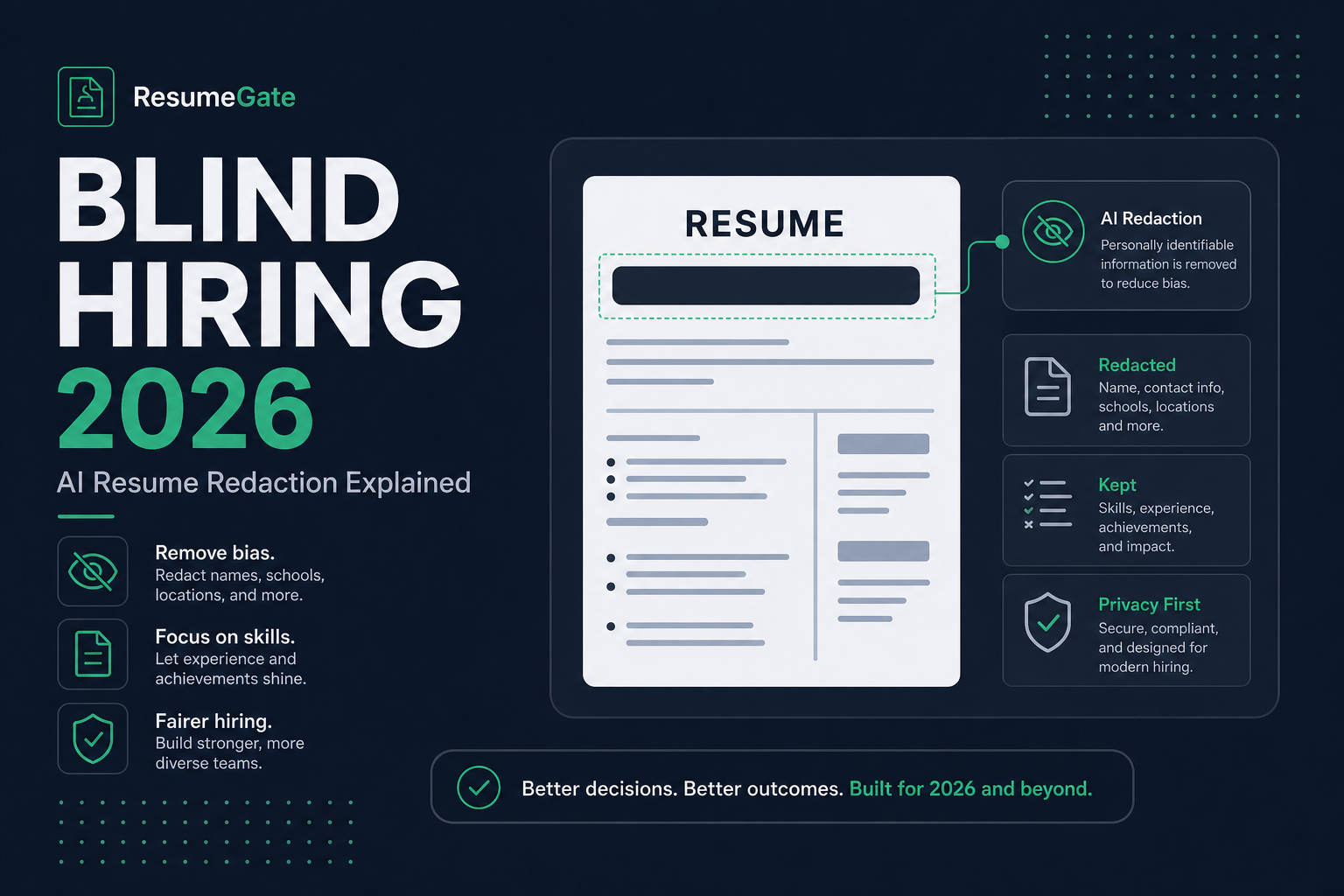
Blind hiring uses AI resume redaction to remove names, photos, addresses, and often school names before a human screener reviews your application—so early decisions lean on skills, titles, dates, and bullet content. Workday, Greenhouse, and iCIMS integrations can run redaction in milliseconds after upload, usually only for portal applicants in the first screening round.
For job seekers, the shift is practical: identity shortcuts (prestige school, familiar name) carry less weight at the moment of first review. Bullets must state scope and impact plainly. This guide maps what gets stripped, why employers adopted redaction at scale in 2026, how to write for it, and where the practice still falls short.
| Resume field | Typical redaction | What screeners still see |
|---|---|---|
| Name, photo, address | Removed or replaced with ID | Neutral candidate label only |
| School name / grad year | Often stripped or tier-labeled | Degree field sometimes kept |
| Job titles and dates | Kept | Full timeline visible |
| Employer names | Usually kept; deep-blind pilots vary | Company names in most configs |
| Skills and certifications | Kept | Searchable plain text |
| Achievement bullets | Kept | Primary evaluation input |
Key Takeaway
Assume name and school may be invisible round one—make bullets carry the full argument.
How AI resume redaction works in ATS pipelines
After you submit on a company careers site, the ATS parses your file into fields. Redaction software—often a third-party module on top of Workday or Greenhouse—flags PII: name blocks, photos, street addresses, sometimes institution names. It outputs a sanitized view for first-pass reviewers while retaining the original for compliance and later stages.
- Upload and parse resume text into structured fields.
- Detect and mask configured identity fields.
- Route redacted view to early screeners or scoring models.
- Restore full profile when candidate advances to interview stage.
Redaction is not full anonymity. Writing style, ethnic affinity organizations listed in volunteer sections, or geographic clues in project descriptions can still leak signals. Treat redaction as partial, not perfect.
Common Mistake: creative resume layouts that confuse redaction models into stripping achievement bullets along with the header.
Why employers adopted blind screening at scale
Manual blind hiring pilots were slow and expensive. AI redaction made first-round anonymization operationally cheap. Research such as Bertrand and Mullainathan's field experiment on resume callbacks showed identical resumes with different names received sharply different response rates—evidence that motivated later corporate experiments.
The EU Pay Transparency Directive and related reporting expectations pushed large employers to document where bias might enter hiring. Blind first-round screening offers a measurable intervention at the top of the funnel. US state pay-transparency laws create parallel pressure to audit screening—not a blind-hiring mandate, but a reason to show process rigor.
High-volume reqs on Workday and Taleo benefit most: hundreds of applications per role make human consistency hard; redaction standardizes what screeners see first.
Pro Tip: blind screening helps most when bullets are specific—vague duty lists fail whether or not your name is visible.
How to write a resume that wins under redaction
Standard resumes lean on two signal layers: identity shortcuts and content proof. Redaction weakens the first layer at screening. Your bullets must do more work.
- State team size, budget, geography, and system scale in the bullet text.
- Put metrics in the line—percentages, dollars, volume, time saved.
- Replace internal project codenames with plain descriptions.
- Lead each role with your strongest outcome, not a duty list.
Mid-article: test parse quality and bullet clarity on HireFlow's free ATS checker before you apply through a portal that may redact identity fields.
Quick Check: hide your header and education, read aloud—if you would not shortlist this profile, neither will a blind screener.
Before/after bullets for blind-first screening
| Before (relies on brand context) | After (stands without identity shortcuts) |
|---|---|
| Supported enterprise clients on strategic initiatives at a major SaaS vendor. | Customer success manager for 28 mid-market accounts ($4.2M ARR); raised gross retention from 91% to 96% in 12 months via quarterly success plans. |
| Led Project Helios launch with cross-functional partners. | Product manager—shipped self-serve billing migration for 140K users; cut support tickets 22% and met SOC 2 control deadlines for payment data. |
| Managed team and improved operations. | Operations lead for 11-person warehouse team; improved order accuracy from 97.1% to 99.4% and reduced overtime 14% through WMS slotting redesign. |
For formatting that survives both ATS parse and redaction layers, see Workday resume format guidance and optional DEI and pronoun lines on resumes .
Key Takeaway: if a bullet only makes sense to someone who recognizes your employer, rewrite it for a stranger.
Where blind hiring breaks down
Blind screening improves one funnel moment; it does not fix sourcing, interview bias, or offer-stage disparity. Referrals often skip redaction. Interviewers see full profiles later. Sourcing channels that over-represent certain networks still skew the applicant pool before redaction runs.
The U.S. Equal Employment Opportunity Commission guidance still expects employers to run fair processes end to end—not only at resume review. Candidates should not assume redaction guarantees equitable outcomes in later rounds.
AI redaction errors matter: a mis-parsed table can remove skills with a name block. Single-column, plain-text resumes reduce dual risk on Greenhouse and Lever uploads.
Common Mistake: assuming blind hiring removes the need for networking and interview prep—it shifts first-round weight to bullets, not the whole process.
Referrals vs portal applications under blind hiring
Blind redaction most often applies to candidates who enter through the public ATS portal. Employee referrals frequently skip the anonymized view—a hiring manager may receive your full resume with name and context attached from the first touch. That asymmetry means two applicants to the same req can face different screening rules.
Practical implication: write portal resumes as blind-ready even when pursuing referrals. Referral strength helps at the margin; it does not replace weak bullets if the referral routes through standard HR intake on Workday anyway.
Some enterprises run blind screening only above application volume thresholds—a req with 40 applicants may redact aggressively; a niche role with eight may not. You cannot know the threshold; blind-ready writing still helps.
Quick Check: ask your referral contact whether HR uses name-blind first review—not to game the system, but to know which file version to emphasize.
DEI sections, pronouns, and what redaction does not remove
Optional DEI lines—pronouns, affinity group leadership, community org names—may remain visible when they appear inside experience bullets rather than header fields. Redaction targets configured PII slots; free-text volunteer lines are inconsistent across vendors. Some tools flag gendered honorifics; others leave prose untouched. When in doubt, lead with scope of the ERG or program you led rather than the org name alone—outcomes read as skills, not labels.
Include DEI-relevant leadership when it demonstrates skill (ERG program management, mentorship scale). Avoid listing org names solely as identity signals without scope. See pronouns and DEI optional section practices for placement that keeps bullets scannable on Greenhouse and Lever.
Common Mistake: assuming redaction hides everything except skills—volunteer prose and writing style still carry signal.
Blind hiring and senior candidates: prestige vs proof
Senior resumes often relied on employer brand to imply scope: a well-known bank suggests deal size; a flagship tech company suggests system scale. Deep-blind pilots that mask employer names remove that inference temporarily. Senior candidates with outcome-dense bullets adapt well; those with title-and-brand-only lines lose ground.
Rewrite pattern for directors and above: every bullet answers size (people, budget, revenue, geography), mechanism (what you changed), and result (metric or risk removed). Executive summaries should not assume the reader recognizes your last two logos.
| Senior signal | Weak when redacted | Strong when redacted |
|---|---|---|
| Scope | "VP at Fortune 100 firm" | P&L owner for $180M product line; 9 direct reports |
| Impact | "Drove transformation" | Cut procurement cycle 34 days to 19; $12M annualized savings |
| Technical depth | "Enterprise architecture leader" | Migrated 240 services to Kubernetes; 99.95% uptime SLA maintained |
Pro Tip: blind-ready senior resumes interview better too—panels ask about your numbers, not your former employer's logo.
ATS parsing still happens before redaction
Redaction sits on top of extraction. If Workday drops your title into the wrong field or iCIMS scrambles dates, screeners see a distorted history—even anonymized. Fix parse issues first; blind hiring cannot repair mangled text.
Compare PDF vs DOCX for ATS when choosing upload format for enterprise portals.
Pro Tip: run the same file through a parse check and a manual redact test—two minutes, two different failure modes caught.
Blind hiring outside the US: what changes
Public-sector anonymized CV pilots in parts of Europe often redact more fields than typical US corporate configs—including graduation year and sometimes employer names in first pass. US applicants applying to EU entities should still write bullets that stand without school prestige signals.
Work authorization lines may remain visible because they gate eligibility, not bias—a US candidate needing sponsorship still faces filters unrelated to blind intent. Format resumes in parse-safe English plain text even when applying abroad; SuccessFactors and Taleo EU instances parse the same failure modes as US tenants.
Key Takeaway: blind-ready bullets help globally; redaction depth varies by country and sector, not by your preference.
Blind-hiring resume checklist
- Cover name and education; bullets still read compelling.
- Each recent role has at least one quantified outcome in the first bullet.
- No internal codenames without plain-language description.
- Skills and certs in plain text, not icons only.
- Single-column layout tested with copy-paste and ATS scan.
- Employer names kept where accurate; bullets do not assume reader knows them.
- Referral and portal versions aligned on facts—no conflicting metrics.
- Impact sheet prepared with same numbers for post-blind interviews.
Quick Check: if your blind test reader asks "how big was the team?" your resume is not ready.
Schedule a quarterly refresh of your master resume even during passive search—skills and metrics go stale; blind-ready bullets decay when projects end and numbers are no longer defensible in conversation. Update the same week you update LinkedIn so portal and profile stories stay aligned.
Metrics that matter when blind screening reads your bullets
Without name or school context, screeners gravitate to numbers that imply scale: revenue influenced, headcount led, error rates reduced, cycle time shortened, NPS or CSAT movement, compliance findings closed, uptime maintained. Vague superlatives ("significantly improved," "highly successful launch") carry almost no weight in redacted review.
If you cannot disclose exact figures due to NDA, use defensible ranges or percentages tied to public outcomes: "contributed to 18% YoY growth in assigned region" beats "drove growth." Avoid fabricating precision—you may be asked to walk through math in round two when identity is visible.
Pair metrics with mechanism: what you changed (process, tooling, team structure) and what constraint you operated under (regulated environment, 24/7 operations, global stakeholders). Mechanism plus metric reads as credible experience, not keyword padding.
Pro Tip: one metric per bullet is enough when scope is clear—three metrics in one line often parse poorly on mobile recruiter views.
Industry patterns: who uses blind screening most
Large tech, financial services, and consulting firms led adoption because they run high-volume campus and experienced-hire reqs where unconscious bias audits drew scrutiny. Healthcare systems and universities use redaction on staff roles tied to public funding or equity reporting. Small employers under 200 employees often skip redaction entirely—cost and req volume do not justify configuration.
Government contractors may redact for compliance demos while still running clearance filters that reveal identity-linked eligibility. Defense applicants should still write blind-ready bullets for unclassified resume lines while following separate security resume rules for classified work—see cleared defense resume guidance .
Staffing agencies rarely redact before client submission; the agency recruiter knows your name throughout. Direct employer portals remain the primary place blind hiring changes what you should optimize. When both paths are open—referral and portal—use the same fact base on both files to avoid contradictory metrics if HR merges records in Workday.
Key Takeaway: blind-ready writing helps everywhere; redaction itself is concentrated in large employer portal volume.
After blind screening: interview prep still shows identity
Candidates who pass redacted review should prepare for full-context interviews—panels will know your name, LinkedIn, and background. Blind hiring shifts first-round emphasis to bullets; it does not make interviews anonymous. Use the same metrics on your resume as talking points; inconsistencies between redacted file and interview stories erode trust fast.
Video interviews reintroduce visual and vocal cues bias research discusses. Treat blind hiring as a resume-writing discipline that strengthens early funnel odds, then invest in structured interview prep for later rounds where identity is fully visible. Keep a one-page impact sheet with the same numbers as your resume so you do not paraphrase metrics differently under pressure.
Common Mistake: inflating metrics on blind-ready bullets you cannot defend once the hiring manager knows your former employer.
Where redaction sits in Workday, Greenhouse, and iCIMS stacks
Blind hiring is rarely a standalone app—it is a module or integration triggered after standard ATS parse. Workday Recruiting customers may enable redaction on high-volume reqs; Greenhouse partners offer anonymized review panes for early screeners; iCIMS implementations vary by staffing vs corporate HR configuration.
Candidates do not control vendor choice. You control document quality: bullets that survive redaction also survive semantic matching and recruiter skim patterns described in recruiter AI copilots in 2026 .
Redaction errors correlate with parse errors—fix layout first on hireflow.net, then optimize bullet proof. A mangled date range hurts blind and non-blind screeners equally. Test uploads on both desktop and mobile career sites—some candidates upload phone-scanned PDFs that OCR poorly before redaction ever runs.
Key Takeaway: blind hiring is a layer on top of normal ATS behavior, not a replacement for it.
Before and after (ATS-safe wording)
Key Takeaway: keep the same fact, add the tool name and a number.
| Before | After |
|---|---|
| Responsible for reports and team support. | Built weekly Workday headcount reports that cut manager follow-ups by 30%. |
| Used office software and helped customers. | Processed 40+ Greenhouse tickets/week in Zendesk with 96% CSAT. |
| Improved processes across the department. | Mapped the Taleo requisition workflow and cut time-to-post from 5 days to 2. |
Blind hiring and AI redaction push more weight onto what you did and how clearly you say it—titles, dates, skills, and quantified bullets. Identity fields may disappear in round one; proof should not.
Build a parse-safe, impact-heavy resume with HireFlow's free resume builder , validate extraction on hireflow.net , and read what recruiter AI copilots see in 2026 for the next layer after blind screening. Writing as if your name were invisible produces stronger documents in every hiring process—not only when redaction runs.
Frequently asked questions
Usually not. Some employers mention name-blind or anonymized screening on careers pages; many do not. Write every resume as if name and school fields may be stripped in the first round—strong bullets cost nothing extra and help in non-blind processes too.
Typically no. Referrals often bypass portal redaction—a hiring manager may see the full resume from day one. Referrals can still carry identity context that portal applicants do not get at the same stage.
Yes. Most configurations keep employer names through early screening; deep-blind pilots are rarer. Write bullets that stand without brand recognition, then let company names reinforce when visible.
Mixed. Candidates who leaned on employer prestige without quantified scope may lose an implied shortcut. Candidates with strong outcome-focused bullets from less-famous employers can gain ground. Specific writing matters more than seniority alone.
As of mid-2026, no broad private-sector mandate exists in the US. Several European public-sector programs encourage or pilot anonymized first-round screening. US pay-transparency and equity reporting pressure nudges large employers toward documented fair-process tools, including redaction.
Yes. Unusual layouts—tables, graphics, multi-column headers—can confuse parsers and redaction models, stripping skills or leaving identifying text. Standard single-column formatting reduces both ATS and redaction errors.
Identity is usually restored before interviews. Blind hiring targets early resume review, not the full funnel. Interview performance, references, and offers still run with full candidate information.
Cover your name and education lines, then read only experience bullets. If scope and impact are unclear, blind screeners will struggle too. Run a parse check on hireflow.net to ensure machines read the same text humans would.