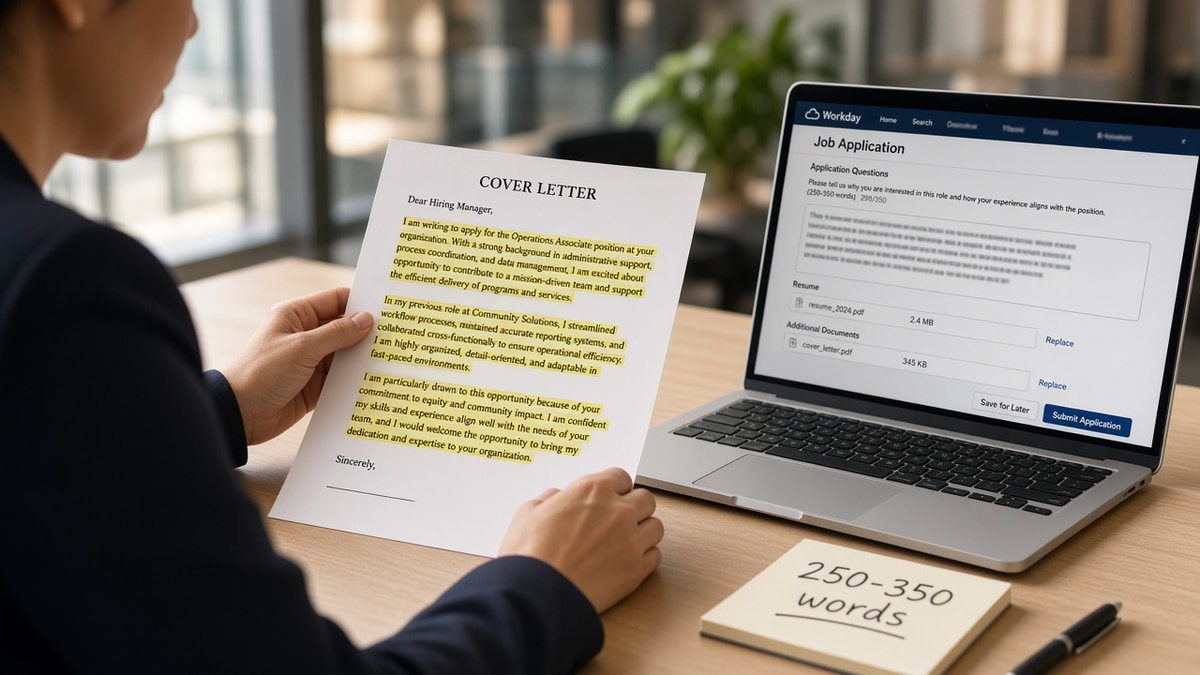
11 min read
A US cover letter in 2026 should run 250 to 350 words in plain text, usually three short paragraphs that fit one screen in Workday or Greenhouse paste fields. Line one names the role and req ID when the posting lists one. Paragraph two carries one dated win from resume bullet one. Stop near 400 words unless the posting explicitly asks for more.
You're not writing a memoir. You're giving a hiring manager one reason to keep your file open after the resume skim. Job searching is slow and the optional cover letter field feels like busywork when you've already tailored bullet one. Length isn't politeness. It's whether paragraph two still shows up before the scroll bar on a recruiter's laptop.
Before you trim or stretch anything, check your resume for free with the posting pasted in. You'll see whether your proof sits in dated Experience lines or only in a Skills footer the letter can't rescue. When the field is open, generate a cover letter draft, then cut it to three paragraphs by hand. Templates give you structure. You still own the metric in paragraph two.
I've screened stacks of these in Workday and Greenhouse, and the file that wins is boring and specific. Below you'll see when to stretch past 350 words, when 220 words is enough, and how US portals treat paste-box letters differently from uploaded DOCX files.
Quick Wins
- Count words in Word or Google Docs with greeting and signature included.
- Keep three paragraphs: role line, one proof paragraph, neutral close.
- Mirror the same metric from resume bullet one in paragraph two.
- Paste into Notepad first to confirm no stray formatting before Workday upload.
Why screen time drops after paragraph three
Corporate recruiters in the US do not read cover letters like essays. They open the file after the resume skim, scroll once, and look for a match between the posting's must-have and something dated on your resume. Length matters because paste boxes and human attention share the same ceiling: one screen without hunting for the point.
Paragraph two is the whole game. Line one proves you applied to the right req. Paragraph two proves you already did work the hiring manager cares about. Paragraph three is availability and thanks. Everything else is padding that pushes paragraph two below the fold on a 13-inch laptop.
Workday, Greenhouse, Lever, Taleo, and iCIMS handle cover letters differently. Some expose a plain-text paste field with no rich formatting. Others accept DOCX upload. A few treat the letter as optional metadata the parser never scores. Length advice that ignores the field type sends you toward a four-paragraph letter that truncates mid-sentence or arrives as a wall of unbroken text.
Parsers that do read cover letters scan for tokens from the posting, same as the resume. A 600-word letter with the right keywords still loses if the human never reaches paragraph two. A 280-word letter with one posting phrase in line one and one stack term tied to a metric in paragraph two often outperforms the longer file because the proof is visible immediately.
US hiring norms in 2026 still expect a letter on many professional reqs even when the checkbox says optional. Optional does not mean ignored on smaller candidate pools. It means the field won't block submit. When fifty people apply and twelve look qualified on paper, the letter becomes a tiebreaker. A one-screen letter respects that reality without asking the reader to carve out lunch-block reading time.
If your resume bullets still read like duty lists, fix those before you argue about word count. Read impact-first resume bullets US hiring teams prefer when paragraph two has nothing concrete to pull from. The letter cannot invent scope the resume never showed.
Best US Cover Letter Length in 2026: trim or expand to the right count
Use the posting and the portal field type to pick a target band, then edit paragraph two until the word count lands without losing the metric. These five moves take about fifteen minutes per application once you keep a master file.
Step 1: Pick your target band before you write
Default to 250 to 350 words for paste-box fields on corporate reqs. Move toward 200 to 250 when the posting is entry-level and you have one internship anchor. Stretch toward 350 to 400 only for academic, nonprofit, or leadership roles that ask for motivation and stakeholder context. Never target a full page unless the employer requests a writing sample.
Before: You start writing without a number and end at 520 words because every prior job felt relevant.
After: You set 300 words as the ceiling in Word, write three paragraphs, and stop when the counter hits the band.
Step 2: Build paragraph two from resume bullet one
Open your tailored resume and copy the scope line from bullet one under your current role. That bullet already passed your own quality check. The letter explains why that same scope maps to this posting, not every job since 2018. One metric, one stack term from the ad, one outcome. If bullet one says you cut report turnaround from five days to two using Looker and SQL, paragraph two keeps those numbers and tools.
Edge case: career change. You may not have a bullet that mirrors the new field. Pull the closest transferable project and name the parallel explicitly: same stakeholder management, smaller budget, shorter timeline. Keep it one paragraph. Do not spend 200 words apologizing for the pivot.
Edge case: returning after a gap. One honest line about recent upskilling or contract work belongs in paragraph two if it matches the posting. Do not use the letter to narrate the full gap year. The resume carries dates. The letter carries proof you can do the work now.
Step 3: Cut fluff without cutting the metric
When you're over 380 words, delete adjectives and duplicate greetings first. Then remove any sentence that repeats a skill already listed on the resume without adding scope. Keep proper nouns from the posting. Drop generic lines about passion, culture fit, and fast-paced environments. Those phrases eat word budget without moving paragraph two up the screen.
Before: I am a highly motivated professional with excellent communication skills who thrives in collaborative environments and would be honored to join your innovative team.
After: I am applying for Operations Analyst at Ridgeline Logistics (Req OL-4421), where your posting emphasizes SQL reporting and cross-team SLA tracking.
Step 4: Expand thin letters without adding a fourth paragraph
Under 220 words usually means paragraph two is vague. Add scope: team size, system names, time window, user count. Do not add a second project. Deepen the one win until the paragraph carries 80 to 120 words on its own. If you still cannot reach 250 words honestly, the role may not match your background yet.
Before: At my last job I improved processes and worked with stakeholders.
After: At Harbor Health, I rebuilt weekly census reporting in SQL and Looker for six clinic directors, cutting manual Excel handoffs from five days to two and standardizing definitions finance used in board slides.
Step 5: Paste-check and match the filename pair
Copy the letter into Notepad or a blank TextEdit window. If weird symbols appear, strip formatting before the portal sees it. Export DOCX only when upload is allowed and the posting does not specify paste-only. Name the file Firstname-Lastname-Cover-Letter.docx to mirror the resume. Run a final word count with greeting and signature included.
For a faster loop when you're applying to multiple similar reqs, see the ten-minute resume tailoring method for US job posts . Swap line one and paragraph two per posting while keeping the same 250 to 350 word skeleton.
Copy-paste block: US cover letter length skeleton
{`TARGET BANDS (pick one before drafting):
• Paste box, corporate req: 250–350 words
• Entry-level / internship anchor: 220–280 words
• Leadership / narrative ask: 350–400 words max
• Hard character cap (Lever/Greenhouse): 2 sentences, role + metric

THREE-PARAGRAPH SHAPE (plain text):
Dear Hiring Manager,

I am applying for [Role Title] at [Company] (Req [number if listed]). [One sentence linking your current scope to a must-have from the posting.]

At [Current Employer], [verb] [outcome with metric from resume bullet one] using [stack from posting]; [secondary scope line if room remains under word cap]. This maps to your requirement for [repeat must-have in posting language].

I would welcome a conversation about [team or product from posting]. Thank you for your consideration.

Sincerely,
[Your Name]

TRIM ORDER WHEN OVER 380 WORDS:
1. Delete adjectives and "passion/culture" sentences
2. Remove duplicate skills already on the resume
3. Shorten paragraph three before touching paragraph two's metric`}
Before/after by role: operations analyst
Before (485 words): Opening thanks the company for the opportunity. Middle paragraphs list every tool since 2019. Closing repeats excitement. Paragraph two starts on screen four.
After (298 words): Line one names Operations Analyst and req ID. Paragraph two cites SQL dashboard work with the same two-day turnaround metric from resume bullet one. Close is two sentences. Hiring manager sees the proof without scrolling.
Before/after by role: registered nurse (clinical)
Before (190 words): I am a dedicated nurse who loves helping patients and would be a great fit for your team.
After (265 words): Line one names Med-Surg RN and unit type from the posting. Paragraph two cites precepting four orientees on a 32-bed unit and the same patient-ratio language from bullet one. Clinical letters still follow the three-paragraph rule. You are not writing a care philosophy essay.
Before/after by role: customer support lead
Before (410 words): Letter restates Zendesk, Salesforce, and CSAT from the Skills section with no ticket volume or escalation scope.
After (312 words): Paragraph two names tier-two queue ownership, weekly QA coaching for eight agents, and CSAT 96% on the same quarter cited in resume bullet one. Tools appear once, tied to scope.
Where US portal length rules break
These patterns show up on qualified applications where the resume could carry a screen and the letter wastes the one-screen budget.
Pasting a designed PDF into a plain-text box. Columns collapse. Logos vanish. Your metric lands after the signature block as a word salad. Write in Notepad first, then paste. Length cannot fix formatting loss.
Treating the letter as a second resume. Four paragraphs of job history push paragraph two below the fold. The resume already lists employers and dates. The letter should carry one bridge sentence per must-have, not a chronological recap.
Metrics that disagree with the resume. Letter says 40% improvement, resume says 27%. Screeners notice in phone screens. Copy figures verbatim from bullet one.
One-sentence letters on optional fields. "Please see my resume" wastes a tiebreaker when twelve files look similar on paper. Two sentences with role and metric beat an empty field when you have thirty seconds to edit.
Ignoring character caps. Some Greenhouse and Lever instances hard-stop at 500 or 1,000 characters. A full 350-word letter will not fit. Draft a two-sentence version: role, req ID if it fits, one metric. Save the long master file for DOCX upload reqs.
Using the same 400-word letter on entry-level and director reqs. A director posting may tolerate 380 words when stakeholder scope needs context. An internship posting wants 240 words and one campus project. Fork the file per band, not per company name only.
See resume upload mistakes that instantly disqualify you when the portal pair fails before a human reads either file. Filename and format mistakes compound length problems.
Draft and verify before upload
Tools confirm whether your resume and letter agree on the same proof before Workday or Greenhouse stores the pair. Paste the posting and your resume into HireFlow's free ATS resume checker and read which section surfaced the must-have tokens. If keywords only appear under Skills, fix bullet one before you trim the letter.
When you need a starting draft at the right length, generate a cover letter with the job description loaded, then rewrite line one and paragraph two by hand. Recruiters spot untouched template openers. Keep the three-paragraph skeleton. Replace every bracket with your real scope and metric.
Do this now: Set a 300-word ceiling in Word, draft three paragraphs from bullet one, paste into Notepad to strip formatting, run one ATS check on the resume, then upload both files with matching names.
Submit a one-screen letter
The best US cover letter length in 2026 is the count that keeps paragraph two visible without scrolling: usually 250 to 350 words in plain text, three paragraphs, one metric from resume bullet one. Length is not politeness. It is whether a hiring manager sees your proof before they move to the next file.
Open the posting. Highlight the top must-have. Pull the matching metric from bullet one. Set a word ceiling in Word, draft the three paragraphs, paste into Notepad, and run a free ATS check on the resume before you upload the pair.
- Pick a target band: 250 to 350 words for most paste-box reqs.
- Build paragraph two from bullet one with the same numbers.
- Cut adjectives before you cut the metric when you're over 380 words.
- Fork a shorter file when the portal enforces a character cap.
- Skip the letter only when the posting or field truly does not allow one.
This won't fix applying to roles where your scope does not match the posting. It does stop qualified candidates from losing attention because a 500-word letter buried the one win a recruiter needed in paragraph two.
Read more
Frequently asked questions
Not when the portal uses a paste box and your three paragraphs name the role, carry one dated win from resume bullet one, and close with availability. Under 200 words often skips the proof hiring managers need. Under 150 words reads like you pasted a sentence because the field was required. Aim for 250 to 350 words for most corporate reqs. Stretch toward 400 only when the posting asks for a writing sample or leadership narrative.
Workday and Greenhouse paste fields do not truncate politely. Dense letters with headers, tables, or bullet icons lose structure on upload. Hiring managers on tight queues often stop after paragraph two when the letter runs past one screen. If you need more space for scope, move detail to resume bullets. The letter should mirror one win, not duplicate your entire Experience section.
Entry-level letters can sit at 220 to 280 words when you have one internship or campus project to anchor paragraph two. You still need three paragraphs: role and company in line one, one concrete outcome in paragraph two, neutral close in paragraph three. Do not shrink to a single paragraph because you have less tenure. Recruiters read short letters when the proof is specific, not when the letter is empty.
Yes. Word count tools in Word, Google Docs, and most portals include Dear Hiring Manager and Sincerely in the total. If you are at 380 words and the posting did not ask for a long narrative, cut adjectives from paragraph two before you drop the greeting. Req ID lines and company names count too.
Skip it when the posting says no cover letters, when the portal offers no field, or when the only option is a 200-character box and you have nothing beyond what bullet one already proves. Optional fields on high-volume reqs are different: a tight 250-word letter can still help a hiring manager connect your file to their must-have. Never upload a designed PDF into a plain-text box hoping length will compensate for formatting loss.