11 min read
You didn't miss the keyword. Workday ate your layout. The importer read your two-column template out of order, dropped dates that lived in table cells, or skipped contact lines tucked in a header band. The PDF thumbnail looked perfect. The candidate profile behind it didn't match what you wrote. That's ATS resume optimization for Workday in the US: boring structure first, tailoring second.
I've screened Workday imports in corporate hiring stacks, and the file that clears the candidate profile is boring: single column, selectable text, dates inline with titles. Before you rewrite bullet one, check your resume for free against the posting and confirm you can copy employer names and dates out of the PDF. If the paste test fails on your laptop, Workday's importer will fail too. This page maps each Workday screen symptom to a cause and a fix you can run tonight.
You're not learning generic ATS theory. You're diagnosing why a Workday upload looked fine on your screen and died in the imported profile. Job searching on corporate career sites is draining. These fixes are about changing the file and the upload habit, not pep talks about persistence. And they don't require a new template subscription.
Quick Wins
- Paste PDF text into Notepad before every Workday upload. Scrambled paste means a bad file.
- Rename to LastName_FirstName_Resume.pdf with no spaces or special characters.
- Export single-column PDF from Word, under two megabytes, with selectable text.
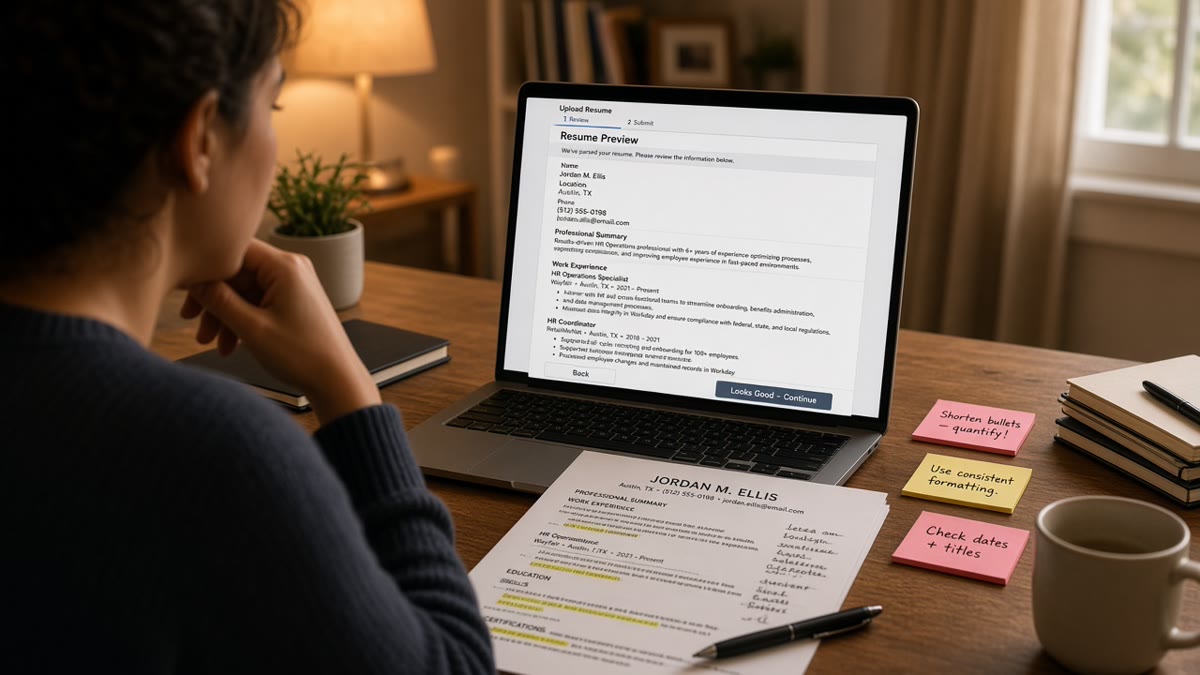
- Open the Workday parsed preview and confirm employer lines landed in the right order.
What Workday ATS resume formatting failures look like on screen
Workday powers career portals for a large share of US employers: retail, healthcare, manufacturing, and corporate HR teams all run applications through the same family of upload widgets. The symptoms repeat even when the company logo changes.
The four screens that mean trouble: the upload button spins and never completes; a red validator rejects the file before preview; the preview opens but experience fields stay empty; or the preview fills with jumbled text where your most recent job landed under Education.
Confirmation email does not prove success. Many Workday flows attach your file and attempt a parse in parallel. Recruiters sort on parsed fields inside the ATS profile. A thumbnail that looks perfect while employer names are blank is still a failed upload for ranking purposes. You were not rejected on experience. You were not scored.
And if you've only applied on Greenhouse or Lever before, Workday career sites feel familiar until the parse preview step. Same anxiety, slightly different error copy. The diagnostic method is the same: match what you see on screen to what broke in the file.
Read resume parsing preview: see your resume like an ATS for file-layer failures that hit every ATS, not only Workday. This page stays on Workday-specific symptoms and the fixes that clear them on the next attempt.
Five Workday upload failures: how to tell which is yours and what to fix
Work through the causes in order. Each one has a tell on your laptop before you waste another hour on a broken portal session.
Cause 1: Image PDF or scan with no live text
Phone photos of paper, flatbed scans without OCR, and some Canva exports save text as pixels. Human eyes read it. Workday's importer does not. The upload may finish. The preview stays empty or shows one garbled line.
How to tell: Open the PDF and try to highlight a single word in the job title. If you cannot select individual words, or copy-paste into Notepad returns nothing useful, you have an image PDF.
Before: Scanner PDF of a two-page paper resume saved as resume_scan.pdf.
After: Single-column Word doc at 11-point Calibri, exported to PDF with every employer line selectable in Adobe or Preview.
Fix: Rebuild in Word or Google Docs. Do not re-scan the same paper. Export fresh PDF, run the Notepad paste test, then upload to Workday again. If you must start from a scan, run OCR first and confirm word-level selection before you apply.
Cause 2: Filename or extension the validator rejects
Workday career sites often fail before parse when the filename carries spaces, emoji, apostrophes, or double extensions like resume.pdf.pdf. Some Mac exports default to Resume.pages or untitled.docx sitting in a Downloads folder with a long path name.
How to tell: Error appears immediately on file select, before any preview. Message text mentions invalid file, unsupported type, or upload failed with no preview step at all.
Before: My Resume (FINAL v2)!!!.pdf uploaded from iPhone Files.
After: Smith_Jane_Analyst_Resume.pdf saved locally, under two megabytes, extension .pdf only once.
Fix: Rename with letters, numbers, underscores, or hyphens. Match the allowed types in the tooltip. Convert .pages to .docx or PDF on a desktop before upload. Never upload a screenshot .png in the resume slot.
Cause 3: File too large or browser session timeout
Oversized files stall mid-upload. So do career forms left open for an hour while you hunted references. The spinner runs forever, or the page refreshes and wipes your attachment. Embedded headshots, portfolio spreads, and press-quality PDF settings are the usual size culprits.
How to tell: Upload fails on mobile data but works on home Wi-Fi with a smaller file. Or failure happens only after you stepped away and returned to a timed-out tab. Check file properties: many corporate portals struggle above two megabytes even when the hard cap is higher.
Before: Four-page marketing resume with a three-megabyte headshot and full-bleed graphics, uploaded on Safari with twelve extensions active.
After: Two-page text-forward PDF under one megabyte, photo removed, uploaded in Chrome after a fresh page load.
Fix: Compress images to web resolution. Drop appendix pages from the upload copy. Link to portfolio in the header instead of embedding PDFs inside the resume. Refresh the Workday form, re-enter required fields, switch to Chrome or Firefox, disable ad blockers for that session, and retry with the smaller file.
Cause 4: Two-column layout, tables, or text boxes scrambling the parse
Workday imports read left to right, top to bottom. Sidebars, skill columns, and table-based templates reorder employers so your current role lands under Education or Skills. Recruiters see a profile that does not match the PDF you attached. Keyword match scores tank because job titles never linked to the right dates.
How to tell: Preview populates but field order is wrong. Your 2024 manager role appears above a 2018 internship. Skills duplicated across sections. Paste from PDF into Notepad shows columns interleaved instead of chronological blocks.
Recruiters often open Workday applicant profiles where the PDF thumbnail looked clean and the parsed experience block listed three employers in reverse order with dates stripped. That's a layout problem, not a content problem.
Before: Two-column Canva template with skills in a left rail and jobs in a right rail, exported to PDF.
After: Single column, employer bold on its own line, Month Year dates, standard round bullets, no tables or text boxes.
Fix: Rebuild in Word with one column. Move skills below Experience. Use simple headings: Experience, Education, Skills. Export PDF, paste into Notepad, confirm employer order reads chronologically, then re-upload. Read Workday resume format 2026 for the same single-column rules that also protect Workday parses.
Cause 5: Wrong file type for what the posting allows
Some Workday postings list DOCX only. Others accept PDF and Word. Sending .odt, .rtf with exotic encoding, or old .doc from pre-2007 Word trips validators that expect modern structure. Designers sometimes upload interactive PDFs with forms embedded. Parsers skip them.
How to tell: Tooltip lists allowed extensions and yours is not on it. Or PDF works on other portals but this Workday site shows unsupported file type on select.
Before: resume.odt from LibreOffice uploaded because it looked fine locally.
After: .docx saved from Word when the portal lists Word, or PDF with selectable text when both PDF and DOCX are accepted.
Fix: Read the upload label every time. Match it exactly. When both PDF and DOCX are allowed, default to PDF with a clean paste test. When Word only, export DOCX from the same single-column master file.
Before/after pair: warehouse supervisor (image scan failure)
Before: Photo of a paper resume saved as PDF from iPhone; Workday preview empty; candidate assumed the site was down for maintenance.
After: Word rebuild with OSHA 30, forklift certification, and shift lead scope in dated bullets; PDF under one megabyte; preview shows last three employers with correct dates.
Before/after pair: registered nurse (two-column scramble)
Before: Template with credentials in a left column; Workday preview listed BSN under Skills and buried current hospital under Volunteer.
After: Single column: RN license and BSN in header line; Experience opens with current med-surg unit, patient ratio, and Epic documentation in bullet one; preview matches PDF order.
Before/after pair: corporate analyst (filename validator)
Before: Chen_Resume (1).pdf.pdf rejected on select with no preview.
After: Chen_Michael_Analyst.pdf uploaded on desktop Chrome; parse preview populated on first try.
Copy-paste Workday upload checklist
"Export single-column PDF from Word · Paste all text into Notepad and confirm employer order · Rename LastName_FirstName_Resume.pdf · File under 2 MB · Open Workday parsed preview before Submit · If fields blank, rebuild text layer, not bullet content."
Run that list on every Workday application tonight. It catches image PDFs, scrambled columns, and bad filenames before you burn a reference contact on a half-submitted form.
Edge case: Workday asks you to paste a resume instead of uploading
Some flows offer a text box paste path when upload fails. Paste plain text from Word, not rich HTML from a web profile. Strip bold and bullets if the box chokes. Upload the PDF anyway when both options exist so recruiters still see your formatted file in the attachment tab.
Before: Pasting LinkedIn profile HTML into the text box; symbols and line breaks everywhere.
After: Copy from Word as plain text into the box, plus a clean PDF upload with the same employer order.
Edge case: you already submitted with a bad parse
Withdraw and reapply if the portal allows it. If not, email recruiting with one corrected PDF and the req title in the subject. One fixed file beats four versions recruiters cannot reconcile.
What still breaks Workday uploads after candidates "fix" the file
Trusting the green check without opening preview. Upload complete is not parse complete. Always scroll the imported experience block before Submit. Blank fields mean start over with a new export.
Re-saving a broken PDF in Preview. That does not add a text layer to an image file. Go back to the Word or Docs source and export again.
Uploading the same two-column template on every employer ATS. Workday, Greenhouse, and Taleo all scramble sidebars differently. One single-column master file travels better than three pretty templates that fail three different parsers.
Applying on mobile with a file still in iCloud. Downloads that never finished locally produce zero-byte uploads or corrupt attachments. Save to device storage first, confirm file size, then upload from desktop when possible.
Keyword stuffing in a file parsers cannot read. Tailoring bullets matters after the text layer works. Fifteen extra skills in a scrambled PDF still rank last because job titles never linked to dates.
Password-protected or edit-locked PDFs. Security flags block extraction. Export an unlocked copy for applications. Keep the locked archive at home, not on the submit button.
Verify the file before your next Workday submit
After you rebuild the export, run the same checks on your screen that Workday will run on its servers. Paste test first. Parsed preview second. Posting match third.
Run a free ATS check with the job description pasted in. Confirm must-have terms appear in Experience text the parser can copy, not only in a sidebar your Workday import dropped.
Then score your job match on the same PDF before you upload. Fixing layout without checking keyword placement in dated bullets wastes a clean parse on a weak match.
Fix the parse, then submit
Workday ATS resume formatting failures usually trace to one of five layout problems: image PDF, header contact loss, hidden tables, scrambled columns, or wrong file type. Match the symptom on screen to the cause, run the paste test, open the parsed preview, and only then hit Submit.
This won't fix applying to roles you're not qualified for. It does stop qualified candidates from sitting in silence because a two-column template buried their current employer under Education. Export single-column tonight. Rename the file. Confirm preview fields before you walk away from the form.
When the posting also asks for a letter, generate a cover letter that repeats the same employer line and metric from bullet one so human review matches what the parser imported.
And if you're applying across Workday, Greenhouse, and Taleo this week, keep one boring single-column master. Fork content per req. Do not fork layout per portal. Parsers disagree on plenty. They all read plain text in one column better than they read design awards.
Read more
Frequently asked questions
Dates trapped in table cells or text boxes often land in the wrong field or disappear entirely. Workday reads table rows left to right, so a date in the right column can attach to the wrong employer. Rebuild with dates inline after each job title on plain lines, export fresh PDF, confirm order in the parse preview, then submit.
Read the upload tooltip on that specific posting. Many US employers accept PDF and DOCX. PDF exported from Word with live text is the safest default when both are allowed. Choose DOCX when the portal lists Word only or when your PDF fails the paste test. Avoid .pages, .odt, image files, and old .doc unless the posting explicitly allows them.
Use letters, numbers, underscores, or hyphens only. LastName_FirstName_Resume.pdf beats My Resume (Final)!!!.pdf. Spaces and special characters trigger validator errors on some Workday career sites. Keep the name short and professional so recruiters recognize the attachment in their queue.
Check file size first. Stay under two megabytes when you can. Drop embedded photos and compress any remaining images. Switch browsers to current Chrome or Firefox, disable extensions, and clear cache. If the form sat open for a long time, refresh the page, re-enter required fields, and upload a smaller test file before you retry the full application.
Yes. Many Word and Canva templates use invisible-border tables to control spacing. Open the file in Word and toggle gridlines. If you see a grid around dates or skills, rebuild that section as plain stacked text before you upload to Workday again.