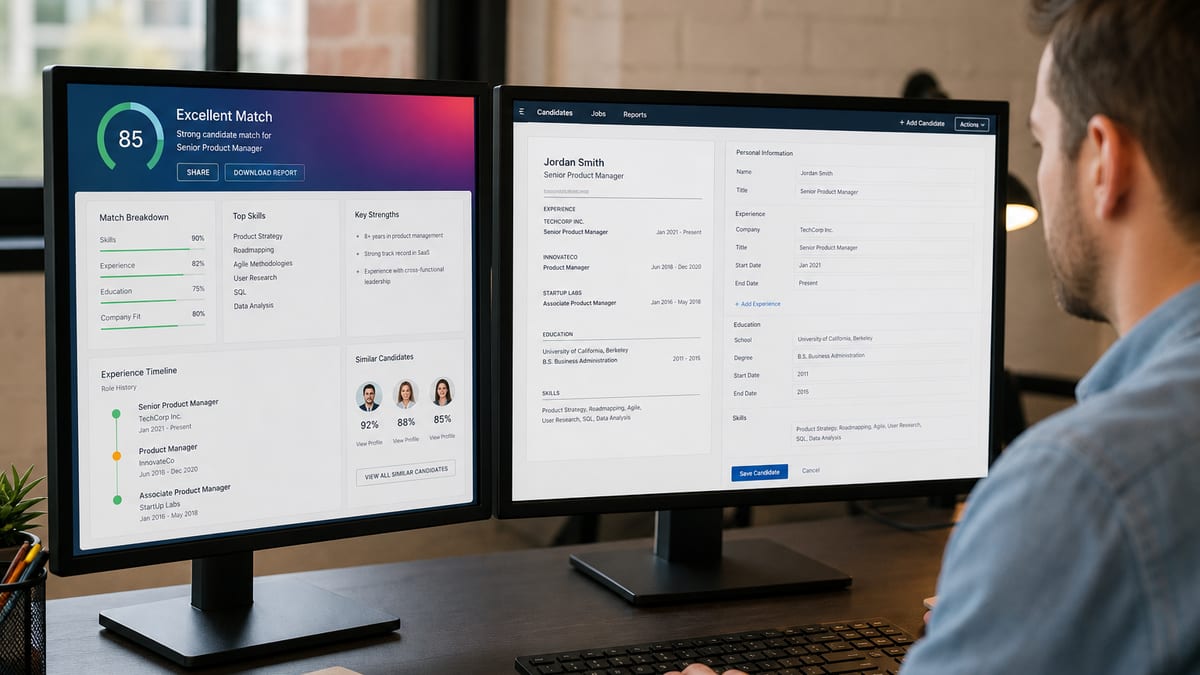
Accurate enough to catch parse and keyword landmines—not accurate as a clone of the employer’s ATS. When people ask are ATS checkers accurate, they usually hope for a crystal ball: “If I hit 90 here, Workday will love me.” That is not how hiring software or consumer tools work. Checkers are proxies. Employer systems are configured databases with human operators.
This guide separates what checkers measure well, where they diverge from Greenhouse or Workday, why two tools disagree, and a workflow that keeps you sane. Pair it with what’s a good ATS score , why scores run low , how ATS really works , and the free checker comparison .
Key Takeaways
- Consumer checkers are proxies for parse and keyword risk, not employer ATS clones
- What checkers reliably catch versus what they cannot see at all
- Why two different checkers can give the same resume different scores
- A practical, non-obsessive workflow for using a checker before you apply
- What recruiters actually think about consumer ATS scores
Proxy score vs employer ATS: different jobs
Key Takeaway
Consumer checkers simulate risk. Employer ATS stores applications and helps recruiters search. Accuracy means “useful warning,” not “identical ranking.”
| Layer | What it does | What “accurate” means |
|---|---|---|
| HireFlow / Jobscan-style checker | Scores formatting, sections, content, keyword overlap | Flags real risks before you apply |
| Employer ATS | Parses, stores, filters, stages; humans decide | Correct fields + searchable candidate |
| Recruiter judgment | Skim, compare, interview, advance | Fit, proof, communication—not a public score |
If you expect the checker to equal the employer’s private model, every tool will look “inaccurate.” If you expect it to catch columns, missing contact fields, and obvious skill gaps, good checkers look quite accurate—and worth the five minutes.
What ATS checkers get right (often)
Key Takeaway
Structure and extractability issues transfer well across portals. That is the highest ROI accuracy checkers offer.
- Multi-column and table layouts that scramble reading order
- Contact info stuck in headers, footers, or text boxes
- Missing or nonstandard section headings
- Inconsistent or unreadable dates
- Image-only PDFs with no text layer
- Clear hard-skill gaps versus a pasted job description
- Thin bullets that lack scope or proof
Real scenario: Two candidates apply to the same Greenhouse role. Alex ignores a checker warning about columns; the parsed title becomes garbage. Blair fixes the same warning, keeps a 78 score, and appears in the recruiter’s “Product Manager” search. The checker did not “get Blair hired.” It accurately predicted Alex’s parse risk.
What ATS checkers miss or overstate
Key Takeaway
They cannot see knockouts you answered wrong, referral strength, hiring freezes, or a company’s custom ranking weights. Soft-skill obsession in some tools is noisy.
Limits to respect:
- No access to the employer’s configured knockout rules
- No knowledge of internal vs external candidate priority
- No perfect model of every parser version in the wild
- Match % can reward stuffing if you let it
- High score ≠ interview; low score ≠ permanent ban
That is why “are ATS checkers accurate?” needs a scoped answer: accurate for file risk; incomplete for hiring outcomes. Pipeline reality is covered in will recruiters see my resume and do recruiters use ATS .
Why two checkers disagree on the same resume
Key Takeaway
Disagreement is normal. Compare trends and shared flags. Do not oscillate edits to please every vanity meter.
Tool A may weight job-description overlap heavily. Tool B may run dozens of formatting checks first. Paste different JD text and scores move again. None of that means both tools are “wrong.” It means you asked two different questions.
| Observation | Interpretation | Action |
|---|---|---|
| Both flag columns | High-confidence risk | Rebuild layout now |
| 12-point score gap, same flags | Weighting difference | Pick one primary tool |
| Only soft skills missing | Often low severity | Don’t overstuff adjectives |
| 100 only after pasting JD | Overfit / stuffing risk | Roll back; keep truth |
For shopping criteria, use the free ATS resume checkers comparison .
Want a practical proxy check—not a fake employer clone?
Try HireFlow’s free ATS resume checker — upload, read ranked flags, fix, re-scan. No account wall.
How to use checkers accurately (without superstition)
Key Takeaway
Fix structural flags first, aim for a sane band, stop before stuffing, then compete like a human—referrals, targeting, interviews.
- Upload to one primary checker (HireFlow’s free tool works well for iteration).
- Clear formatting and section issues before keyword chasing.
- Interpret bands with good ATS score guidance —often ~75–89 is enough.
- If still low, debug causes via why is my ATS score low .
- Optional second opinion before a dream apply.
- Apply, track outcomes, and remember knockouts/referrals from auto-reject myths .
Honest product note: what HireFlow optimizes for
Key Takeaway
HireFlow aims for clear, ranked fixes across formatting, sections, content, and keyword gaps—not a claim that we are secretly Workday. Use the report; keep your judgment.
Any vendor that says “our score is exactly what employers use” is selling certainty nobody has. Configurations differ. Recruiters override. Referrals skip queues. The accurate promise is narrower and more useful: reduce avoidable parse and match failures before you apply at volume.
Bottom line: are ATS checkers accurate? Yes as proxies for common failure modes. No as employer clones or interview guarantees. Use them like a preflight checklist—then go win the human parts of hiring.
Define accuracy before you grade the tools
Key Takeaway
“Accurate” must mean “correctly identifies fixable risk,” not “predicts interview offers.” Most disappointment with checkers comes from the wrong definition.
Science-friendly framing helps. Sensitivity: does the checker catch true problems (columns, missing contact, empty experience)? Specificity: does it avoid false alarms that send you on wild goose chases? Predictive validity for offers: almost none, because offers depend on humans, timing, and headcount.
On sensitivity for structural issues, serious checkers do well—especially when multiple tools agree. On predictive validity for “will Acme hire me,” no consumer tool is accurate, including premium ones. Anyone claiming otherwise is selling comfort.
Write your own success metric: “Checker reduced avoidable silence caused by broken files.” That metric is testable over a month of applications. “Checker guaranteed interviews” is not.
A personal test protocol for checker accuracy
Key Takeaway
Run controlled A/B files. If fixing flagged issues improves portal outcomes, the checker was accurate enough for your search—regardless of absolute score myths.
- Save Resume A (current) and Resume B (fixes only what the checker flagged).
- Apply both to similar role families over two weeks (ethical, truthful content).
- Track views, replies, and screens—not just feelings.
- Note which flags, when fixed, correlated with better responses.
- Keep fixes that help; ignore soft-skill nagging that never mattered.
You will not get a perfect lab environment. You will get directional evidence. Most candidates discover formatting flags were “accurate” in the only sense that counts: fixing them changed results. Keyword stuffing flags that pushed them toward JD paste often hurt human replies—another accuracy lesson about over-trusting match %.
Document the job text you pasted each time. Otherwise you will accuse the tool of randomness when you actually changed the target.
How to read vendor claims without getting played
Key Takeaway
Prefer tools that show ranked issues and file-type support over tools that only sell a mysterious percentage. Upsells are fine; locked diagnoses are not.
Marketing language to treat carefully:
- “Guaranteed to beat ATS” — not a real warranty
- “Official Workday score” — consumer tools are not the employer tenant
- “Only 2% get past ATS” — scare statistic without methodology
- “Instant interview probability” — fiction
Healthier claims sound like: checks formatting, explains missing sections, compares keywords to a JD, lets you re-scan free. HireFlow positions around that diagnostic job. Compare categories in the free checker guide and pick a workflow you will actually repeat.
If a free tier hides the report behind a paywall after upload, accuracy does not matter because you cannot iterate. Iteration is part of accuracy in practice: you need to verify that fixes landed.
Human override: the accuracy ceiling nobody can remove
Key Takeaway
Even a perfect parse loses to a stronger referral slate. Checkers cannot price that. Use them for file risk; use networking for access risk.
Accuracy debates that ignore humans are incomplete. A recruiter can open a mid-score resume because a teammate forwarded it. Another can ignore a high-score resume because the hiring manager already filled the loop. Proxy scores do not include politics, timing, or budget freezes.
That ceiling is why are ATS checkers accurate must be answered in layers. Layer one— file diagnostics—can be strong. Layer two—employer ranking clone—cannot. Layer three— offer prediction—should be rejected as a category.
Budget your time accordingly: one focused hour on checker-driven fixes per tailor cycle; ongoing hours on outreach and interview prep. Inverting that ratio produces beautiful scores and empty calendars.
Practical accuracy checklist before you trust a score
Key Takeaway
Validate the file type, the flags, the JD pasted, and your next action. Then move. Dwelling on a single percentage is the opposite of accurate use.
- Did I upload the same file I will submit to portals?
- Are critical flags about structure, not soft-skill vanity?
- If I used match mode, is the JD the real target role family?
- Did I re-scan after edits to confirm movement?
- Am I stopping before stuffing to chase 100?
- Do I have a referral or outreach plan besides the score?
Run that list every time you obsess over accuracy. The checklist keeps checkers in their lane: helpful proxies sitting beside employer ATS and human judgment—not above them.
When flags point to PDF text-layer failure, fix export habits with the PDF guide. When flags point to low overlap, fix targeting and bullets. When outcomes stay weak after clean scores, fix channel mix. Accuracy is a chain; the score is only one link.
False positives and false negatives: reading the report like an adult
Key Takeaway
Some flags are optional polish. Some misses are silent. Triage by severity and by whether a second tool agrees.
False positive example: a checker wants the word “communication” though your bullets already show cross-functional delivery. Skipping that synonym is fine. False negative example: a checker fails to notice a subtle two-column frame that still breaks Workday. Mitigate with a select-text linearization test and, if needed, a second tool.
Severity-first reading keeps are ATS checkers accurate from becoming are ATS checkers annoying. Critical: contact missing, sections undetected, image-only PDF, columns. Medium: dates inconsistent, title mismatch vs JD. Low: missing soft skill buzzword.
When a flag is wrong, ignore it once—not every flag forever. Tools update. Your file changes. Re-evaluate on each major revision.
Match meters vs structure meters: two accuracies, one resume
Key Takeaway
A high match on a broken layout is inaccurate as a readiness signal. A clean structure with low match may be accurate—and still the wrong job target.
Split your evaluation. Structure accuracy: does the tool correctly see sections and contact? Match accuracy: does the overlap list reflect real missing skills versus noise? HireFlow-style suites try to cover both. Pure match tools may look “accurate” on keywords while letting a toxic layout through.
| Result | Meaning | Action |
|---|---|---|
| Low structure, high match | Dangerous false comfort | Fix layout before applying |
| High structure, low match | Clean file, weak overlap | Retarget or add true skills |
| High structure, mid match | Often ready to apply | Light tailor + humans |
This matrix is how you use proxy scores accurately relative to employer ATS reality: employers need structure to store you and overlap to find you. Your checker should help both—without pretending to be the employer.
What recruiters say when asked about checker scores
Key Takeaway
Most have never seen your consumer score and do not want it on the resume. They want a clear, searchable, credible story inside their ATS.
Ask recruiters whether ATS checkers are accurate and you will hear variants of: “If it helps you fix formatting, great. If you keyword-stuff, I can tell.” That field report matches the proxy model. Checkers are homework. The ATS is class. The recruiter is the grader who also skips half the stack under time pressure.
So the accurate use of a checker is private rehearsal. The inaccurate use is treating the percentage like a credential. Put energy into the artifacts recruiters actually load: parsed fields and the PDF. Keep the score off the page.
When recruiters do use ranking features inside their ATS, those models still differ by vendor and configuration. Your HireFlow number will not equal their rank—and does not need to. It needs to stop you from uploading garbage.
Buyer’s guide: picking a checker when accuracy claims conflict
Key Takeaway
Choose for iteration speed, clear flags, PDF/DOCX support, and honest limits—not for the loudest “employer identical” claim.
When two landing pages both say they are the most accurate ATS checker, ignore the superlative. Compare: Can you re-scan free? Do you get ranked issues in plain language? Does it explain formatting failures? Can you paste a JD without paying immediately? Is the score methodology at least roughly described?
HireFlow’s free checker is built for that iteration loop: upload, flags, fix, re-scan, no account wall for the core flow. Pair it with human judgment and, when needed, a second opinion from another free tool listed in the comparison guide. That combination is more “accurate” in practice than a single locked percentage from a vendor who claims to be Workday in disguise.
Accuracy also includes what the tool refuses to claim. Prefer products that say proxy diagnostics over products that promise interviews. The restraint is a feature. It keeps your strategy balanced across file quality, targeting, and networking—the triad that actually moves hiring outcomes.
If you already use a paid matcher, keep it for keyword gaps on dream roles. Still run a structure-focused pass so you do not submit a high-match, low-parse disaster. Dual-use is smart. Dual-worship of two vanity scores is not.
Close the loop by asking one question after every scan: “What concrete edit will I make in the next fifteen minutes?” If the answer is “nothing, just worry,” the tool is not being used accurately—even if the math inside is fine. Accuracy is a workflow property, not only a model property.
Worked example: when the checker was right vs wrong
Key Takeaway
Believe structural flags that match what you see in select-text tests. Doubt soft-skill nags and any path that only hits 100 after pasting the entire JD.
Right: Checker flags multi-column and missing phone. Candidate rebuilds single-column with body contact. Portal profile finally shows phone and ordered jobs. Callbacks appear on similar roles. Accuracy as diagnostic: high.
Wrong to over-trust: Checker wants five soft skills listed. Candidate pastes leadership synonyms. Score rises; hiring manager calls the resume fluffy. Accuracy as interview predictor: low. The tool measured keyword presence, not human taste.
Mixed: Match score low against an engineering JD for an operations resume. Tool is accurate about overlap. Candidate should change targets, not fake Python. Are ATS checkers accurate? Yes about the mismatch; no as a demand to invent skills.
Operating cadence: weekly checker use without obsession
Key Takeaway
Scan after structural edits and before dream-role batches. Do not re-score after every adjective change.
Suggested cadence: baseline scan on Sunday, fix critical flags Monday, light tailor midweek, optional re-scan before Friday’s priority applies. Track outcomes separately from scores so you see when the proxy did its job.
Obsession looks like twenty scans a day and zero outreach. Accurate use looks like a short diagnostic loop and a longer human loop. Proxy scores versus employer ATS stay in their lanes when you respect that split.
Frequently asked questions
They are reasonably accurate as diagnostics for formatting, section detection, and obvious keyword gaps. They are not accurate as clones of every employer’s Workday, Greenhouse, or Lever configuration. Treat the score as a rehearsal for risk—not a prediction that Company X will hire you. Useful warning beats false certainty.
Different weights for structure versus job-description overlap, different rule sets, and different job text you pasted. A 10–15 point gap is normal. Shared red flags—columns, missing contact, no dates—are the signal to trust. Pick one primary tool to iterate so you do not thrash overnight.
No. Consumer scores stay private. Recruiters see their ATS fields and your file. Never print ATS Score 96 on the resume. The accurate use of a checker is private preflight, not a credential. Keep the percentage off the page and the fixes in the file.
No honest tool can. Volume, referrals, knockouts, and human judgment dominate outcomes. Checkers reduce avoidable parse disasters so you can compete in the filtered set. Interview guarantees are marketing, not methodology. Budget time for outreach after the file is clean.
Catching multi-column layouts, missing sections, contact extraction issues, thin content, and clear keyword gaps against a pasted posting. That alone saves many candidates from silent applications. Structure sensitivity is where serious checkers earn their keep relative to employer ATS reality.
Predicting a specific company’s ranking model, scoring culture fit, judging company prestige, or knowing whether a referral will open your file tomorrow. They also cannot invent experience you do not have. Soft-skill obsession in some tools is noisy compared with hard skills and parseability.
One solid primary tool for iteration is enough for most people. A second opinion helps before a dream-role apply if the first score feels weird. Compare free options in our checker comparison guide. Dual-use is smart; dual-worship of two vanity scores is not.
Often about 75–89 on a serious checker—parse-safe and relevant without stuffing. Read our guide on what a good ATS score means for opinionated bands. Past that range, improve proof for humans instead of chasing a perfect hundred that only appears after pasting the job description.
Done for you
Turn this advice into an interview-ready resume
Professional writers rebuild your resume for ATS + recruiters — unlimited revisions, interview guarantee.