12 min read

Airflow Resume Keywords & Bullets for US ATS (2026)

March 18, 2026
Updated August 1, 2026

Apache Airflow resume keywords and bullet examples for US ATS: DAGs, operators, sensors, executors, parse tips, and before/after rewrites for data engineers.

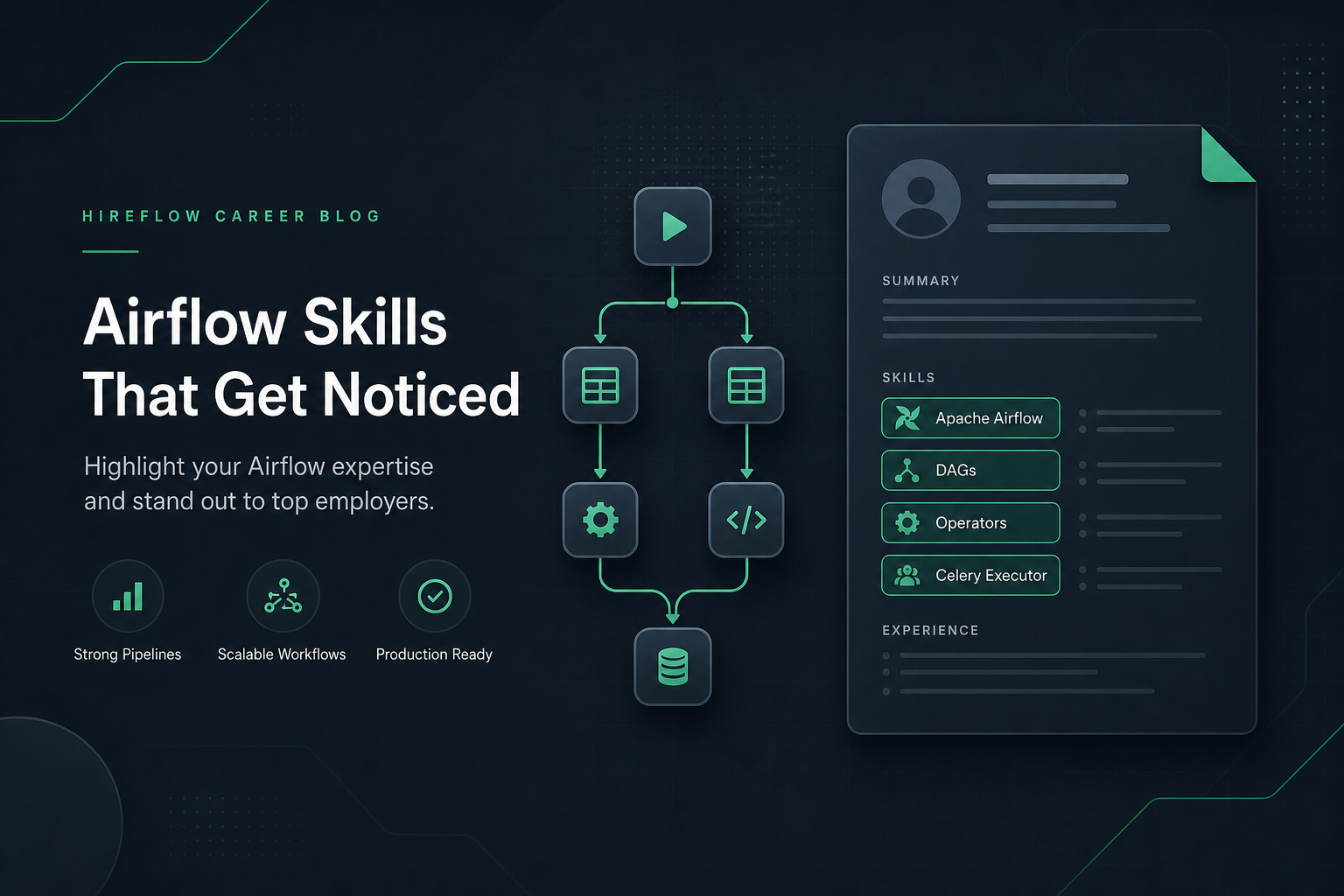
Apache Airflow resume keywords and DAG-style pipeline next to a resume with ATS keyword chips

For US data engineering roles, Apache Airflow keywords work when they name what you built—DAGs, operators, sensors, schedulers, and the executor—inside measurable bullets, not as a lonely line in Skills. ATS software and recruiter Boolean searches look for those exact strings. A resume that says “managed data pipelines” without Airflow, DAG, or operator language often never reaches a human, even when the work was real.

This guide is a practical keyword and bullet kit for Apache Airflow on US resumes: which terms hiring teams actually search, how to rewrite weak bullets into ATS-readable ones, and which formatting mistakes hide those terms from Workday, Greenhouse, and similar systems. Use only what you can defend in a technical screen.

  • Core Airflow keyword clusters by concept, executor, and surrounding stack
  • Three before/after bullet rewrites you can adapt
  • ATS parse notes for tables, columns, and skill sidebars
  • A short tailoring checklist before you submit

Key Takeaways

  • Write “Apache Airflow” once, then use “Airflow,” “DAGs,” and operator/sensor terms in context.
  • Pair every Airflow keyword with scope (volume, latency, failure rate) and your actual executor or cloud stack.
  • Skills lists help search; accomplishment bullets win the human skim after the ATS pass.
  • Two-column layouts and tables can drop tool names from the parsed candidate profile—even when the PDF looks fine on screen.
  • Tailor to the posting: Celery vs Kubernetes executor, AWS vs GCP, ETL vs ELT language.

Why Airflow keywords matter on US data engineering resumes

Key Takeaway

Recruiters search for product names and orchestration concepts—not synonyms—so related phrasing alone often fails the first filter.

Large US employers rarely hand every data engineering application to a hiring manager on day one. Applications land in an ATS, get parsed into a candidate profile, and then get ranked or searched against the requisition. When the posting says “Apache Airflow” and “DAG development,” a resume that only says “workflow automation” is easy to miss in a keyword search—even if you did the same work under a different label.

Airflow is also a specificity signal. Many candidates claim “ETL pipelines.” Far fewer can truthfully describe dynamic DAGs, sensor-driven dependencies, SLA misses, or a migration from SequentialExecutor to Celery. Naming those concepts correctly helps both the ATS match and the five-second recruiter skim that follows.

That does not mean stuffing every Airflow term into one paragraph. It means mirroring the language of the jobs you want, then proving each term with a bullet a staff engineer would believe.

Core Apache Airflow resume keywords (US ATS list)

Key Takeaway

Treat this as a checklist against the posting—not a paste list. Only include terms you can explain in an interview.

Group keywords the way recruiters and ATS Boolean strings often do: product name, orchestration concepts, operators/sensors, runtime/executor, and adjacent data stack. Pull from the posting first; use this list to notice gaps.

Product and role language

  • Apache Airflow
  • Airflow DAG / Directed Acyclic Graph
  • Workflow orchestration
  • Data pipeline orchestration
  • ETL / ELT pipeline automation
  • Batch and scheduled data workflows

Core Airflow concepts

  • DAG design and task dependencies
  • Scheduler and task lifecycle
  • Operators (PythonOperator, BashOperator, custom operators)
  • Sensors (ExternalTaskSensor, FileSensor, SqlSensor)
  • XComs and task communication
  • SLA monitoring and alerting
  • Retries, backfills, and idempotent tasks
  • Airflow Variables, Connections, and Secrets backends
  • Jinja templating in DAG definitions
  • TaskFlow API / @task decorators (when you used them)

Executors and deployment

  • CeleryExecutor / Celery workers
  • KubernetesExecutor / KubernetesPodOperator
  • LocalExecutor or SequentialExecutor (honest for smaller setups)
  • Dockerized Airflow / docker-compose Airflow
  • Helm charts for Airflow on Kubernetes
  • MWAA (Amazon Managed Workflows for Apache Airflow)
  • Cloud Composer (Google Cloud)
  • Astronomer (when that was your platform)

Adjacent stack terms US postings often pair

  • Python, SQL, Spark, dbt
  • PostgreSQL metadata DB (Airflow metastore)
  • Redis or RabbitMQ (Celery broker)
  • AWS S3, Glue, Redshift, EMR
  • GCP BigQuery, GCS, Dataproc
  • Azure Data Factory adjacency (if you integrated, not if you only used ADF)
  • Kafka, Snowflake, Databricks
  • Terraform / Infrastructure as Code for Airflow infra
  • CI/CD for DAG deployment (GitHub Actions, GitLab CI, Jenkins)
  • Observability: Prometheus, Grafana, Datadog, CloudWatch alerts on DAG failures

Expert tip: If the posting says “MWAA” or “Cloud Composer,” use that product name in addition to Apache Airflow. Managed offerings are often searched as their own keywords.

Before and after: Airflow resume bullets that show impact

Key Takeaway

Weak bullets hide the product name; strong bullets name Airflow, the mechanism, and a result a hiring manager can verify.

These rewrites keep the same underlying work. The difference is searchable vocabulary plus a concrete outcome. Adapt the metrics to your real numbers—do not invent them.

Before After
Managed workflows using Airflow for data pipelines. Designed and maintained 40+ Apache Airflow DAGs for nightly ETL into Snowflake, cutting average data freshness lag from 6 hours to under 90 minutes.
Improved pipeline reliability and fixed failing jobs. Added ExternalTaskSensor dependencies and SLA email alerts across critical Airflow DAGs, reducing silent overnight failures and cutting mean time to detect broken tasks from hours to minutes.
Migrated orchestration to the cloud and scaled workers. Migrated self-hosted Airflow to Amazon MWAA with CeleryExecutor workers, containerized task images with Docker, and stabilized peak concurrent task runs during month-end load.

Notice the after versions still read like human writing. They include Apache Airflow, DAG, sensor/SLA or MWAA/CeleryExecutor, and a result. That combination is what US ATS filters and data engineering managers both respond to.

Want a quick read on whether your Airflow terms are parsing cleanly?

Run your file through HireFlow's free ATS resume checker — no signup required for the first scan — then compare wording against one target data engineering posting.

ATS parse specifics that hide Airflow keywords

Key Takeaway

Keyword quality does not help if the parser never extracts the text—fix layout before you polish phrasing.

Two formatting patterns show up constantly on data engineering resumes and quietly strip tool names from the profile an ATS stores:

  1. Workday and table-based date columns. When job titles sit in one table cell and employment dates sit in another, Workday's candidate-profile importer commonly blanks or scrambles titles. Your “Senior Data Engineer — Apache Airflow” line can disappear from the structured Experience block even though the PDF still looks correct. Prefer a single-column layout with dates on the same line as the employer, not in a separate table column.
  2. Greenhouse and left-sidebar skill chips. Greenhouse usually keeps linear body text intact, but resumes with a left sidebar of skill pills often get reordered so skills appear before Experience in the parsed text. That can bury Airflow bullets or split “Apache” from “Airflow” across columns. Put core tools in a standard Skills section in the main column, and repeat the most important ones inside Experience bullets.

Also avoid putting contact info or a skills strip only in the PDF header/footer, and avoid icon-only tool rows. Parsers do not read logos of Airflow, AWS, or Kubernetes. Spell the words.

File type tip: a clean DOCX or a text-based PDF from Word or Google Docs is safer than a design export. If you must use PDF, open it, select the Airflow line, and confirm you can copy real text—not a flat image.

Where to place Airflow keywords so ATS and humans both see them

Key Takeaway

Use light redundancy: product name in summary and Skills, proof in Experience—never the same stuffed phrase five times.

Professional summary (2–3 lines)

Lead with role + orchestration stack. Example shape: “Data engineer with 5 years building Apache Airflow DAGs for ETL into Snowflake and BigQuery, including CeleryExecutor deployments on AWS.” That one sentence can carry Apache Airflow, DAGs, ETL, Snowflake, BigQuery, CeleryExecutor, and AWS—only if each is true.

Skills section

Use a simple comma- or pipe-separated list under a standard heading like “Skills” or “Technical Skills.” Include: Apache Airflow, Python, SQL, plus your real executor and cloud tools. Do not hide Airflow inside a paragraph titled “Other.” Many ATS configs map a Skills field preferentially.

Experience bullets

This is where keywords earn trust. Prefer one strong Airflow bullet per relevant role over repeating “Airflow” in every line. Rotate related terms: DAG, PythonOperator, sensor, backfill, MWAA—matched to what you did.

Projects (optional)

Career changers and early-career candidates can put a public DAG repo or course project here. Name the schedule, data source, and failure handling. Link the GitHub URL in plain text if the application allows it.

Copy-ready Airflow bullet templates (edit the numbers)

Key Takeaway

Templates are scaffolds—replace every metric and tool name with your real stack before you submit.

  • Built and owned [N] Apache Airflow DAGs orchestrating [ETL/ELT] from [source] to [warehouse], improving data availability for [team/use case].
  • Implemented custom PythonOperators and SqlSensors to gate downstream tasks, reducing partial loads and rework after upstream source delays.
  • Tuned Airflow scheduler settings and migrated from LocalExecutor to CeleryExecutor, raising sustainable concurrent task throughput during peak windows.
  • Deployed Airflow on Kubernetes (KubernetesExecutor / KubernetesPodOperator) with Docker task images, standardizing runtime dependencies across environments.
  • Configured SLA misses and alerting (email / PagerDuty / Slack) on tier-1 DAGs, shortening detection time for failed production workflows.
  • Managed Airflow Connections, Variables, and secrets integration with [AWS Secrets Manager / Vault], removing hardcoded credentials from DAG code.
  • Partnered with analytics/ML to schedule model-feature refresh jobs in Airflow, replacing manual notebook runs with monitored, retryable tasks.
  • Added CI checks for DAG parse errors and unit tests for task callables before merge, cutting broken-DAG deploys to production.

Airflow resume bullets by seniority level

Key Takeaway

Junior resumes prove you operated DAGs; mid-level prove reliability and scale; senior prove platform decisions, cost, and cross-team standards—not the same bullet shape at every level.

US ATS filters do not read seniority from job titles alone. They look for scope signals in the same Airflow keywords everyone uses. The difference is what you pair with “DAG,” “operator,” and “scheduler”—task count, failure rates, executor choice, or org-wide migration impact.

Junior / associate data engineer

Before: “Worked on Airflow pipelines with the data team.”

After: “Maintained 8 Apache Airflow DAGs with PythonOperators and SqlSensors ingesting SaaS exports into Postgres; documented retry and alerting runbooks for on-call rotation.”

Mid-level data engineer

Before: “Improved Airflow performance and fixed DAG failures.”

After: “Reduced tier-1 DAG SLA misses 40% by tuning scheduler parallelism and ExternalTaskSensor chains across 35 production workflows on CeleryExecutor; partnered with analytics on backfill playbooks after source outages.”

Senior / staff platform focus

Before: “Led Airflow migration to Kubernetes.”

After: “Owned org-wide migration from self-hosted Airflow to Amazon MWAA; standardized DAG CI checks, Secrets Manager integration, and KubernetesPodOperator patterns used by 6 product teams—cutting infra toil and unblocking concurrent task scale during month-end close.”

Match bullet depth to the posting's level language. If the job asks for “DAG development,” junior proof is fine. If it asks for “orchestration platform ownership,” lead with migration, standards, and multi-team impact—not only task maintenance.

How to describe Airflow alongside Prefect, Dagster, or dbt Cloud

Key Takeaway

Name each tool accurately and state who did what—Airflow schedules, dbt transforms, Spark processes. Honest split beats listing every orchestrator in one Skills line.

Many US data teams run hybrid stacks. Your resume should not imply Airflow did work another product performed—but it should still surface Apache Airflow when the posting requires it, even if you also used Prefect or Dagster on adjacent projects.

Airflow + dbt: “Orchestrated dbt Cloud jobs via Apache Airflow DAGs with ExternalTaskSensor gates on upstream S3 landings; Airflow owned schedule, retries, and paging—dbt owned transform tests and documentation.”

Airflow + Spark: “Scheduled PySpark EMR steps from Airflow using EmrAddStepsOperator; Airflow managed dependencies and SLA alerts while Spark executed large partition backfills.”

Migration context: If you moved from Luigi or cron to Airflow, say so once: “Replaced brittle cron scripts with versioned Airflow DAGs and centralized monitoring—cut manual reruns during upstream delays.” That shows orchestration judgment, not just tool familiarity.

If the posting lists Prefect or Dagster but your production experience is Airflow, mirror their concepts without false claims: “Airflow DAG design (dependency graphs, sensors, backfills)—equivalent patterns to Prefect flow orchestration.” Only use that framing when you genuinely understand both models; otherwise keep the resume Airflow-accurate and address other tools in the interview.

Common Airflow resume mistakes that hurt ATS match

Key Takeaway

Most failures are vagueness, false stack claims, or unreadable layout—not “not enough keywords.”

  • Saying “Airflow” once with no DAG or operator proof. Recruiters treat that as keyword padding unless a bullet shows what you orchestrated.
  • Claiming every executor and every cloud. Technical screens ask which executor you ran and how you debugged worker failures. Stick to what you operated.
  • Confusing Airflow with the transform layer. If dbt or Spark did the transforms and Airflow only scheduled them, say that clearly. Accuracy builds trust.
  • Stuffing a skills blob with twenty Airflow sub-terms. One clean Skills line plus two strong bullets outperforms a wall of synonyms.
  • Design-heavy templates. Icons, text boxes, and multi-column skill grids are a frequent reason tool names never enter the ATS profile.
  • Ignoring the posting's managed service name. If they run MWAA or Composer, mirror that term when you have equivalent or direct experience.

10-minute Airflow resume tailoring checklist

Key Takeaway

Tailor the executor, cloud, and warehouse language to each posting after the base Airflow story is clear.

  1. Highlight every Airflow-related phrase in the job description.
  2. Confirm “Apache Airflow” appears once near the top of your resume.
  3. Align executor language (Celery, Kubernetes, Local) with the posting.
  4. Match warehouse/lake terms (Snowflake, BigQuery, Redshift, S3, GCS).
  5. Swap ETL vs ELT wording to match how the company describes the work.
  6. Keep one quantified Airflow bullet in the most recent relevant role.
  7. Remove multi-column or table layouts that risk parse errors.
  8. Export DOCX or a selectable-text PDF and re-check copy/paste of key lines.
  9. Run a structural scan on HireFlow before submitting high-priority applications.
  10. Read the resume out loud once—if it sounds stuffed, cut duplicate terms.

Strong Airflow resumes are not longer—they are more precise. Name Apache Airflow, show DAG-level work, match the executor and cloud terms in the posting, and keep the file in a layout US ATS platforms can parse. Do that, and your keywords stop being decoration and start doing the job they are supposed to do: get a qualified data engineer in front of a human.

When you are ready to validate formatting and keyword coverage against a real posting, start with a free scan on HireFlow . Fix parse issues first, then tailor Airflow bullets with confidence instead of guessing.

Frequently asked questions

Use both. Write “Apache Airflow” at least once in your summary or skills section, then “Airflow” in bullets. ATS and recruiter searches use both strings; spelling the full product name once covers exact-match filters that look for “Apache Airflow.”

There is no magic count. Aim for the terms that appear in the posting you are applying to—usually core Airflow concepts (DAGs, operators, sensors, scheduler) plus the executor and cloud stack named in that job. Five well-placed, accurate terms beat fifteen stuffed ones.

Skills gets you into keyword search results; bullets convince a human. Put Apache Airflow in Skills, then show at least one accomplishment that names DAGs, an operator type, or an executor you actually used. Keywords without context look thin in screening calls.

Most parse plain text fine when the resume is single-column and terms sit in body text. Problems start when tool names live in graphics, multi-column sidebars, or tables. Workday often blanks or reorders fields when dates and titles sit in separate table columns; Greenhouse usually keeps linear text intact but can reorder left-sidebar skills ahead of Experience.

Only name the executor you have used. Many US postings list Celery or Kubernetes executors as preferred experience. Claiming both without evidence is easy to catch in a technical screen. If you used LocalExecutor in a smaller environment, say that—and describe scale honestly.

Yes, if you label them clearly under Projects. Describe the DAG design, data sources, scheduling, and failure handling. Skip vague claims like “built pipelines.” Name tools (S3, BigQuery, Postgres, Docker) and what the workflow actually did.

Upload a DOCX or a simple, text-based PDF to a structural ATS checker such as HireFlow. Confirm your name, titles, dates, and Airflow-related skills extract cleanly before you spend time on keyword tailoring. A high keyword match on a file the ATS cannot read still fails silently.

Tags

airflow resume keywordsapache airflow resume bulletsairflow resume keywords USdata engineer resume airflowATS resume keywords airflowAirflow DAG resume examplesHireFlow