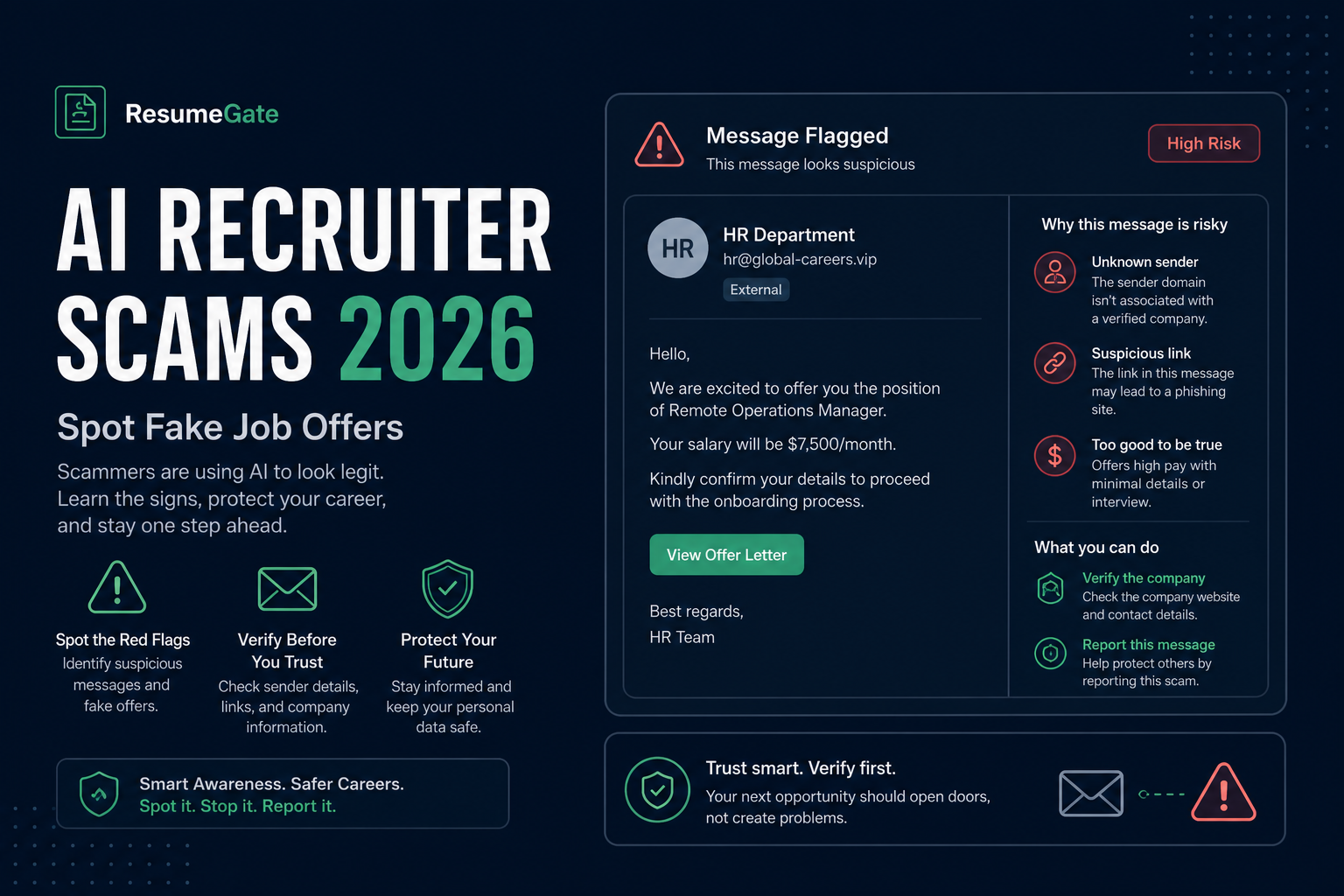
For years, job seekers were told that typos and broken grammar were the easiest way to identify a fraudulent recruiter message. That shortcut is gone. In 2026, generative AI tools can produce outreach that is indistinguishable from a message sent by a real talent acquisition professional—polished subject lines, plausible role descriptions, and warm, personalized follow-ups. At the same time, voice-cloning and AI-generated video have moved from science fiction to affordable scam infrastructure. What used to take a criminal organization months to construct can now be assembled over a weekend by a single operator with a laptop and a few cheap subscriptions.
The stakes are real. Victims of recruitment fraud in 2026 have lost thousands of dollars to fake equipment-purchase schemes, had identity documents stolen through fraudulent onboarding portals, and had banking details harvested via fake payroll setup forms—all before realizing the job they accepted never existed. Understanding how these scams are built, what signals survive the AI polish, and what to verify before you share anything personal is no longer optional for active job seekers.
This guide covers the full picture, from first contact through the fake offer stage, and gives you a step-by-step process for confirming that a recruiter and company are real before you engage further.
Key Takeaways
- Why AI removed the classic tells job seekers used to rely on
- Red flags that survive the AI polish—before you respond to anything
- A step-by-step checklist for verifying any recruiter or company
- What to do if you have already shared information with a scam
- Six frequently asked questions about job scams in 2026
Why AI made job scams harder to catch
Key Takeaway
AI-polished writing, cloned voices, and fake company pages have erased the old tells like typos—verification now has to come from sources the recruiter did not send you.
The traditional advice—look for poor grammar, spelling errors, or awkward phrasing—was always a low bar. But it worked because most recruitment fraud originated from operators who were not writing in their first language and were not investing heavily in the quality of individual messages. That assumption no longer holds. Modern large-language models produce outreach that reads exactly like a competent in-house recruiter wrote it, complete with appropriate industry vocabulary, realistic company details scraped from legitimate career pages, and follow-up cadences that mirror real recruiting workflows. The grammar check is no longer useful.
The leap from text to audio and video is what has made 2026 qualitatively different from prior years. Voice-cloning software can now reproduce a person's speaking patterns from a small sample of audio, meaning a scammer can clone a real executive's voice—sourced from a publicly available earnings call or a conference talk posted online—and use it in a phone call or a recorded video message. Some documented schemes in 2026 have gone further, staging fully AI-generated video interviews in which a fabricated "interviewer" appears on screen, moves naturally, responds to candidate statements with contextually appropriate replies, and never raises a visual flag that something is wrong. The technology required to do this at a passable quality is no longer experimental; it is available as a commercial subscription service.
The third enabler is the cost and speed of building a convincing fake company presence. A fraudulent operation can register a domain that closely resembles a real company's name, spin up a professional-looking website with a populated careers page, generate plausible headshots of fake leadership team members, and create a LinkedIn company page with a few hundred followers in under an hour using publicly available tools. Most job seekers do not independently navigate to a company's website before responding to an unsolicited message—they click the link provided by the recruiter. That one behavior is what the entire scam infrastructure is designed to exploit.
None of this means every unsolicited recruiter message is fraudulent. Real recruiters send cold outreach constantly, and many legitimate opportunities begin with an unexpected LinkedIn message or email. The point is that the surface-level quality of a message is no longer sufficient evidence of legitimacy. Verification now has to happen at a deeper level—through independently confirmed information, not through the materials the recruiter themselves sent you.
Red flags before you respond to any unsolicited offer
Key Takeaway
No single signal proves a scam on its own, but an instant offer, banking requests before day one, or an equipment "reimbursement" check together are enough to stop and verify.
These signals survived the upgrade to AI-polished messaging because they reflect structural features of the scam rather than its surface presentation. One signal alone is rarely conclusive—two or more together should stop you from proceeding until you have independently verified the recruiter and company are real.
| Signal | Why it is suspicious |
|---|---|
| An offer extended with no meaningful interview at all | Legitimate employers do not make offers after a single short chat or with no interview whatsoever. An immediate offer—especially an enthusiastic one—is a pressure tactic designed to prevent you from slowing down and verifying anything. |
| A request for banking details to "set up payroll" before you have started | Real employers collect banking information only after a background check clears and a start date is confirmed, through a secure HR or payroll platform—never via email or a direct message from a recruiter. Any request for account numbers before day one is a harvesting attempt. |
| Asked to purchase your own equipment and be "reimbursed" by check or transfer | This is one of the most consistent markers of a job scam regardless of how advanced the surrounding materials are. The scheme works by sending you a fraudulent check for more than the equipment cost, asking you to forward the difference, and disappearing once you do. Legitimate remote employers either ship equipment directly or use verified third-party vendors. |
| Interview conducted only over text or chat with no live call or video ever offered | A text-only process is not proof of a scam on its own—some accessibility accommodations are text-based—but combined with other signals it is a strong tell. Real hiring processes at any established company involve at least one live voice or video touchpoint. An insistence on chat-only with excuses about microphone issues or scheduling constraints is a pattern worth questioning. |
| The company domain in the recruiter's email is slightly off from the real company's domain | Fraudulent operators register look-alike domains that swap a letter, add a word, or use a different top-level domain. A recruiter claiming to work for a well-known company but emailing from a domain that does not exactly match that company's real web address is a major warning sign. |
| Urgency pressure: offer expires in 24 to 48 hours with no stated reason | Artificial time pressure is designed to stop you from running the verification steps in the next section. Real hiring timelines have natural urgency, but legitimate offers do not expire in under two days with threats of being "passed to the next candidate" if you do not sign immediately. |
If you spot three or more of these signals in a single interaction, do not proceed further until you have independently confirmed the recruiter and company through the steps below—regardless of how professional the messaging appears.
What a legitimate process looks like
- Initial contact from a recruiter who names a specific role and team
- At least one live voice or video touchpoint before any offer
- Offer letter sent through official company email—domain matches exactly
- Equipment shipped directly or a stipend paid after your start date
- Payroll and banking details collected through a secure HR platform
- No pressure to decide within hours—reasonable time to review the offer
What a scam process looks like
- Offer extended immediately after a brief chat or with no interview at all
- Process stays entirely in text; video or phone is always deflected
- Email domain has a subtle variation from the real company's domain
- Asked to buy equipment and forward part of an overpayment check
- Banking details requested directly by the recruiter via email
- Offer "expires" in 24 to 48 hours with vague threats about other candidates
Verifying a recruiter or company is real, step by step
Key Takeaway
Verify with information you found yourself—company site, LinkedIn, and a phone call— never with links or documents the recruiter sent you.
Each of these steps uses independently sourced information—meaning information you found yourself, not links or documents provided by the recruiter. That distinction matters: a scam can fake everything it sends you, but it cannot fake what you find on your own.
- Navigate independently to the company's real website and careers page. Do not click any link provided by the recruiter. Instead, type what you believe the company's domain to be directly into your browser, or use a search engine to find it. Once you are on the genuine site, navigate to the careers or jobs section and look for the specific role the recruiter described. If the role does not appear there under any reasonable search, that is a significant red flag. If it does appear, compare the description, location, and seniority level against what the recruiter told you—any meaningful discrepancy warrants further investigation.
- Find the recruiter's LinkedIn profile independently. Search for the recruiter's name on LinkedIn without clicking any link they provided. When you find a profile, check: how long they have been listed as an employee of that company (a newly created profile claiming years of tenure is suspicious), whether they have endorsements or connection history with people who also work at that company, and whether their activity feed shows legitimate recruiting behavior—posting about roles, commenting on industry content, receiving recommendations. A brand new profile with few connections and no history is a red flag even if the name and photo match.
- Call the company's publicly listed main phone number. Find this number from the company's own website—not from anything the recruiter sent you. Ask to be connected to the HR or talent acquisition department, and confirm that the recruiter you were contacted by is a current employee and that the role described to you is an open position. This step takes under five minutes and is the single most reliable verification method available. Fraudulent operations cannot intercept a call you placed yourself to a number you independently sourced.
- Reverse-search the recruiter's profile photo if something feels off. If the recruiter's LinkedIn or company profile photo looks unusually polished or generic, run a reverse image search using a search engine's image search feature. AI-generated headshots have characteristic visual patterns that reverse search tools can surface—images appearing across multiple profiles or stock photo sites under different names is a strong confirmation of fraud.
- Check the recruiter's email domain character by character. Copy the domain portion of the recruiter's email address into a text editor and examine it carefully against the company's known domain. Common tricks include replacing the letter "l" with the number "1," adding a word like "-hr" or "-talent" after the company name, or using a country-code extension that differs from the company's primary domain. If the domains do not match exactly, treat it as a scam until proven otherwise.
One more quiet signal worth checking: a legitimate application almost always leaves a paper trail in a real applicant tracking system. If you applied through a company's own careers page and the process is genuine, you typically receive an automated confirmation from a platform like Greenhouse or Workday—complete with a candidate portal link on that same company's domain—within minutes of applying. A recruiter who claims you were "selected from a database" with no matching application on file and no ATS confirmation email is a detail worth following up on.
While you are verifying an offer, it is a good time to make sure your resume itself is ready to go.
Run it through HireFlow's free ATS resume checker — no signup required — so you are not scrambling to fix formatting once a real offer shows up.
Running all five steps adds roughly ten to fifteen minutes to your process for any unsolicited contact—a reasonable investment when the alternative is a potential financial or identity loss. For inbound applications where you initiated contact with a real company, you can apply lighter scrutiny, though steps one and five remain worth a glance.
One final note: do not feel obligated to keep a recruiter conversation going while you verify. It is entirely reasonable to say you will review the materials and follow up in a day or two—legitimate recruiters will not object to that. A recruiter who reacts to a brief delay with escalating pressure or threats that the role will be filled immediately is confirming the suspicion rather than alleviating it. Genuine hiring processes have natural urgency, but they do not require you to skip your own due diligence. If you find during verification that the company and recruiter are real and the role exists, the conversation can resume exactly where it left off with nothing lost—and a great deal of risk removed.
Where to take this next
Protecting yourself from fraudulent recruiters is one part of a smarter job search in 2026—but it only matters when the listings you are applying to are real in the first place. Before you spend time tailoring applications, it is worth learning how to tell an active posting from a ghost listing with our guide on ghost jobs in 2026 and how to spot fake postings . Once you have confirmed a role is live and the recruiter is legitimate, make sure your resume is as strong as possible by running it against the job description with HireFlow's Job Match Score , and check that your file parses cleanly through an ATS with a free scan on HireFlow . Spending your applications on verified, real opportunities and submitting the strongest possible resume to each one is the combination that moves the needle.
Frequently asked questions
Yes—this is no longer theoretical. Real-time AI video generation tools capable of producing a convincing on-screen persona that responds to conversation in near real time have been available commercially since late 2024, and the quality has improved substantially since then. The latency (the slight delay before the AI "interviewer" responds) is the most common tell reported by people who have experienced these interviews and later realized what they were. If an interviewer consistently pauses an unusual amount of time before each response, their video has slight visual artifacts around the edges of the face, or they seem unable to react naturally to an off-script comment, those are worth noting—though the technology is improving quickly and these tells are becoming less reliable over time.
Remote job seekers are disproportionately targeted because the entire process—from recruiter contact through onboarding—can be conducted without a physical meeting that would expose the fraud. But recruitment scams are not exclusive to remote work. Hybrid and in-person roles have been used as bait when the scammer's goal is document collection or an upfront equipment-purchase scheme rather than a sustained fake employment relationship. The red flags in this article apply regardless of the listed work arrangement.
A fake job creates a legitimate-seeming context for collecting the exact information that is most valuable to steal: government ID documents, banking details, and in some cases login credentials under the guise of setting up company systems. A phishing email asking directly for any of these things is immediately suspicious. A fake hiring process that asks for them as part of routine onboarding paperwork is far more effective because the request feels procedurally normal. The investment in building a convincing scam—fake website, fake recruiter profile, AI-polished outreach—pays off because it significantly increases the rate at which targets hand over high-value information willingly.
Real background checks are initiated through established third-party screening vendors, and you will typically receive an invitation directly from that vendor's platform—not a form embedded in an email from the recruiter. Before entering any personal details into a background check portal, confirm that the vendor is real by independently searching for them, that the link domain matches the vendor's known domain, and that the company has confirmed in writing which vendor they use. A legitimate employer will not object to you taking a day to verify these details before completing the form.
Very rarely, and when they do, the process looks nothing like a scam. A small number of legitimate companies offer a home-office stipend that you spend at your own discretion, but this is paid to you after you start work, through normal payroll or expense reimbursement systems, with no requirement that you purchase anything before your first day. No legitimate company sends you a check for more than the equipment costs and asks you to wire the difference to a third party—that specific pattern is definitionally a scam and should be treated as one regardless of how professional the surrounding communications appear.
Reports of AI-assisted recruitment fraud have grown substantially year over year since 2023, tracking closely with the broader availability of high-quality generative AI tools. Consumer protection agencies and cybercrime reporting centers in multiple countries have noted year-on-year increases in recruitment fraud complaints in each of the last three years, with 2025 and early 2026 showing the largest jumps. The combination of AI-polished outreach, deepfake video capability, and inexpensive fake website infrastructure has lowered the barrier to running a convincing operation to the point where the volume of attempts has increased significantly even as detection has become harder. Running the verification steps in this guide adds a few minutes per contact and eliminates the vast majority of risk.