7 min read · Examples · Before/after
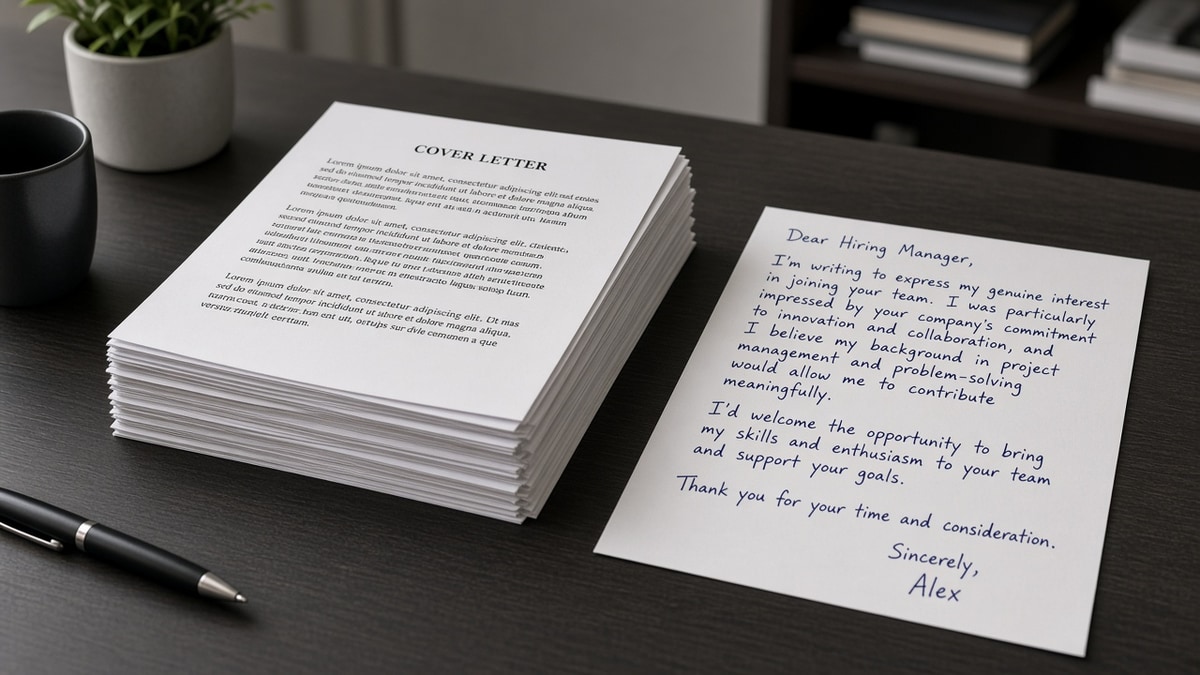
Template cover letters aren't failing on grammar. They're failing on a swap test. If you can paste the same paragraph into another company's Greenhouse form, a recruiter already knows you didn't read the req.
Check your resume for free before you draft the letter. Paragraph two should ctrl-f to the same metric and tool names bullet one already uses, so you're not maintaining two different stories.
And when the portal marks the letter optional, don't upload noise. A tight four-paragraph note beats polished language that never names anyone's product.
Quick Wins
- Paste the posting title verbatim into sentence one.
- Pull bullet one into paragraph two without changing the numbers.
- Delete any line that still works after a company name swap.
What generic means when a recruiter scans paragraph one
A generic cover letter reads like a mail merge. The verbs are fine. The company name might even be correct because you remembered to replace it. What's missing is a noun from the posting that proves you opened the same PDF the hiring manager wrote.
Swap test. Read sentence one aloud and substitute a competitor's name. If the sentence still sounds plausible, it's generic. Specific letters break when you swap brands because they mention a product line, customer segment, or internal team name.
Resume echo. Parsers store Experience first. When paragraph two repeats five bullets the resume already shows, the letter adds no new signal. One proof line that matches bullet one is enough.
Portal reality. Workday and Greenhouse often show the letter beside the resume in one pane. Screeners give you a few seconds on paragraph one before they scroll back to Experience. Generic openings don't earn a second click on the attachment.
Three signals to pack in sentence one. Exact title string from the posting, the legal company name, and one noun pulled from the req (team, product, tool, or customer segment). You don't need a story yet. You need proof you read the same page they're hiring against.
I've screened stacks of these in Greenhouse queues where the resume was strong but paragraph one said excited to join your innovative team with no title string. Those files rarely moved forward even when Experience matched the req.
For tone that still sounds human after you cut the template lines, see how to write a cover letter that sounds human before you upload another Dear Hiring Manager draft.
Before and after: why generic cover letters get ignored
Use these pairs as a teardown, not a word bank. Copy the structure. Replace every noun with language from tonight's posting.
Opening line (operations role)
Before: I am excited to apply for your open position and believe my skills make me a great fit for your team.
After: I am applying for the Supply Chain Analyst role at Northline Foods and want to bring the inventory reconciliation work I ran across four distribution centers.
Proof paragraph (customer success)
Before: In my current role I manage client relationships and drive satisfaction.
After: At my current employer I own 18 mid-market SaaS accounts on Zendesk and Gainsight; last year I cut escalations from 14 per month to 6 while holding QBR attendance at 95%.
Why us paragraph (engineering)
Before: Your company is a leader in technology and I admire your culture of excellence.
After: Your posting calls for Terraform modules on AWS EKS; I shipped the same stack for an internal platform team that migrated 22 services without a customer-facing outage window.
Close (required cover letter field)
Before: Thank you for your consideration. I look forward to hearing from you.
After: I am free for a 30-minute screen Tuesday or Thursday after 2 p.m. ET and can walk through the Zendesk automation bullet on my resume line by line.
Finance analyst (posting cites SQL and month-end close)
Before: I am a detail-oriented finance professional with strong analytical skills.
After: I am applying for the Senior Financial Analyst role on your corporate FP&A team; in my last close cycle I rebuilt the revenue bridge in SQL and cut manual journal entries from 40 to 12 per month.
Copy-paste four-paragraph skeleton
Copy-paste skeleton
Paragraph 1: Applying for [Exact Title] at [Company]. One clause on the team problem from the req.
Paragraph 2: One resume bullet restated with the same metric, tools, and time window.
Paragraph 3: One sentence on why that work maps to their stack or customer segment.
Paragraph 4: Availability plus phone and email already on the resume.
Replace bracketed fields from tonight's posting. If a sentence still works when you swap company names, delete it.
Draft faster with the cover letter generator , then cut any line that fails the swap test above.
Run the swap test on the close too. Availability windows and time zones are specific. Thank you for your consideration is not.
When metrics in the letter need to match resume bullets, read how to use metrics the right way on resumes so paragraph two does not invent numbers Experience cannot support.
Template habits that still get skipped
Repeating the whole resume. The letter should add context, not duplicate ten bullets parsers already stored.
Keyword stuffing without proof. Listing Python, SQL, and Tableau in prose while Experience shows only Excel reads hollow.
Wrong greeting. Dear Hiring Manager is fine only when you truly cannot find a name. Pair it with the company name in sentence one anyway.
Novel-length letters. Page two does not earn more time on a Greenhouse req with hundreds of applicants in the same view.
Uploading optional fluff. An optional field is not a charity slot for a template. Skip it unless paragraph one passes the swap test.
Align letter and resume before upload
Run the free ATS resume checker on the file you'll attach. Fix bullet one first so paragraph two of the letter has something real to cite.
When the posting is a stretch, score your job match and spend your letter on the one requirement you still clear, not on generic enthusiasm.
What to do tonight
Open the req. Paste the title and one product or team noun into paragraph one. Pull bullet one from your resume into paragraph two without changing the numbers.
- Delete any sentence that survives a company name swap.
- Keep the letter under four paragraphs.
- Match tools named in the letter to Experience bullets.
When bullet one and the letter agree, generate a cover letter draft from the same posting text so you're not maintaining two different stories.
Read more
Frequently asked questions
Not always on the first pass. Many read them when the field is required, when the resume is borderline, or when a hiring manager asks for narrative context. They skim paragraph one for company name, exact title, and one proof line. Generic openings fail before paragraph two loads.
About 250 to 320 words in four short paragraphs. Paragraph one names role and company. Paragraph two ties one resume bullet to a posting requirement. Paragraph three maps that win to their stack or customer segment. Paragraph four states availability plus contact details already on the resume. Longer letters rarely earn more attention.
Upload only if you can name a team, product, or tool from that specific req. An optional generic letter signals low effort on high-volume roles. Silence beats a template that could have gone to any competitor.
No. Parsers and recruiters weight Experience blocks first. The letter should explain one win or context the resume cannot carry in a bullet, not restate the whole file. Fix bullet one, then write the letter to match it.