12 min read
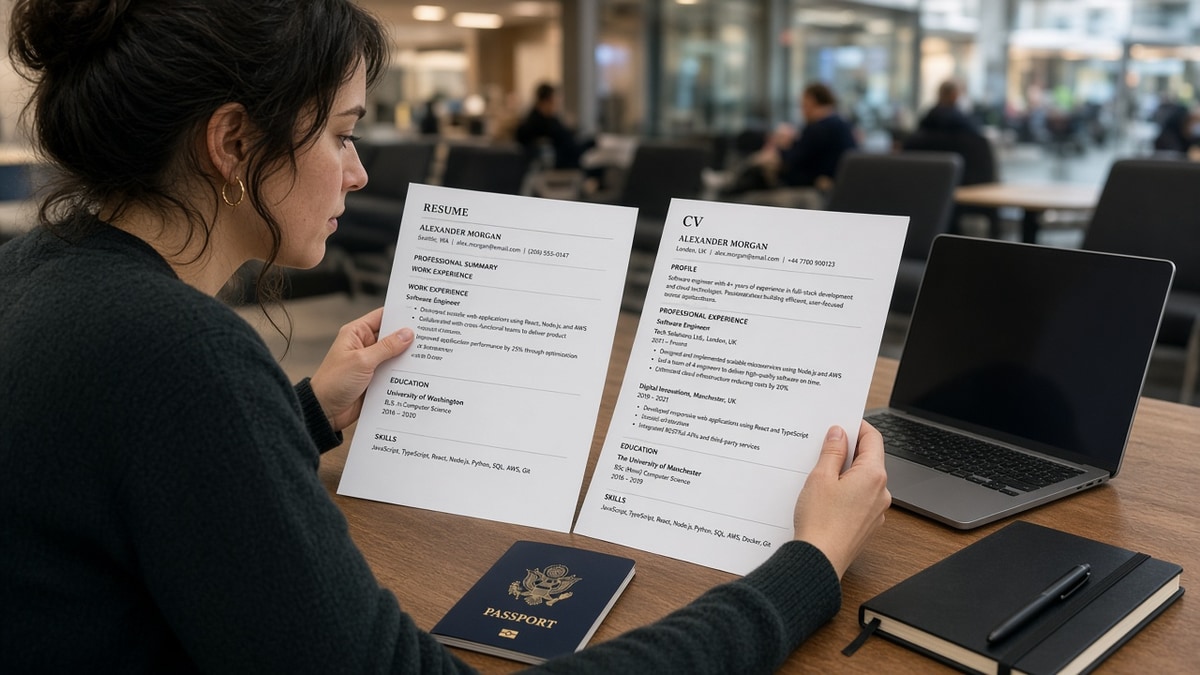
For US roles, send a one-page resume with no photo, experience first, and Month Year dates in a single column. For UK roles, send a two-page CV with education and early jobs spelled out on standard headers. Same career story, two files. You're not confused about your skills. You're shipping the wrong document shape to the wrong parser.
If you're applying on both sides of the Atlantic this month, don't merge formats into one global file. Before you tailor bullets, check your resume for free on whichever version you're uploading. A UK CV with a photo table can mislabel your job title in Workday. A trimmed US resume can look like you're hiding your first agency role to a London hiring manager.
Job searching across borders is already exhausting. The US resume vs UK CV gap isn't abstract etiquette. It's which five differences change whether a recruiter opens your file or archives it after the preview pane.
Keep two masters in a folder named by country code. Ten minutes of re-ordering beats a silent rejection because your degree block sat where a US parser expected your current employer. When the portal asks for a letter after upload, generate a cover letter that cites one dated bullet, not a nationality line you stripped from the resume.
Quick Wins
- Duplicate your file into US-Resume.docx and UK-CV.docx before you edit either.
- Remove photo, birth date, and full street address from the US version tonight.
- Paste each export to plain text and confirm employer names read before degree lines.
- Move education to page one on the UK file if you're under eight years out of university.
Why one hybrid file fails both parsers
US corporate hiring runs through ATS first. Workday, Greenhouse, Lever, Taleo, and iCIMS store your upload as searchable text. Recruiters ctrl-f for three must-haves in the first screen. A two-page UK CV with GCSE tables and a sidebar eats keyword space and can reorder employers when the layout uses columns or text boxes.
UK hiring still leans on job boards and in-house recruiters who expect a fuller narrative. A one-page US resume that jumps straight to a senior title can look like you're hiding early contracts, gaps, or qualifications. The human reader wants context. The parser still wants a single column and boring section labels.
The contrast most people miss: US files reward density on page one. UK files reward completeness across two pages without decorative layout. Same person, two different reading orders.
A composite operations analyst applies to a US SaaS role with her UK CV export. Greenhouse stores the skills table as a phantom job block. She applies to a Manchester firm with a trimmed US resume. The hiring manager never sees her first logistics contract because it was cut for length. Neither rejection was about talent. Both were about document shape.
Personal data norms widen the gap. US employers expect name, phone, email, and city-level location. UK CVs historically carried more detail. Modern practice on both sides: drop age, nationality, and marital status. Photos stay off US files always, and off UK files unless the employer still asks.
Section naming matters for parsers, not just humans. Professional Experience and Work Experience both work if you're consistent. Mixing Career Journey with Employment History on one file splits parsing across unlabeled chunks.
Edge case: you're a US citizen applying to a UK remote role for a US parent company. Read the posting for which portal and which document label they use. When they say resume and route through Workday, ship the US shape even if the salary is in pounds.
Edge case: you're UK-based targeting a US multinational's London office. They may still run Greenhouse with US-style one-page expectations. Paste to Notepad after export. If your current employer line disappears, fix layout before you argue about CV tradition.
For international framing beyond these two markets, read writing a CV for international job applications . For Canada-specific spine rules, pair this page with resume format for Canada when you're building a third file in the same week.
US resume vs UK CV: five differences that change your screen
Work from your longest honest version, usually the UK CV, then derive the US resume by cutting and re-ordering. Don't write the US file first and stretch it for UK boards. You'll invent filler bullets.
Difference 1: length and what earns a second page
US recruiters treat page two as optional proof, not a career memoir. UK hiring managers often expect page two for earlier roles, certifications, and technical modules. Cut US lines that don't map to the posting. Keep UK lines that explain how you entered the field.
Before: UK CV at three pages with full GCSE list and hobbies paragraph for a US product manager req.
After: US resume at one page: current role with four bullets, prior role with two, MBA one line, six skills echoed in bullets.
Before: US resume at one page for a UK civil engineering grad role with no A-level block.
After: UK CV at two pages: degree, A-levels, industrial placement, then part-time roles during study.
Difference 2: personal data and header layout
US files stay minimal up top. UK files can include postcode and a short profile paragraph, but not birth date or marital status on either market anymore. Icons and two-column contact rows break imports in both countries.
Before: UK header with photo table, date of birth, and nationality under the name.
After: Name on line one, Manchester UK · phone · email on line two, no image block.
Difference 3: section order and education placement
US default: Experience, Education, Skills, optional Certifications. UK default: Profile or Personal Statement, Education when early career, Experience, Skills, Referees or references on request. Parsers pair dates with the nearest header. Wrong order attaches your MBA to the wrong employer in preview.
Before: US resume with MBA block above fifteen years of work history.
After: MBA moved below experience with one line unless you're a campus hire.
Before: UK CV hides BSc details on page two while freelance clients sit on page one.
After: Degree, institution, and graduation year on page one when you're under eight years out.
Difference 4: bullet tone and proof style
US bullets lead with verbs and tools in the first eight words. UK bullets can carry slightly more context, but parsers still weight dated lines. Responsible for and Duties included still fail on both sides. Quantify inside the bullet when you have honest numbers from the role, not as a claim about hiring outcomes.
Before: Responsible for month-end close and stakeholder reporting.
After: Closed 140+ GL accounts in NetSuite monthly; cut reconciliation exceptions 18% over two quarters.
Before: Involved in client onboarding and documentation.
After: Onboarded 22 enterprise clients in Salesforce; trimmed setup time from 12 days to 8.
Difference 5: references, file type, and upload label
US resumes rarely list referees. Save names for when HR asks. UK CVs sometimes end with two referee lines or references available on request. Either is fine when contact details stay professional. Don't let referee tables push your most recent job below the fold in plain text.
DOCX exported from Word with a single column usually parses best on both sides. PDF is fine when it's text-based from that same file. Scanned PDFs and Canva exports break employer pairing in US and UK portals alike.
Before: Upload labeled Resume.pdf that's a two-page UK CV with photo header to a US Workday req.
After: US-Resume.docx, one page, no image, filename Firstname-Lastname-Resume-Company.docx.
Copy-paste block: US vs UK header skeletons
US RESUME (top of file)
[Full Name]
[Dallas TX] · [phone] · [email]

Professional Summary (3 lines max)
[Current title] with [X years] in [sector]. [Tool] and [tool].

Experience
[Company] | [Title] | Mar 2021 to Present
• [Verb] [scope] in [tool]; [outcome with number from role]

Education (below experience unless new grad)
[Degree] | [University] | 2018

Skills (6–10 tools echoed in bullets above)


UK CV (top of file)
[Full Name]
[Manchester UK] · [phone] · [email]

Personal Statement (4–5 lines)
[Title] with background in [sector]. Seeking [role type].

Education (page one if early career)
[BSc Subject] | [University] | 2022
[A-Levels or equivalent] | [School] | 2018

Experience
[Company], [City] | [Title] | Jun 2022 to Present
• [Verb] [scope]; [outcome]

Skills
[Tools list matching bullets]

References available on request
Paste each export to Notepad before you submit. Employer names should appear before degree names on the US file. On the UK file, degree lines can precede experience only when you're early career.
When your US file keeps failing preview, read resume rejected by ATS to separate layout failure from keyword mismatch before you rewrite bullets again.
When the usual rules bend
The five differences above are defaults, not laws. These exceptions show up on cross-border applications more than people admit.
Academic and research roles. US universities may ask for a CV-style publication list even though industry jobs want a resume. UK fellowships can want three pages. Read the upload label on the posting, not the country code in your head.
Senior executives. A US C-suite resume can run two pages when every line maps to P&L scope. A UK board CV can run three for non-exec director packs. Still drop photos for US uploads. Still use single-column Word exports for ATS routes.
Contract and gig-heavy careers. US files can group contracts under one consultancy header with dates per client. UK files often list each contract employer separately. Pick the style the posting's sector uses, then keep dates in Month Year format on one line per role.
Career returners. Month Year honesty on the employer line beats a Summary paragraph explaining the gap on both sides. Parsers read dates on Experience blocks. Prose in Summary rarely maps to tenure filters.
Before: US resume renames internal title to match posting Senior Data Analyst when payroll said Coordinator.
After: Official title with clarifying phrase: Data Coordinator (analytics team, senior-scope projects).
Before: UK CV lists references with full phone numbers on page one.
After: References available on request at the bottom; referee contacts held in a separate doc for HR.
I've screened stacks where the Skills block matched the posting and bullet one still opened with assisted with. The parser highlighted tools. The hiring manager never saw proof you owned the workflow.
This won't qualify you for roles that require credentials you don't hold. It stops a qualified file from dying because you sent a UK-length CV to a US req with a photo header still attached, or a US one-pager to a UK board that needed your placement year spelled out.
Parse before you tailor keywords
After you split files, upload the version you're about to send to HireFlow's free ATS resume checker and confirm must-have terms appear under dated Experience, not only in Skills. A high Skills match with empty Experience import is still a failed file on either side of the Atlantic.
Then run score your job match on the same posting pair. You're checking whether bullet openers moved the match, not whether you renamed the document CV when the portal asked for Resume.
Do this now: Duplicate into two files, strip the US header, paste both to Notepad, fix whichever version lists Education before your current employer, preview upload once per market.
Pick the file the board expects
US resume vs UK CV comes down to length, personal data, section order, bullet proof, and upload label. You already did the work those bullets describe. You're packaging it so the right parser and the right human can find it in the first pass.
Save two masters with honest history. Tailor openers per posting inside each market. Don't argue terminology on the upload form. If it says Resume, send the US shape. If it says CV on a UK board, send the two-page version with education visible when you're early career.
- Strip photo and birth date from the US file tonight.
- Move degree details to page one on the UK file when you're under eight years out.
- Notepad paste both exports before you hit submit.
- Filename with Resume or CV to match the portal label.
- Score once per file before you apply.
Open the posting you're targeting. Run a free ATS check , confirm your reframed openers landed under Experience with dates, and send one file that reads like the req already.
Read more
Frequently asked questions
In everyday US hiring, resume means a one- or two-page work history file tuned for ATS and recruiter skim. CV in American English often means an academic curriculum vitae with publications and grants. When a UK employer asks for a CV, they mean a fuller career document, usually two pages, with education and early roles visible. Don't send a US resume length to a UK board role or a UK CV with a photo header to a US corporate req.
Most US corporate roles want one page through mid-career and two only when every line earns space. UK CVs commonly run two pages even for early career because hiring managers expect GCSE or A-level lines, degree detail, and earlier contracts spelled out. Length is not vanity. It's which parser and which human get enough context without burying your current title.
Yes, always for US applications. Photos in headers can break ATS pairing and trigger bias concerns. UK employers increasingly prefer no photo as well, though some sectors still accept one. Default to no image on both files unless a UK posting explicitly requests a headshot.
You can keep one master career document, but you should export two tailored files. A hybrid usually fails both sides: too sparse for UK screens that want early roles on page one, too long or oddly sectioned for US keyword scans that weight the top third of page one. Duplicate into US-Resume.docx and UK-CV.docx, then edit section order and length separately.
US: name, phone, email, city and state or city and country. Skip full street address, date of birth, marital status, and nationality. UK: name, phone, email, city and postcode or region. Same privacy rules apply on personal data. Never include national insurance or social security numbers on either file.