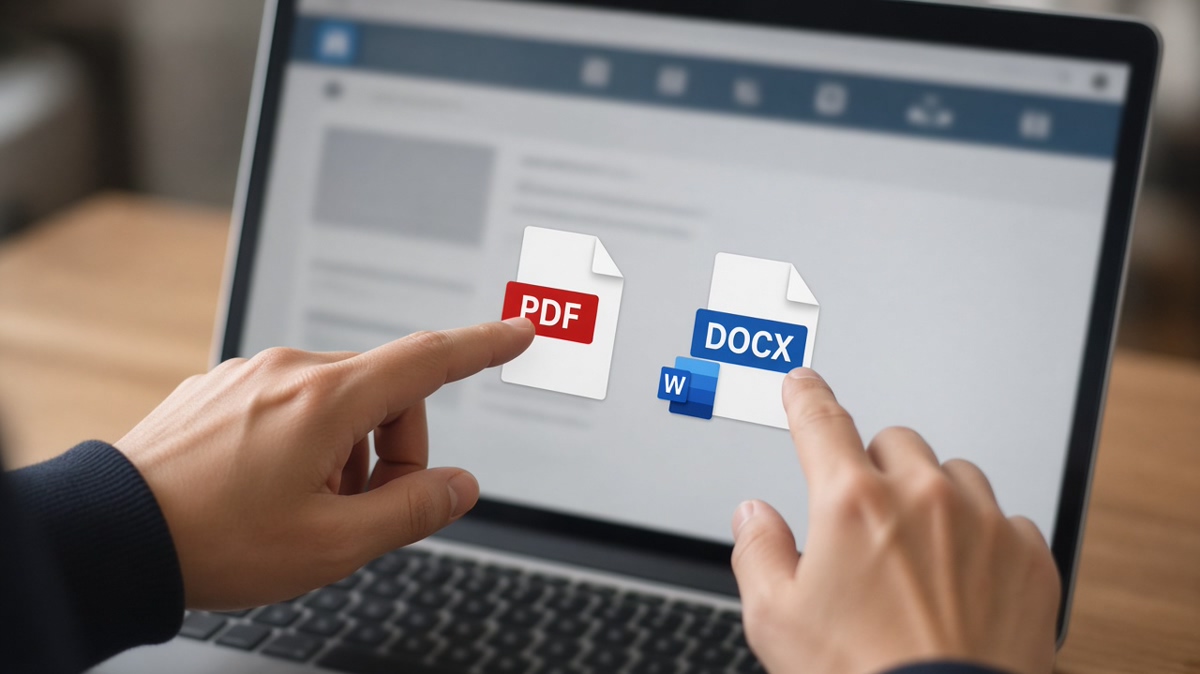
When you're ready to apply for jobs on LinkedIn, one of the first decisions you'll face is choosing the right file format for your resume. Should you submit resume as PDF or Word? This seemingly simple choice can significantly impact whether your application reaches a human recruiter or gets filtered out by an applicant tracking system (ATS).
The answer isn't always straightforward because it depends on multiple factors: the specific job platform, the company's hiring process, ATS compatibility, and how you want your resume to appear on different devices. Many job seekers submit the wrong format and never realize why they're not getting callbacks.
In this guide, you'll learn:
- The pros and cons of PDF versus Word formats
- How ATS systems handle each file type differently
- LinkedIn-specific submission best practices
- Common mistakes that reduce your interview chances
- Step-by-step guidance for choosing the right format
- Real-world scenarios and when to use each format
Why Resume Format Matters More Than You Think
Your resume format affects two critical stages of the hiring process: ATS parsing and human review. An ATS is software that scans, indexes, and ranks resumes before they reach recruiters. If your file format causes parsing errors, your qualifications may never be seen by a human.
LinkedIn's platform adds another layer of complexity. When you upload a resume to LinkedIn, the platform attempts to extract data and populate your profile. The success of this extraction depends heavily on your file format and how the resume is structured. A poorly formatted resume might upload successfully but display incorrectly, damaging your professional appearance.
Additionally, different companies use different ATS platforms—some parse PDFs better, others prefer Word documents. Understanding these nuances gives you a competitive advantage, especially when applying to multiple positions.
PDF Format: Advantages and Disadvantages
When PDF Works Best
PDF is the safest choice for maintaining visual consistency across devices and operating systems. When you save your resume as a PDF, fonts, spacing, colors, and layout remain exactly as you designed them—whether opened on a Mac, Windows PC, or mobile device. This consistency is crucial for creating a professional first impression.
PDFs are also harder to accidentally edit, which protects your document's integrity during transmission. They're widely accepted and universally compatible. Most modern ATS systems handle PDFs effectively, especially if your resume follows proper formatting guidelines.
PDF Parsing Challenges
The main disadvantage of PDF is that some older ATS systems struggle to parse them correctly. If a company uses legacy software, complex PDF formatting can cause text extraction errors. Tables, columns, graphics, and unusual fonts may not parse cleanly, resulting in scrambled text that confuses the ATS algorithm.
Additionally, when you upload a PDF to LinkedIn, the platform's data extraction tool sometimes misinterprets your information. LinkedIn may populate fields incorrectly or miss entire sections, creating a misaligned profile that doesn't match your actual resume.
Word Format: Benefits and Limitations
Why Word Offers Better ATS Compatibility
Word documents (.docx or .doc) are the native format for most ATS systems. These platforms were originally designed to parse Word files, and they still do it most reliably. When you submit a Word resume, the ATS can easily extract text, identify sections, and parse your qualifications with minimal errors.
Word files are also more editable, which some recruiters prefer when they want to annotate or modify resumes. From a technical standpoint, Word documents have cleaner code structure that ATS software understands intuitively.
Word Format Drawbacks
The primary disadvantage of Word is that formatting can shift when opened on different computers or versions of Microsoft Office. A resume that looks perfect on your machine might display with broken spacing, misaligned text, or changed fonts on a recruiter's computer. This inconsistency damages your professional appearance.
Word documents are also more vulnerable to accidental modifications and compatibility issues with non-Microsoft software. If a recruiter uses Google Docs or another platform, your carefully formatted resume might not display correctly.
LinkedIn Resume Upload: PDF vs Word
LinkedIn accepts both PDF and Word formats, but the platform handles them differently. When you upload your resume, LinkedIn's system attempts to automatically extract information and populate your profile fields. This process is called "resume parsing."
For LinkedIn specifically, PDF is generally the better choice. Here's why: LinkedIn's parsing algorithm handles PDFs more consistently because PDFs preserve formatting integrity. When you upload a Word file to LinkedIn, the platform may misinterpret spacing or section breaks, leading to incorrect data population.
However, LinkedIn also allows you to manually edit extracted information after upload. So if the parsing isn't perfect, you can correct it. The key is choosing a format that minimizes errors in the first place. A well-formatted PDF will parse more accurately on LinkedIn than a poorly formatted Word document.
ATS Compatibility: Which Format Wins?
Modern ATS systems have improved significantly, and most now handle both PDF and Word formats reasonably well. However, the quality of parsing depends on your resume's internal structure, not just the file format.
The best approach is to optimize your resume for ATS regardless of format. This means using simple fonts, clear section headings, standard bullet points, and minimal design elements. Formatting errors that break ATS parsing can occur in either format if your resume structure is complex.
If you're unsure which format a company prefers, Word is statistically the safer choice for direct ATS submission. But if you're uploading to LinkedIn or a modern platform, PDF provides better visual consistency.
Common Mistakes to Avoid
- Using design-heavy PDFs: Resumes with graphics, colored text, or complex layouts often fail ATS parsing. Stick to simple, clean designs regardless of format.
- Saving Word as PDF incorrectly: Some Word-to-PDF conversions lose formatting. Always preview your PDF before submitting to ensure it looks correct.
- Ignoring the job posting requirements: Some companies explicitly request a specific format. Always follow their instructions, even if you prefer a different format.
- Using outdated file extensions: Submit .docx (not .doc) for Word and .pdf for PDF. Older extensions may not be compatible with modern systems.
- Assuming PDF always looks better: While PDFs preserve formatting, they can sometimes fail to parse in legacy ATS systems. Word is often the safer default.
- Not testing your resume after conversion: Before submitting, open your resume in different applications and on different devices to verify it displays correctly.
Best Practices for Resume Submission
- Create a master resume in Word: Design your primary resume in Word with clean formatting. This serves as your editable source document.
- Export a PDF version: Save a PDF copy of your Word resume for situations where PDF is preferred or required. Use your word processor's native export function, not third-party converters.
- Keep formatting simple: Use standard fonts (Arial, Calibri, Times New Roman), black text, and basic bullet points. Avoid tables, columns, graphics, and colored text.
- Use standard section headings: Include clear headings like "Professional Experience," "Skills," and "Education." ATS systems look for these standard labels.
- Optimize for ATS first, design second: Your resume should be readable by both machines and humans. Never sacrifice ATS compatibility for visual appeal.
- Test with ATS checkers: Use free ATS resume checkers to verify your resume parses correctly before submitting.
- Follow company instructions: If a job posting specifies a format, use it. Some companies have specific requirements based on their hiring software.
- Save with a professional filename: Use "FirstName_LastName_Resume.pdf" or "FirstName_LastName_Resume.docx" instead of generic names like "Resume" or "CV_Final_FINAL."
Step-by-Step Guide: Choosing Your Format
- Check the job posting: Read the application instructions carefully. If a specific format is requested, use it. If not, proceed to step two.
- Identify the application method: Are you applying through LinkedIn, the company's website, an ATS portal, or email? This determines the best format.
- For LinkedIn uploads: Use PDF format. LinkedIn's parser handles PDFs more reliably than Word documents.
- For company websites and ATS portals: Use Word (.docx) format. Most ATS systems parse Word documents more effectively than PDFs.
- For email submissions: Ask the recruiter which format they prefer. If they don't specify, Word is the safer choice.
- Create both versions: Maintain a Word version and a PDF version of your resume. This allows you to submit the appropriate format for each application.
- Test before submitting: Open your resume in different programs and on different devices. Verify that formatting, spacing, and text are correct.
- Submit with confidence: Once you've verified your resume looks and parses correctly, submit it. Don't second-guess your format choice after submission.
Final Verdict: PDF or Word?
The answer to "should you submit resume as PDF or Word on LinkedIn" depends on context, but here's the practical takeaway: Use Word (.docx) as your default format for most job applications. Word documents parse more reliably through ATS systems, which is where most resumes are initially screened.
For LinkedIn specifically, use PDF because LinkedIn's parsing algorithm handles PDFs more consistently. Create and maintain both versions of your resume so you can adapt to each application's requirements.
More important than format is content quality and ATS optimization. A well-written, cleanly formatted resume in either format will outperform a poorly structured resume in the "perfect" format. Focus on clear structure, relevant keywords, and professional presentation—regardless of whether you choose PDF or Word.
Always verify your resume displays correctly after conversion, follow the job posting's stated format preferences, and test your final document before submitting. These practices will maximize your chances of getting past ATS screening and reaching a human recruiter.
Frequently asked questions
No, you should submit only one version. Submitting both formats may be flagged as a duplicate application or appear unprofessional. Choose the format that best matches the application method (PDF for LinkedIn, Word for ATS portals) and submit only that version. If you're unsure which is better, contact the recruiter and ask for their preference.
Recruiters' preferences vary, but most prefer formats that preserve visual consistency and parse cleanly through their ATS. PDF is preferred for visual consistency, while Word is preferred for ATS compatibility. The best approach is to follow the company's stated preferences or use Word as your default since most ATS systems handle it better. Modern recruiters understand both formats work; the key is clean formatting and accurate content.
It depends on your resume's complexity. Simple, well-formatted Word resumes usually convert to PDF without issues. However, if your resume uses tables, columns, or unusual formatting, conversion might cause problems. Always preview your PDF after conversion and compare it to the original Word version. If formatting is damaged, simplify your resume design and try converting again. Use your word processor's native export function rather than third-party converters.
Google Docs is convenient for collaboration and cloud storage, but it's not ideal for resume creation. Google Docs exports to both Word and PDF, but the conversion quality can be inconsistent. If you use Google Docs, export your resume as a Word document (.docx) rather than PDF for better ATS compatibility. Always verify the exported version looks correct before submitting. For optimal results, create your resume in Microsoft Word, which has better ATS integration and more reliable export options.
Most modern ATS systems accept both PDF and Word, but if you encounter an error, try the alternative format. If the system only accepts one format, use that format. If you're still having issues, contact the company's HR department or recruiter for assistance. They can clarify which formats their system accepts and may be able to help you troubleshoot upload problems. Don't assume the problem is your resume—it could be a technical glitch on their end.
LinkedIn's Easy Apply is convenient but less personalized. When you use Easy Apply, your LinkedIn profile data auto-populates the application. This is faster but may not accurately represent your resume if your profile isn't fully optimized. Submitting a separate resume file gives you more control over how your information is presented. For competitive roles, submitting a custom resume file is better. For high-volume applications, Easy Apply saves time. Choose based on the job's importance and your available time.
Done for you
Turn this advice into an interview-ready resume
Professional writers rebuild your resume for ATS + recruiters — unlimited revisions, interview guarantee.