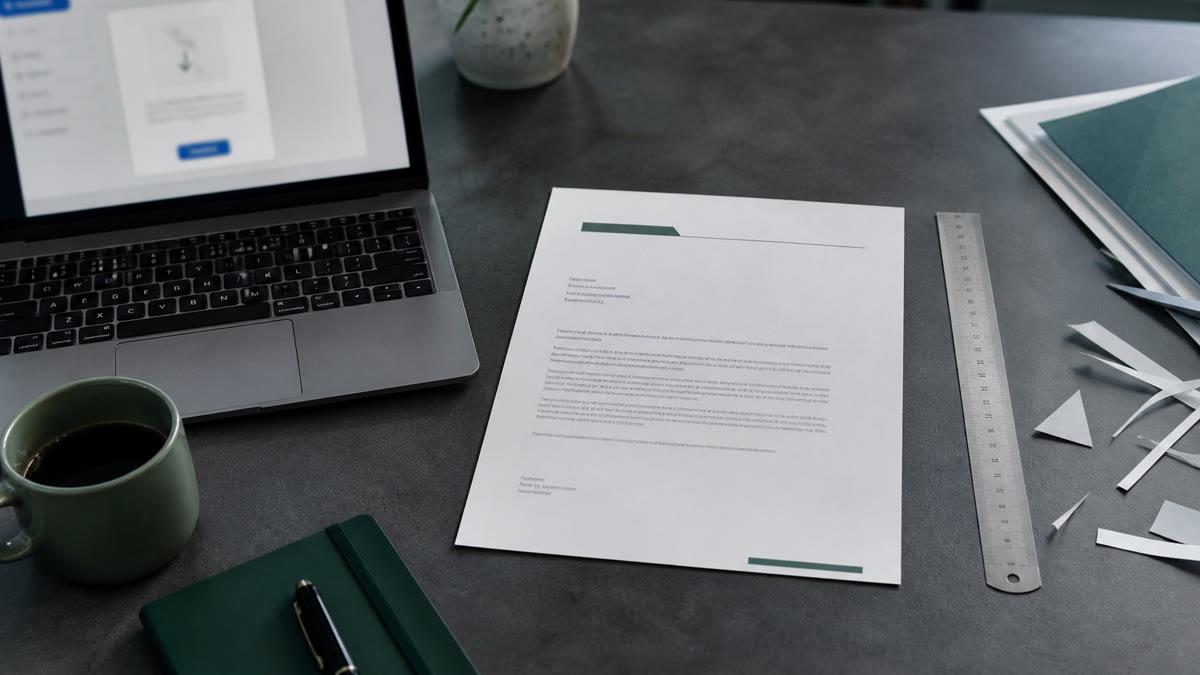
Should a cover letter be one page? For most US corporate, nonprofit, and startup jobs in 2026, yes — one page with three to four paragraphs is the default. Use a second page only when the posting asks for a longer statement or when a faculty or research packet treats the letter as a research overview.
This page is a length rule, not a “should you write one” guide. For when to submit or skip, see when a letter is worth writing . For the rare cases that need more room, see when a second page is allowed . Below: a one-page fit scorecard, what career offices publish, and a trim sequence with decision points.
Key Takeaways
- Default for US corporate applications: one page, three to four paragraphs
- Target 250–400 words in 11- or 12-point type with normal margins
- A half page with two proofs beats a full page of filler
- Do not shrink fonts or margins to hide extra copy
- Cut resume repeats first; keep one proof the posting actually asked for
- Paste boxes on Workday and Greenhouse may truncate — plan a shorter paste version
One-page fit scorecard: channel × word count × posting type
Before you trim, score the draft against three variables. The scorecard tells you whether one page is enough, whether you need a shorter paste version, or whether the posting itself overrides the one-page default.
Yale’s Office of Career Strategy cover-letter guidance says to limit the letter to one page, with three to four paragraphs. Purdue OWL’s letter formatting notes still apply — date, a professional email, and the employer block belong in the body, not only in a designed header that some parsers skip.
| Channel | Word count target | Posting type | Fit call |
|---|---|---|---|
| PDF upload (Workday / Greenhouse) | 250–400 words | Required or strongly preferred | One page — full story in the attachment |
| Paste box only | 200–300 words | Required text field | Three paragraphs + close — no header block |
| PDF + paste box (same portal) | PDF 250–400 / paste 200–300 | Both fields present | Match content — paste is a preview, not a second draft |
| Email to recruiter | 150–250 words in body | Asked to “send a letter” | Paste three paragraphs; attach same one-page PDF |
| Optional upload | 0 or 250–350 | Optional field | Skip unless you have new context — referral, gap, pivot |
| Faculty / research packet | Follow the ad | Letter of interest with page cap | Use the cap they wrote — may be 1–2 pages |
| USAJOBS attachment | Short — under 300 words | Optional letter | USAJOBS document rules cap the resume at two pages, not the letter — still keep the letter brief |
How to read the scorecard: start with posting type. If the field is optional and your draft only restates the resume, the fit call is skip — not squeeze. If required, pick the word count for your channel, then trim until you hit it without shrinking fonts.
Key Takeaway: one page is a channel-and-posting decision, not a vanity metric. Score all three variables before you edit.
What US career offices publish about length
The one-page default is not a HireFlow opinion. US university career centers and federal application help pages repeat the same ceiling because screeners treat the letter as a short business note, not a second resume.
Yale Law’s cover-letter advice tells applicants to keep the letter to one page because the reader is busy. UC Berkeley’s cover-letter guide describes the same structure: opener, evidence, close — with no second page unless the employer asks.
That guidance holds across industries. A senior finance applicant and a first-year analyst applicant both send one page for a standard corporate requisition. The difference is proof density, not page count. If you need more room for board work or published research, the posting usually moves that content into a separate statement — not an extra letter page you add on your own.
Key Takeaway: when career offices agree on one page, treat that as the employer’s expected format unless the ad says otherwise.
What does one page actually mean?
One page is not a word-count contest. In practice it means three to four paragraphs that a recruiter can read in under a minute: who you are for this role, two proofs that map to the posting, and a close. Most US career offices describe that as roughly 250 to 400 words in standard business-letter formatting.
A strong half page is fine. Screeners prefer a tight match over filler about company culture copied from the About page. If you are under 200 words and still have two posting-specific proofs, submit — do not pad.
- Paragraph 1: role + strongest match (one sentence on why this employer)
- Paragraph 2: proof point tied to a requirement in the ad
- Paragraph 3: second proof or career-change bridge the resume cannot hold
- Close: availability + thank you — two sentences max
Common Mistake: treating “one page” as a quota. A 450-word letter with five resume repeats fails the rule even if it fits on one sheet.
Key Takeaway: one page means one minute of new information — not one sheet of enthusiasm.
When is one page not enough?
The exception list is short. A second page earns its keep only when it answers a prompt the employer wrote, not a prompt you invented. For the full matrix on length exceptions, read can a cover letter be two pages .
- The announcement asks for a detailed statement of interest, responses to numbered questions, or a “letter not to exceed two pages.”
- A faculty or research search treats the letter as the place to outline research agenda and teaching — and the ad does not split those into separate statements.
- An executive search consultant asked for a career narrative with scope that will not fit one page without dropping required proof.
Myth to drop: “Senior people get two pages by default.” Senior applications still fail when page two restates the resume. If you need more room for deals, P&L, or board work, that belongs in resume bullets or an addendum the posting requested.
Key Takeaway: stay on one page unless the posting or packet instructions name a longer cap.
How do I cut a long draft to one page?
Use this sequence. Stop as soon as the letter fits one page with 11- or 12-point type and roughly one-inch margins.
- Run the fit scorecard for your channel and posting type. Decision: if optional and generic, skip instead of trimming.
- Delete the “I am applying for…” opener if the subject line or portal already names the requisition. Decision: if a human will only see the attached PDF, keep one identifying line; if the portal stamps the job title, cut it.
- Highlight every sentence that also appears on the resume. Keep at most one of those facts, rewritten as why it maps to this posting. Cut the rest.
- Keep two proof points, not five. Decision: if a bullet does not match a requirement in the ad, it belongs on the resume or nowhere.
- Cut adjectives and company history you copied from the About page. One specific product, team, or metric beats a paragraph of praise.
- Close in two sentences: interest + how to reach you. No vague forward-looking filler.
If you still overflow, you are using the letter as a second resume. Fix the resume instead — a free ATS check will show whether the primary file even parses.
Key Takeaway: overflow is almost always duplicate resume content, not a shortage of pages.
Three trims that actually free a page
These lines are illustrative. Copy the cut, not the industry.
| Before (overflows one page) | After (fits one page) |
|---|---|
| I am writing to apply for the Marketing Coordinator role at BrightPath Software as posted on your careers site. I have attached my resume for your review and I believe I would be a great addition to your team. | I am applying for Marketing Coordinator (req 4421). At Lane & Co I grew trial signups 18% with the same lifecycle emails your posting lists for the freemium funnel. |
| In my current role I manage social media, write blog posts, run paid ads, coordinate events, and support sales with collateral. I also helped with the product launch and several cross-functional projects. | I own HubSpot nurture for 40k contacts and cut unsubscribes from 2.1% to 1.4% in Q3. Those two duties match the posting; the rest stays on the resume. |
| Your company is a leader in SaaS with a rich history of innovation and a culture of excellence that I have admired for many years. I am passionate about marketing and eager to grow with your team. | I already run the same Marketo → Salesforce handoff your ad describes. I can start the week of September 8. Thank you for the review. |
Mid-check: if the resume still fails a parse, a longer letter will not save it. Run HireFlow’s ATS checker on the resume, then come back to length.
Key Takeaway: each cut should remove a resume repeat or a compliment — never the one proof the posting asked for.
Federal packets vs corporate one-pagers
People mix up two different documents on USAJOBS. USAJOBS says you may include a cover letter to share skills or goals that are not already on the resume. The same help page caps the resume at two pages — that cap is not permission to write a two-page letter.
Some federal announcements ask for extra narratives, KSAs, or questionnaires. Those are separate files with their own length rules. Read Required Documents before you attach anything. If the letter is optional and the questionnaire covers the story, a long letter adds file clutter without adding scored content.
Corporate Workday and Greenhouse uploads follow the same one-page habit. The screener opens resume first, letter second — if at all. A tight one-pager respects that order.
Key Takeaway: on USAJOBS, spend your page budget on the resume; keep any letter short unless that announcement says otherwise.
What formatting tricks actually backfire?
In practice, the failures we see on uploads are mechanical: 9-point type, 0.4-inch margins, text boxes, and headers that hide the contact line. Match the resume font family so the packet looks like one document.
- Do not drop below 11-point body type to fake a one-page layout.
- Do not put the only phone number in a header or footer.
- Export PDF and confirm you can select/copy every paragraph before upload.
- Use the same date format and contact block as the resume.
Key Takeaway: if you need design tricks to fit the text, the text is too long.
PDF, paste box, or email on Workday and Greenhouse
The one-page rule still holds, but the channel can hide overflow. A one-page PDF can still fail if you then paste the same text into a 2,000-character Greenhouse or Workday box. In practice, paste boxes truncate without a warning you will see. Write the PDF first, then cut the paste to the first three paragraphs plus a close.
Email is not a second page. If a recruiter asks you to “send a letter,” attach the same one-page PDF or paste those three paragraphs into the body — do not add a biography because the channel feels informal. LinkedIn Easy Apply often has no letter field at all; that is a skip, not a reason to message the hiring manager unsolicited with a long file.
Failure mode we see: applicants export a two-page Word file, convert to PDF, then paste page one into the portal and attach both. Screeners get two versions. Pick one channel, one file, one page unless the announcement wrote a different cap.
Key Takeaway: match the field you were given; do not send a second copy through a side channel to dodge the length rule.
When the one-page rule is the wrong call
This will not work when the employer published a different instruction. A faculty ad that says “letter of no more than two pages addressing research and teaching” is the spec. A grant or fellowship that asks for a two-page statement is the spec. Ignoring that to “look concise” is noncompliance, not professionalism.
It also fails when you have no new information. A page of enthusiasm does not repair a resume that never mentions the required tools. Fix the resume first; then decide length. If you are unsure whether to write a letter at all, start with do cover letters matter in 2026 .
For a standard corporate apply, one pass with the scorecard above is enough. When the resume and letter are both ready, check the resume on HireFlow before you upload to Workday or Greenhouse — extra pages will not repair a file the importer cannot read.
Key Takeaway: follow the announcement; the one-page default is for the jobs that did not write a different rule.
Frequently asked questions
Yes. Yale’s Office of Career Strategy and most US career offices tell applicants to limit the letter to one page with three to four paragraphs. That usually lands around 250 to 400 words in 11- or 12-point type with normal margins. Senior titles follow the same rule unless the posting asks for more.
In 11- or 12-point type with one-inch margins, most letters hold 250 to 400 words — enough for an opener, two proof paragraphs, and a close. Paste boxes on Workday or Greenhouse often cap around 2,000 characters, which is closer to 300 words. Write the PDF first, then trim the paste version.
No. A tight half page with two posting-specific proofs beats a full page of praise. Add content only when you have new information the resume cannot hold: a referral, a career change bridge, or one metric tied to a requirement in the ad.
When the announcement asks for a longer statement, when a faculty packet treats the letter as a research overview, or when a search firm requests a career narrative. Follow the posting over any general rule. See our guide on when a second page is allowed for the full exception list.
Portals store the file you upload; they do not rank you higher for word count. A one-page letter with the right context is safer than a two-page repeat of the resume. Put keywords on the resume; use the letter for match context a screener cannot get from bullets alone.
No. Dropping below 11-point type or squeezing margins under about 0.75 inches makes the letter harder to read and can scramble copy-paste extraction. Cut sentences instead. Move extra proof points onto resume bullets or a portfolio link.
Both store the PDF you attach. If the same application also has a paste box, the box often truncates around a few thousand characters — your full page may not arrive. Attach a one-page PDF and paste only the first three paragraphs plus a close into any text field.
Skip when the field is optional and you have no new information. Upload a short tailored page when required, strongly preferred, or when you have a referral, gap, or career change the resume cannot explain. Optional plus generic is worse than empty.