11 min read
Short answer: A good resume match score for US roles means your must-have keywords live inside dated experience bullets, not a Skills footer. Mid-70s with thin proof on must-haves still loses to high-60s when bullet one names the tool and scope recruiters search. The percentage is a location check, not a hire guarantee.
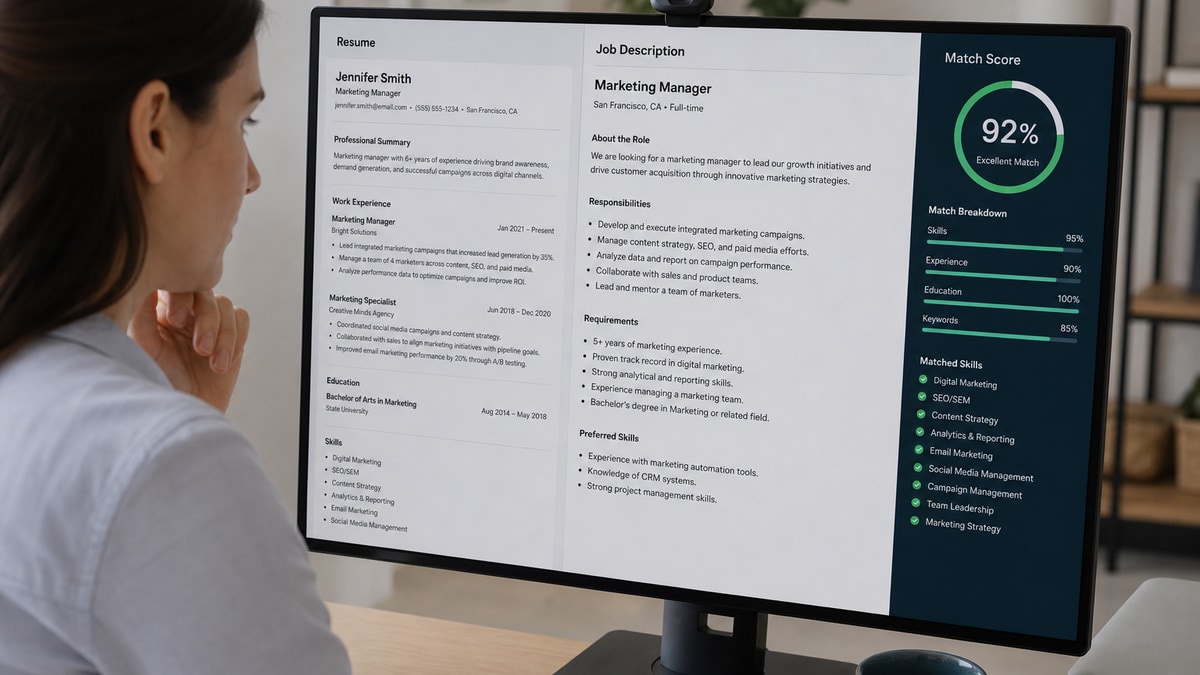
You're not chasing a magic number on a dashboard. You're checking whether Workday or Greenhouse can tie your current employer to the same language the req uses. If you've been staring at a green bar wondering whether to apply, check your resume for free with the posting pasted in first. You'll see gaps faster than guessing from a headline percent, and you won't waste an evening padding Skills.
Below: why the score moves when bullets move, which exceptions matter for US applicants, score traps that look healthy, and a ten-minute fix path with before/after lines you can paste tonight.
Quick Wins
- Highlight five must-haves from the posting before you look at any percent.
- Move the first missing tool into bullet one under your current job.
- Trim Skills duplicates that never appear in dated work history.
- Re-run the score only after you change a bullet, not after adding footer keywords.
Why a good resume match score is about bullet placement
Match tools compare your file text to a job description. They reward overlap on required nouns: systems, certifications, scope words, seniority signals. What they cannot fully judge is whether you actually did the work. Recruiters use the same split. Keywords in a footer answer "does this string exist on the page." Keywords in a dated bullet answer "did this person do it recently."
The line worth remembering: Skills lists help parsers see tools; experience bullets prove you used them under an employer recruiters recognize.
US corporate stacks usually map resume text into employer, title, dates, and bullet blocks. When Python or Salesforce only appears under Skills, the matcher may still count a hit and lift your percent. The recruiter view often sorts on experience first. You get a flattering number and a thin story.
That's why a mid-70s file with must-haves trapped in a footer can lose to a high-60s file with the same terms in bullet one. The lower score is more honest about where proof lives. I've passed a 67% profile into a hiring manager screen because bullet one said "Owned Workday reporting for 140-person sales org" while a 76% file hid Workday under a twelve-line Skills grid with no dates.
Percent bands are shorthand, not law. For many US reqs, anything in the mid-60s with clean parsing and must-haves in experience is worth submitting when you truly fit. Below that, you usually have a missing license, wrong title level, or a layout break. Above the mid-80s without changing bullets often means synonym stuffing or soft-skill padding.
Job searching is slow and the numbers feel personal. A score is feedback on one file against one posting, not a verdict on your career. Use it to find the next edit, then apply when the honest gaps are closed.
Read how many keywords a resume should have in 2026 when you're tempted to add a fifteenth synonym just to nudge the bar.
Federal and licensed roles add hard gates: clearance level, RN license, CPA, bar admission. Match percent does not override missing credentials. Put license strings in the header or summary only when the posting demands them in plain text, then prove scope in bullets.
Career changers should expect lower headline scores on senior reqs until one bridge role carries posting language in dated lines. That is normal. You're trading percent for honesty until a pivot bullet lands the must-have in experience.
What to do now when your score looks close
Step 1: Mark must-haves before you look at the percent
Open the posting. Circle tools, certifications, and scope words repeated twice or labeled required. Ignore nice-to-haves on the first pass. Those five to seven lines are what the score should reflect in experience, not what you wish you had.
Before: Scanning a 74% headline and adding every yellow keyword to Skills.
After: List five must-haves on paper; check each against dated bullets only.
Step 2: Fix bullet one on the current role
Parsers and humans overweight the first bullet under your latest employer. Put the heaviest must-have in the first eight words with a scope noun and tool. Use numbers as illustrations of your work, not market claims.
Before: "Responsible for client relationships and reporting."
After: "Built Salesforce dashboards for 22 enterprise accounts; cut renewal risk calls 18% in Q2."
Step 3: Demote footer-only keywords
If a tool appears only in Skills, either move it into a bullet with dates or delete it. Footer-only terms inflate match percent without proof. Recruiters searching Greenhouse for "Tableau" want to see where you used it, not that you typed it once at the bottom.
Step 4: Run parsing before keyword chasing
A scrambled date column or two-column layout can drop effective match even when words exist on the page. Export PDF, paste into Notepad, confirm employer and Month Year ranges read in order. Fix layout once, then tune language.
Before: Tweaking synonyms while Workday imports the employer name into the skills block.
After: Single-column DOCX, plain bullets, re-export, then keyword edits.
Step 5: Compare two versions, not two postings
Save JobTitle_Company_v2.pdf after each bullet change. Score version two against the same req. You're measuring whether proof moved, not whether a different job flatters you.
Copy-paste ten-minute score pass
"Paste posting; list five must-haves; open current role; rewrite bullet one with tool plus scope; move any footer-only must-have into a dated bullet or delete it; export single-column PDF; paste text to Notepad; fix dates; upload to matcher; if percent rises but must-have still footer-only, undo Skills padding and fix bullet one again."
Before/after: operations coordinator, US hybrid
Before: 73% match; Asana, Smartsheet, and vendor management only in Skills; bullets say "organized projects" without tools.
After: 69% match after deleting footer padding; bullet one reads "Ran Asana portfolio for 14 vendor onboarding projects; Smartsheet trackers for facilities budget owners."
Before/after: data analyst pivot
Before: 78% with SQL, Python, and Looker repeated in Skills; experience bullets mention "reports."
After: 66% honest score; bullet one under current job: "Built Looker churn dashboards in SQL and Python for subscription SKU cohorts."
Before/after: registered nurse, hospital system
Before: 71% with Epic and ACLS in Skills; clinical bullets describe "patient care" without system names.
After: 64% after trimming duplicate certs; bullet one: "Epic documentation on 32-bed med-surg unit; ACLS team lead for rapid response three shifts weekly."
Before/after: customer success manager, SaaS
Before: 75% driven by "stakeholder management" and "SaaS" in Skills; no CRM in experience.
After: 68% with bullet one: "Managed Gainsight health scores for 48 mid-market accounts; cut churn saves 12 accounts in H1."
Edge case: overqualified applicant
Very high scores on down-level reqs sometimes mean title and scope overshoot. Trim senior verbs if the posting says coordinator and your file screams director. Match is alignment, not maximalism.
Edge case: acronym vs spelled-out tool
Some matchers treat "Google Analytics" and "GA4" as separate gaps. Mirror the posting's spelling in bullet one. Do not stuff both in Skills without a bullet reference.
Edge case: multi-page resume
Page two rarely saves a weak bullet one. If must-haves sit on page two only, move the strongest proof up or cut older roles. Recruiters on Lever often never scroll.
Exceptions: when a lower score is fine
Referral-heavy companies may read you before filters tighten. Public-sector reqs with rigid KSA paragraphs reward narrative over percent. Startup founders applying to operator roles may show company building in bullets matchers underweight. Still fix parsing. Still put must-haves in experience when honest.
When to stop tuning and apply
Stop when every honest must-have from the posting appears in a dated bullet or title, parsing is clean, and bullet one tells the story in one breath. Another hour on synonyms rarely beats sending the file and tailoring the next req.
Score traps that look healthy on the dashboard
Chasing percent with Skills padding. You can jump from 68% to 79% in ten minutes by dumping posting nouns into a footer. Recruiters still see empty experience lines.
Ignoring the gap list. Headline color feels good. The missing "SOC 2" or "B2B" line is what actually blocked search.
Treating one score across all reqs. Your master file might score 82% on one posting and 58% on another. That's normal. Tailor per apply.
Keyword stuffing in white text or tiny fonts. Some candidates hide terms. Parsers may read them; humans reject instantly when copy-paste exposes the trick.
Applying with a broken PDF to hit a number. A readable 65% beats a scrambled 80%. Fix columns before synonyms.
Assuming Easy Apply skips matching. One-click apply portals still map fields into employer systems. Bullet proof matters on every channel.
Deleting older roles to inflate percent. Thin history can raise match while hurting seniority signals. Trim bullets, not years, when possible.
See resume rejected by ATS when the score looks fine but silence continues after apply.
Score your file against the posting you want
Use a matcher to see missing must-haves and parsing warnings side by side. Fix the first gap in experience, not the tenth synonym in Skills. Re-run after one bullet change so you know what moved the needle.
Pair keyword alignment with a layout check. Match tools flag missing nouns; parser checks flag broken dates and columns. Both need to pass before you trust a mid-60s score enough to submit.
Score your job match with the full job description pasted in. Note which missing terms are must-haves versus nice-to-haves. Then run a free ATS resume check on the same PDF to catch formatting issues that percent alone will not show.
Apply when proof beats padding
A good resume match score for US applicants is not the highest bar on the screen. It's must-have language sitting in dated experience bullets recruiters actually read, with parsing clean enough that Workday imports your current title intact.
When you're deciding whether to submit tonight, compare bullet one to the posting, not the headline percent. Mid-60s with proof beats mid-70s with a Skills footer every time I've sorted a stack.
Open one req, rewrite one bullet, run the matcher once, and apply with a named PDF. That's the whole loop. The score is there to show you where proof is missing, not to keep you editing until midnight.
Read more
- Why your resume never reaches a human
- ATS score: how it is calculated and how to improve
- Generate a cover letter when the resume is tight on space
Frequently asked questions
Seventy percent can be fine when must-have tools and scope terms sit in dated experience bullets with outcomes. Seventy percent with those terms only in a Skills footer is weak. Read the gap list, not the headline number.
Matchers weight where keywords appear. A file at 68% with Salesforce and pipeline language in bullet one under the current employer often ranks above 74% when those terms repeat in Skills but never show up in work history. Placement beats density.
No. Chasing ninety percent usually means stuffing synonyms or soft skills you cannot defend. Stop when every honest must-have from the posting appears in a dated bullet or title, parsing is clean, and the first screen tells the story. Apply and move on.
Employer ATS rarely shows you their internal rank. Third-party scores are practice mirrors. They help you find missing terms and layout breaks before upload. Treat them as a pre-flight check, not a promise about Workday or Greenhouse internals.
Put searchable tools and scope words in the first eight words of a bullet under the employer that used them. Skills lines support parsing but do not replace proof. A footer list without dated context inflates percentage without moving recruiter search.