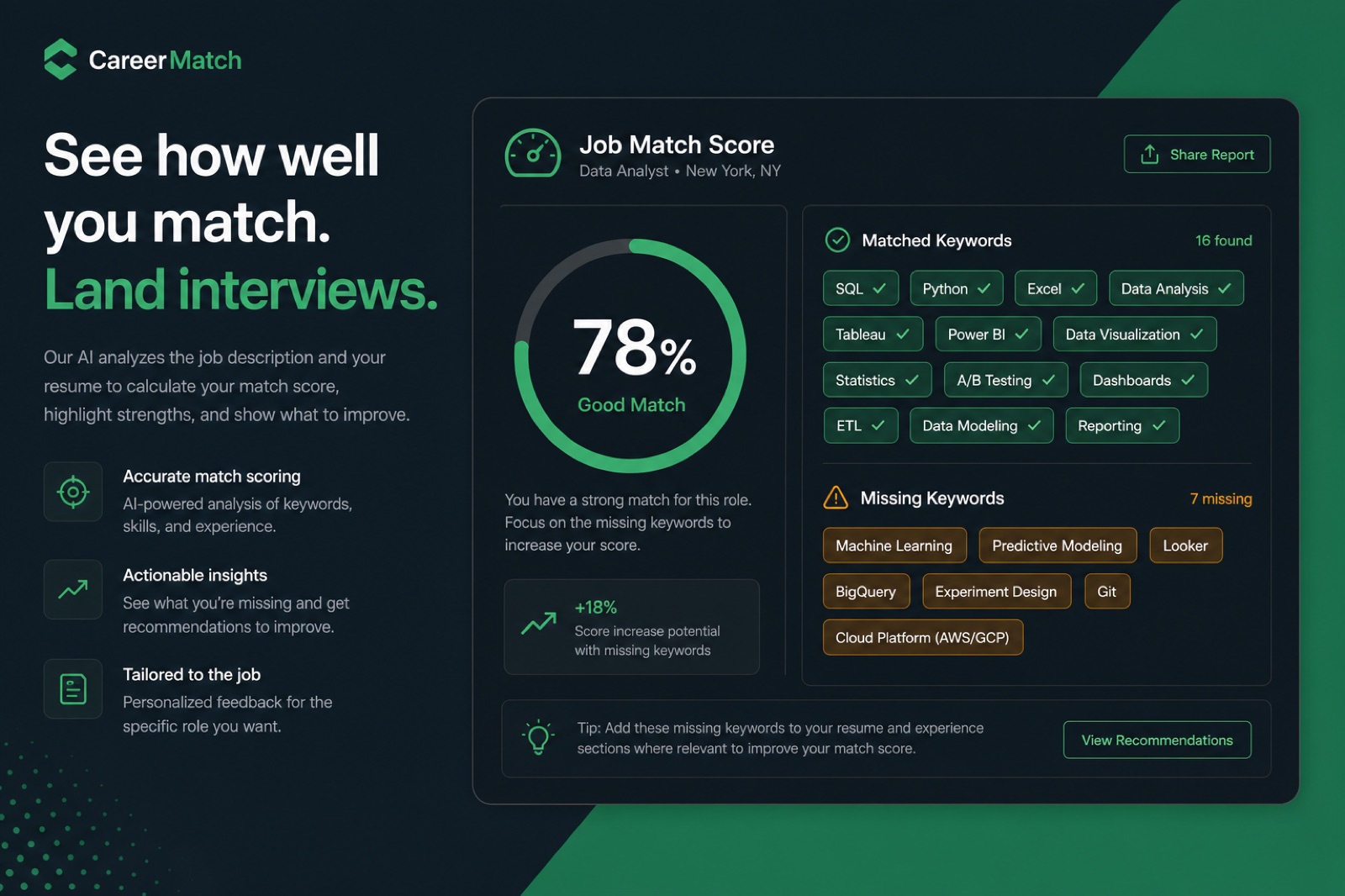
A resume job match score compares the language in your resume against one specific job description and estimates how closely they overlap—usually a percentage, plus a list of matched and missing terms. It is a tailoring signal, not a hiring prediction. A high score tells you your resume speaks the same language as that posting; it does not guarantee an interview, and a low score does not mean you are unqualified.
The number itself is where most people get stuck. They see “62%” and have no idea whether that is fine, worrying, or nothing to worry about—so they either ignore the report or chase 95%+ by pasting in phrases from the posting until the resume stops sounding like them. Both reactions skip the part of the report that actually matters: the specific list of overlapping and missing terms underneath the percentage.
This guide walks through how to read that number by band, a repeatable workflow for closing the gaps it surfaces, and the 8-15 keyword method for tailoring a resume without turning it into a copy of the job description. You can run the checks described here with HireFlow’s job match score tool as you go.
Key Takeaways
- What a match score does and does not measure
- Score bands: what 40%, 65%, and 92% each actually mean
- A step-by-step gap-fix workflow for missing keywords
- The 8-15 keyword method for tailoring without stuffing
- Turning keywords into evidence bullets, plus a checklist
What a match score actually means
A match score is recalculated fresh for every job description you paste in—it is not a fixed grade attached to your resume. The same resume can score 45% against one posting and 78% against another, because the score measures overlap with that specific text, not overall resume “quality.” Underneath the percentage, most tools are measuring overlap across a few dimensions:
- Hard skills and tools named in the job description—software, platforms, certifications, and technical terms that appear in the requirements.
- Role-specific language such as responsibilities, seniority terms, and industry phrasing repeated across the posting.
- Explicit qualifications like “5+ years,” “bachelor’s degree required,” or a named methodology the employer calls out directly.
Some tools, including HireFlow’s, also weigh semantic overlap—recognizing that “led a team of six” and “managed staff” describe the same thing even without an exact phrase match. That matters because it means the honest fix for a low score is often rewording an existing bullet, not inventing a new one.
Expert tip: treat the percentage as a summary stat, not a grade. Its real value is the matched and missing term lists underneath it—that is the actual checklist. Skim past the number and go straight to those two lists first.
Key Takeaway: the percentage is recalculated per posting, not a fixed grade—go straight to the matched and missing keyword lists underneath it, since that's the part that actually tells you what to edit.
What a match score is not
Most of the frustration with match scores comes from expecting them to answer a question they were never built to answer. Before you touch your resume, it helps to rule out what the number is not telling you:
- It is not a hiring prediction. Interview decisions depend on experience fit, competition for the role, referrals, and recruiter judgment—none of which a text comparison can see.
- It is not a full ATS or parsing check. A resume can score well on keyword overlap while a broken two-column layout or an image-based header still prevents an applicant tracking system from reading it correctly. Workday, for example, often merges multi-column text into the wrong reading order, and Taleo can drop skills that live inside a text box instead of the main document body. A match score alone will not catch either problem.
- It is not a grammar or writing-quality check. Overlap percentage says nothing about whether your bullets are clear, whether your summary is compelling, or whether a recruiter will actually want to keep reading.
- It is not proof you are qualified. A score measures whether the same words appear in both documents, not whether you can actually do the job. The words still need to be true.
Keep these limits in mind as you read the score bands below—the percentage is a starting point for editing, not a verdict on the resume or the candidate.
Key Takeaway: a match score doesn't check whether Workday or Taleo can actually parse your layout—run a separate structural ATS check alongside it.
Score bands: what your number actually means
Exact thresholds vary slightly by tool, but the pattern below holds across most job-match checkers in 2026. Use it to decide how much editing time a given score is worth, rather than treating every percentage point the same way.
| Score band | Label | What it usually means | What to do |
|---|---|---|---|
| Below 40% | Mismatch | A genuine stretch, or the same experience described in very different language than the posting. | Check whether the missing terms genuinely apply before deciding to tailor for this role. |
| 40-59% | Partial overlap | Likely real relevant experience, phrased differently, or a few secondary requirements missing. | Run the gap-fix workflow on each missing term before applying. |
| 60-74% | Workable | A typical starting point before tailoring—a handful of keyword gaps, not a fundamental mismatch. | Apply the 8-15 keyword method, then re-check. |
| 75-89% | Target range | Strong, honest overlap while still reading like a real resume, not a copy of the posting. | Light polish only. Read it aloud once, then stop. |
| 90-100% | Check for stuffing | Occasionally a strong fit, but usually a sign of repeated exact phrases copied from the posting. | Re-read every bullet; remove anything you can't defend in an interview. |
Notice that the “ideal” zone is not 100%. A resume that matches a posting almost word for word is more likely to have been over-tailored than to be an unusually perfect fit.
Key Takeaway: target 75-89%, not 100%—a near-perfect score usually means over-tailored, copied phrasing rather than an unusually strong fit.
How to run a job match score check, step by step
- Go to HireFlow’s job match score page and upload your resume (PDF or DOCX).
- Paste in the full job description, not just the title—the tool needs the actual requirements and responsibilities text to compare against, not a job title alone.
- Note the percentage as a starting reference point, then skip straight to the matched and missing keyword lists—that is where the actionable information lives.
- Find your current score’s band in the table above, so you know roughly how much editing this posting is worth before you start.
- For each missing keyword, run it through the gap-fix workflow below before adding anything to the resume.
- Re-run the check after editing to confirm the changes moved the score without making the resume read like a list of terms lifted from the posting.
Key Takeaway: paste the full job description, not just the title, and go straight to the matched/missing keyword lists—the percentage alone isn't actionable.
If you'd rather start with the broader structural check first, HireFlow's free ATS checker flags parsing risks before you get to keyword tailoring.
The gap-fix workflow
A missing-keyword list is only useful if you have a consistent way to decide what to do with each term. Instead of adding every missing word, sort each one into one of three buckets first:
| Gap type | What it looks like | What to do |
|---|---|---|
| You have it, but didn’t say it | The experience exists but was described with different wording, or left out entirely. | Rewrite an existing bullet to include the term naturally, anchored to a real result. |
| You have something adjacent | Not the exact tool or term, but a close equivalent or related skill. | Mention the adjacent skill honestly—“familiar with” is fine if true. |
| You genuinely don’t have it | No real experience, adjacent or otherwise, backs up this term. | Leave it out. Don't add a keyword you can't discuss for two minutes in an interview. |
Once a term is sorted, run it through the same four-step loop every time:
- Classify it using the table above—have it, adjacent, or don’t have it.
- Decide where it belongs—your summary, your skills list, or one specific experience bullet. Most terms only need one home, not three.
- Attach evidence if it is going into a bullet: a number, a scope, or an outcome, not just the bare word.
- Move to the next gap rather than trying to fix the whole list in one pass—working term by term keeps the resume from drifting into a keyword dump.
Key Takeaway: sort each missing keyword into have it, adjacent, or don't have it before adding anything— never add a term you can't back with real evidence.
The 8-15 keyword method
The gap-fix workflow tells you what to do with a term once you have found it. The 8-15 keyword method controls how many terms you go looking for in the first place, so tailoring stays manageable per application:
- Read the job description once for context, then a second time to highlight recurring terms—skills, tools, and qualifications mentioned more than once.
- Sort highlighted terms into two buckets: skills you genuinely have evidence for, and skills you do not. Discard the second bucket.
- Narrow the first bucket to 8-15 terms that are most central to the role—prioritize terms that appear in the job title, first bullet of requirements, or repeated across the posting.
- Distribute them across three places: your summary (2-3 terms), your skills section (most of the list), and 1-2 experience bullets per term where you can attach real evidence.
- Never repeat the same keyword more than 2-3 times across the whole resume. Repetition beyond that reads as stuffing to both ATS systems and human readers.
Signs you are stuffing, not tailoring
- The same phrase appears four or more times
- Keywords appear in a list with no supporting bullet
- Sentences read awkwardly because a term was forced in
- You added a skill you cannot explain in an interview
Key Takeaway: pick 8-15 keywords tied to the job title and repeated requirements, and never repeat one more than 2-3 times across the resume.
Turning keywords into evidence bullets
A keyword on its own is a claim. A keyword inside a bullet with a number or outcome is proof. Compare these two approaches to the same job description requirement, “stakeholder management”:
Keyword stuffing (weak)
“Skilled in stakeholder management, cross-functional stakeholder communication, and managing stakeholder relationships across teams.”
Evidence bullet (strong)
“Managed relationships with 6 department stakeholders during a system migration, resolving conflicting priorities to hit a shared launch date two weeks ahead of schedule.”
Both mention stakeholder management once. Only the second proves it happened. This is the same gap between a high match score and a resume that actually reads well: matching the posting’s language matters less than matching it with proof a recruiter can picture.
Key Takeaway: a keyword alone is a claim—pair it with a number, scope, or outcome so it reads as proof, not a term lifted from the posting.
Pre-apply tailoring checklist
- Found your score’s band in the table above before editing
- Extracted 8-15 keywords from the actual job description
- Ran each missing keyword through the gap-fix workflow
- Removed any keyword you cannot back up with evidence
- Placed keywords across summary, skills, and 1-2 bullets each
- No single keyword repeated more than 2-3 times
- Re-ran the match score after edits, not before
- Read the resume aloud to confirm it still sounds natural
Before you submit this application
If you have a posting open right now, that is the best time to use everything above—not after you have already sent the resume. Paste it into HireFlow’s job match score tool , find your band in the table, and work through the missing terms with the gap-fix workflow before you hit apply.
And if you are not sure whether the score is even the right thing to fix—formatting and parsing issues can hide underneath a decent-looking percentage—head back to HireFlow’s homepage to see the rest of the toolkit before you decide what to work on next.
Frequently asked questions
Roughly 75-89% is a practical target band—strong, honest overlap while still reading like a real resume. Below 40% suggests a genuine mismatch or very different phrasing than the posting. Above 90% is worth a second look for stuffing, since near-perfect overlap often means exact phrases were copied from the posting rather than an unusually perfect fit.
No. The score measures text overlap with one specific posting, not your qualifications. A low score often means real, relevant experience is described with different wording than the job description uses, or a few secondary requirements are missing—not that you can't do the job.
Aim for 8-15 keywords per application, pulled from terms that repeat in the posting or appear in the job title. Distribute them across your summary, skills section, and 1-2 experience bullets each, and never repeat the same keyword more than 2-3 times across the whole resume.
No. A score that close to perfect usually signals over-tailoring—phrases copied nearly verbatim from the posting rather than genuine, varied overlap. Recruiters and interviewers notice stuffed language, and it can undermine trust even if it clears an automated filter.
No. Only add a keyword if you can discuss it for two minutes in an interview. Adding unverifiable skills to chase a higher match score creates a gap between your resume and your actual interview performance, which usually costs more than a lower score would have.
No. A match score measures keyword and phrase overlap with a job description—it does not check whether an ATS can actually extract your work history, dates, and contact details correctly. Run a separate structural ATS check to confirm your resume parses cleanly before trusting a high match score alone.
A job match score compares your resume's language to one specific posting and returns an overlap percentage. A broader ATS check looks at formatting and parsing risk—columns, tables, fonts, and section structure—which a match score does not evaluate at all.