11 min read
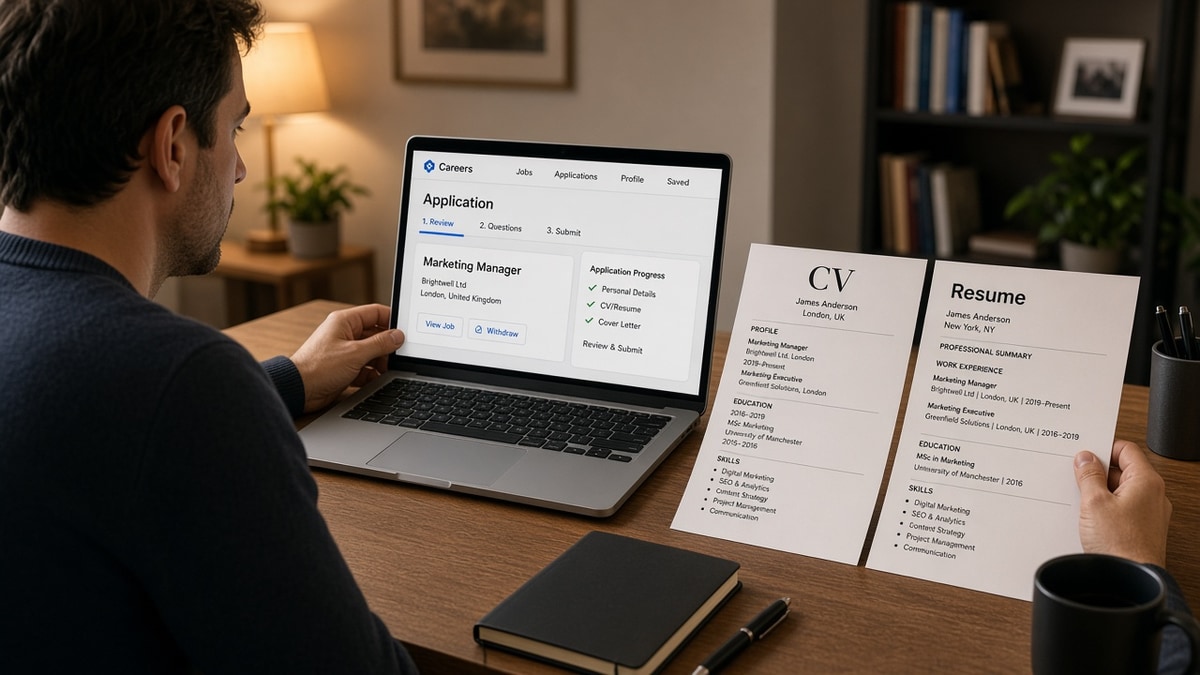
You're probably staring at two exports that look fine until you upload the wrong one. If you're applying across the Atlantic tonight, the UK CV vs US resume split isn't mainly about page count. Wrong personal fields, date order, and section labels break Workday and Greenhouse parsing when you upload a London file to a US req, or the reverse. Drop the photo and marital status for US uploads. Don't paste day-first dates. Use Month Year formatting. One column. Standard headings the parser already knows.
Check your resume for free with the posting pasted in before you retitle anything. You'll often see matched keywords in Skills while the header still carries a National Insurance number, a day-first start date, and a two-column table the parser reads sideways. Cross-border job searching is draining enough without the file dying before a recruiter opens it.
Below: resume and CV formatting differences UK vs US explained by section, not by myth. Why recruiters care about the shell; the exceptions (academia, medicine, creative portfolios); and what to change on your master document in the next twenty minutes. You've already got the experience. The formatting gap is mechanical, and it's fixable tonight if you're willing to export two shells.
Quick wins
- US header: name, city and state, phone, email, LinkedIn. No photo, DOB, or marital status.
- Dates everywhere: Jan 2022 to Mar 2024. Not 03/2022 or 14/06/2019.
- One column, standard headings: Professional Summary, Experience, Education, Skills.
- UK shell: British spelling, fuller Education OK, referees on request not inline on US uploads.
Resume and CV formatting differences UK vs US: why parsers fail first
Recruiters do care about length and tone, but the first gate is almost always software. Workday, Greenhouse, Lever, and Taleo map your upload into fixed fields: employer name, title, start month, end month. When your UK CV leads with Personal Profile, Date of Birth, and a photo column, the mapper grabs the wrong lines. Your last three roles land under Education. Skills fills with address fragments.
US files assume a marketing one-pager. Tight summary up top, reverse-chronological Experience, Education near the bottom unless you are early career. Personal data stays minimal because US employment law pushes employers away from age and family status on applications.
UK CVs assume a fuller record. More education detail, earlier roles kept visible, sometimes referees listed, British English throughout. None of that is wrong on a UK small-business email apply. It is wrong inside a US corporate portal that expects a resume-shaped field map.
The exceptions are narrow. Academic CVs in the US can run long with publications. Medical roles on both sides want credentials up front. Creative portfolios sit outside this article. If you are a mid-career analyst, marketer, engineer, or ops lead applying across the Atlantic, you are in the bucket where header and date hygiene matter more than whether you call the document a CV or resume.
Date format is the silent killer. A UK habit of 14/06/2019 to 02/11/2022 becomes nonsense in a US parser trained on month names. Gaps appear where none exist. Current role reads as ended. Fix the dates before you argue about two pages versus three.
For a deeper cut on dates alone, read month-year vs year-only on resume dates . This page covers the full cross-border shell. That one helps you pick granularity once the order is correct.
What to change now: before/after pairs by section
Work section by section on a duplicate of your file. Do not rebuild every bullet tonight. Fix the header, dates, and headings first, then tighten bullets if you still have room. Each pair below is copied from patterns that break US and UK screens in different ways.
Header and personal details
Before: Name | Photo (headshot right column) | Date of birth: 14 March 1988 | National Insurance No. | Marital status: Married | Full home address with postcode | Mobile | Email
After (US): Jordan Ellis | Chicago, IL | (312) 555-0142 | [email protected] | linkedin.com/in/jordanellis
After (UK): Jordan Ellis | Manchester, UK | 07700 900123 | [email protected] | linkedin.com/in/jordanellis | Right to work: British citizen (if the posting asks)
Date lines under Experience
Before: Senior Product Manager, Brightline Apps, 06/2019 – 11/2023, London
After (US): Senior Product Manager, Brightline Apps, Jun 2019 to Nov 2023, London, UK (remote OK on US file if true)
After (UK): Senior Product Manager | Brightline Apps | Jun 2019 to present | London, UK
Opening profile vs professional summary
Before: Personal Profile: A highly motivated professional with extensive experience across multiple sectors, seeking a challenging role to apply broad skills…
After (US): Professional Summary: Product manager with six years in B2B SaaS. Owned roadmap for billing and integrations; cut churn 11% in Q3 after shipping usage-based pricing.
After (UK): Profile: Product manager, six years B2B SaaS. Roadmap owner for billing and integrations; churn down 11% after usage-based pricing launch.
Experience bullets (same role, different market)
Before: Responsible for managing stakeholder relationships and delivering key projects on time.
After (US): Ran quarterly roadmap reviews with Sales and Finance; shipped SSO and audit logs, enterprise win rate up 14% in two quarters.
After (UK): Ran quarterly roadmap reviews with Sales and Finance; delivered SSO and audit logs, enterprise win rate up 14% in two quarters.
Education block placement
Before (US upload): Education listed above Experience with full A-level subjects, GCSE grades, and dissertation title for a 2012 degree while applying to a senior role.
After (US): Experience first. Education one line: BSc Economics, University of Leeds, 2012. A-level detail removed for senior applications.
After (UK): Education can stay higher for grad schemes. For experienced hires, mirror US order unless the posting asks for full qualifications.
Skills and tools line
Before: Skills in a two-column table with logos for Excel, Jira, and Salesforce.
After: Skills: SQL, Looker, Jira, Salesforce, stakeholder workshops, PRD writing, Agile delivery. Plain comma list or simple bullets, one column, no icons.
Copy-paste header and section skeleton
US RESUME SHELL (DOCX or PDF, one column):
FULL NAME
City, ST | phone | email | linkedin.com/in/handle
PROFESSIONAL SUMMARY
Two lines max. Role, years, domain, one metric from your latest job.
EXPERIENCE
Job Title | Company | Mon YYYY to Mon YYYY | City, ST or Remote
Bullet with verb, scope, tool, outcome number.
EDUCATION
Degree, School, Year
SKILLS
Comma-separated list pulled from the posting.
UK CV SHELL (same master bullets, different wrapper):
FULL NAME
City, UK | phone | email | LinkedIn URL
PROFILE
Three lines, British spelling, no photo unless employer requests.
EXPERIENCE
Job Title | Employer | Mon YYYY to present | Location
Same bullets as US file; swap organize/organise to match market.
EDUCATION AND QUALIFICATIONS
Degree, institution, year; professional certs if regulated role.
ADDITIONAL INFORMATION
Languages, visas, notice period. Referees available on request (not on US portal upload).
Edge case: UK-based candidate, US remote req
You live in Edinburgh but the team sits in Austin. Use the US shell. City line can read Edinburgh, UK with a note that you are open to US hours if true. Drop NI number and photo. Keep bullets in US English if the hiring company is US-owned, even when recruiters are in London.
Before: UK CV with photo, full address, and Personal Profile sent to a Workday link for a US SaaS company.
After: US resume, two pages, Month Year dates, Professional Summary, no personal data beyond contact, visa line only if the form asks.
Edge case: US professional relocating to the UK
Your old US resume is one page and clean, but UK recruiters want to see A-levels or equivalent only when you are early career. For senior moves, keep the US brevity, add British spelling, and expand Education only if the role is regulated. Do not paste a ZIP code in the header; use town and UK postcode if you include address at all.
Before: Dallas, TX 75201 at the top, Skills section above Experience, no mention of notice period.
After: Manchester, UK | notice period four weeks in Additional Information | British spelling in Profile | Experience order unchanged.
Running parallel searches in both markets gets messy fast. Read how to build a US application funnel when you are batching US portals while keeping UK recruiter email applies in a separate track.
Where cross-border files still break
Candidates often translate words but not structure. These four patterns show up on both sides of the Atlantic more than typos do.
Mistake 1: Two-column Canva layouts
Sidebars look polished. Parsers read down the left column, then the right, and merge job titles with university names. Export a single-column version for every ATS upload.
Mistake 2: Referees inside the upload file
UK tradition puts referees on the CV. US portals have separate reference fields. Inline referee blocks push Experience off the first screen and confuse field detection.
Mistake 3: Mixed spelling markets
organise in the Profile and organize in bullets signals a mail merge, not a tailored file. Pick British or American English per version and run spellcheck once.
Mistake 4: Uploading the wrong PDF export
I've seen strong candidates upload the portfolio PDF or the cover letter PDF to the resume field because the filenames looked similar. Label exports clearly: Ellis_Resume_US.pdf and Ellis_CV_UK.pdf.
Before: One master Canva file with photo, tables, and icon skills sent to every country.
After: Two plain exports from the same bullet master, each opened once in a parser check before apply.
Match the posting before you swap countries
Regional formatting fixes the shell. Keywords still have to match the req. Score your job match on the US or UK posting you have open. The scan shows when Skills is full but Experience never repeats the must-have tools from the ad. Paste the same terms into bullet one after you fix dates and headers.
Some UK employers still ask for a short cover letter in the body email. US portals often skip it, but when a field appears, mirror duty language from the posting. Generate a cover letter from the job description after your resume shell matches the market. Keep it one page. Recruiters skim.
Export two shells tonight
Resume and CV formatting differences UK vs US come down to contact fields, date order, section labels, and spelling more than the word on the cover. Build one bullet master, then save two exports: US resume with Month Year dates and no personal data; UK CV with British spelling and qualifications where the role expects them.
Open your current file. Fix the header in five minutes. Fix every date line next. Run a parser check. Then tailor keywords per posting. You will still get silence when teams freeze reqs. You will not lose as often to a mapper that thinks your photo caption is your latest job title.
Run a free ATS check on the US version and the UK version before you send the next batch. Same career, two shells, one less parsing surprise.
Read more
Frequently asked questions
Use resume on US portals and in the file name when the posting says resume. UK employers still say CV on many boards, but the label on the upload button matters less than the fields inside. A two-page file with US date order, no photo, and a Professional Summary heading parses fine even if you grew up calling it a CV. Match the posting language in the cover email, not in the header block.
You can, but most US recruiters expect one to two pages for mid-career roles unless you are in academia or medicine. Length is not what breaks Workday. Extra pages with referee names, A-level subject lists, and narrative paragraphs without bullets do hurt the skim. Trim history older than ten years on US files, keep early roles to one line each, and move referees to a separate list you send after a screen.
Many US HR teams strip photos for compliance reasons, and parsers sometimes misread image blocks as garbled text. Date of birth and marital status are not standard on US resumes and can trigger automatic redaction in some systems. For UK applications, photo and fuller personal blocks are still common on smaller employer sites, but large corporate boards increasingly mirror US privacy norms. When the portal is Workday or Greenhouse, assume US rules even for a London HQ if the req is US-based.
US resumes use Month Year ranges with an en dash or the word to between dates: Jan 2022 to Mar 2024. UK CVs often lead with day-first numeric dates in running text, which US parsers read as employment gaps or future start dates. Pick one format per file and keep it consistent in Education and Experience. Spell out months on both markets when you apply through an ATS upload, not a plain text box.
You need two formatted versions, not two careers. Same roles, same metrics, different header block, date order, spelling, and section order. Build a master list of bullets once, then export a US resume and a UK CV with the regional shell. Run each through a parser check before you batch apply. Swapping only the spelling from organise to organize while leaving a photo and National Insurance line in the header still fails on a US upload.