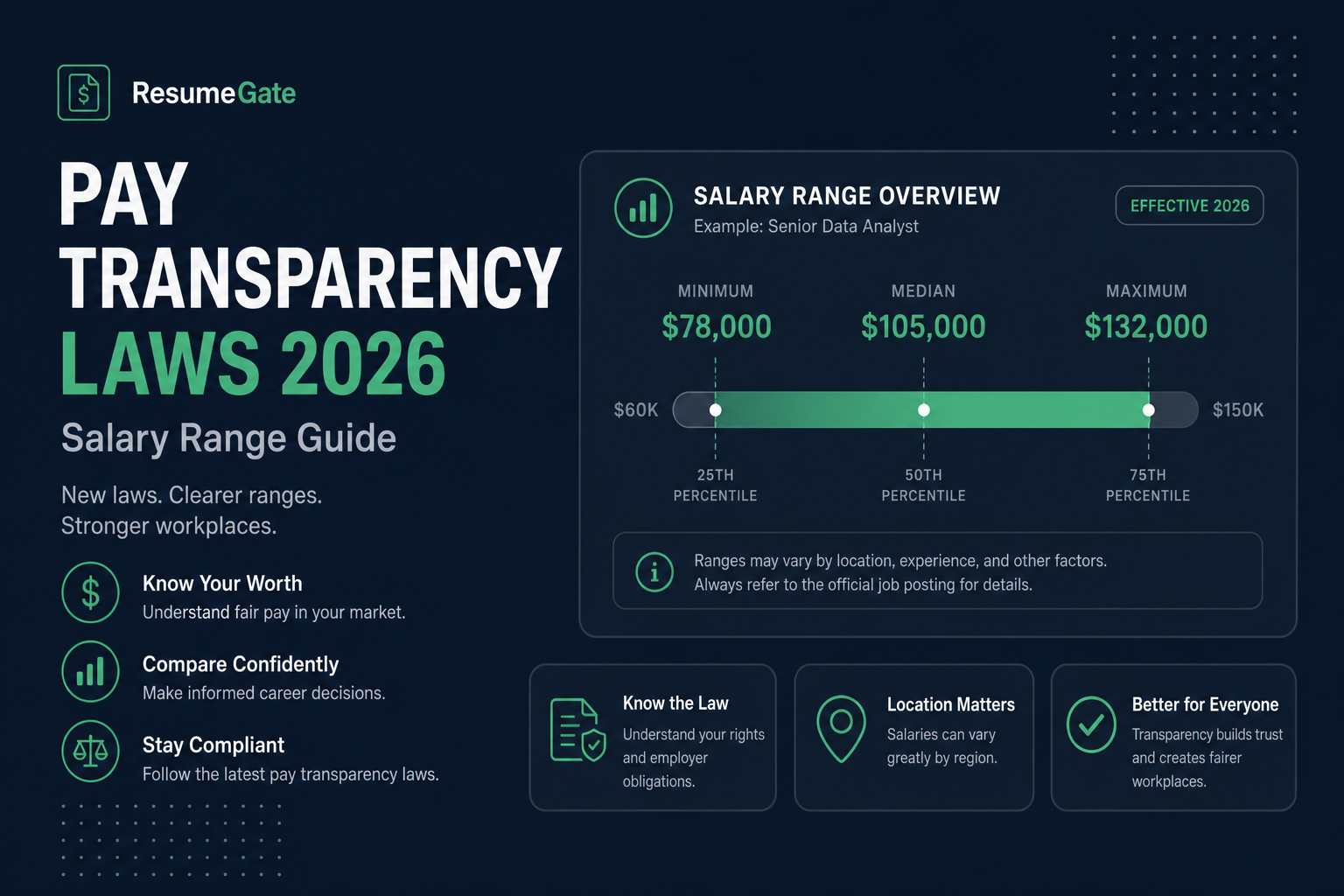
A few years ago, seeing a salary range on a job posting was a pleasant surprise. In 2026, it is increasingly the default — and in a large and growing number of jurisdictions, a legal requirement. Employers across a significant share of the United States, plus the European Union and other developed economies, must now attach some form of compensation disclosure to their job postings. If you are job searching today, that shift is one of the most practically useful changes the labor market has made in years — if you know how to read the numbers correctly.
The catch is that pay transparency laws did not automatically create honest salary disclosures. They created posted salary disclosures — and those are not the same thing. Employers have found ways to comply with the letter of these requirements while still obscuring what they would actually pay a strong candidate. A range of $60,000 to $140,000 technically satisfies most posting requirements while telling you almost nothing. Understanding the tactics behind these disclosures, and knowing how to use a posted range strategically regardless of how it was constructed, is where the real advantage lies.
This guide covers the current state of pay transparency requirements across jurisdictions, the two most common ways employers game the disclosure obligation, and a practical framework for using any posted range — wide or narrow, honest or padded — to your benefit at the offer stage.
This article is general information about workplace practices, not legal advice. Pay transparency rules vary by state and country and change frequently — verify the specific requirements that apply to you through your state labor department or an employment attorney before relying on them for a legal position.
Key Takeaways
- Where pay transparency laws stand in 2026, by jurisdiction type
- Why some posted ranges tell you almost nothing useful on their own
- A worked negotiation example using a posted range as your anchor
- What to do when no range is posted at all
- Frequently asked questions about pay transparency and negotiation
Where pay transparency laws stand in 2026
Jurisdictions that require some form of salary disclosure now cover a substantial and growing share of the employed U.S. workforce, and the trend shows no sign of slowing. Rather than cataloging specific statutes — which change more frequently than a blog post can be reliably updated — it is more useful to understand the three broad categories that most jurisdictions fall into, and what each means for you as a candidate.
| Category | What employers must do | What it means for candidates |
|---|---|---|
| Range required in the posting | Post a salary range alongside the job description before accepting applications | You can see a compensation figure before investing time in applying or interviewing |
| Range plus pay history protections | Post a range and, in many cases, are prohibited from asking candidates for their salary history | Stronger protection — you enter negotiations with market data rather than anchoring to your previous pay |
| No disclosure requirement yet | No legal obligation to post a range; salary history questions may still be permitted | You need to do more external research to establish a market anchor before negotiating |
A large and growing share of U.S. states now fall into the first two categories — many major population centers are covered — and the European Union's pay transparency directive has been pushing member states toward mandatory disclosure on a parallel timeline. Canada and several other developed economies have comparable frameworks at various stages of implementation. The practical effect is that a significant majority of white-collar job seekers in 2026 are searching in markets where employers are at minimum expected, and often legally required, to post a range alongside the job description.
One of the most consequential practical effects of these laws is their reach into remote work. When a job can be performed from anywhere, courts and regulators have generally taken the position that the disclosure rules of the most protective applicable jurisdiction apply — not just the rules where the employer is headquartered. A company based in a state with no disclosure requirement that posts a remote role visible to candidates in a jurisdiction with a posting requirement will typically need to comply with the stricter rule. As a candidate, this means that even in a state with no local requirement, many remote postings should still carry a range. When they do not, that absence is itself worth noting.
It is also worth noting that the speed of legislative change has been uneven across jurisdictions. Some states and countries moved quickly to strong, well-enforced requirements; others have passed laws with narrow scope or limited penalties that give employers significant room to technically comply without providing meaningful transparency. Checking whether the specific jurisdiction you are applying in has an active enforcement mechanism — not just a statute on the books — is worth a few minutes of research if you plan to use the posted range as the basis for a negotiation conversation.
None of this is a reason to treat a posted range as a legally binding contract or a precise reflection of what the company will actually offer. It is a starting point for your conversation — one piece of employer- supplied data that you can use strategically, as long as you understand how that data was produced and what incentives shaped it.
Key Takeaway
Treat posted ranges as a starting data point shaped by employer incentives—not a binding contract or a precise offer forecast.
Why some posted ranges are deliberately wide or misleading
When pay transparency laws first passed in various jurisdictions, many employers scrambled to comply in the least revealing way possible. The result is two well-documented employer tactics that technically satisfy the law while providing candidates with minimal useful information. Recognizing both patterns is the first step to working around them.
The compliance-padding tactic. An employer posts a range like $60,000 to $140,000. This satisfies the letter of a posting requirement — but a range that spans $80,000 tells you almost nothing about where you would actually land. Compliance padding is most common for roles where the employer genuinely has a wide internal pay band that spans multiple levels, but it is also used by employers who want maximum flexibility to offer as little as possible to candidates who do not push back. The range is technically real and technically useless as a negotiation anchor. A candidate staring at a $60K to $140K band has no rational basis for placing themselves within it without external benchmarks.
The anchor-low tactic. A more deliberate strategy is posting a range that sits near the bottom of what the company would actually pay a well-qualified candidate — often the minimum or low-mid portion of their internal band. The theory is that candidates who do not know the market will anchor their expectations to the figure they see, and that most people will not push toward the top of a range or above it. A role where the employer would comfortably pay $95,000 to a strong candidate gets posted with a range of $72,000 to $90,000. Most candidates apply without comment. Those who do negotiate tend to aim near the midpoint — around $81,000 — rather than asking for more than the stated top of the range. The employer captures most of the surplus.
Both tactics have countermeasures. For compliance padding, the range still establishes a floor — the minimum the employer is publicly committing to, at least in good-faith jurisdictions. Build your actual target from external benchmarks and use the posted floor as a sanity check, not as an anchor. For anchor-low ranges, the countermeasure is independent market data: when benchmarks from outside sources show the market rate for the role is higher than the top of the posted range, you have clear grounds to ask for more than the ceiling, as long as you can point to a specific external basis rather than simply asserting a higher number.
The broader point is that no posted range should be accepted at face value. It is one data point — employer-supplied, produced with the employer's interests in mind — and it is most valuable when read alongside other market signals rather than treated as a definitive statement of what the role is worth or what you should be willing to accept.
Key Takeaway
Wide or low-anchored ranges still give you a public floor—build your real target from external benchmarks, not the midpoint.
How to use the range in your favor — a worked example
Here is a concrete scenario. A role is posted with a compensation range of $70,000 to $95,000. You have seven years of directly relevant experience, you have managed a team before, and external salary benchmarks for the role in your metro area place the market rate between $88,000 and $105,000. The posting describes a mid-to-senior position that requires owning a function with minimal oversight.
The mistake most candidates make in this scenario is anchoring to the middle of the posted range — around $82,500 — because it feels like the safe, reasonable, non-greedy number. In practice, opening at the midpoint of a posted range signals to an experienced recruiter that you are not especially confident in your market value, and it gives away negotiating room that you could have preserved. You are also accepting the employer's framing as your own, rather than introducing your own anchor grounded in external data.
A stronger approach is to anchor at or slightly above the top of the posted range, backed by a specific rationale. Here is what that looks like in practice:
Example negotiation opener — role posted at $70K to $95K
"Based on the scope of this role and the independence it requires, I was thinking about compensation in the $95,000 to $100,000 range. My reasoning is that I bring seven years of directly relevant experience and have already managed a team in a similar function, which lines up with the senior end of the range you posted. Independent benchmarks I have looked at also put the market rate for this scope of role in this market at around $100,000 to $105,000. I want to be upfront about what I am targeting so we can figure out whether there is a path to making this work."
This opener anchors above the posted ceiling, provides a specific external basis for the number, frames the ask as collaborative, and does not apologize for the figure.
A few things this opener does that a midpoint ask does not: it uses the posted range itself as evidence that the request is not wildly out of scope — you are asking for just above the employer's own stated top figure, not an unrelated number. It introduces an independent market reference the employer cannot simply dismiss. And it frames the conversation as mutual problem-solving rather than a demand, which makes it easier for the recruiter to take the number to a hiring manager and advocate for it.
Even if the employer cannot reach $100,000, opening there typically lands you higher than opening at $82,500 would have. Negotiation research consistently shows that first offers anchor final outcomes — and when an employer has already committed to a posted ceiling in writing, asking for slightly more than that ceiling is far easier to defend than a demand that ignores the posted range entirely.
On timing: this conversation should generally happen after you have a written offer in hand, not during the screening call. If a recruiter asks for your salary expectations before an offer, you can acknowledge the posted range and indicate that you would rather discuss compensation fully once both parties have a complete picture of the role — deferring the anchor-setting to the point where you have the most negotiating power.
Note that many application portals ask for salary expectations at the submission stage itself, before you ever speak with a recruiter. Workday's application forms, for example, frequently include a required compensation field, and Greenhouse-powered postings often surface a similar prompt through a custom application question. When a numeric field is mandatory, entering the top of the posted range (or your researched target if no range is posted) is generally safer than leaving it blank, since some systems will not let you submit without a value.
One final note on the worked example: the same logic applies even when the posted range is wide or padded. If the range is $60,000 to $140,000, that does not mean you should aim at $100,000 simply because it is the midpoint. It means you should determine from external research where a candidate with your specific background and in your market would realistically land — and then anchor to that number with a rationale, independent of where the midpoint of the posted range happens to fall. The posted range is a constraint that defines the low end of the conversation, not a guide to where the conversation should end.
Key Takeaway
Anchor at or just above the posted ceiling with an external market rationale—and wait until you have a written offer before locking in a number.
A strong negotiation opener only works if your resume clearly supports the senior end of the range. Scan it free with HireFlow's ATS checker before you apply.
What to do when there is no range posted at all
Not every employer posts a range, and not every jurisdiction requires one. If you are looking at a posting with no compensation figure attached, you have several reasonable options — and the absence of a range is itself useful information about how the employer approaches compensation conversations.
It is also worth separating two distinct situations. The first is an employer in a jurisdiction with no disclosure requirement who simply has not provided a range — common, entirely legal, and not necessarily a red flag in itself. The second is an employer in a jurisdiction where disclosure is required who has omitted the range anyway — which may reflect an oversight, a deliberate choice to see whether candidates notice, or a misunderstanding of the applicable rules. Those two situations call for different responses. The first invites a direct ask; the second warrants a slightly more pointed question about whether the posting is compliant with local requirements.
Ask directly. In many situations, you have a practical right to ask what the budgeted range is for a role, even if the employer is not legally required to disclose it proactively. A straightforward question during or after a recruiter screen — "Could you share the budgeted compensation range for this role before we go further?" — is appropriate and increasingly expected. Many recruiters will answer without hesitation. Some will not.
Treat a refusal as data. An employer who declines to share any compensation information at any stage of the process — not just deferring the conversation until later, but actively refusing to engage with the question at all — is telling you something meaningful about how they approach negotiation and internal pay equity. It does not make the role a bad opportunity automatically, but it does mean you should enter any offer conversation with more caution, better external research, and a clearly established target number of your own.
Build your own number from market data. When there is no posted range to work from, the alternative is to establish your own anchor using external benchmarks before you reach the offer stage. Compensation data aggregators, professional association salary surveys, publicly reported figures for similar roles at comparable companies, and conversations with peers in your network who hold similar positions are all reasonable inputs. The goal is to arrive at the offer conversation with a specific, defensible number in mind — not a vague sense that you deserve more — so that you are not forced to anchor off the employer's first figure by default.
Consider the full picture before deciding whether to proceed. A missing salary range is not automatically a reason to walk away from an interesting opportunity. But it does shift more of the preparation burden onto you. If the company operates in a jurisdiction that should require a posted range and is not providing one, a polite but direct question about compliance is reasonable — though treat that conversation as informational rather than confrontational, especially early in the process. If the opportunity is genuinely compelling and the employer is otherwise professional, proceed — but do so with thorough market research and a clear target in hand before any offer lands.
Key Takeaway
No posted range means you ask early, treat refusals as signal, and arrive at offer stage with your own defensible market number.
Where to take this next
Understanding how to read and use a posted salary range is half the picture. The other half is making sure your resume and application give you the standing to credibly ask for the upper end of that range. If your materials do not clearly reflect the depth of experience that justifies a senior-end offer, even the best negotiation opener will be undercut by the documents behind it. Run your resume against the specific job description with HireFlow's Job Match Score to see how well your background reads against the posting before you apply, and make sure the document itself parses cleanly with a free scan on HireFlow . If you are also trying to decide whether to give a specific number or a range when an employer asks for your salary expectations, our guide on whether to share a salary range or a single number walks through the strategic tradeoffs in detail.
Frequently asked questions
In most cases, yes — a posted salary range is generally not a legally binding offer in the way a signed employment contract is. Some jurisdictions require that the posted range be in "good faith," which creates some accountability for wildly inaccurate disclosures, but enforcement is limited. This means a company that posted $70,000 to $95,000 could theoretically offer $67,000 at the offer stage. In practice, doing so exposes the employer to reputational risk and, in good-faith jurisdictions, potential legal scrutiny. If you receive an offer below a posted range, you have standing to ask why — and in writing, if the gap is significant. That question is reasonable, professional, and in many jurisdictions explicitly contemplated by the law.
Early research on this question is genuinely mixed, and the answer appears to depend heavily on how employers construct their ranges. When employers post narrow, accurate ranges, some studies suggest that average offers rise slightly — candidates who previously would have accepted below-market numbers gain a reference point and negotiate more effectively. When employers post wide or artificially low ranges, the effect is more neutral or slightly negative for candidates who simply anchor to the stated midpoint and do not push above it. The practical implication is that pay transparency is a tool, not a guarantee — it improves your outcome if you use the information actively, and provides less benefit if you treat the posted number as a ceiling rather than a starting point.
This is an actively evolving area, and the general direction of enforcement has been toward applying the rules of the jurisdiction where the candidate or remote worker is located, rather than exclusively the employer's home state. Many employers have responded by posting ranges on all remote job listings regardless of where individual applicants are located, to avoid tracking jurisdiction by jurisdiction. If you are in a state or country with a posting requirement and you see a remote role without a range, it is reasonable to ask whether the employer is complying with disclosure requirements applicable to your location — though frame that question as informational rather than adversarial, particularly early in the process.
A range that spans more than $60,000 to $70,000 for a single role at a single level is a strong sign of compliance padding rather than a genuine market estimate. If you see a range like that, treat it as providing only a floor — the minimum the employer is publicly committing to, at least in good-faith jurisdictions — and build your actual negotiation target from independent benchmarks instead. A padded range is not a reason to skip the opportunity, but it is a strong reason not to anchor your expectations to the midpoint of the stated figure, which may be well below what a qualified, confident candidate who negotiates would actually receive.
In jurisdictions with salary history ban provisions — which now make up a significant and growing share of pay transparency frameworks — employers cannot legally request your current or prior compensation at all. Even where it is permitted, you are generally not required to volunteer it, and sharing your current salary proactively typically works against you unless your existing pay is already at or above the market rate for the role you are targeting. If an employer asks and the question is permitted in your jurisdiction, you can redirect to your target rather than disclosing your current figure: "I would rather focus on the market rate and the value I bring to this role — I am targeting $95,000 based on the scope and the benchmarks I have looked at." That response is professional, direct, and keeps the anchor on your terms.
Most pay transparency laws focus on the hiring and posting side — what must be disclosed when an employer is recruiting externally. Internal pay equity (how existing employees are compensated relative to one another and to posted ranges) is a related but distinct issue, and far fewer jurisdictions have legislated binding requirements around it. Some employers have proactively run internal pay equity audits in response to transparency laws, recognizing that posting ranges for new hires can create difficult situations when long-tenured employees discover they are below the posted minimum for their own role title. That remains the exception rather than the rule. If internal equity matters to you, asking during the offer stage how the company approaches compensation reviews for existing employees is entirely appropriate — and the answer is informative regardless of what it is.