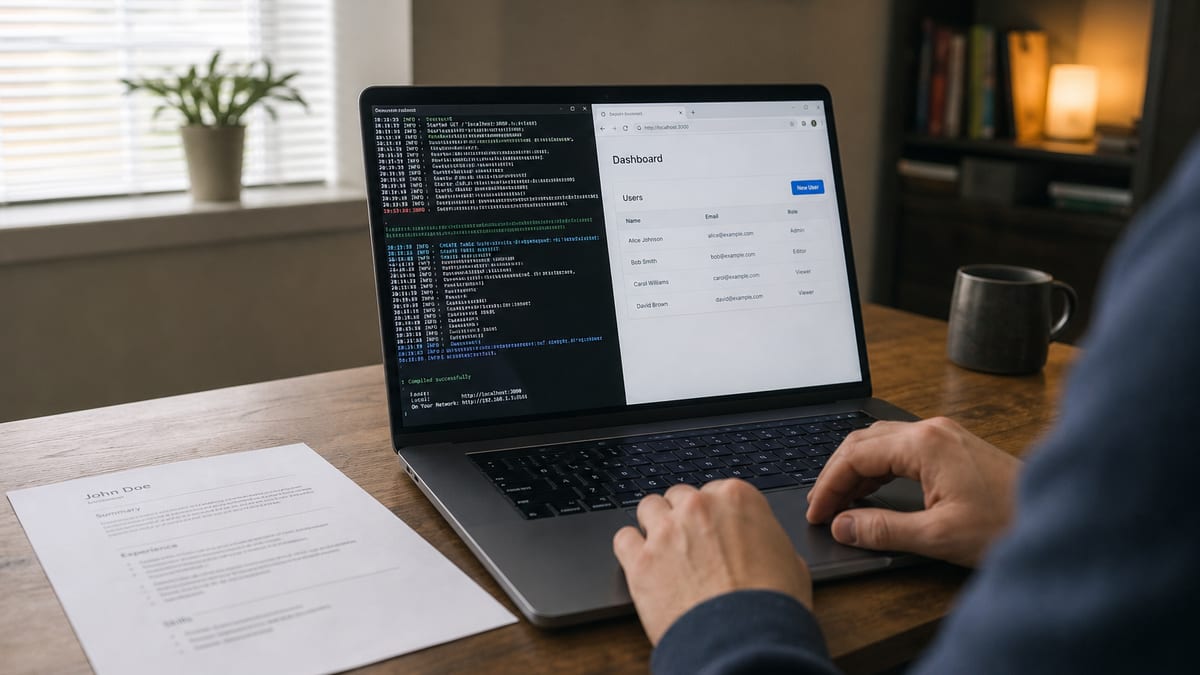
Yes, real open-source ATS-related tools exist. OpenResume (github.com/xitanggg/open-resume) includes a genuine resume parser you can self-host, and Reactive Resume (github.com/amruthpillai/reactive-resume) is a self-hostable resume builder with ATS-friendly templates. Neither is a perfect substitute for a maintained hosted checker, but both are real, inspectable code — not vague claims.
Here's what each one actually does, their genuine limits, how their parsing logic works under the hood, and when self-hosting is worth the setup effort versus just using a free hosted tool.
It's a fair question to ask, since a lot of ATS-checker sites lean on vague marketing language. OpenResume and Reactive Resume are different: their full codebases, commit histories, and issue trackers are public on GitHub, so any claim about what they check can be verified by reading the source rather than trusting a landing page.
OpenResume: an actual open-source parser
Key Takeaway
It's a real, documented 4-step parsing algorithm you can read line by line — not a black box.
OpenResume is an open-source resume builder and parser with roughly 8,700 GitHub stars, licensed under AGPL-3.0. Its resume parser page extracts text from your PDF using Mozilla's pdf.js library, groups text into lines, detects sections (Experience, Education, Skills), and scores how well fields like name, email, and phone were identified.
The project's own documentation is upfront about scope: the algorithm is designed for single-column resumes in English, and its last major commits were in late 2024 — so treat it as a solid structural sanity check, not a fully current model of every modern ATS.
OpenResume began as a free resume builder before the parser page was added, and both live in the same Next.js codebase. You can try the hosted version at open-resume.com without creating an account, or pull the source and run it against your own resumes to see exactly which function flags a missing field.
The project is maintained largely by a small group of contributors rather than a company or foundation, which is a common pattern for widely-used open-source tools. It's also a reasonable explanation for why updates have slowed since 2024 rather than stopped outright — there's simply less maintainer bandwidth than a funded product would have.
How OpenResume's parser actually works, step by step
Key Takeaway
The pipeline genuinely is four sequential stages — extraction, line grouping, section detection, then field scoring — not one opaque model.
The first stage reads your PDF with Mozilla's pdf.js library, which pulls out every individual text item along with its x/y position and font size on the page — not just a flat string of words. That positional data matters because the next stage uses it to rebuild which items sit on the same horizontal line.
Once lines are reconstructed, the algorithm groups consecutive lines into sections by looking for heading-style text — larger font size, bold weight, or common labels like "Experience," "Education," and "Skills" — that typically separates one part of a resume from another. A heading rendered as a graphic or icon rather than real text won't register as a heading at all.
Heuristic section detection also has known edge cases: resumes that use non-standard headings like "Where I've Worked" instead of "Experience," or that skip headings entirely in a compact one-page format, are more likely to confuse this stage than the extraction or scoring steps that come before and after it.
The final stage scores individual fields inside each detected section — checking whether something that looks like an email address, phone number, or date range appears where it's expected, then flagging how confident the match is. The parser's demo page shows this directly, highlighting each field so you can see exactly what it found and what it missed.
Because every stage is plain, readable TypeScript rather than a trained model, you can trace a parsing failure back to the exact function that produced it — something no closed hosted checker lets you do. That transparency is a big part of why the project is a useful reference even if you never plan to self-host it.
One detail worth knowing: OpenResume's parser runs entirely in your browser once pdf.js has loaded — your resume file itself is never uploaded to a server just to generate that field-by-field breakdown. That's a meaningful privacy property on its own, independent of whether you ever self-host the app.
Reactive Resume: open-source builder, not a scorer
Key Takeaway
Great for building an ATS-friendly resume from scratch with full data control — not for scoring one you already have.
Reactive Resume is a free, MIT-licensed resume builder that's fully self-hostable via Docker, with no account required for basic use on its hosted version at rxresu.me. It offers a range of templates and exports to PDF, DOCX, Markdown, and JSON, with privacy as a stated core principle — no tracking or ads.
It doesn't include a dedicated ATS scoring feature the way OpenResume's parser does. If your goal is checking an existing resume's ATS readability, OpenResume is the closer fit; if your goal is building a clean resume with full ownership of your data, Reactive Resume is the stronger option.
Under the hood, Reactive Resume runs a React front end against a NestJS backend, with PostgreSQL for data storage and a headless Chrome instance that renders each template to PDF server-side. That stack is also why self-hosting it involves more moving pieces than OpenResume's single Next.js process.
The project ships with a wide range of community-contributed templates and multi-language support, and its maintainers are explicit that privacy — not ATS scoring — is the core design goal. If you want to build a resume once and reuse the underlying data across formats, it's a genuinely useful tool regardless of its ATS-adjacent limits.
Reactive Resume has also attracted a broader base of outside contributors over time than OpenResume, which shows up in its longer list of supported languages and templates compared to OpenResume's narrower, parser-focused scope. That's a natural result of the two projects solving different problems for different audiences.
Open-source vs. hosted checker: honest trade-offs
Key Takeaway
Self-hosting buys you data control and transparency — it costs you setup time and currency of the parsing model.
The table below isn't marketing copy — it's the same trade-off you'd face with any self-hosted versus hosted software choice, just applied to resume tools specifically.
| Self-hosted (OpenResume) | Hosted checker (HireFlow) |
|---|---|
| Full code transparency, AGPL license | No setup, results in seconds |
| Requires npm/Docker setup to self-host | No installation required |
| No job-description keyword matching | Includes job-description match scoring |
| Last major update: late 2024 | Actively maintained |
Neither column is objectively better. A developer comfortable with Docker who wants full control over their data has good reason to pick the left column, while someone applying to ten jobs this week has good reason to pick the right one.
Before relying on either open-source project for anything time-sensitive, it's worth skimming its GitHub issues page. An actively discussed backlog of open bugs tells you more about current reliability than star count alone, and it's a habit worth building for any open-source tool you depend on.
Some people split the difference — use OpenResume locally to sanity-check formatting while drafting, then run a finished version through a hosted checker before submitting it, to get both the transparency and the job-specific keyword matching.
Want a quick score without cloning a repo?
Try HireFlow's free ATS checker — no setup, no signup, results in under a minute.
How to actually self-host each tool
Key Takeaway
OpenResume is a five-minute clone-and-run. Reactive Resume needs Docker and a database, but its Compose setup handles most of that for you.
If you want to try either tool on your own machine rather than the hosted versions, setup looks different for each — OpenResume is a single Next.js app, while Reactive Resume is a multi-service stack.
Self-hosting OpenResume
-
Clone the repository:
git clone https://github.com/xitanggg/open-resume.git -
Install dependencies inside the project folder with
npm install. -
Start the local dev server with
npm run dev. -
Open
localhost:3000in your browser — the resume builder and the resume parser page both run locally from there.
There's no database or environment configuration required for basic local use, which is part of why it's a reasonable first open-source project to read through if you're curious how resume parsing logic is structured.
Self-hosting Reactive Resume
-
Clone the repository:
git clone https://github.com/AmruthPillai/Reactive-Resume.git -
Copy the provided environment example file to
.envand fill in the required values, including database credentials and JWT secrets. -
Run
docker compose up -dto start the app alongside its PostgreSQL database and other bundled services. - Visit the port specified in your Docker Compose configuration to access your self-hosted instance.
Because it depends on PostgreSQL and a few supporting services, expect the first setup to take longer than OpenResume's. Budget time for reading the project's self-hosting documentation rather than expecting a single command to work on the first try.
For anything beyond local testing, both projects expect a bit more than the quick-start
commands above. OpenResume benefits from a production build (
npm run build
followed by
npm start
) behind a reverse proxy if you want it reachable outside your own machine, and Reactive
Resume's documentation covers additional environment variables for file storage and
email delivery that aren't required for a bare-minimum local run.
What OpenResume's parser actually flags: a before/after
Key Takeaway
Formatting, not content quality, is usually what separates a fully-detected resume from one with blank fields.
The clearest way to understand the parser's real behavior is to compare its output for two resumes with identical content but different formatting — one built for single-column, plain-text structure, and one built with a designer-style multi-column layout.
A well-formatted, single-column resume
Name: Jordan Rivera — detected
Email: [email protected] — detected
Phone: (555) 012-3456 — detected
Experience: 3 of 3 entries detected, with dates
Education: 1 of 1 entry detected
Every field resolves cleanly because the text items land in a predictable top-to-bottom, left-to-right order that matches how pdf.js reads coordinates off the page.
A multi-column, graphic-heavy resume
Name: Not detected
Email: Not detected
Phone: (555) 012-3456 — detected, out of order
Experience: 1 of 3 entries detected
Education: Not detected
The content didn't change — only the layout did. Multi-column designs interleave the left and right columns' text items when read by x/y position, which is exactly the single-column limitation OpenResume's own documentation warns about.
The practical fix mirrors what most ATS formatting guidance already recommends: convert multi-column layouts to a single column, and make sure section headings are real, selectable text rather than styled images, before assuming the content itself is the problem.
Who should actually self-host
Key Takeaway
Self-hosting makes sense for developers and privacy-focused users — not for someone who just wants a score today.
- Developers curious about parsing logic — OpenResume's algorithm is fully documented and readable.
- Privacy-focused users who want zero third-party data handling — self-hosting keeps everything on your own infrastructure.
- Teams building their own resume tooling — both projects are permissively licensed enough to build on top of (check AGPL-3.0 vs. MIT terms for your use case).
- Open-source contributors — both repos accept issues and pull requests if you'd rather fix a parsing edge case or add a template than just use the tool.
- Most job seekers who just want a fast score are better served by a maintained hosted checker — no npm install required.
If none of those describe you, the honest answer is that self-hosting solves a problem you probably don't have yet — and that's completely fine.
Frequently asked questions
Yes. OpenResume (github.com/xitanggg/open-resume) is a real project licensed under AGPL-3.0 with roughly 8,700+ GitHub stars. It includes a dedicated resume parser page that extracts text from a PDF using Mozilla's pdf.js and reports how well fields like name, email, and work experience were detected.
Yes. Both OpenResume and Reactive Resume can be cloned and run locally or on your own server — OpenResume via a standard Next.js dev server, Reactive Resume via a documented Docker deployment with PostgreSQL.
Not a dedicated scoring tool — Reactive Resume is primarily an open-source resume builder with ATS-friendly templates, rather than a parser that scores an existing resume. For an open-source parser specifically, OpenResume is the closer match.
Its own documentation notes the algorithm is designed for single-column resumes in English. It's also had no major commits since late 2024, so it won't reflect the newest ATS parsing behaviors, and it doesn't offer job-description keyword matching the way a job-specific checker does.
Mainly for data control — nothing leaves your own server — and for developers who want to inspect or modify the exact parsing logic. If you just want a quick score and keyword gap without running Docker, a hosted checker is faster to use.
Not necessarily. Accuracy depends on how current and well-tested the parsing logic is, not on where it runs. A well-maintained hosted checker can outperform an open-source project that hasn't been updated recently.
To use the hosted versions at open-resume.com or rxresu.me, no. To self-host either one on your own server, yes — you'll need basic comfort with npm, Docker, or both, plus a database for Reactive Resume's self-hosted setup.
It can. AGPL-3.0 is a copyleft license — if you modify OpenResume and run it as a network service, the license generally requires you to make your modified source available too. Reactive Resume's MIT license is far more permissive for commercial use, with no such requirement. Read each repository's LICENSE file directly before building a product on top of either one.