12 min read
You don't need a thirty-day vision board. You need fourteen days where every morning has a job, and that job isn't "scroll boards until you're numb." If you're employed, you'll shrink the blocks, but you won't skip the order.
Most slow searches share a shape: a generic resume, unlimited targets, and outreach that happens only when anxiety spikes. The teardown below judges daily plans against that shape. Before you block calendar time, check your resume for free on a live posting so week one isn't spent uploading a file Workday mangled on page two.
Below you'll see the bar a serious two-week sprint clears, before/after pairs for different roles and schedules, what weak plans still share, and copy-paste blocks for your calendar. Job searching is draining; a plan should reduce decisions, not add guilt on days you're tired.
If your last two weeks were fifty quick applies and zero recruiter replies, you're not failing as a person. You're running the wrong weekly script. Swap the script before you swap careers.
Open your calendar app. If there's no recurring block labeled "apply" or "outreach," you've been hoping interviews appear. Hope isn't a system. The pairs show what to put in those blocks instead.
Quick Wins
- Fix one single-column PDF before you add a single req to the tracker.
- Cap the target list at twelve roles with must-have skill overlap.
- Batch three applications in one sitting; tailor only the top bullet and summary line.
- Book two outreach blocks in week two, same time each day.
The standard two-week job search plans are judged against
Recruiters don't reward busywork. They reward files they can read fast and candidates who match the req they are trying to close this month. Your plan should force those two outcomes, not "feel productive."
File first: Days 1 to 2 are for parsing, not applying. One column, standard fonts, Month Year dates, and bullet one that names a tool from your target role. If you skip this, every later hour is wasted when the profile looks blank in Greenhouse.
Capped targets: Twelve reqs max for the sprint. Each row in the tracker gets a fit note, portal, req number, and date applied. Unlimited lists create unlimited half-fit apps.
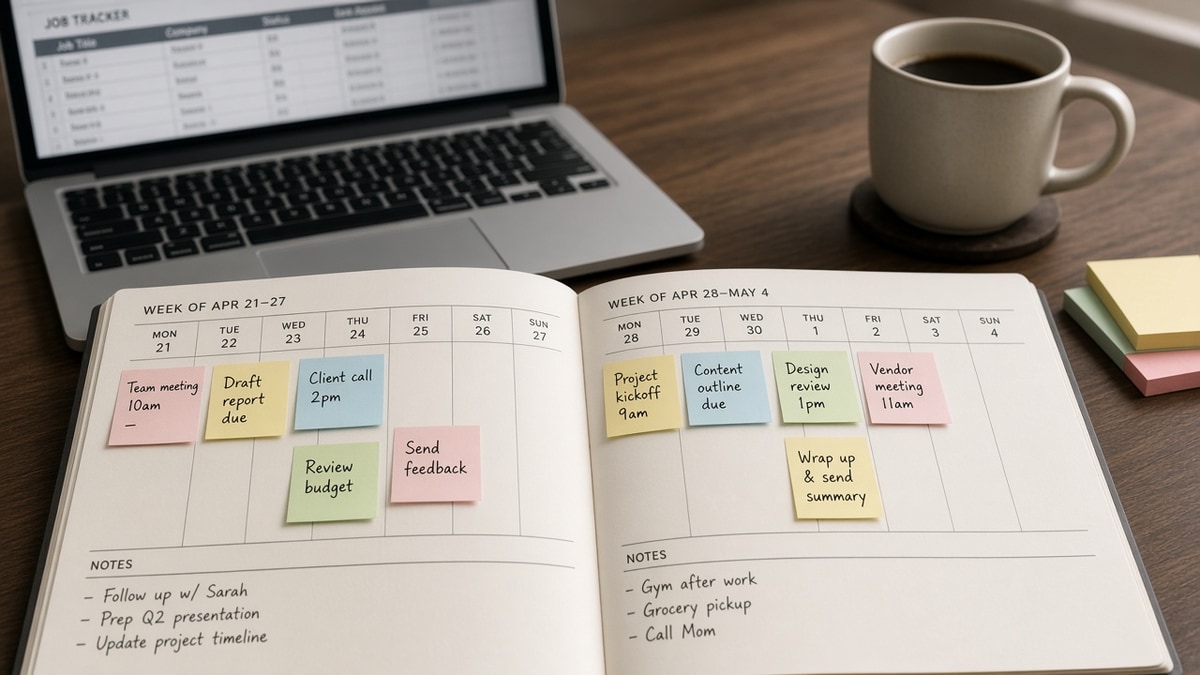
Daily blocks, not moods: Apply batches Mon/Wed, outreach Tue/Thu, interview prep Fri, admin and follow-ups Sat. When you're employed, halve the time, keep the order.
Proof before volume: One outreach note per apply with a req-specific proof line beats ten "just checking in" messages with no hook.
I've screened stacks of these in Workday and Greenhouse, and the profiles that move to phone screens during a sprint almost always belong to people who applied to fewer reqs with cleaner files, not people who won a race to click submit forty times.
Read networking messages that don't feel spammy before you paste outreach into week two. The calendar only works if the note is one ask and one proof line.
A job search plan for faster interviews isn't a motivation poster. It's a set of tradeoffs: fewer companies, more tailoring depth, and scheduled human contact instead of hoping a parser loves keyword soup.
The two-week window is long enough to run one full cycle and short enough that you can see whether the target list was wrong. If week two ends with silence, you adjust titles and employers, not your worth.
Job Search Plan for Faster Interviews (2-Week System): before/after pairs
Pair 1: Week one calendar (marketing coordinator)
Before: "Week 1: apply everywhere, update resume sometime, network if I have energy."
After: "Mon: ATS check on base PDF plus three target reqs. Tue: rewrite top bullet for email ops stack. Wed: apply to reqs 1102, 1108, 1114 with tailored summary line. Thu: recruiter notes for those three. Fri: draft two STAR stories on campaign launches. Sat: tracker review, drop two misfit reqs."
Pair 2: Week two calendar (same candidate)
Before: "Week 2: keep applying randomly, panic follow-ups, no interview prep until someone calls."
After: "Mon: apply to four new reqs from capped list only. Tue: follow-ups on week-one apps with one new metric. Wed: mock screen with friend, record audio. Thu: outreach to two hiring managers on reqs already submitted. Fri: research companies with screens next week. Sat: reset list, add three fresh reqs for next sprint."
Pair 3: Daily morning block (data analyst)
Before: "Morning: coffee, job boards, apply until bored, maybe tweak a bullet."
After: "8:00 to 8:15: open tracker, pick two reqs, paste JD keywords into notes. 8:15 to 9:00: tailor bullet one for SQL and Looker, upload to Workday, log req number. 9:00 to 9:20: send recruiter note with proof line on pipeline dashboards. Stop when block ends."
Pair 4: Target list row (customer support lead)
Before: "Company: BigCo. Role: anything customer related. Status: applied?"
After: "BigCo Req 4421 Support Lead. Must: Zendesk, WFM, 8+ agents. Fit: 9/12 (missing WFM vendor name in resume). Portal: Greenhouse. Applied: blank until Wed block. Outreach: Thu if applied."
Pair 5: Application batch (operations analyst)
Before: Same PDF for thirty roles, cover letter repeats resume bullets, no req numbers saved.
After: One base PDF, three uploads per session. Change summary clause and bullet one only. Cover letter adds one process win not on the resume. Tracker updated before closing the laptop.
Pair 6: Outreach note after apply (software engineer)
Before: "Hi, I applied to your company and would love any opportunities. Please review my profile."
After: "Hi Morgan, I applied to Backend Engineer Req 9912 in Greenhouse on Tuesday. Last year I shipped Go payment webhooks with on-call rotation. Are you still screening for that req, or should I ask the platform lead instead? Happy to keep this to email."
Copy-paste two-week skeleton (adjust times to your job)
Week 1
Mon: Parser check + pick 12 reqs + build tracker columns.
Tue: Resume bullet rewrites for top three must-have tools.
Wed: Apply batch A (3 reqs) + log numbers.
Thu: Recruiter outreach for batch A.
Fri: STAR stories (2) + read company news for top five targets.
Sat: Drop weak reqs, add three replacements, prep Mon batch B.
Week 2
Mon: Apply batch B (3 to 4 reqs).
Tue: Follow-ups on week 1 with one new proof line each.
Wed: Mock interview or take-home prep block.
Thu: Hiring manager or alumni outreach (2 notes max).
Fri: Interview prep for any scheduled screens.
Sat: Retro: which titles replied, which portals ghosted, refresh list.
Pair 7: Tracker columns (project coordinator)
Before: Spreadsheet with company names only, no dates, duplicate rows for the same req.
After: Columns: Company, Req ID, Title, Portal, Fit score, Applied date, Outreach date, Follow-up date, Stage, Next action. One row per req, color when stale past ten business days.
Pair 8: Interview prep slot (finance analyst)
Before: "I'll prep when they schedule." Then cram the night before with generic answers.
After: Friday 45 minutes: pick two reqs, write four bullets on close process and one variance story, read last earnings headline for each company. When a screen lands, you're extending notes, not starting from zero.
Edge case: searching while employed
Run the same two-week map on ninety-minute weeknight blocks. Stack applications on Tue/Thu nights, outreach on Wed lunch, tracker admin on Sunday. Don't burn PTO for mass applying; use PTO for interviews once screens land.
Edge case: remote-only filter
Tag reqs "remote verified" only when the JD states it or the portal field is explicit. Otherwise you'll waste week one on hybrid roles you'd quit on day one. Shrink the list to eight if the filter is tight; depth beats twelve maybes.
What to do in the next ten minutes
Duplicate the copy-paste skeleton into your calendar. Pick three live reqs. Run one free parser check. If bullet one doesn't name a tool from req one, fix that before you schedule apply blocks.
See follow-up email after interview examples when week two turns outreach into scheduled screens. If a portal requires a letter, use the cover letter generator for a short add-on that doesn't repeat your proof line verbatim.
Pair each outreach block with a fresh read of the JD. If the posting changed mid-sprint, update the tracker before you send a note that references a closed req.
When a recruiter replies, protect the next morning block for response instead of new applies. Momentum on warm threads beats cold volume every time.
What slow two-week searches still share
Applying before the file parses. A pretty PDF that scrambles in Taleo wastes every block that follows. Parser check is day one, always.
No req numbers in the tracker. Follow-ups without a req ID look like bulk mail. Recruiters can't map you to a row in their dashboard.
Treating outreach as optional. Portals are queues. A short note won't bypass policy, but it often gets a human to open your profile while the req is active.
Interview prep only after scheduling. Week two screens go badly when stories aren't drafted yet. Friday prep blocks exist for a reason.
Changing the whole resume per app. You'll burn out by req four. Tailor summary plus bullet one; keep the rest stable so you can actually finish twelve.
Ignoring fit scores. If you're missing half the must-haves, the plan won't fix it. Swap titles before you swap calendars.
Weekend guilt spirals. The sprint includes a Saturday retro, not seven-day grind. Rest is part of the system so week two notes don't sound exhausted.
Chasing new boards instead of finishing the list. Fresh shiny reqs midweek derail batches. Finish the twelve, retro, then refresh.
Pair the sprint with fit scoring and a clean upload
Before you lock the target list, run the job match score on each must-have req. Drop rows below a honest fit threshold so week one isn't wasted on portals that will auto-reject.
Re-run the free ATS checker after you rewrite bullet one for each batch. The proof line in outreach should match what the recruiter sees when they open the attachment from your note.
Fourteen days, then reset
A two-week system works when you treat the calendar like a production schedule: file, list, batch, outreach, prep, retro. Speed comes from clarity, not caffeine.
Start tonight: paste the skeleton, pick three reqs, run one parser pass, and schedule the first apply block. When the fourteen days end, read the tracker before you add more companies. Double down where humans replied, not where portals went dark.
And if you need a reset mid-sprint, shrink the list before you abandon the plan. Eight well-fit reqs beat twelve maybes every time.
Save the calendar as a template, not a shrine. Next sprint, swap employers and proof lines, keep the blocks. That's how a job search plan for faster interviews stays repeatable without turning into another full-time job.
Read more
Frequently asked questions
Cap quality apps, not volume. Most people do better with eight to twelve tailored uploads in two weeks than forty generic ones. Each app should share one base resume file, one tailored top bullet, and one tracked req number. If you are still applying past twelve, you probably skipped the target list step and are guessing at fit.
Yes, but shrink the daily blocks. Employed searchers often run ninety-minute evening sprints instead of four-hour mornings. Keep the same sequence: fix the file once, build the target list on weekend one, batch applications midweek, and stack outreach on Thu/Fri when recruiters are scheduling screens. You trade total hours, not the order of moves.
Follow up once, about five business days after apply, only on roles where you match must-have skills. Reference the req number, add one proof line, and ask one question. Do not follow up on every portal submission. The plan builds follow-ups into week two so they are deliberate, not panic pings on day two.
You can get screens from strong fit plus clean uploads alone, but the plan assumes light outreach. A short note to the recruiter after apply often gets your profile opened in Greenhouse before the req closes. Skipping outreach is allowed; just expect slower human eyes on the same file.
Run the file fix on day one and address the gap in bullet form, not a defensive essay. Use the same two-week calendar, but swap one application slot for a contract or volunteer proof line that maps to the posting. Interview prep still starts in week two so you are not cramming stories the night before a surprise call.