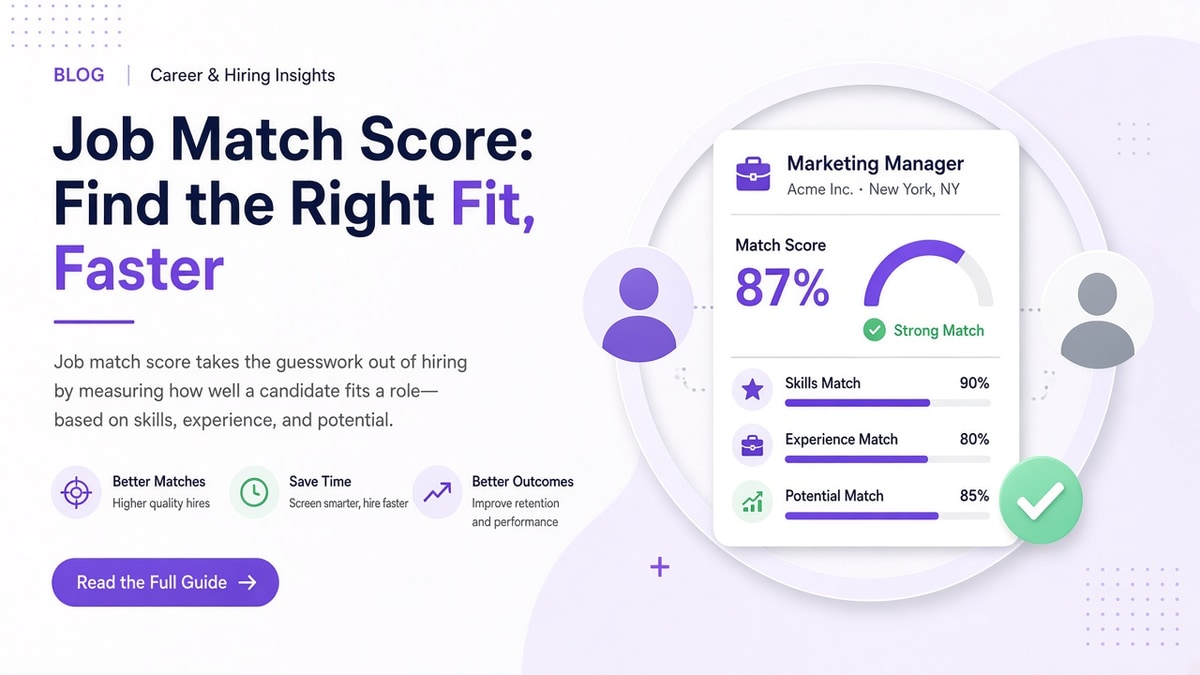
When you apply for a job online, your resume doesn't go directly to a hiring manager's inbox. Instead, it passes through a job match scoring algorithm that ranks you against other candidates before a human ever sees your application. Understanding how this job match score works—and how to optimize for it—can dramatically improve your interview chances.
Job match score explained in practical terms: it's a numerical rating (usually 0–100) that measures how closely your qualifications align with the job posting. The algorithm analyzes your resume, experience, skills, and job history to calculate this score. Recruiters use it to shortlist candidates, often only reviewing applications that exceed a minimum threshold.
In this guide, you'll learn:
- What factors influence your job match score
- How different platforms calculate scoring differently
- Common mistakes that tank your score
- Proven strategies to improve your ranking
- Why two similar resumes can receive vastly different scores
Why Job Match Scores Matter for Your Job Application
Job match scores are the gatekeepers of modern hiring. When a position attracts hundreds or thousands of applications, recruiters rely on algorithmic ranking to filter candidates efficiently. Your score determines whether your resume reaches the hiring manager or gets buried in the system.
The reality: most job boards and ATS platforms use automated scoring to rank candidates. If your score falls below the recruiter's cutoff (often 60–75%), your application may never be manually reviewed, regardless of your actual qualifications. This means optimizing for the algorithm is as important as having relevant experience. understanding how job platforms rank applicants helps you position yourself competitively from the start.
Key Components of Job Match Scoring Algorithms
Keyword Matching and Relevance
The foundation of most job match scores is keyword alignment. The algorithm scans your resume for terms that appear in the job description. If the posting mentions "Python," "machine learning," and "AWS," and your resume contains these exact terms in relevant contexts, your score increases.
However, simple keyword presence isn't enough. Advanced algorithms evaluate keyword context and frequency. Mentioning a skill once in a bullet point scores differently than listing it multiple times across different roles. The system also recognizes related terms—"JavaScript" and "JS" may be treated as equivalent, while "Python" in a project description carries more weight than appearing in a skills list without supporting evidence.
Experience Level and Seniority Matching
Job match algorithms evaluate whether your career level aligns with the role's requirements. If you're applying for a senior position but your resume shows only junior-level experience, the algorithm penalizes your score—even if you have the technical skills. Conversely, overqualification can also lower your score if the system flags you as a flight risk.
The algorithm assesses seniority through job titles, tenure at each position, and scope of responsibility. Years of experience in the specific domain matter significantly. A developer with 8 years in backend engineering scores higher for a senior backend role than someone with 8 years across multiple specialties, even if both have identical technical skills.
Skills Gap Analysis
Modern job matching systems perform skills gap analysis by comparing your resume skills against the job requirements. The algorithm identifies which required skills you possess, which are missing, and which are bonus qualifications. This creates a gap score that influences your overall ranking.
If the job requires 5 core skills and you have 4, your gap score is lower than a candidate with all 5. However, if you demonstrate related skills that suggest you could learn the missing requirement quickly, some advanced systems give partial credit. what ATS systems read in your skills section directly impacts this scoring component.
Industry and Domain Expertise
Job match algorithms weight industry-specific experience heavily. If you're applying to a fintech role, experience in financial services or banking boosts your score. If your background is entirely in retail tech, you start with a lower baseline score, even if your technical abilities are strong.
Domain expertise is measured through job titles, company types, and industry-specific terminology in your resume. The system recognizes that someone who's worked at three different banks understands financial domain challenges better than someone with equivalent technical skills from non-financial backgrounds. This factor often determines whether you're considered a strong match or a reasonable backup candidate.
How Job Match Algorithms Differ Across Platforms
Not all job match scoring systems work the same way. LinkedIn, Indeed, Glassdoor, and specialized job boards use different algorithms with varying weights for keywords, experience, and skills. Understanding these differences helps you tailor your resume for each platform.
LinkedIn's algorithm emphasizes profile completeness, endorsements, and network connections alongside resume keywords. Indeed focuses heavily on keyword density and exact phrase matching. Specialized platforms (like those for tech, healthcare, or finance) often incorporate domain-specific scoring that general job boards don't use. why niche job boards often perform better partly stems from their more sophisticated, industry-tailored matching algorithms.
Some platforms also factor in your profile activity, application history, and engagement metrics. If you've been active on the platform and have a strong completion rate, your score may receive a slight boost. Others use machine learning to predict which candidates are most likely to accept an offer or perform well, adjusting scores based on historical hiring outcomes.
Common Mistakes That Lower Your Job Match Score
- Keyword stuffing: Jamming unrelated keywords into your resume to game the algorithm backfires. Modern systems detect keyword stuffing and penalize it. Your resume should read naturally to human recruiters while still containing relevant keywords in proper context.
- Using generic job titles: If your actual title was "Associate" but you list it as "Senior Developer," the algorithm may flag this as inconsistent. Use your real job title but clarify your actual responsibilities in bullet points to boost relevance without misrepresenting yourself.
- Ignoring the job description: Applying with a generic resume that doesn't reference the specific role's requirements tanks your score. Customize your resume for each application by mirroring language from the job posting where it accurately reflects your experience.
- Poor formatting that breaks parsing: If your resume uses unusual formatting, graphics, or tables, the algorithm may fail to parse it correctly, missing key information. resume formatting errors that break ATS parsing directly lower your match score by preventing the system from reading your qualifications.
- Omitting relevant experience: If you have experience that matches the job but don't mention it because you think it's outdated or minor, you're leaving points on the table. Include all relevant experience, even if it's from earlier in your career, especially if it matches the job's requirements.
- Vague bullet points: Saying "worked on projects" scores lower than "led development of three customer-facing features using React and Node.js." Specific, quantified accomplishments with relevant keywords score significantly higher.
Best Practices to Improve Your Job Match Score
- Mirror job description language: Extract key terms from the job posting and incorporate them naturally into your resume. If the posting emphasizes "cross-functional collaboration," mention projects where you collaborated across teams. This alignment signals to the algorithm that you're a strong fit.
- Lead with relevant experience: Place your most relevant roles and accomplishments at the top of your resume. Algorithms often weight earlier content more heavily, so put your strongest matches first.
- Use a clear, standard resume structure: Follow a conventional format: contact info, summary/headline, experience, skills, education. Algorithms parse standard structures more accurately than creative layouts. resume structure that improves interview rates also optimizes for algorithmic parsing.
- Include a skills section: Dedicate a section to listing relevant skills. This gives the algorithm a clear target for skills matching and helps with keyword recognition. List skills in order of relevance to the target role.
- Quantify achievements: Numbers improve scores. Instead of "improved performance," say "reduced load time by 40%" or "increased conversion rate by 25%." Quantified results demonstrate impact and provide more specific keyword matches.
- Match experience level claims: If applying for a senior role, ensure your resume reflects senior-level responsibilities: managing teams, setting strategy, mentoring, or driving major initiatives. If applying for mid-level, show growth and increasing responsibility without claiming executive-level work.
- Keep it to one or two pages: Longer resumes may dilute keyword density or contain irrelevant information that confuses the algorithm. Focus on the most relevant 10–15 years of experience.
- Customize for each application: Generic resumes score lower than customized ones. Spend 5–10 minutes reordering bullet points and adjusting language to match each job posting's priorities.
Step-by-Step Guide to Optimizing for Job Match Scoring
- Analyze the job description: Read the posting carefully and highlight all required skills, experience, and qualifications. Note the language used—exact phrasing matters for keyword matching.
- Assess your alignment: For each requirement, honestly evaluate whether you meet it. Mark which you have strong evidence for, which you partially meet, and which you lack. This reveals your gap score.
- Reorder your experience: Move roles and accomplishments that best match the job to the top of each section. Algorithms often weight earlier content more heavily.
- Integrate job description keywords: Where you genuinely have relevant experience, use the job posting's terminology. If they say "agile methodology" and you've used it, say so explicitly.
- Expand your skills section: Add skills from the job posting that you possess but may not have explicitly listed. Be honest—only include skills you can defend in an interview.
- Refine bullet points: Rewrite accomplishments to include metrics and relevant keywords. Vague statements should become specific, quantified achievements.
- Test formatting: Save your resume as both PDF and Word, then open each to ensure formatting is clean and readable. Poor formatting breaks algorithmic parsing.
- Review for consistency: Ensure job titles, dates, and company names are consistent. Inconsistencies can lower scores and raise red flags in background checks.
Conclusion: Taking Control of Your Job Match Score
Job match score explained simply: it's the algorithmic gatekeeper between your resume and a hiring manager's inbox. Understanding how these algorithms work—what they prioritize, how they weight factors, and where they fall short—gives you a competitive advantage in your job search.
The key takeaway: optimize for both the algorithm and the human. Use relevant keywords and clear structure to pass the algorithm, but write compelling, specific accomplishments that engage recruiters. Match the job posting's language and requirements without keyword stuffing. Customize your resume for each application to improve your match score while maintaining authenticity.
Your next step: audit your current resume against a recent job posting you applied to. Identify missing keywords, weak bullet points, and formatting issues. Make targeted improvements and reapply if the position is still open. As you refine your approach, you'll see higher match scores, more recruiter reviews, and ultimately, more interviews.
Frequently asked questions
A score of 75–85% is generally considered strong and likely to result in recruiter review. Scores above 85% are excellent and typically fast-tracked. Scores below 60% rarely receive human review unless there's a specific reason (like a strong referral). However, thresholds vary by platform and employer. Some recruiters review all applications regardless of score; others only look at top 20%. The platform and recruiter behavior matter as much as the absolute score.
Most job boards don't display your match score before submission. LinkedIn shows estimated match percentages for some roles, but these are rough estimates. You can estimate your own score by comparing your resume against the job description: count how many required keywords you have, assess experience level alignment, and evaluate skills gaps. This manual assessment helps you decide whether to customize your resume before applying or skip the application if you're significantly underqualified.
Most modern job boards use some form of algorithmic ranking, but implementation varies widely. Large platforms like LinkedIn, Indeed, and Glassdoor use sophisticated machine learning algorithms. Smaller or niche job boards may use simpler keyword matching. Company career pages often use basic ATS systems that score resumes but may not be as advanced as job board algorithms. Regardless of the specific algorithm, optimizing your resume for keyword matching, experience alignment, and clear formatting helps across all platforms.
Several factors explain score differences: resume formatting (one may parse better than the other), keyword placement and context (same skills mentioned differently), experience recency (more recent roles may weight higher), profile completeness (LinkedIn factors in profile strength), and application timing (some systems factor in when you applied). Additionally, if resumes are uploaded to different platforms, they use different algorithms entirely. why two similar resumes get different ATS scores explores this in detail.
No. A high match score gets your resume past the algorithm, but hiring managers make the final decision. Your resume then competes on readability, communication clarity, and demonstrated impact. Some candidates with 90% match scores don't interview because their resume is poorly written or doesn't tell a compelling story. Conversely, candidates with 70% scores sometimes interview because they have strong referrals or their resume stands out despite lower algorithmic ranking. The match score is a necessary condition, not a sufficient one.
Yes, if you're serious about the role. Customization doesn't mean rewriting your entire resume—it means reordering bullet points to prioritize relevant experience and adjusting language to match the job posting's terminology. This 5–10 minute investment significantly improves your match score and increases interview chances. For mass applications to similar roles, you can use a template that emphasizes relevant skills, but for targeted applications to specific positions, customization is worth the effort.
Done for you
Turn this advice into an interview-ready resume
Professional writers rebuild your resume for ATS + recruiters — unlimited revisions, interview guarantee.