12 min read
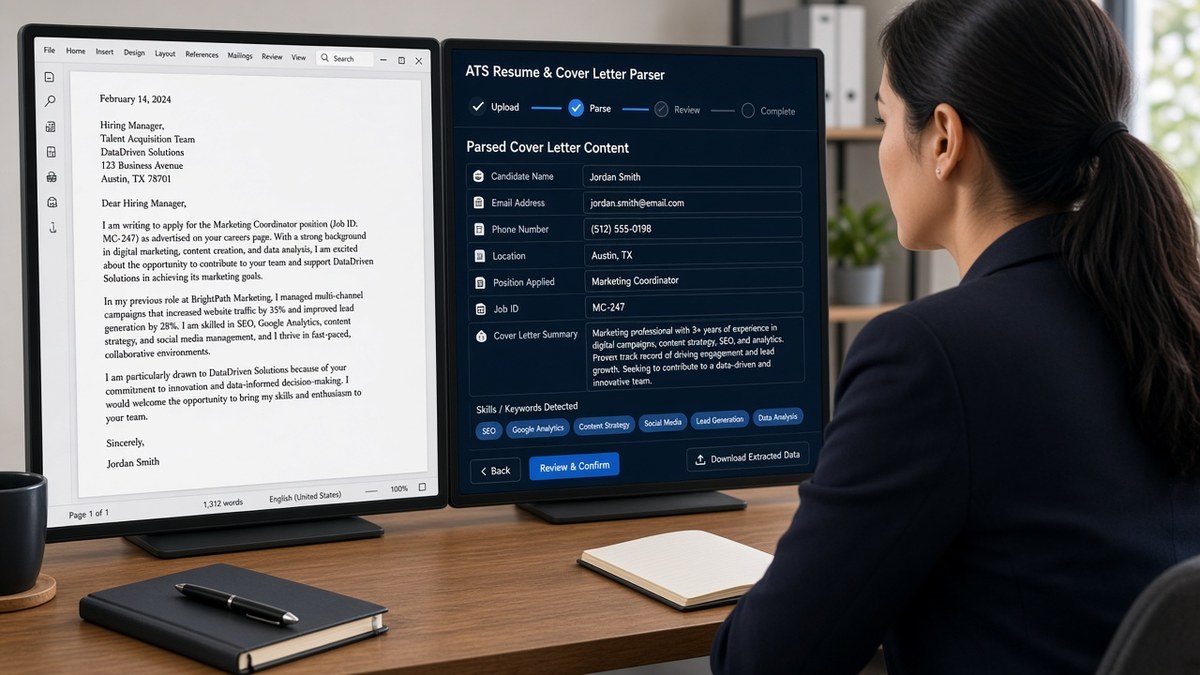
Your cover letter isn't a second resume. In most US corporate stacks it's a text extract bolted onto the same candidate profile as your PDF. How US ATS processes cover letters matters because recruiters search what parsed, not what you designed in a sidebar template.
Workday, Greenhouse, Lever, and iCIMS strip formatting first. They keep words, mostly. Contact lines, company names, role titles, and skill tokens that match the posting survive. Tables, logos, and header blocks usually vanish. That gap between your PDF and the stored text is where strong candidates look generic.
Before you rewrite tone, check your resume for free against the posting. The letter can't fix a resume that never parsed. Align contact lines across both files, then tune the letter paragraphs below.
You don't need a novel. You'll need four short blocks that survive paste test rules you already use on resumes. The pairs below show weak lines next to lines that store cleanly for operations, finance, engineering, and customer roles.
Job searching's slow enough without uploading a letter the portal can't read. If you're batch applying tonight, fix the resume file first, then draft one bracket template you can swap per employer without breaking parse rules.
Quick Wins
- One column, plain Word or Google Doc, export text-based PDF.
- Same name, phone, and email as the resume header block.
- Company name and exact job title in the first paragraph.
- Three posting keywords in sentences, not a keyword list.
What US ATS keeps when you upload a cover letter
Think upload, convert to text, attach to candidate ID, index tokens. Greenhouse often shows the letter as a separate document on the profile. Workday may fold extracted text into search alongside resume rows. Lever varies by employer configuration.
The parser does not reward design. It rewards readable strings: Hiring Manager, Acme Corp, Senior Operations Analyst, SQL, Looker, stakeholder reporting. Those strings become searchable even when nobody opens the PDF on day one.
What usually drops: images, text boxes, multi-column layouts, footer disclaimers, and contact lines locked in a header region. What usually survives: plain paragraphs, hyphen bullets, and spelled-out month names in project examples.
Edge case: optional cover letter fields left blank never hurt parsing because nothing runs. Edge case: portals with a paste box skip file conversion entirely and store exactly what you typed. Treat paste boxes like Notepad, not like Word layout.
Edge case: referral uploads where a recruiter attaches your letter later still get indexed if the file is text-based. Edge case: internal transfers sometimes skip letter fields while external applicants on the same req do not.
What recruiters see versus what the parser stores. On Greenhouse I often open the attachment after the profile loads. On Workday I search tokens first, open second. If search returns nothing because the letter was an image PDF, you're relying on someone opening an blank-looking row.
Sentiment scoring and tone models show up in vendor marketing more than daily screens. Do not write for an AI mood detector. Write short proof a human can scan. Professional, specific, and free of tables beats clever formatting every time.
Read why cover letters still matter for competitive roles when you're deciding whether to write one on optional reqs. Parsing rules still apply when you do.
How US ATS processes cover letters: before/after pairs
Judge every line against two tests. Paste test: select all, paste to Notepad, read order. Posting test: highlight three required terms from the ad, confirm each appears once in a sentence, not a list stuffed at the bottom.
Operations analyst (Workday-heavy employers)
Before: Dear Sir/Madam, I am a hard worker excited about your opening. I have experience with reports and teamwork. Please see my resume.
After: Dear Hiring Manager, I am applying for the Operations Analyst role at Northwind Logistics. In my current role I built weekly SLA dashboards in Looker and cut reactive tickets 11% in Q3 while owning vendor scorecards across twelve carriers.
Corporate finance (Greenhouse common)
Before: To Whom It May Concern, my diverse background makes me a great fit. I am proficient in Excel and communication.
After: Dear Hiring Manager, I am applying for the Financial Analyst role at Harbor Retail Group. I close monthly P&L for forty locations, automate variance notes in Excel, and partner with store ops on inventory shrink targets.
Backend engineer (keyword proof without stuffing)
Before: I love coding and want to join your fast-paced team. Skills: Python Python Python microservices Kubernetes gRPC.
After: Dear Hiring Manager, I am applying for the Backend Engineer role at Relay Payments. I own gRPC services in Go on Kubernetes, migrated five REST endpoints to protobuf contracts, and cut cross-service p99 latency from 420ms to 180ms last year.
Customer success (scope the team size)
Before: I am passionate about customers and would be honored to join your amazing company culture.
After: Dear Hiring Manager, I am applying for the Customer Success Manager role at Signal Desk. I manage a book of forty-two mid-market accounts on Zendesk and Salesforce, hold CSAT at 96%, and run quarterly business reviews that reduced churn on my tier.
Product manager (tie letter to one shipped outcome)
Before: I have led many cross-functional initiatives and thrive in agile environments.
After: Dear Hiring Manager, I am applying for the Product Manager role at Lattice Works. I shipped self-serve onboarding that lifted activation 14 points in two quarters by pairing user research with experiment logs in Amplitude.
Closing block (same structure every time)
Before: Thanks!!! Looking forward to hearing from you soon :)
After: Thank you for reviewing my application. I welcome a conversation about how my reporting work maps to your Q4 ops roadmap. Sincerely, Jordan Lee · 512-555-0142 · [email protected]
Copy-paste skeleton (swap bracket lines):
Jordan Lee
512-555-0142 · [email protected]
Dear Hiring Manager,
I am applying for the [Exact Job Title] role at [Company Name]. [One sentence with posting keyword one and a metric from your resume.]
[One sentence with posting keyword two and scope: team size, region count, or tool name.]
[Optional one sentence on why this company: product, customer segment, or public roadmap item you can name without flattery.]
Thank you for reviewing my application. I welcome a conversation about [posting keyword three or team goal from the ad].
Sincerely,
Jordan Lee
Healthcare admin (compliance language without tables)
Before: I am a dedicated professional seeking to use my skills in a dynamic healthcare environment.
After: Dear Hiring Manager, I am applying for the Patient Access Supervisor role at Mercy Ridge Health. I lead twelve registrars across two clinics, hold prior-auth turnaround under forty-eight hours, and train new hires on Epic pre-service workflows.
Sales development (name the quota mechanics)
Before: I am a motivated seller who hits goals and loves outreach.
After: Dear Hiring Manager, I am applying for the SDR role at Relay CRM. I booked thirty-two qualified meetings last quarter at 128% of sequence target using Outreach and Salesforce activity logs.
What each pair fixes
Weak lines hide employer name, req title, and tools the posting repeats. Strong lines put the title in sentence one, the company in the same sentence, and one metric or scope marker recruiters can verify on a screen call.
Do not add a second page to fit more keywords. Extra length does not improve extraction. It increases truncation risk on mobile uploads and tired recruiter skim time.
Upload order on multi-step applications
Most Workday flows want resume first, letter second, demographics last. Upload the repaired resume, open preview, then attach the letter. If you upload the letter before the resume parses, some profiles attach the letter to an empty shell and never re-index when the resume lands.
Greenhouse one-page apply often accepts both files in one step. Still name files consistently and run paste test on each before submit. A broken letter will not tank a strong resume, but it wastes a customization slot you spent twenty minutes writing.
Before: Upload cover letter PDF from Canva, then resume PDF from an older export with mismatched phone.
After: Upload Lastname_Northwind_Analyst.docx resume, confirm preview rows, then upload Lastname_Northwind_Analyst_Letter.pdf exported from the same Word session with identical header digits.
What weak cover letters share after parsing
Generic salutations with no role title. Dear Hiring Team parses, but it signals zero customization. Use Hiring Manager when the name is unknown. Put the exact req title in sentence one.
Keyword footer blocks. A paragraph of comma-separated tools at the bottom reads like stuffing to recruiters and adds little beyond what the resume already indexed.
Mismatched contact lines. Resume shows one phone number, letter shows another. Some stacks flag duplicates. Some attach the letter to the wrong profile merge. Match digits exactly.
Repeating the resume summary verbatim. Parsers store both. Recruiters see redundancy. Use the letter for one proof point and one company-specific line instead.
Fancy PDF exports. Canva and InDesign letters fail the paste test the same way resumes do. Write in Word, export PDF, confirm selectable text.
Long letters on mobile uploads. Portals truncate or timeout on large files. Stay under one page and under four hundred words unless the posting asks for more.
Salary or relocation paragraphs in optional letters. Unless the posting asks, keep comp and relocation out of the letter body. Those answers belong in application fields with numeric validation, not free text that parses beside your skills.
Attachments with different names. Resume_Last.pdf plus CoverLetter_Final_v3.pdf makes profile merge harder for coordinators. Use Lastname_Company_Role for both files every time.
Read the US cover letter final review checklist before submit. It catches contact mismatch and title drift in five minutes.
Draft and match in one pass
Start from the posting in the job match score tool to see which three terms belong in paragraph one. Then generate a cover letter skeleton and swap bracket lines for the before/after proof above. Same company name, same title string, same phone as the resume file.
Fix resume parsing before you upload the letter. Optional letters do not rescue broken Experience rows. Upload both files in one session so profile merge stays clean.
Track uploads in the same spreadsheet as applications: company, req title, resume file name, letter file name, date. When a coordinator emails asking for a clean copy, you won't send the wrong version from Downloads.
Upload checklist
How US ATS processes cover letters is simpler than the myths. Upload, strip format, index text, attach to your profile. Recruiters search those tokens later. Your job is to make the stored text as specific as the PDF looks.
Write four blocks: salutation with req title, proof paragraph, optional company line, close with contact. Run paste test. Match resume header digits. Upload both files in one sitting.
When the posting marks the letter optional, write one anyway on your top five reqs. Keep it under four hundred words. Name the company once in paragraph one and once in the optional why line at most. Repetition parses fine. It reads lazy to humans.
Optional fields still matter on roles you want badly. A plain letter beats a missing one when two resumes tie. Keep it short, named, and readable to software first and humans second.
Batch applying tonight? Draft one letter template with brackets, then swap company and title per req. Do not reuse the same company paragraph across employers. Parsers do not care, but recruiters do.
I've screened stacks of these in Workday and Greenhouse, and the letter that wins names the req, proves one outcome, and matches the resume header. Everything else is noise before the first human read.
Read more
Frequently asked questions
No. Many reqs mark cover letters optional and some Greenhouse workflows store the file without keyword scoring. Workday often attaches the letter to the candidate record as a searchable document when you upload one. Treat optional as worth doing on roles you care about. The letter still feeds recruiter search tokens when the file parses as text.
Plain text, contact lines that match the resume header, employer and role names you type, and skill tokens that also appear in the job description. Tables, images, and header/footer blocks usually drop. Fancy fonts convert to blanks. The stored value is closer to a pasted Notepad file than your designed PDF.
Overlap core terms from the posting, but do not paste duplicate paragraphs. The letter should add proof the resume lacks: why this company, one metric from a relevant project, or scope the resume bullet trimmed. Identical keyword blocks in both files look templated to recruiters even when the parser accepts them.
Text-based DOCX or PDF exported from Word. Same rule as resumes. Avoid Canva PDFs and scanned images. When the portal offers a paste box instead of upload, paste plain text without bullet icons. A one-page letter under four hundred words parses fully on every stack I use in US corporate hiring.
Often yes on narrow shortlists, rarely on first-pass volume screens. They search names, companies, and skill tokens pulled from both files. A readable letter helps on tie-breakers. A broken parse means they open the attachment manually or skip it. Write for the human who has ninety seconds, but format so the text layer survives upload.