11 min read
You've got a valid clearance and you're not sure what belongs on page one. Maybe a former colleague told you to paste the investigation date so recruiters know you're current. Maybe your last resume still names a program you can't discuss in a hallway. Defense and federal contractor reqs want proof you can access classified space. They don't want your SF-86 details in a PDF that gets forwarded to three hiring managers.
Check your resume for free with the posting pasted in before you upload to Workday or Taleo. You'll often see clearance language in Skills while Experience still carries a codename from 2019. The parser and the security officer read different risks. One wants a mapped field. The other wants you to stop oversharing.
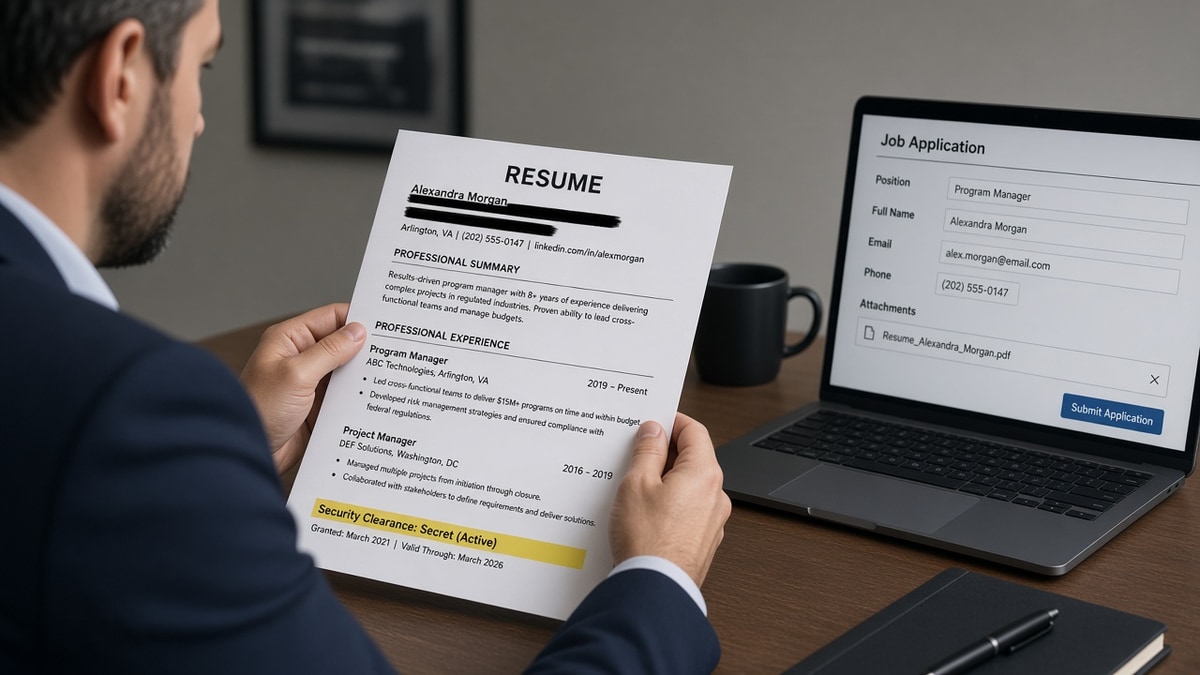
The safe pattern isn't complicated. Level plus active or eligible status. One dedicated Clearances section. No investigation dates, badge numbers, or project nicknames anywhere on the file. Below: six steps, before/after lines by role, two edge cases, mistakes that get resumes pulled, and copy-paste wording you can drop in tonight. Job searching with a clearance adds paperwork anxiety on top of the usual silence. This won't speed up adjudication. It stops a qualified file from dying because line four read like a classified email.
Quick wins
- One line per clearance: level plus Active, Inactive, or Eligible only.
- Label the section Clearances so Workday and iCIMS can map it to knockout fields.
- Scrub Experience bullets for codenames; use generic scope under cleared work.
- Match the same wording on portal clearance questions and the resume.
How to list security clearances on a US resume safely: what belongs on the page
A security clearance on a resume is a trust signal, not a biography. Recruiters screening defense contractor reqs need to know you hold or can obtain the level the statement of work requires. They verify status later through official channels. Your job on page one is to state level and access status in plain language a parser can read and a hiring manager can skim in five seconds.
Include: clearance level (Confidential, Secret, Top Secret), whether access is active or inactive, reinvestigation eligibility if true, and polygraph type only when the posting explicitly asks and you can state it without compartment detail. One line. Maybe two if you hold both DoD and IC eligibility with different statuses.
Exclude: investigation or adjudication dates, clearance certificate numbers, granting agency internal codes, SAP or SCI compartment names, project codenames, and customer agency names tied to classified work. Those details belong in controlled personnel systems. A resume circulates wider than you think.
Where it lives: a dedicated Clearances section with a standard heading. Not in the header next to your phone number. Not woven through a summary paragraph. Workday often has a separate clearance dropdown. When your resume section label matches what the form expects, triage moves faster because the recruiter does not hunt through bullet four for a maybe.
Experience still proves domain. A systems engineer might write: maintained classified Linux environments for defense clients under active Secret clearance. The clearance line confirms access. The bullet confirms stack and scope without naming the program office.
Read resume rejected by ATS when your file never reaches a human even though the clearance line looks fine. Format and section order still gate defense reqs the same way they gate commercial ones.
Six steps to list security clearances on a US resume safely
Work in order. Confirm status before you draft wording. Build the section before you tweak Experience. Match portal fields last so resume and form agree.
Step 1: Confirm level and status from your own records
Pull your most recent clearance documentation or HR letter. Note level, whether access is active, and if you're reinvestigation eligible. Write those three facts on a sticky note. Do not copy dates or case numbers onto the resume draft.
Before: Clearances section reads Top Secret, adjudicated March 2021, DOD CAF case pending reinvestigation.
After: Top Secret clearance, inactive, reinvestigation eligible.
Step 2: Add a labeled Clearances section in a parser-friendly slot
Place Clearances after Skills or Certifications on a single-column layout. Use the word Clearances as the heading, not Security Credentials or Access Authorizations. Parsers and recruiters have seen Clearances thousands of times. Creative headings bury the field.
Before: Active TS/SCI with poly, mentioned once in a three-line summary under the name block.
After: Dedicated Clearances section below Certifications with one line: Active Top Secret clearance.
Step 3: Write one safe line per clearance level
Format: [Level] clearance, [status]. Status is Active, Inactive, Eligible, or a short reinvestigation phrase. No commas stuffed with dates. No parenthetical agency abbreviations unless the posting uses the same abbreviation.
Before: Secret clearance (granted 2019, reinvestigation due 2024).
After: Active Secret clearance.
Step 4: Rewrite Experience bullets without codenames or compartment titles
Defense work often feels impossible to describe. You can still show scope. Replace program nicknames with mission type, stack, and outcome. Move access proof to the Clearances section so you're not repeating level in every bullet.
Before: Lead engineer on Project NIGHTJAR SCIF migration, TS/SCI SAP, 40 engineers.
After: Led SCIF network migration for classified defense client under active Top Secret clearance; 40 engineers, zero lost accreditation days during cutover.
Step 5: Mirror the same level on Workday, Taleo, or iCIMS knockout questions
Portal forms often ask clearance level before resume upload finishes parsing. If the form says Secret required and you select Yes but the resume is silent, triage assumes mismatch. Copy the exact level string from your Clearances section into the dropdown or free-text field.
And if you're eligible but not active, answer Eligible or Previously held on the form the way your line reads on the resume. Contradictions between form and file trigger manual review queues that add weeks without an interview.
Step 6: Export PDF and confirm the section survives upload
Save as single-column PDF from Word or Google Docs. Avoid text boxes for the Clearances block. Upload to your target portal or run a parse check. If Clearances disappears or lands at the bottom after Skills, switch to a simpler heading style and re-export.
I've screened defense contractor packets where the clearance line was perfect and Experience still leaked a codename in bullet two. Security review flagged the file before recruiting finished triage.
Before/after: cybersecurity analyst, Secret roles
Before: Summary says cleared professional; Skills lists TS/SCI, CISSP, Splunk; no Clearances heading; Experience names a three-letter agency customer.
After: Clearances section with Active Secret clearance; Experience bullet reads monitored classified enclave endpoints for defense integrator under active Secret clearance, 12K hosts, mean time to detect down 18%.
Before/after: program manager, inactive clearance
Before: Previously held TS until 2023, willing to reactivate; investigation paperwork available upon request.
After: Top Secret clearance, inactive, reinvestigation eligible. One line. No paperwork offer on the resume.
Copy-paste clearance lines
ACTIVE ACCESS:
Active Secret clearance
Active Top Secret clearance
INACTIVE / REINVESTIGATION:
Secret clearance, inactive, reinvestigation eligible
Top Secret clearance, inactive, reinvestigation eligible
NEVER HELD, CAN OBTAIN:
Eligible for Secret clearance (US citizen)
Eligible for Department of Defense security clearance
EXPERIENCE BULLET SHELL (no codenames):
[Verb] [scope] for [defense/federal integrator type] under active [level] clearance: [metric].
Edge case: dual status (active Secret, eligible for Top Secret upgrade)
List current access first. Second line only if upgrade is in process and you can state it without investigation detail. Example line one: Active Secret clearance. Line two: Top Secret upgrade in process. Do not add investigator names or submission dates. If upgrade is not yet sponsored, stick to eligible language instead of in process.
Edge case: clearance through a prior employer, not current role
Clearance follows the person when still active, not the job title on your latest bullet. Keep the Clearances section current even if your present role is commercial and uncleared. If access lapsed when you left the cleared employer, switch to inactive or eligible wording. Do not imply active access to make a commercial gap look defense-ready.
When the req also wants a cover letter, mirror the same level string there in sentence two. Read how to follow up after sending your resume if you applied through a portal and heard nothing after two weeks. Clearance reqs often move on government funding cycles, not your typo count.
Lines that get clearance resumes flagged or skipped
These patterns show up in defense recruiting queues more than spelling errors. Fix them before you blame the market.
Mistake 1: Investigation dates in the Clearances section
Dates look specific and credible. They also publish timeline data that isn't yours to share on a resume. Recruiters infer current from active language. Dates invite security review.
Mistake 2: Codenames in Experience because the work feels vague without them
Generic scope beats a named program every time for screening. Codenames can pull the file from circulation even when the clearance line is clean.
Mistake 3: Clearance only in Skills as a keyword dump
TS/SCI listed between Python and Kubernetes tells the parser nothing about status. A labeled Clearances section with Active or Eligible wins knockout mapping.
Mistake 4: Claiming active when access ended
Background checks compare your statement to official records at offer stage. Inactive stated honestly still beats active stated falsely.
Mistake 5: Mismatch between portal answers and resume wording
Form says Secret, resume says active TS. Manual review slows everyone. Copy the same string both places.
Before: Summary claims fully cleared; form left blank; Experience names classified customer.
After: Clearances section, matched portal field, generic defense integrator language in bullets.
Check parse before you upload to a cleared req
Clearance language does not fix a two-column template or a header the parser drops. Run the free ATS checker with the defense posting pasted in. Confirm Clearances survives as its own block and required terms from the statement of work still appear under Experience.
Some federal integrators still ask for a short cover letter naming clearance level and availability. Generate a cover letter from the posting, then paste your one-line clearance status from the resume into paragraph two. Same level, same active or eligible wording. One story across both files.
Fix your clearance section tonight
How to list security clearances on a US resume safely comes down to one habit: level plus status in a labeled Clearances section, nothing else. No dates. No codenames. No badge numbers in the margin. Experience shows what you did in generic terms. The clearance line shows what door you can walk through.
Open your file now. Add or fix the Clearances heading. Rewrite one Experience bullet that still names a program. Match the portal dropdown to the same string. Export PDF. Run the checker on the req you have open.
Run a free resume check before the next defense upload. You won't control funding cycles or investigation backlog. You can control whether page one reads like a screening document or a leak.
Read more
Frequently asked questions
No. Investigation and adjudication dates belong in personnel files, not on a resume a recruiter forwards. Write level plus status only: Active Secret clearance or Top Secret clearance, eligible for reinvestigation. HR verifies dates during onboarding. A date on page one creates unnecessary exposure if the PDF circulates outside the hiring team.
Use a dedicated Clearances section with a plain heading recruiters and parsers recognize. Place it after Skills or Certifications, not inside contact lines or a summary paragraph. One line per clearance level. Workday and iCIMS often map a labeled section to knockout questions faster than a clearance mention buried in bullet three under a defense job.
No project codenames, program nicknames, or compartment titles on a resume. Describe scope in generic terms under Experience: supported classified network operations under active Secret clearance. The clearance line confirms access level. Experience confirms domain. Mixing codenames into either section is how files get pulled from circulation.
State level plus eligibility, not a lapsed date. Example: Secret clearance, inactive, reinvestigation eligible. That signals you held access before and can likely reactivate faster than a candidate who never held one. Do not claim active if your access formally ended. Recruiters check status against government databases during contingent offer stages.
Yes, when the role requires cleared work. Knockout forms and resume text should match. If Workday asks Secret required and your resume stays silent, triage may assume you do not hold one. Mirror the same level and status in both places. Keep wording identical so a skim and a form click tell the same story.