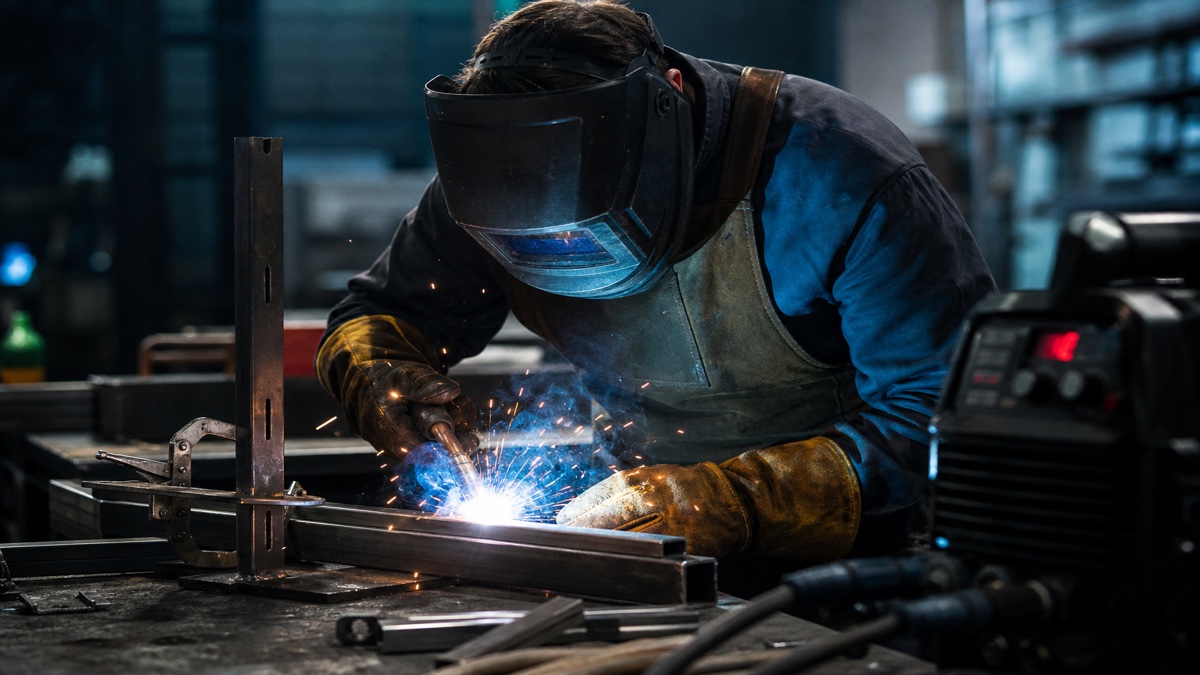
You become a welder by learning a process, proving it on a code-qualified test plate, and getting hired to keep that qualification current—not by buying a national license. The United States has no universal welder license. Shops, shipyards, and pipeline contractors qualify you to AWS D1.1, AWS D1.5, API 1104, or ASME Section IX procedures, then screen applications on Workday and Oracle Taleo for those exact process and code words in plain text.
Welding joins metal with heat and filler so the joint meets a drawing and an inspection standard. That sounds simple until you meet the real forks: stick versus wire versus TIG, shop versus field, plate versus pipe, and a continuity log that can lapse if you stop welding that process. This guide covers how to become a welder in 2026 using Bureau of Labor Statistics occupation 51-4121, honest training options, the certifications employers actually call out, how specialties differ, and how to write a resume hireflow.net applicants can check against a live posting before they hit submit.
| Path | Typical entry | What employers verify | Watch-outs |
|---|---|---|---|
| Trade school / community college | Months of booth time + coupon tests | Process, position, and any AWS ATF card | Classroom hours do not replace shop production |
| Employer trainee / helper | Hire, then WPS test on the job | Fit-up, safety, and passing the shop coupon | Training quality varies by shop |
| Registered apprenticeship | Multi-year paid OJT + class | Hours, related-instruction, and code tests | Often via pipefitter, boilermaker, or ironworker |
| Military / prior craft crossover | Documented welding MOS or helper time | Translate process and thickness to civilian codes | Civilian WPS still required at most shops |
Key Takeaways
- No nationwide welder license—qualification is to a procedure, code, and continuity log
- AWS D1.1, D1.5, API 1104, and ASME Section IX are different tests for different work
- SMAW, GMAW, GTAW, and FCAW are hire filters; list the ones you can still pass
- BLS 51-4121 shows modest employment growth but tens of thousands of replacement openings a year
- Trade school, employer training, and apprenticeship all work if they lead to paid welding hours
- Workday and Taleo miss process and code names hidden in graphics or two-column layouts
Welder career outlook: BLS occupation 51-4121 in 2026
Before you pay tuition or wait on an apprenticeship list, look at the federal numbers as they are published—not as social posts rewrite them. The Bureau of Labor Statistics outlook for welders, cutters, solderers, and brazers uses SOC code 51-4121. For 2024, BLS reported about 457,300 jobs and a median annual wage of $51,000 ($24.52 an hour). Typical entry education is a high school diploma or equivalent, with moderate-term on-the-job training after you are hired.
Employment is projected to grow 2 percent from 2024 to 2034—slower than the all-occupations average. That is not a collapse story. BLS still projects about 45,600 openings a year on average over the decade, mostly because people leave the occupation or retire. If you can pass a current structural or pipe test and show up for shutdowns, you are competing for replacement demand as much as for "new" headcount.
Industry mix matters more than the national median. BLS notes that manufacturing employs the largest share of 51-4121 workers, with smaller shares in specialty trade contractors, self-employment, and repair. Shops often run GMAW or FCAW on shifts. Field contractors pay travel and overtime on outages, then go quiet. Pipeline, shipyard, and pressure-equipment work usually pay more because inspection and schedule risk are higher.
O*NET's welder profile (51-4121.00) lists blueprint and WPS reading, heat control, and self-inspection before QC. Physical demands are real: plate, overhead, heat, and fumes (including hexavalent chromium on some stainless work). Travel shutdowns mean weeks away and drug tests; local plants trade that for shift work. Signal which lifestyle you want on the resume so recruiters do not waste a slot.
Related mechanical trades share job-site culture and sometimes the same contractor career portals. If you are still choosing among crafts, compare this path with how to become an electrician —that trade is state-licensed in a way welding usually is not—and skim keyword patterns used for plumber resume keywords and HVAC technician resume keywords when the same GC or millwright contractor posts mixed-craft helper roles.
Key Takeaway: BLS 51-4121 is a large occupation with slow headline growth and heavy replacement hiring—your edge is a current, named procedure test plus a resume that matches shop versus field postings.
Training paths: trade school, employer programs, and apprenticeship
There is no single school that "makes" you a welder. There are three honest pipelines, and they overlap. What they must share is time under the hood on joints that look like the work you want, plus a test someone will stamp.
Trade school and community college
Vocational and community-college certificates teach SMAW, GMAW, GTAW, and FCAW plus blueprint reading. Useful programs inspect coupons and, as AWS Accredited Test Facilities, can issue AWS Certified Welder credentials for specific procedures. Ask which codes they test, whether local shops hire graduates, and how many clock hours you spend welding versus sitting in theory. High school career-tech and military hours count if you can name process, position, and material. Civilian shops still usually retest you to their WPS.
Employer training and helper work
Many fabrication shops hire fitter helpers, grinders, and trainee welders, then test you after you prove you can fit square, keep the booth clean, and follow lockout and hot-work rules. This path is faster into a paycheck. The risk is narrow skill: you might only run GMAW on 1G plate for a year. Ask for a written progression—when you test 3G/4G, when you see pipe, who pays for failed coupons. If the answer is "we will see," you are cheap labor until you advocate for a test date.
Apprenticeship and craft overlap (pipefitter, boilermaker, ironworker)
Welding is often a skill inside another registered apprenticeship. Pipefitters weld and fit process pipe. Boilermakers weld pressure parts and heavy plate. Ironworkers weld structural steel. Those programs combine paid OJT, related instruction, and code tests. Compare union and merit-shop packages—wages, travel, and whether they test to AWS D1.1 or ASME Section IX. Bring OSHA 10, a driver's license, and a one-page resume that already names processes you have practiced. Treat helper months as an audition.
Key Takeaway: Pick the path that puts you on inspected joints with a named WPS—school, shop trainee, or craft apprenticeship—then document hours and test dates from week one.
AWS, ASME, and API certifications employers actually ask for
Certification in welding is not a diploma on the wall. It is evidence that you deposited a weld that passed visual and often bend, nick-break, or radiographic inspection for a specific procedure. If you cannot name the code, process, thickness range, and position, you do not have a useful cert for ATS or for the welding engineer.
AWS D1.1 is the structural steel code for buildings and most shop and field steel. Tests are often 3G and 4G groove welds. AWS D1.5 is the bridge code—do not assume D1.1 covers highway or rail bridges. API 1104 covers pipeline welding, usually pipe positions (5G, 6G) with strict continuity. ASME Section IX is how many boiler, vessel, and process-piping shops qualify welders to a WPS, including shop TIG on stainless even when a posting only says "TIG certified."
The AWS Certified Welder program documents a procedure at an Accredited Test Facility. It is portable, not a lifetime license, and shops may still retest you. Continuity is typically a six-month window: weld that process or retest. Expired cards look worse than no card. You will also see AWS D17.1 (aerospace), NAVSEA and society rules in shipyards, and company-only WPSs. List what is current.
OSHA does not issue a welder license, but electrical safety for welding and cutting, hot-work permits, fire watch, confined-space awareness, and PPE show up in contractor onboarding. Put OSHA 10 or 30 and hot-work experience in plain text.
Key Takeaway: Name the code (D1.1, D1.5, API 1104, ASME IX), process, and position, and keep continuity—generic "AWS certified" without details fails both inspectors and parsers.
Choosing a process and specialty: SMAW, GMAW, GTAW, FCAW, and beyond
Process choice is a labor-market choice. Learn what your region pays for, then add a second process when you have hours in the first.
SMAW (stick) is the field workhorse for structural steel, repairs, and many pipe roots. It works in wind better than gas-shielded processes. GMAW (MIG) dominates production fabrication; postings that say "MIG welder" usually mean shop GMAW on carbon steel. FCAW (flux-cored) is common on structural steel and ironworker 3G/4G tests; watch fumes. GTAW (TIG) is slower and often better paid on stainless, sanitary pipe, or aerospace. Do not claim TIG stainless from mild-steel class beads.
Structural versus pipe versus TIG stainless is the resume split. Structural: plate, D1.1/D1.5, often FCAW/SMAW. Pipe: 5G/6G, API 1104 or ASME IX. TIG stainless: purge and alloy control. Keep separate files if you apply across those worlds.
Extra gates: shipyard (badges, sometimes citizenship, NAVSEA/ABS, tanks); aviation (AWS D17.1); underwater (commercial diver first). Those pay after extra medical and security screens—they are not step two for most readers. Fumes, UV, and shutdown travel are daily realities. Hunt shop GMAW for a stable zip code; accept mobility for pipe money.
Key Takeaway: Let local hiring demand pick your first process, then specialize (pipe, stainless TIG, shipyard) only when you can pass that family's test and live with its travel and safety load.
How Workday and Taleo screen welder resumes
National industrial contractors, fabricators, and shipyards route welder, welder-fitter, and trainee requisitions through applicant tracking systems. Workday Recruiting and Oracle Taleo are the two you will meet most often in that world. Both extract text from the file you upload. Decorative columns, skill wheels, and photos of your helmet do not help. If "AWS D1.1," "FCAW," or "6G" live inside a text box or an image, the match score can drop before a welding superintendent ever sees you.
Postings are literal. A pipe job may require ASME Section IX, GTAW, and stainless. A structural traveling job may require AWS D1.1, 3G/4G, and FCAW. Synonyms fail: "stick welding" may not match SMAW; "MIG" may not match GMAW. Put both the nickname and the process letters in the skills line.
Headline and certifications block should read like a WPS header: process, code, position, material, current year. Employment bullets should show production context—tons, joint types, inspection method (VT, MT, PT, RT), and whether you fitted or only welded. Helper experience still counts if you name tools, bevels, tacking, and safety (hot work, fire watch, confined space).
Mid-application check: run the tailored file through HireFlow's ATS resume checker against the specific Workday or Taleo posting. The checker is built to surface missing process/code terms and format traps that hide skills from extraction. Use it before you burn an application that some portals will not let you edit later.
File type: follow the portal. Many Workday sites accept .docx and text-based PDF. If you export from Canva, paste into Notepad and confirm every cert string survives. Taleo implementations at older shipyards can be even pickier about special characters and multi-column layouts.
Key Takeaway: Workday and Taleo rank exact process and code strings—write SMAW/GMAW/GTAW/FCAW and AWS/ASME/API in a single-column file, then match-check before submit.
Before/after resume bullets for welder and trainee applications
Rewrite honest shop, construction, military, or school time into procedure language. Do not claim a 6G pipe card you have not passed.
| Before (weak) | After (ATS-friendly) |
|---|---|
| Certified welder looking for a job in a shop or in the field. | Structural welder—SMAW and FCAW-G to AWS D1.1; 3G/4G plate test current (continuity through 2026); fitted and welded W-beam connections on commercial steel; OSHA 10; hot-work permit and fire-watch experience. |
| Worked at a fabrication shop doing MIG and grinding. | Production welder—GMAW short-circuit and spray on carbon-steel frames; followed shop WPS; visual inspection of fillet welds; operated grinder and band saw for fit-up; 18 months, zero lost-time incidents. |
| Military welder transitioning to civilian work. | U.S. Navy hull technician—SMAW and GMAW on carbon steel plate; read blueprints and joint details; confined-space and hot-work procedures; pursuing AWS D1.1 3G/4G at regional ATF; eligible for shipyard contractor badging. |
| Welding school graduate skilled in all processes. | Welding certificate (community college)—completed SMAW 3G, GMAW 1G/2G, and GTAW carbon-steel labs; passed visual and bend tests on SMAW groove coupons; seeking trainee or helper role to qualify FCAW to AWS D1.1. |
Pattern: process letters, code, position, material, inspection, safety, and a time box. Superintendents forward files that sound like their WPS sheet, not like a motivational summary.
Key Takeaway: Replace "certified welder" with named process, code, and position—and keep school claims limited to tests you actually passed.
Mistakes that block welder candidates
- Fake or expired cards: listing AWS D1.1 or 6G pipe when the coupon lapsed or was never taken. Continuity is checked.
- Process mismatch: sending a TIG stainless resume to a flux-core structural traveling job, or the reverse.
- Format traps: two-column Canva files that hide "SMAW" and "Section IX" from Workday and Taleo.
- School-only identity: no helper, fit-up, or production hours, plus a claim that you are journey-level.
- Ignoring safety tokens: no OSHA, hot-work, or respirator language on contractor reqs that list them as required.
- Lifestyle surprise: applying to shutdown contractors when you cannot travel, then ghosting after the offer.
- Wrong craft title: calling yourself a pipefitter or boilermaker without the apprenticeship or UA/local card those postings expect.
Attitude failures end welding jobs as fast as porosity. Showing up late to a hot-work window, skipping fire watch, or fighting QC on a failed RT will follow you in small markets. Treat qualification as a privilege the shop can pull.
Key Takeaway: Honesty on codes and travel, plus a parser-safe layout, will beat a decorated resume that overclaims process range.
Pre-submit checklist for welder applications
- Headline names the target: structural welder, pipe welder, TIG stainless, or trainee.
- Skills line lists SMAW, GMAW, GTAW, and/or FCAW exactly as the posting does.
- Certifications name AWS D1.1, D1.5, API 1104, and/or ASME Section IX with position and year.
- Continuity or last test date is visible; stale cards are omitted or marked expired.
- Bullets include fit-up, inspection method, materials, and safety (OSHA, hot work).
- Single-column layout survives a Notepad paste test.
- File is matched to the Workday or Taleo posting—not a generic trades template.
- Travel, shift, and TWIC/citizenship items are answered honestly in the portal.
- References include a supervisor who can confirm process and attendance.
- Run HireFlow's ATS checker once more after the last keyword pass.
Key Takeaway: Submit only after process, code, position, and safety strings are visible in plain text and matched to that requisition.
How to become a welder in 2026 is a practical sequence: training that produces inspected joints, a current qualification to AWS D1.1, D1.5, API 1104, or ASME Section IX, a process specialty you can still pass, and a plain-text resume that Workday and Taleo can read. Federal data from BLS 51-4121 shows a large workforce, modest employment growth, and steady replacement openings. Your first filter is often software—name the process and the code, then prove reliability and safety before anyone hands you a WPS.
Check your tailored file on HireFlow's ATS resume checker against the contractor or shipyard posting, then compare craft paths with how to become an electrician if you are still deciding among licensed and qualification-based trades.
Frequently asked questions
There is no universal U.S. welder license. Most shops and contractors qualify you to a written welding procedure (WPS) under AWS, ASME Section IX, or API 1104, then keep a continuity log so the coupon stays current. A few cities and states add local rules—always check the jurisdiction where you will work. Hiring managers care more about a recent, documented test than a generic "certified welder" line with no code, process, or position.
A focused trade-school or employer program can get you test-ready in months if you already have shop hours and a steady hand. Registered apprenticeships in related crafts—pipefitter, boilermaker, ironworker—often run several years because they teach fit-up, rigging, and code work alongside the arc. Timeline depends on process and specialty: production GMAW is faster to hire into than GTAW stainless pipe or underwater work, which stack extra training and medical requirements.
The American Welding Society Certified Welder program tests you at an Accredited Test Facility to a specific procedure: process, metal, thickness, and position. It is not a lifetime license. Employers still may require their own shop test, and you must maintain continuity—typically by welding that process on the job or retesting if the log lapses. List the code, process, and position on your resume so Workday and Taleo can match the posting.
Start with the process your local shops actually hire. SMAW (stick) and FCAW (flux-core) dominate structural steel, bridges, and many field repairs. GMAW (MIG) is common in production fabrication and manufacturing. GTAW (TIG) is the path into stainless, sanitary, aerospace, and high-spec pipe. Many welders keep SMAW plus one wire process, then add TIG when they want shop or pipe premiums. Do not collect unused certs that will expire before you use them.
The Bureau of Labor Statistics classifies welders, cutters, solderers, and brazers as SOC 51-4121. The May 2024 median pay was $51,000 a year, with about 457,300 jobs. Employment is projected to grow 2 percent from 2024 to 2034—slower than average—yet BLS still projects about 45,600 openings a year, mostly from replacement as workers retire or change occupations. Pay and travel load vary sharply by industry: manufacturing shops versus pipeline, shipyard, and shutdown contractors.
Yes. Some contractors run welding-specific apprenticeships; more often you enter as a welder trainee, fitter helper, or through a craft apprenticeship where welding is a core skill—pipefitter, boilermaker, ironworker, or sheet metal. Those programs add paid on-the-job hours, classroom theory, and a path into union or merit-shop wage scales. Ask whether the sponsor tests to AWS D1.1, ASME Section IX, or API 1104, and whether they pay for coupons and continuity.
Put process, code, position, and material in plain text: SMAW, GMAW, GTAW, FCAW, AWS D1.1, ASME Section IX, API 1104, 3G, 6G, carbon steel, stainless. Add OSHA 10, hot-work permit, confined-space awareness, and any current continuity. National contractors and shipyards often screen on Workday or Oracle Taleo, which extract single-column text and miss icons, tables, and two-column Canva layouts. Mirror the posting's exact code names instead of writing "certified in welding."
Structural work (often AWS D1.1, or D1.5 on bridges) joins beams, plate, and miscellaneous steel in shops or on buildings. Pipe welding (ASME Section IX in many shops, API 1104 on cross-country pipeline) joins round joints, frequently in 5G or 6G, with stricter root quality and sometimes radiography. TIG stainless adds cleanliness, purge, and heat-input control. The processes overlap, but the test plates, travel, and pay packages differ—target one posting family at a time on your resume.