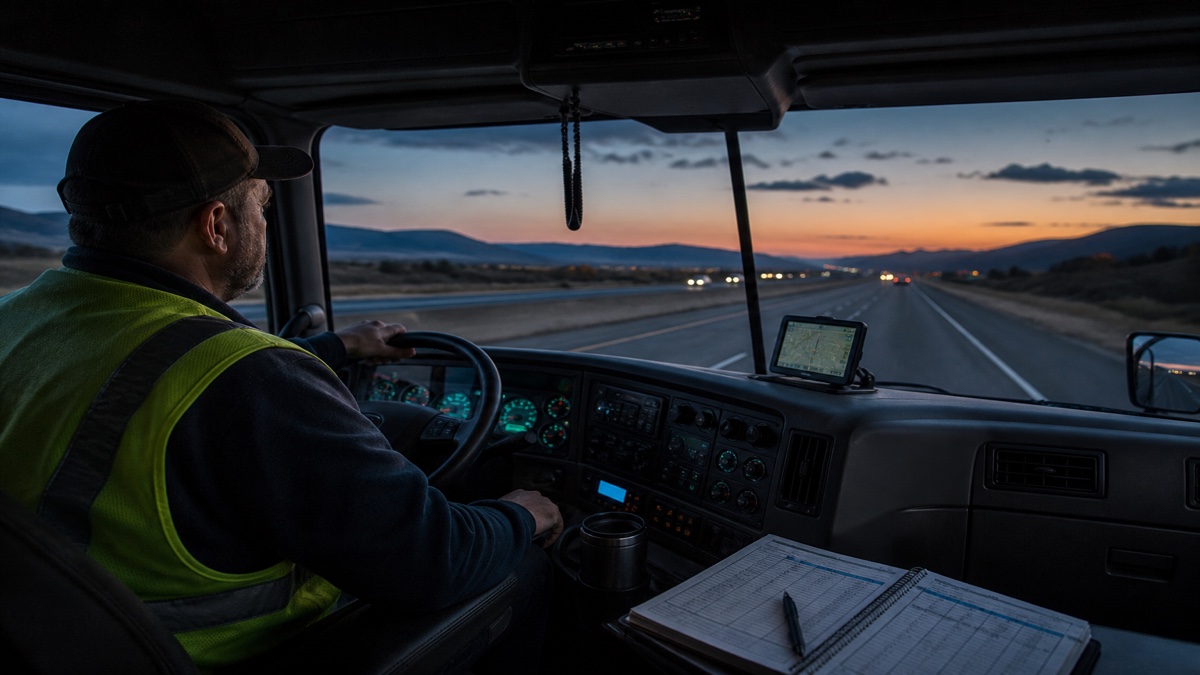
You become a truck driver by earning a Commercial Driver's License—almost always Class A for combination vehicles—after Entry-Level Driver Training (ELDT) with an FMCSA-registered provider, a DOT physical, a Commercial Learner's Permit, and a skills test. Interstate seats generally require age 21; 18–20-year-olds are often limited to intrastate work. Large carriers screen CDL applications on Workday and Taleo, so “CDL Class A” has to live in plain text, not in a truck graphic.
People searching how to become a trucker and how to become a truck driver are asking the same federal path. The license, medical card, and Clearinghouse record are the gate. This guide walks ELDT, school choice, OTR versus local work, and a driver resume that Workday and Taleo can read.
Safety teams verify license class, endorsements, accidents, and dates. If you are leaving warehouse or yard work, keep dock and forklift language and add CDL terms as you earn them—see warehouse role keywords that US ATS systems match .
| Stage | What you complete | What it unlocks |
|---|---|---|
| Eligibility | Age, DOT physical, Clearinghouse, driving record | Legal path to a CLP and carrier interest |
| ELDT | Theory + BTW range and public road (FMCSA-registered) | Skills test eligibility for a first CDL or covered upgrade |
| CLP + skills test | Knowledge tests, 14-day wait, pre-trip / skills / road | Class A CDL (air brakes as tested) |
| First seat | Orientation, trainer, ELD/HOS, CSA-aware habits | OTR, regional, or local dispatch |
Key Takeaways
- Class A is the combination-vehicle license; ELDT theory plus BTW must come from an FMCSA-registered provider
- Interstate driving is generally age 21; 18–20 is often intrastate-only unless a current federal pilot applies
- DOT physical, medical examiner certificate, and Clearinghouse status travel with the CDL—not optional paperwork
- Paid carrier school, community college, and private academies all work if they are on the Training Provider Registry
- OTR, regional, and local jobs use different home time, freight, and resume keywords
- Workday and Taleo will miss a CDL that exists only as a graphic—type the class and endorsements
The CDL and ELDT path: Class A, CLP, and the skills test
A Class A CDL authorizes combination vehicles—the tractor and trailer pairing behind most over-the-road jobs. Class B covers heavy straight trucks; Class C covers smaller vehicles that still need a CDL because of passengers or hazmat. If you want to become a trucker in the sense recruiters mean (dry van, reefer, flatbed, tanker pulling a trailer), plan on Class A with air brakes.
FMCSA Entry-Level Driver Training is not a brand-name school. It is a federal training standard: theory (knowledge) plus behind-the-wheel range and public-road instruction from a provider listed on the Training Provider Registry. After the provider reports completion, you can take the state skills test. That sequence replaced the old pattern of walking into a DMV with only a permit and a friend's truck.
Knowledge tests come first: general knowledge, combination vehicles, and air brakes for most Class A seats. You receive a CLP and must hold it at least 14 days, practicing with a qualified CDL holder—you do not run solo on a CLP. The skills test is pre-trip, basic control, and an on-road drive.
Endorsements sit on top of the base class: H (TSA), N tanker, T doubles/triples, P passenger, S school bus. An “X” is tank plus hazmat. Only add what the seat uses. After you are licensed, ELDs record HOS and carriers watch CSA scores.
Key Takeaway: Class A plus ELDT from a registered provider, then CLP, then skills test, is the legal path—there is no shortcut around the Training Provider Registry.
Age, DOT physical, Clearinghouse, and background checks
Age is the first filter. Interstate commerce—the freight that crosses state lines, which is most national OTR—generally requires you to be 21. Many states will issue a CDL at 18 for driving that stays inside the state. If you are 18–20, search local, construction, agricultural, or dedicated in-state lanes, not “48 state solo” ads. Limited federal apprenticeship pilots have existed for under-21 interstate driving with extra supervision; they are carrier-specific and change. Check current FMCSA materials rather than a recruiter's verbal promise.
Every CDL driver in a safety-sensitive CMV job needs a DOT physical from a medical examiner on the National Registry of Certified Medical Examiners . You receive a medical examiner's certificate. Duration is often up to two years; sleep apnea, diabetes, blood pressure, or other conditions can shorten it. That certificate is what makes the CDL valid for CMV work. An expired card with a still-valid license is not a technicality—you are not legal to dispatch.
Employers must query the FMCSA Drug and Alcohol Clearinghouse before you perform safety-sensitive functions, and they run ongoing queries after hire. A violation or refusal that is not resolved will stop hiring even if your road test was perfect. Do not assume an old employer “didn't report it.” Register your own Clearinghouse login so you see what carriers see.
Background depth depends on freight: MVR, criminal history, employment verification; TSA for hazmat; TWIC for some ports; extra fingerprinting for passenger and school bus. A record is not always a lifetime Class A ban, but lying on the application is. Bring your medication list to the examiner—some prescriptions legal for a personal car are disqualifying in CMV service.
Common Mistake: finishing CDL school while the medical certificate is expired or was issued by a clinic that is not on the National Registry—carriers will not onboard you.
Key Takeaway: age 21 for interstate, a current FMCSA medical examiner certificate, and a clean-enough Clearinghouse record are as binding as the plastic CDL itself.
Mega-carrier paid CDL school vs community college vs private academy
Training quality is not determined by who pays. It is determined by whether the provider is on the FMCSA Training Provider Registry, whether you get real BTW hours in a comparable truck, and whether the contract you sign is one you can live with. Three common funding models dominate 2026 hiring.
| Path | Who typically pays | Best fit | Main tradeoff |
|---|---|---|---|
| Mega-carrier academy | Carrier (often recaptured if you quit early) | Need a CDL fast; accept their freight and home time | Contract length; orientation then trainer miles before solo |
| Community college / workforce | You, grants, or WIOA-style aid | Want local instruction and no carrier lock-in | Waitlists; you still must find the first seat |
| Private CDL school | You (cash, loans, or “job placement” packages) | Flexible start dates if the school is on the TPR | Sales pressure; placement is not a guaranteed job |
Paid carrier programs work if you cannot float tuition. Read the recapture clause: leave during the commitment window and you may owe a prorated balance. Ask what truck you will test in and how many BTW hours are scheduled.
Community colleges produce drivers who can apply anywhere. Confirm the program's TPR listing. A local course that never reports ELDT completion leaves you unable to test.
Private academies range from excellent to predatory. Walk if they are not on the registry, rush a parking-lot loan, or promise weekly pay no posting shows. Stay if they publish an ELDT curriculum, use comparable tractor-trailers, and talk about CSA, ELDs, and medical cards.
Skip owner-operator pitches until you have a CDL and a year of clean inspections. If you are still choosing a skilled trade, compare this path with how to become an electrician and HVAC technician resume keywords before you sign a tuition note you cannot unwind.
Key Takeaway: pick the funding model you can finish, then verify FMCSA registry status—paid carrier school is a contract, not free money.
Job types after the CDL: OTR, regional, and local
The license is one product. The job is another. Home time, touch freight, and pay method (miles, percentage, hourly) change more than the truck color. New Class A drivers often start OTR because mega-carriers hire students from their own academies into that network. That does not mean local work is “lesser”—it is a different physical day and a different resume.
| Type | Home time pattern | What the days look like | Resume language to use |
|---|---|---|---|
| OTR (over the road) | Days to weeks out; team or solo | Long miles, drop-and-hook or live unload, ELD-managed HOS | 48-state, OTR, solo/team, dry van/reefer/flatbed |
| Regional / dedicated | Often home weekly; same shipper lanes | Repeat customers, tighter appointment windows | Regional, dedicated account, appointment freight |
| Local | Home daily (typical) | More stops, dock work, foodservice, construction, LTL | Class A local, touch freight, pallet jack, multi-stop |
OTR rewards people who can live in a sleeper, manage fatigue, and stay legal on the ELD without “creative” logging. Detention, weather, and receiver hours will test patience more than shifting gears. Team driving can increase miles and shrink rest quality. Ask recruiters for a realistic weekly home-time example from a current driver, not a brochure average.
Regional and dedicated accounts trade some miles for repeat docks and often weekly home time. Local Class A is usually more physical—liftgates, pallet jacks, foodservice, LTL—and still requires HOS compliance on CMV runs. Flatbed, tanker, and hazmat are skill layers: get stable Class A time before you chase freight you are not endorsed for.
Derates, DPF regen, DEF quality, and SPN/FMI codes show up on the job long before they show up on a resume. Owner-operators and fleet techs who can name the code and the test order look more hireable than drivers who only list "preventive maintenance." When a Cascadia or a Cummins truck goes into limp mode, use Professional Diesel Repair's heavy-duty diesel diagnostics to look up brand fault codes and the shop test order, then write the resume bullet as the action you took (limp vs tow, regen, DEF, SCR), not as a mystery check-engine light.
Key Takeaway: match the posting's home time and freight type—OTR miles, regional dedicated lanes, and local touch freight are different jobs that share one license class.
ATS resumes for drivers: Workday, Taleo, and why CDL cannot hide in graphics
National carriers, 3PLs, and many private fleets run driver recruiting on Workday or Oracle Taleo. Those systems extract text from your upload, then match phrases from the requisition: CDL Class A, tanker, hazmat, OTR, regional, automated manual transmission, ELD, and sometimes a minimum age of 21. A two-column Canva template with a chrome truck illustration can drop the only line that said “Class A.” The recruiter never sees a knockout if the parser never stored the license.
Put the license in three places if it is true: the headline (“CDL Class A Driver | Air Brakes | Dry Van OTR”), a certifications line (“CDL Class A, air brakes, tanker (N), doubles (T); medical examiner certificate current”), and the most recent job bullets. Spell endorsements as letters and words once so both “hazmat” and “H endorsement” can hit. List ELD and hours-of-service by name. If you ran electronic logs, say so—postings still screen out people who only know paper logs from a previous decade.
Workday often adds license fields after the parse—fill them even when the PDF already lists the CDL. Taleo still weights exact posting phrases. If the ad says “drop and hook,” do not write only “no touch freight.”
Do not paste a photo of the CDL as “proof”—parsers miss it and you have uploaded your license number. Type the class in the body. Workday will not follow a QR code for keyword match.
Mid-application check: upload your file to HireFlow's ATS resume checker against a real carrier posting before you click submit on Workday or Taleo. Confirm “CDL Class A,” the endorsement letters, and the freight type still appear in the extracted text. If they vanish, the template is the problem, not your experience.
| Do | Don't |
|---|---|
| Single-column text: CDL Class A, air brakes, ELD, HOS | CDL only inside a header image or icon skill bar |
| Name trailer types and whether solo, team, or local | “Professional truck driver” with no class or freight |
| State accident-free period only if you can document it | Invent miles or hide a preventable crash |
Key Takeaway: Workday and Taleo match typed license class and freight words—if the CDL lives only in a graphic, the application is incomplete.
Before/after resume bullets for CDL and career-changer drivers
Rewrite honest work so safety and operations can scan it. Do not claim OTR miles you did not run or endorsements you do not hold.
| Before (weak) | After (ATS-friendly) |
|---|---|
| Drove trucks for a living and have a clean record. | CDL Class A (air brakes)—solo OTR dry van; ELD/HOS compliant; drop-and-hook and live unload; current medical examiner certificate; no preventable accidents in the period listed on MVR. |
| Warehouse worker ready to get my CDL and hit the road. | Warehouse associate—operated sit-down forklift and pallet jack; staged outbound freight and verified load counts; completed employer safety training; enrolled in FMCSA-registered Class A ELDT (theory + BTW) with CLP in hand; targeting regional dry van after skills test. |
| Army veteran looking for a trucking job. | U.S. Army motor transport (88M)—operated combination vehicles in convoy conditions; performed PMCS and documented defects; held military license equivalent experience now converting through ELDT to civilian CDL Class A; comfortable with night driving and tight time windows. |
| Local delivery driver, box truck, wants bigger trucks. | Non-CDL straight-truck delivery—multi-stop routes, electronic handheld scanning, liftgate and hand-cart freight; clean personal MVR; completing Class A ELDT to move into local or dedicated tractor-trailer; already used to customer docks and appointment times. |
Notice the pattern: license class, air brakes, equipment, ELD or the training stage you are actually in, and a freight or dock fact a recruiter can ask about on the phone. Warehouse and delivery history still counts—it proves you show up, handle freight, and already speak dock language.
Key Takeaway: name the CDL class and the freight you actually ran—or the ELDT stage you are in—so Workday can match you to the right requisition.
Mistakes that stall new truckers: shady schools and driving without a medical card
A school that is not on the FMCSA Training Provider Registry cannot report ELDT, so you will not skills-test as a first-time CDL applicant. Ask for the registry legal name and search it yourself. The other classic failure is showing up to academy or orientation with an expired medical examiner certificate. The plastic CDL does not override an expired card.
- Unregistered ELDT: paying a program that never appears on the Training Provider Registry.
- Medical gap: letting the examiner certificate lapse while you still treat the CDL as valid for CMV work.
- Clearinghouse surprise: not registering your own login before a carrier query.
- Graphic resumes: hiding Class A in a truck illustration Workday cannot parse.
- Wrong job family: applying to local touch-freight ads with an OTR-only resume, or the reverse.
- Endorsement fiction: listing H or tanker before TSA or the knowledge test is done.
- Contract blind spot: quitting a paid academy early without reading tuition recapture.
Speeding, false logs, and out-of-service inspections follow you to the next fleet. Ask trainers how the company handles breakdowns and detention—that answer beats a signing bonus.
Common Mistake: assuming a still-in-date CDL means you can legally drive while the medical examiner certificate is expired.
Key Takeaway: verify the school on the FMCSA registry and keep the DOT medical certificate current—those two failures strand more new drivers than a missed backing skill.
Checklist: from first CDL steps to a carrier application that parses
- Confirm you meet interstate (typically 21) or intrastate age rules for the freight you want.
- Complete a DOT physical with an FMCSA-listed medical examiner and keep the certificate dates visible.
- Create your Drug and Alcohol Clearinghouse login and review what employers will query.
- Choose an ELDT provider on the Training Provider Registry—carrier academy, college, or private.
- Pass knowledge tests, obtain the CLP, and hold it the required period before the skills test.
- Finish theory plus BTW range and public-road training; confirm the provider reported ELDT completion.
- Pass pre-trip, basic control, and road skills for Class A with air brakes as required.
- Add H, N, T, P, or S endorsements only when the job and background process support them.
- Write a single-column resume with CDL Class A, endorsements, ELD/HOS, and freight type in plain text.
- Run the file against the actual Workday or Taleo posting on an ATS checker, then submit.
Key Takeaway: the checklist is legal eligibility first, registered training second, license third, parser-safe resume last—skipping the medical or ELDT step wastes every application after it.
How to become a truck driver in 2026 is a regulated sequence: prove you can pass a DOT physical and Clearinghouse query, complete ELDT with an FMCSA-registered provider, earn the CLP, pass the Class A skills test, then pick freight and home time you can actually live with. Paid carrier school, community college, and private academies are all valid when the registry listing is real. Your first hiring screen at a mega-carrier is often Workday or Taleo—type the CDL class, endorsements, and job type so the parser and the safety team see the same person.
Run a free match check on HireFlow's ATS resume checker against the exact driver posting, keep “CDL Class A” in extractable text, and only then hit submit.
Frequently asked questions
Most first-time Class A candidates finish ELDT, hold a Commercial Learner's Permit at least 14 days, and pass the skills test in a few weeks to a few months. Paid mega-carrier programs then add orientation and a trainer period before you run solo. You cannot skip ELDT with a certificate from a provider that is not on the FMCSA Training Provider Registry.
Yes if you are getting a first CDL, upgrading a class, or adding a passenger (P), school bus (S), or hazardous materials (H) endorsement that ELDT covers. Theory plus behind-the-wheel range and public-road training must come from an FMCSA-registered provider, which reports completion before the skills test. Confirm the school's registry listing before you sign a tuition contract.
Many states issue a CDL at 18 for intrastate work inside that state's lines. Interstate commerce—typical 48-state OTR—generally requires you to be 21. Limited federal apprenticeship pilots for 18–20 interstate driving exist only with participating carriers; check current FMCSA listings rather than a recruiter's verbal promise.
Class A covers combination vehicles—the tractor-trailer people mean when they ask how to become a trucker. Class B covers heavy straight trucks and many buses that are not pulling a large trailer. OTR dry van, reefer, or flatbed seats want Class A plus air brakes; do not apply to Class A postings with only Class B unless the carrier will train the upgrade.
Many large carriers run paid CDL academies in exchange for a work commitment after you pass. Read the contract: early resignation often triggers tuition recapture. Community colleges, workforce grants, and FMCSA-registered private schools are the other common paths if you want no carrier lock-in.
Put CDL Class A, air brakes, medical examiner certificate status, endorsements (H, N, T, P, S), and ELD/HOS in plain text—not in a cab photo or header graphic. Add trailer types and whether you ran solo, team, dedicated, or local. Workday and Taleo extract single-column text; if “CDL Class A” exists only as a logo, the parser never sees it.
Start with Class A and air brakes. Doubles/triples (T) and tanker (N) open more freight without TSA; hazardous materials (H) needs fingerprints. Passenger (P) and school bus (S) are separate career tracks. Do not list unused endorsements—recruiters verify the CDL.
No. A CDL is not valid for CMV work without a current medical examiner's certificate from an FMCSA-listed examiner, plus Clearinghouse eligibility. If the certificate expires, you are not legal even if the plastic license is still in your wallet. Carriers query the Clearinghouse before dispatch.