11 min read
Send a signing bonus email only after you have a written offer in hand. Name one forfeiture you would absorb if you start, not a vague market-average ask. That is the move that gets forwarded to finance instead of deleted. You're not negotiating during screening. You're closing a gap between what the offer pays and what you'd give up to accept it.
If you're still waiting on callbacks, don't draft bonus language yet. Check your resume for free against the posting you're targeting. A thin file never reaches offer stage where signing bonuses live. Fix parse errors and bullet one before you worry about make-whole pay.
Job searching while you're employed is already draining. You shouldn't also guess whether HR will laugh at your tone. Below: when the email works, five steps with copy-paste lines, two edge cases, mistakes that stall approvals, and a signing bonus email template you can adapt tonight.
And if you're comparing total pay across offers, read total compensation vs base salary before you anchor on base alone. Signing bonuses sit outside base but still hit your first-year cash.
Quick Wins
- Wait for the written offer PDF before you mention bonus pay.
- Name one forfeiture: unvested equity, relocation, or retention you'd leave behind.
- Email the recruiter who sent the offer, not the hiring manager first.
- Keep the note under 150 words. Gratitude, gap, ask, openness to talk.
Why signing bonus emails work after the offer, not before
Recruiters cannot approve money that is not on an approved requisition. During screening, your file is compared to forty others on fit and salary band. Nobody has authority to add a signing line to a hypothetical package. Once the written offer exists, the req is real, the band is set, and HR can model a one-time payment without reopening the whole search. I've seen signing bonus emails land in finance the same afternoon when the candidate named one forfeiture instead of a market lecture.
The email wins when it names a cost you'd absorb, not when it sounds confident. "I'd like a signing bonus because that's market standard" gives finance nothing to verify. "I'd forfeit $8,000 in unvested RSUs if I resign before March" gives them a number tied to a decision you're already making.
That contrast is why generic market language stalls. The recruiter has to guess what you mean, shop it to a comp partner, and defend it without evidence. One forfeiture line turns the ask into math. Math moves faster through Workday offer workflows than adjectives do.
Signing bonuses also solve problems base salary cannot fix quickly. Bands are rigid. A $5,000 bump to base might need VP approval and set a precedent for the level. A one-time signing payment often sits in a different budget pool with a faster signature path. You're not asking them to regrade the role. You're asking them to close a gap on day one.
Edge case: the offer letter already mentions a signing bonus, but the number is lower than your forfeiture. Reply with thanks, cite the specific cost, and ask whether the amount can adjust. You're negotiating up, not asking for something that was never on the table.
Edge case: you're a new grad with no forfeiture story. Relocation, exam fees, or delayed income between graduation and start date still count. Tie the ask to a receipt or a lease quote when you have one. "I'd appreciate help with moving costs" beats silence when the role is in another state.
For salary moves when you do not have a competing offer in writing, see how to negotiate salary without competing offers . The same forfeiture framing works on base when the band has a little room.
Five steps for your signing bonus email template
Work these in order. Pick your forfeiture before you open a blank email. Draft short. Send to the recruiter who owns the req. Follow up once if you hear nothing in three business days.
Step 1: Confirm you have a written offer and a reply deadline
How to tell you're ready: an offer letter PDF or DocuSign envelope with title, base, start date, and a response date. Verbal "we'd like to hire you" is not enough. No letter means no signing bonus email yet.
Before: Asked about bonus pay during the second interview before any numbers were on paper.
After: Waited for the written offer, then replied within 48 hours with a one-paragraph signing bonus request tied to relocation quotes.
Read the letter twice. Note whether it mentions at-will employment, bonus eligibility, or clawback language. You are not rewriting those terms in email. You are asking about one additive line item.
Step 2: Pick one forfeiture number you can defend
List what you give up by starting: unvested stock, retention bonus, moving deposit, certification exam, bridge pay between jobs. Choose the largest verifiable item. Round to a clean figure only if the real number is messy. Do not stack three small items when one big one tells the story.
Before: "I'd like a $15,000 signing bonus because that's what people at my level get."
After: "If I resign before April, I forfeit $12,400 in unvested units per my current employer's vest schedule. I'd appreciate a signing bonus that helps close that gap."
Keep proof in your folder. You may never need to send the vesting statement, but you should have it if finance asks. Honest numbers beat inflated ones when HR verifies.
Step 3: Address the recruiter and lead with yes
Open with thanks and clear intent to join. One sentence on excitement. One sentence on the gap. One sentence with the ask. One sentence inviting a call. Sign your name. No bullet lists. No ultimatums.
Before: Subject: Money. Body: I need more cash or I walk.
After: Subject: Offer for Analyst role / signing bonus question. Body opens with gratitude, cites forfeited retention pay, asks if a one-time signing payment is possible, offers to discuss on a short call.
Match the tone of their offer email. If they were formal, stay formal. If they used first names, you can too. You're continuing a thread, not cold pitching.
Step 4: Send during business hours and track the deadline
Tuesday through Thursday morning local time to their office usually gets a faster read than Friday at 5 p.m. Send at least two business days before your response deadline so HR can route the ask. If the deadline is tomorrow, call the recruiter instead of only emailing.
Bcc yourself. Save the sent thread. If they revise the offer, compare PDFs line by line. Signing bonus, start date, and base can change independently.
Edge case: remote hire across time zones. Send when their morning starts, not yours. A 6 a.m. ping to a West Coast recruiter from an East Coast candidate can wait three hours and still land first in the inbox.
Step 5: Follow up once, then decide
If you hear nothing in three business days, reply on the same thread with a short bump. Restate enthusiasm. Ask whether they had a chance to review the signing bonus question. Do not send a second novel.
If they decline, ask whether another line can move: relocation, equipment, earlier review cycle. Then decide. Walking away is valid. Ghosting after you already accepted is not.
Copy-paste signing bonus email template
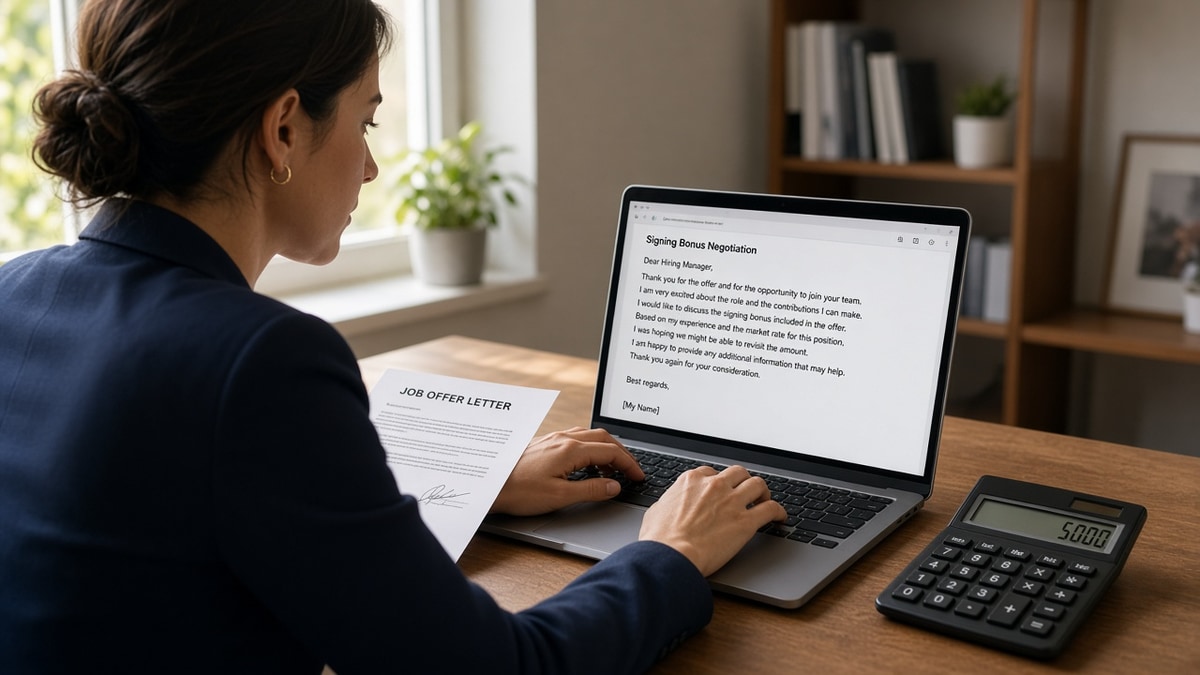
{`Subject: [Job title] offer / signing bonus question

Hi [Recruiter name],

Thank you for the offer to join [Company] as [Job title]. I'm excited about the team and plan to accept pending a quick compensation question.

If I give notice at my current employer, I would forfeit [specific amount or cost: e.g., $X in unvested equity / relocation deposit / retention bonus] to start on [start date]. Would [Company] consider a one-time signing bonus to help close that gap?

I'm happy to share documentation if helpful and can talk by phone this week.

Thank you,
[Your name]`}
Swap bracketed lines with your facts. Keep the body under 150 words. Long emails get forwarded with the question "what do they actually want?" Short ones get answered.
Edge case: internal transfer at the same company. Signing bonuses for internal moves are rare. Ask about retention or project-completion pay instead, or focus on level and base within the new group.
Requests that stall in HR
These patterns slow or kill signing bonus talks even when the role is right and the recruiter likes you.
Asking before the written offer. You sound presumptuous and the recruiter has no package to edit. Wait for the letter even when the manager already said yes on the phone.
Leading with a competing offer you cannot show. Bluffing destroys trust when HR asks for a redacted letter. If you have a real counter, mention it calmly. If you do not, use forfeiture math instead.
Stacking every grievance. Base is low, bonus is low, PTO is low, and you also want a signing payment. Pick the highest-impact line for email one. Bundle asks read like you will never be satisfied.
Demanding instead of asking. Ultimatums trigger legal review and slow everything. "I'd appreciate consideration" plus a real number beats "I require."
Going around the recruiter to the hiring manager first. Managers often lack comp system access. The recruiter owns the req. Loop the manager in after the recruiter knows you're serious, not before.
Before: Four-paragraph email citing salary sites, a relative's pay, and industry averages with no personal cost attached.
After: Three sentences: thanks, $9,200 forfeited retention if I start May 1, open to discuss signing bonus to close the gap.
Ignoring clawback language. Some firms pay signing bonuses with a twelve-month repay clause if you leave early. Read the revised letter before you sign. A bonus that vanishes on departure is still worth modeling against your plan.
This will not create budget where none exists. It stops a reasonable ask from dying because the email sounded like a threat or a lecture.
Get to offer stage first
Signing bonus emails only matter after screen. Upload your resume and the posting to HireFlow's free ATS resume checker and confirm Workday or Greenhouse imported your dates and titles cleanly. Parser gaps kill callbacks before anyone discusses pay.
When the offer references start date or relocation, generate a cover letter that matches the same facts as your resume so nothing contradicts during background review.
Do this now: Fix the file, earn the offer, then send a short signing bonus email with one forfeiture number before your response deadline.
For a repeatable apply rhythm that gets you to offer conversations faster, read how to build a US application funnel . Volume without parse quality wastes signing bonus asks you never get to make.
Send it tonight
A signing bonus email template is useless before you have a written offer. After you do, it is a short note: gratitude, one forfeiture, a clear ask, openness to talk. That beats a market lecture every time.
- Wait for the offer PDF.
- Pick one verifiable cost you'd absorb.
- Email the recruiter in under 150 words.
- Follow up once before the deadline.
- Read the revised letter for clawback terms.
Open the req you used to get here. Run a free ATS check on the file that earned the offer, then send the signing bonus email while the req is still open.
Read more
Frequently asked questions
After you receive a written offer and before you accept. The company has picked you. HR has a number on paper. Screening is over. Asking during the application or first interview reads premature. Asking after you already signed the offer letter removes most room to adjust pay.
Yes when you can tie it to a real cost you would absorb: unvested equity you forfeit, relocation, certification fees, or a bonus you leave on the table at your current employer. A round number with no anchor sounds like a wish list. One forfeiture line gives the recruiter something to take to finance.
Yes. Competing offers help, but they are not required. Relocation, license costs, delayed start date income, or forfeited retention pay are valid on their own. Frame the ask as closing a gap between what you are giving up and what the written offer pays. Do not invent a fake counteroffer.
Send it to the recruiter or talent partner who sent the offer letter, not the hiring manager on the first pass unless they are your only contact. Recruiters route compensation changes through HR systems. Copy the hiring manager only when they asked you to negotiate directly or the recruiter is unresponsive after one polite follow-up.
Ask whether a one-time payment can be labeled differently: relocation stipend, equipment allowance, or start-date make-whole. Some firms have hard caps on signing bonuses but flexibility on other lines. If the answer is still no, decide whether base salary, start date, or title level matters more before you walk away.