12 min read
You heard "apply to more jobs." So you sent twenty yesterday and heard nothing. Volume without tailoring is noise.
How many US applications per day is too many depends on how long each file takes and whether parsers see a match. I've watched candidates burn out on generic uploads while three focused applications would have scored higher on the same postings.
Before you raise your daily count, check your resume for free against one target req. If match and parsing are weak, adding applications multiplies silence.
You need a daily cap, a tracking sheet, and a rule for when to skip a req. We'll set those numbers with examples, not motivational slogans.
Quick Wins
- Time your next application start to submit. If tailoring takes under 15 minutes, your cap can be higher.
- Set a hard stop at seven applies per day unless match scores stay above your baseline.
- Log company, req ID, date, and resume version in a spreadsheet tonight.
What how many US applications per day is too many really means
The question how many US applications per day is too many is really about return on effort. US hiring funnels run ATS filters, recruiter keyword search, and human skim. Each stage rewards relevance. Flooding portals with identical files increases activity metrics on your spreadsheet, not interview probability.
Too many applications show up as: duplicate submissions, wrong resume versions, empty Workday fields, cover letters with the wrong company name, and resumes that never match posting keywords. Recruiters notice patterns when the same PDF hits multiple reqs without edits.
The right daily number varies by stage. Urgent unemployed search can justify more volume than passive exploration, but only when customization keeps pace. Career changers should apply fewer times with heavier retargeting per req.
US remote roles attract higher applicant counts. Competing on volume alone fails when hundreds of candidates share similar backgrounds. Tailoring top bullets and running match checks separates you from mass appliers.
Application volume strategy pairs with networking, referrals, and follow-up. Applications alone rarely carry a search. Caps protect energy for those channels.
Track outcomes weekly: applications sent, recruiter screens, hiring manager interviews. If volume rises and screens flatline, the cap is too high or tailoring is too shallow.
Energy management is part of volume strategy. US searches stretch for weeks. Candidates who sprint fifty applications in three days often disappear from networking and interview prep for the rest of the month. Sustainable caps keep your stories sharp when a manager call lands on short notice.
Weekend application binges feel productive but produce Monday regret when you cannot remember which resume version went to which company. Spread caps across weekdays when possible so tracking and follow-ups stay accurate.
US application volume rule: three tailored applications with strong match scores beat twenty generic uploads in the same afternoon.
Step-by-step: find your daily US application limit
Step 1: Classify your search stage honestly
Pick one profile for this week.
Urgent unemployed: target 5 to 7 tailored apps per day when match workflow is tight.
Employed but active: target 2 to 4 per day.
Passive exploration: target 1 to 2 per week with heavy selectivity.
Career change: target 2 to 3 per day with deeper retargeting per req.
Example: A laid-off marketing manager with three months runway sets a cap of six applies per day, Mon through Thu, leaving Fri for networking calls and resume maintenance.
Mislabeling passive search as urgent leads to spammy volume and weak fit.
Step 2: Time one full application end to end
Pick a real Workday or Greenhouse req. Start timer.
Include: highlight keywords, edit top bullets, export PDF, fill forms, answer screening questions, log the row, optional cover letter.
Under 20 minutes: you may sustain six to seven quality apps daily if match scores hold.
30 to 45 minutes: cap at three to four.
Over 60 minutes: cap at one to two unless reqs are dream roles.
Before: Applying while exhausted at midnight with the same file.
After: Morning block: two focused apps with free ATS check each before submit.
Log actual minutes for five days. Your real average beats any blog quota. Adjust caps from data, not guilt.
Step 3: Set match-score gates before you raise volume
Run job match score or the free checker with posting text.
Gate A parsing: no scrambled sections in paste test.
Gate B keywords: top must-haves appear in dated bullets.
Gate C fit: you meet most hard requirements honestly.
If you fail Gate C, skip the req. Volume on bad fit wastes caps.
Example: Posting requires active Secret clearance. You do not have it. Do not spend a daily slot.
Raise daily caps only when 80% of submits pass A and B without emergency rewrites.
Step 4: Batch by role family to protect quality at scale
Apply to similar reqs in one sitting so tailoring compounds.
Batch example: Four US SaaS product manager reqs sharing Agile, roadmap, and analytics keywords. Swap company name, one metric, and Skills order. Time per app drops from 40 to 22 minutes.
Anti-pattern: PM req at 9am, warehouse ops req at 9:20, nurse req at 9:40 with one resume. Match scores crater.
Maintain separate master PDFs by track: PM, ops, clinical. Batch within a track, not across unrelated fields.
Read 10-minute resume tailoring method for batch rhythm.
Time-box rule: set a 25-minute timer per application. When the timer ends, either submit or park the req for tomorrow. Parking protects quality better than midnight rushed submits that typo company names in screening questions.
Step 5: Track submissions and stop at your cap
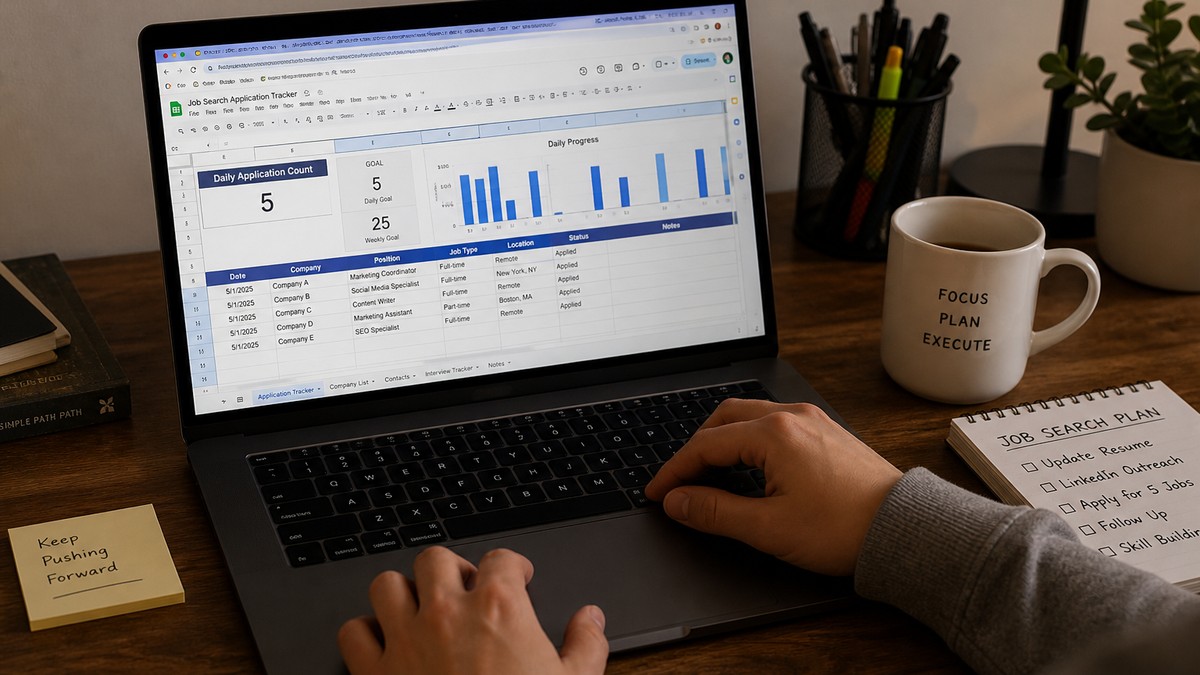
Spreadsheet columns: Date, Company, Req ID, Title, Resume version, Match score, Status, Follow-up date.
Sample row: 2026-03-24 | Northline Health | R-10482 | Marketing Manager | Morgan_MM_v3.pdf | 78 | Submitted | +7 days
When you hit the daily cap, stop. Use remaining energy for recruiter messages or interview prep.
Duplicate detection: search company name before submit. Some portals block duplicates. Others embarrass you with two timestamps.
Set phone reminders for follow-ups. Volume without follow-up is half a strategy.
Color-code rows by portal: Workday, Greenhouse, Lever. Patterns emerge when one platform yields more screens. Shift caps toward portals and role families that respond, not only toward whatever job board is open at lunch.
Step 6: Review weekly and adjust caps with data
Sunday review: applications sent, phone screens, rejections, ghosting.
Signal to lower volume: interviews flat while apps rise.
Signal to raise volume slightly: strong match scores, fast tailoring, low screen rate may mean networking gap, not only resume gap.
Read applied to 100 jobs and got no interviews when outcomes stay zero despite moderate volume.
Use cover letter generator only for reqs where letters matter. Do not burn cap time on optional fields that repeat your resume.
How many US applications per day is too many becomes obvious when your data shows twenty submits and zero screens for three weeks. Cut volume, fix parsing, retarget titles, then ramp again.
Step 7: Pair application caps with weekly networking minimums
Volume strategy fails when applications crowd out relationships. Add a weekly networking floor alongside your daily application ceiling.
Sample week: MAX 5 apps per day Mon-Thu, plus 3 recruiter or hiring manager touchpoints, plus 1 informational call.
Touchpoint examples: comment thoughtfully on a hiring manager's post, send a short referral ask to an alum, reply to a recruiter InMail with a tailored PDF attached only when requested.
Track networking rows beside application rows. If screens stay flat with good match scores, the bottleneck is often visibility, not only resume keywords.
Before: 35 applications, zero LinkedIn messages.
After: 18 applications, 6 targeted messages, 2 phone screens booked.
How many US applications per day is too many includes anything that steals time from conversations that bypass the portal queue.
Edge case: new grad campus plus off-campus search
Split caps. Campus OCR deadlines may force bursts. Off-campus corporate search still needs tailored files.
Sample week: 3 OCR submissions Mon, 4 tailored corporate apps Tue-Thu, Fri for career fair follow-ups.
Do not let OCR generic resumes become your only master. Corporate Workday links need parser-safe PDFs too.
Copy-paste daily application tracker headers
Columns: Date | Company | Req ID | Portal | Title | Resume file | Match % | Submitted Y/N | Contacted referral Y/N | Notes
Daily cap field: MAX_TODAY = 5
Stop rule: No submits after cap even if "one more easy req" appears.
Pair tracker with free ATS check before each row gets Submitted Y.
Edge case: senior leaders with low daily volume
Executives and senior directors should not measure success in applications per day. Caps of one to two highly targeted reqs weekly plus board and investor networking fit better.
Sample: One carefully tailored VP Operations application with referral intro beats five cold uploads.
Time per application may exceed two hours when stakeholder maps and leadership stories matter. That is normal at this level.
Track conversations and search firm relationships alongside application rows. Volume metrics mislead when most hires at senior bands come through networks, not portal spam.
Common mistakes
Chasing quotas from social media. Twenty per day advice ignores tailoring time and fit gates.
Same resume for every req. Mass applying lowers match and signals low interest.
No tracking spreadsheet. You duplicate apps and miss follow-ups.
Applying outside core fit to hit numbers. Bad-fit volume wastes caps and hurts confidence.
Ignoring networking blocks. Applications alone rarely sustain US searches.
Raising volume before fixing parsing. Multiplying broken files multiplies silence.
Check match quality before you add daily volume
Run each tailored PDF through HireFlow's free ATS resume checker with the posting pasted in. Low scores mean slow down, do not speed up.
Use job match score to compare versions when you debate another daily application.
Draft selective cover letters with cover letter generator for high-priority reqs instead of burning time on every form.
Read applied to 200 jobs fix plan if you already blew past healthy caps.
Block application time on your calendar like meetings. Candidates who only apply when they feel motivated send bursts of twenty on Monday and zero by Thursday. Consistent daily caps produce steadier recruiter responses and less burnout when silence lasts two weeks.
Set a US application daily cap that protects quality
How many US applications per day is too many depends on tailoring time, match scores, and search stage. Most US candidates perform better at three to seven focused apps than at twenty generic ones.
- Time one full application and set a realistic daily cap.
- Batch similar reqs and skip bad-fit roles without guilt.
- Track screens weekly and cut volume when interviews stay flat.
Before tomorrow's batch, run the free resume check on your top target req, set a daily cap in your tracker, and stop when you hit it. That is how how many US applications per day is too many turns from anxiety into a strategy you can measure.
Read more
Frequently asked questions
Usually yes unless each file is truly tailored and tracked. Above ten per day, most candidates slip into generic resumes, missed fields, and duplicate errors that hurt ATS match and recruiter trust.
Three to seven well-tailored applications plus networking blocks beats twenty rushed submits. Raise the cap only when tailoring time per req drops below twenty minutes and match scores stay strong.
Some systems flag duplicate files or incomplete profiles, but the bigger risk is low match quality. Identical resumes across many reqs rank poorly and waste recruiter attention when they see repeat uploads.
No. One to two highly targeted applications per week plus relationship building matches passive search. Daily volume signals desperation and produces weak fit.
Track match scores, time per application, and callback rate. If interviews stay flat while volume climbs, you are applying too many times with too little customization.