11 min read
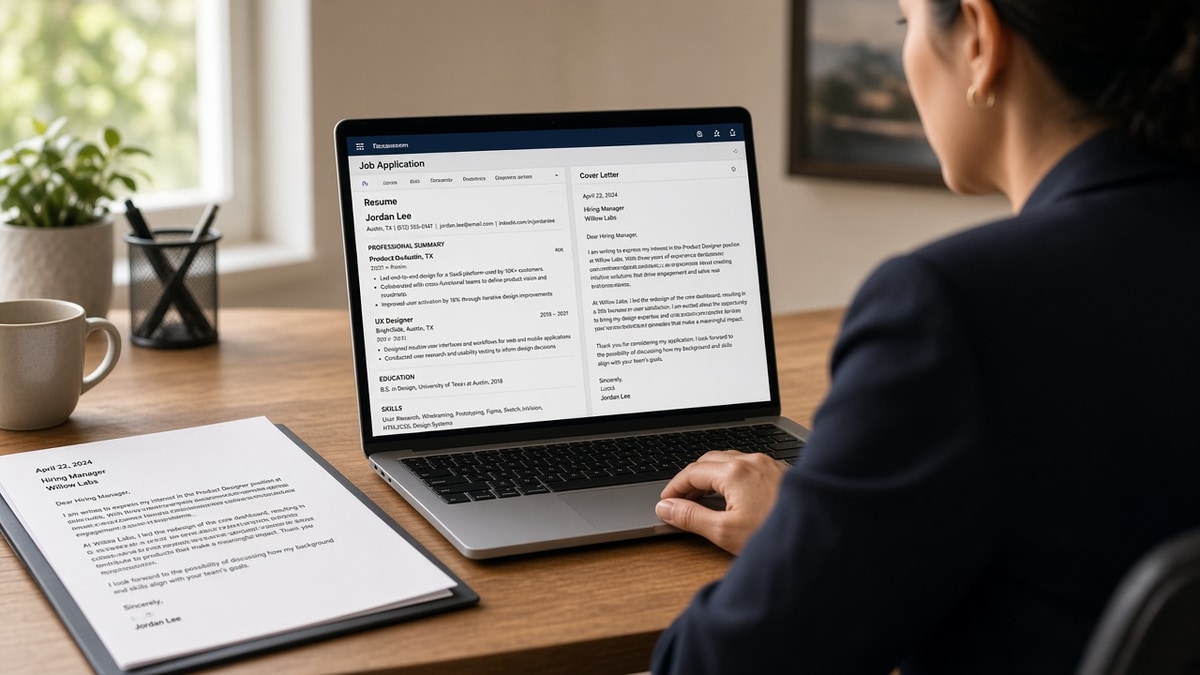
Your resume clears the keyword screen, then nothing happens for two weeks. That is often where a cover letter should have done one job the parser cannot: name the target role, explain a gap or pivot in plain language, and point to the proof line on the resume a six-second skim would miss. How cover letters complement ATS screening is not by repeating every bullet. It is by answering the one question the resume file leaves open after import.
You're not writing a novel. You're writing a caption for the file, and it shouldn't repeat what's already searchable. Before you draft, check your resume for free against the posting. You're confirming must-have terms live in Experience and summary, not only in a letter the ATS may never score.
Job searching while you're still employed or between roles is draining, and an optional letter field does not mean optional work when your title block tells the wrong story. I've screened paired files in Workday and Greenhouse where the resume parsed clean and the letter explained a six-month contract gap in two sentences. Same candidate without that paragraph sat in maybe pile until someone opened both tabs.
Below you'll see the symptom when ATS passes but humans stall, three causes behind it, how to tell which one matches your file, fixes with before-and-after openers, and a copy-paste block. When the portal asks for a letter, generate a cover letter draft, then edit paragraph one so it bridges the gap your resume preview still shows.
Quick Wins
- Fix resume keywords first. Letter complements, not replaces.
- Paragraph one names the role and one gap or pivot.
- Upload letter in the cover letter field, single-column PDF.
- Do not repeat bullets the resume already proves.
The symptom when ATS passes but the packet stalls
Greenhouse shows green keyword match on the resume. Workday imported your Experience block. Status stays New or Reviewed with no outreach. You assume the letter did not matter because the system never flagged it. Often the opposite: the resume scored enough to sit in a pile where a recruiter opens letters only when something on the resume needs translation.
The stall is usually a story gap, not a keyword gap. Parser sees Project Coordinator title, posting asks for Product Owner, bullets mention Jira and backlog grooming but never say product owner. ATS may still rank you mid-pack. Human skim stops on the title mismatch unless the letter names the pivot in sentence one.
Another stall pattern: employment gap between contracts. Resume dates show March 2024 to August 2024 blank. Parser imports the gap. No field asks why. Recruiter assumes unemployment unless the letter states contract ended and you completed a certification in September 2024.
Cover letters complement ATS screening at the handoff between automated resume rank and human tie-break. They do not replace missing skills on the resume file. They prevent a qualified import from dying because a recruiter could not decode the top third of the packet in one pass.
Optional letter fields trick people into skipping work. Optional means the portal will not block submit. It does not mean recruiters ignore the tab when fifty resumes share your keyword score.
For why resume files never reach a human at all, read why your resume never reaches a human . Fix parse failures there first. This page assumes the resume imports and you need the letter to finish the story.
Job searching is slow enough without sending half a packet. The symptom is silence after a pass, not an automatic rejection email.
How cover letters complement ATS screening: three gaps and fixes
Most stalled packets trace to one of three gaps between what the parser stores and what the recruiter needs to click forward. Match yours before you rewrite paragraph four.
Gap 1: Resume keywords pass but the title story is wrong
How to tell: preview pane shows an old industry title while bullets contain posting language. Search hit on skills, skim miss on fit. Common for career changers, internal transfers, and contractors whose agency name dominated the header.
Before: Dear Hiring Manager, I am excited to apply for your opening. I am a passionate professional with diverse experience across many industries.
After: I am applying for the Instructional Designer role. My resume title still reads High School Science Teacher because district payroll has not updated; my last three years built facilitator guides and LMS modules for adult learners, including the capstone project linked on page one bullet two.
The fix: sentence one names the exact posting title. Sentence two explains why the resume title or employer line misleads and points to one proof bullet. Do not apologize. Translate.
Gap 2: Letter repeats resume bullets instead of answering a parser blind spot
How to tell: your letter could be generated by copying the resume into paragraph form. Same achievements, same order, no new information. Recruiters close the tab in ten seconds. ATS gained nothing because those lines were already searchable in Experience.
Before: At Acme I managed Salesforce pipelines, hit quota for four quarters, and led weekly standups with engineering.
After: Acme listed me as Sales Development Rep while I ran the full SMB cycle after our team reorg; see the resume bullet on owning close rate for accounts under 50 seats. I am applying for the Account Executive posting because that scope matches the work I already own unofficially.
The fix: each letter paragraph should carry information that is not duplicated on the resume, usually context (reorg, contract end, title lag) or motivation tied to one company fact from the posting. Metrics stay on the resume unless they explain a gap.
Gap 3: Letter never reaches the human queue
How to tell: you combined resume and letter into one PDF, uploaded only in the resume field, or used a two-column template with contact info in a header the exporter strips. Recruiter view shows resume only or a garbled letter page. Your bridge paragraph literally never rendered.
Before: One PDF named Resume.pdf contains cover page letter, then resume, uploaded to resume field only.
After: Two files: Jane_Doe_Resume.pdf in resume field, Jane_Doe_Cover_Letter.pdf in cover letter field, both single-column, pasted into Notepad shows title before body with no table cells.
The fix: separate files unless the posting demands one. Plain paragraphs. Same contact header style as resume but not inside a text box. Run Notepad test on both exports before submit.
Which gap is yours?
Open the application preview if the portal allows it. If resume keywords match but title looks wrong, start with Gap 1. If letter text mirrors bullets, Gap 2. If letter missing or scrambled, Gap 3. Fix upload mechanics before you polish prose.
Edge case: posting says cover letter optional and you are a near-exact title match with no gaps. A short three-paragraph letter still helps on competitive reqs; skip only when instructions forbid it.
Edge case: federal or university portals with character limits. Put the bridge sentence in the first 400 characters, resume carries proof, attach full letter only when allowed.
Copy-paste block: ATS-complement opener by gap type
GAP 1 (title mismatch / career pivot):
I am applying for the [exact posting title]. My resume still shows [old title] at [employer];
see [section] bullet [n] for [proof in posting language].

GAP 2 (scope or reorg not visible on resume):
At [employer] I [verb from posting] while my formal title remained [old title].
Resume bullet on [topic] covers [metric or scope line].

GAP 3 (employment gap):
Between [Month Year] and [Month Year] I [contract ended / caregiving / coursework].
I completed [credential] in [Month Year]; relevant work resumes on the resume at [employer].

CLOSING (one line):
I would welcome a conversation about [one company-specific detail from posting].
Keep total length under one page, roughly three to four short paragraphs plus closing. Recruiters read on a phone between meetings. Paragraph one does the complement work. Middle paragraph ties one posting requirement to one resume proof line. Close with availability, not a summary of your entire career.
When you are tailoring the resume side of the packet, use the ten-minute resume tailoring method for US job posts . Letter and resume should use the same target title string so nothing contradicts on import.
When a complementary letter still fails
Right role, clean resume import, thoughtful letter, still no movement. These habits explain the leftover failures.
Keyword stuffing the letter. Posting verbs jammed into every sentence read like SEO spam. Use three must-have terms naturally. Resume carries the rest.
Generic company praise. Leaders in innovation adds zero. One line about a product launch or values line from the careers page shows you read the req.
Contradicting the resume. Letter says five years Salesforce; resume shows two. Recruiters flag inconsistency faster than a weak bullet.
Before: Letter addresses Dear Sir/Madam, restates entire resume, no posting title named.
After: Letter opens with exact role title, one bridge sentence, one company-specific line, points to resume proof, ends with clear sign-off.
Uploading only when required on a tie-breaker req. Mid-match piles are where letters decide who gets the phone screen. Optional is not skip when your resume needs translation.
Exception: postings that explicitly say no cover letter. Some government and high-volume retail reqs reject extra files. Follow instructions over generic advice.
This will not fix applying to roles where you lack must-have credentials. It stops qualified imports from stalling because a human never got the one sentence the parser could not store.
Match resume and letter before upload
Paste the posting and resume into HireFlow's free ATS resume checker . Confirm must-have terms appear in Experience before you draft the letter. The letter should not be the first place a skill appears.
Draft paragraph one in HireFlow's cover letter generator , then edit until it names your gap type from the section above. Delete any sentence that repeats a resume bullet verbatim.
Do this now: Run resume check, pick your gap type, paste opener skeleton, Notepad-test both PDFs, upload to separate fields, submit when preview shows role title in letter line one.
What to do now
How cover letters complement ATS screening is simple on paper: resume carries searchable proof, letter answers the one blind spot the parser left. Title mismatch, gap, reorg, upload error. Name it in paragraph one, point to the resume line that proves it, keep files separate and boring.
- Confirm resume keywords in Experience first.
- Pick gap type: title, repetition, or upload.
- Draft opener from the copy-paste skeleton.
- Notepad-test both PDFs before submit.
- Upload letter in the cover letter field.
Open the req you're pursuing. Run a free ATS check , write the bridge sentence, and apply when letter line one matches the posting title.
Read more
Frequently asked questions
Usually no. Most US corporate ATS workflows score and rank the resume first. Cover letters may be stored, keyword-searched lightly, or ignored until a recruiter opens the file. Your letter complements screening when it gives humans context the resume parser cannot extract, such as a career pivot, employment gap, or title translation. It does not replace missing resume keywords.
Repeat only terms that prove fit when the resume leaves a question open. If the posting requires Salesforce and your resume already shows four years of Salesforce admin work, the letter should not restate that bullet. If your resume title still says Retail Manager while you are applying for Customer Success, the letter should name Customer Success in sentence one and bridge one proof line the title block does not carry.
When the application portal marks it required or when your resume has a visible gap the parser will flag. Optional letters still matter on tie-breaker piles after resume keyword match. Skip the letter only when the posting says not to submit one or when the portal has no upload field and adding files breaks the workflow.
Single-column PDF or DOCX with 11-point Calibri or Arial, no tables, no header/footer contact blocks that duplicate the resume, and no images. Name the file FirstName_LastName_Cover_Letter.pdf. Upload it in the cover letter field, not combined with the resume unless the posting explicitly asks for one file.
No. If the resume file will not parse because of layout, missing dates, or wrong section order, fix the resume first. The letter helps after the resume imports or when a recruiter manually opens your packet. It clarifies story; it does not substitute for searchable experience text.