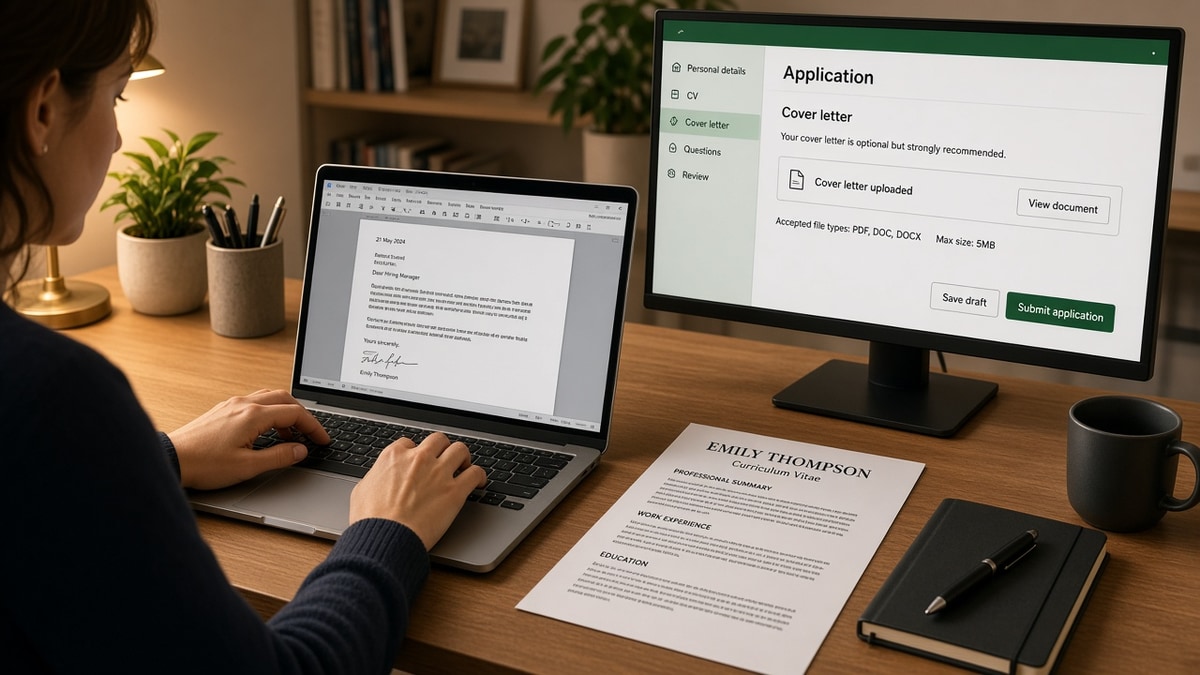
11 min read
You've polished the CV, hit apply, and then the portal asks for a cover letter you didn't plan to write. Most UK applicants either skip it or paste a wall of adjectives that repeats the CV without adding proof. Recruiters notice the gap when they finally open your file. The letter won't rescue a broken CV, but a plain, targeted note can push a borderline profile into the shortlist.
Before you draft anything, check your resume for free against the same posting. If your CV parsers clean, the cover letter's job is to name one requirement your top bullet already proves, not to reintroduce your entire career.
These cover letter generator tips focus on UK cover letters that survive ATS paste boxes and still read human when a recruiter opens them in Workday or Greenhouse. You'll pull posting language into paragraph one, keep British spelling consistent, and stop treating the letter like a second CV.
Job searching is draining enough without guessing whether optional fields matter. They often do once your CV clears the first screen. We're not going to promise a callback from a paragraph alone. We'll give you a repeatable build that takes fifteen minutes per application, and you can reuse the frame on the next five roles you target this week.
Quick Wins
- Draft in plain text first. Tables and icons break paste boxes.
- Mirror the posting's job title exactly in line one.
- Use British spelling throughout: organisation, programme, licence.
- One metric in paragraph two beats three paragraphs of motivation.
- Keep it under one screen. Recruiters skim on mobile between meetings.
What UK recruiters actually scan for in a letter
UK hiring still runs CV-first. ATS scores your CV harder than the letter. That does not make the letter decorative. When your CV lands in a ranked shortlist, recruiters open the cover note to see whether you understood the role or blasted a template.
The letter is a proof block, not a biography. Paragraph one should answer: why this role, at this company, with evidence you have already done the work. Paragraph two adds one scoped example. Paragraph three closes with availability. Anything else is padding that signals you did not read the posting.
British conventions matter on tone, not on length. "Dear Hiring Manager" works when no name is listed. "Yours sincerely" fits when you used a named addressee. "Kind regards" works for both. What breaks screens is American spelling on a London req, or a letter that contradicts dates on the CV.
Read UK CV vs US resume adaptation when your CV still carries US formatting. Fix the CV before you write a British letter on top of an American file.
Edge case: the posting says cover letter optional. Submit one anyway when the role is competitive or client-facing. A short, tailored note beats an empty field when fifty CVs look similar on paper.
Edge case: you are applying through a recruiter agency that strips cover letters before forwarding. Keep a one-paragraph version in the email body to the agent. The full letter still helps you clarify fit on the call.
Cover letter generator tips: five steps for UK cover letters
Work in order. Each step takes a few minutes. Stop when the letter names the role, cites one proof line, and matches your CV facts.
Step 1: Pull three must-haves from the posting
Open the job description and highlight the exact job title, one hard skill or certification, and one outcome language line. Example phrases: "stakeholder management across NHS trusts," "SQL reporting," "reduce churn." These three items become your keyword spine. Do not grab twenty words. Grab the three a recruiter would ctrl-f after reading your CV once.
Paste them at the top of a blank doc as a checklist. You will delete that checklist before upload. It keeps paragraph one honest.
Before: I am a passionate professional eager to join your dynamic team.
After: I am applying for the Operations Analyst role at Meridian Logistics, with three years building SQL dashboards for a 12-site distribution network.
Step 2: Draft in plain text with British spelling
Write in Notepad, VS Code, or a blank Word doc with formatting cleared. UK portals in Workday, Greenhouse, Lever, and Taleo often use paste fields that strip fonts and bullets. A letter built inside a designed template can import as scrambled lines or empty paragraphs on the recruiter side.
Set spelling to British English before you start. Organisation, programme, centre, licence. Mixed spelling between CV and letter looks careless even when parsers do not score it.
Before: Letterhead with logo, two-column layout, skill icons in the margin.
After: Single column, 11-point Calibri or Arial, left-aligned blocks, no graphics.
Step 3: Open with role fit, not your career story
Paragraph one is three sentences max. Sentence one names the role and company. Sentence two connects your current title to one posting must-have. Sentence three states why that match matters to their team, tied to a fact from the posting, not a generic value statement.
Generators help here when you feed them the posting text and your CV summary. Edit every opening line by hand so the company name and req number are correct. Mail-merge openings are obvious after three reads in one morning.
Before: I have always admired your company's innovative culture and would love to contribute.
After: Your posting asks for experience consolidating finance data across acquired subsidiaries. At Holt & Partners I led the post-merger reporting migration for two entities in nine months.
Step 4: Add one evidence paragraph and a short close
Paragraph two is your proof paragraph. One role, one scope number, one outcome. Pull from the same bullet you would lead with on the CV. Do not introduce a new employer or date the CV does not show.
Paragraph three is two sentences: availability for interview and a thank-you. Sign off with the salutation that matches your greeting. No P.S. lines, no quote blocks, no embedded links unless the portal allows them cleanly.
Role example, customer success:
Before: I am great with clients and always exceed expectations.
After: I owned 24 mid-market accounts (£3.1M ARR) and cut renewal risk 8% by building quarterly adoption reviews tied to Salesforce health scores.
Role example, registered nurse:
Before: Dedicated nurse with excellent bedside manner.
After: On a 28-bed acute medical unit I precepted four band 5 nurses and maintained medication round compliance at 99% across 12 months of night shifts.
Step 5: Paste into the portal and verify the CV pair
Upload or paste the letter only after the CV is final. Read the preview if the portal shows one. Blank imported paragraphs mean the parser choked on formatting. Strip headers and footers, paste again. Some Workday builds show a character count as you type. Stay under the limit but do not pad with filler sentences just to fill space.
Cross-check employer names, job titles, and dates between files. A letter that cites "2022 to 2024" while the CV shows "2021 to 2023" kills trust faster than a weak opening.
I've screened enough UK batches to know recruiters forgive a plain letter. They do not forgive a letter that invents scope the CV cannot support.
Copy-paste UK cover letter skeleton
Swap bracketed lines per application. Keep paragraph two tied to your strongest CV bullet.
                Dear [Hiring Manager name or Hiring Manager],

I am applying for the [exact job title] role at [Company]. [One sentence linking your current title to a posting must-have.] [One sentence on why that skill matters to their stated goal from the posting.]

In my role at [Current Employer], [metric or scope proof tied to the same must-have]. [One line on tool, stakeholder, or environment that matches the posting.]

I am available for interview at your convenience and welcome the chance to discuss how I can contribute to [team or project named in posting]. Thank you for considering my application.

Yours sincerely,
[Your name]
Where these letters fall apart before a human reads them
Repeating the CV verbatim. Parsers and recruiters already have the CV. The letter should cite one proof line the CV summary buried. If every sentence restates a bullet, delete half the letter.
Keyword stuffing the greeting. Cramming twelve skills into paragraph one reads robotic and does not help ATS on most UK stacks. CV keyword match drives rank. The letter supports human skim, not parser score.
Uploading designed PDFs to paste-only fields. Some candidates export Canva letters with graphics. The paste box stores garbage lines. Write plain, then paste.
American spelling on British reqs. Organize, program, and license in a London posting signal you did not tailor. Set British English once and run a find for common US variants before submit.
Generic motivation without company facts. "I am excited about this opportunity" without naming a product, team, or posting line wastes the only custom paragraph many recruiters read.
Contradicting knockout answers. If the form says you need full right to work and your letter mentions visa sponsorship needs later, recruiters flag the mismatch. Align letter, CV, and form answers.
Read how to start a cover letter for opening-line patterns that work across markets when you are stuck on sentence one.
Tools that speed the draft without sounding generic
Use the cover letter generator to build the skeleton from your CV and the posting text. Then edit paragraph one and the proof paragraph by hand. Generators save structure. They do not know which metric on your CV is strongest for this req.
Pair the letter with HireFlow's ATS checker on the CV first. A clean parse plus a short letter beats a polished letter sitting on top of a scrambled CV import.
Log each application with the three posting phrases you used in paragraph one. After five applies you will see which openings got recruiter views and which letters were too generic to matter.
Build one proof block, then reuse the frame
UK cover letters that pass ATS are boring on purpose. Plain text, British spelling, posting language in paragraph one, one metric in paragraph two. That is the whole game. Generators give you the frame. Your edit makes it believable.
Run the five steps on your next application tonight. Pull three must-haves, draft plain, open with role fit, prove one bullet, paste and cross-check against the CV.
When the CV parser still scrambles employers, fix that file first. No letter rescues a profile that imported blank experience rows.
- Paragraph one: role, company, one must-have match.
- Paragraph two: one scoped metric from the CV.
- Paragraph three: availability and thanks. Stop there.
Read more
Frequently asked questions
Many do, especially when the portal has a free-text field or the role is client-facing. The letter rarely outranks your CV in ATS scoring, but recruiters open it when your CV lands in the shortlist. A blank or generic field wastes a chance to name one posting requirement your top bullet already proves.
Match the facts, not the layout. CVs often use tables and columns that parsers struggle with. Cover letters should stay single-column plain text or a simple Word export. Same employer names, dates, and job titles. Different structure so the letter adds proof instead of repeating the CV line by line.
Aim for 250 to 350 words in the body. That is roughly three short paragraphs plus a greeting and sign-off. Portals with character limits near 2,000 still reward concise proof over life stories. If you cannot state the role and one metric in the first five lines, trim before you upload.
Only when the portal asks for a file. Many UK applications use a paste box instead. When upload is optional, paste plain text first. Fancy PDF headers and footers sometimes import as blank lines in Workday and Greenhouse, which makes your letter look empty on the recruiter side.
Draft a base letter with your proof paragraph fixed, then swap paragraph one for the company name, role title, and two posting phrases each time. A generator speeds the skeleton. You still hand-edit the opening so it does not read like a mail merge. Run the CV through a checker before you attach both files.