11 min read
You've stared at a blank doc for twenty minutes, searched for cover letter examples, and every template sounds like it was written for a different human. That's not a you problem—it's a template problem. Most samples online are three paragraphs of enthusiasm with zero proof.
Good cover letter examples aren't longer. They're specific: the role title, one outcome you can defend, and a reason this employer instead of any employer. Before you draft, check your resume for free so the letter and the file tell the same story when Workday or Greenhouse stores both.
Below you'll get copy-paste patterns for three common roles, weak vs strong openings, and edge cases (career change, referral, gap). Use our cover letter generator for a first draft, then edit until it sounds like you on a good day—not a brochure.
Quick Wins
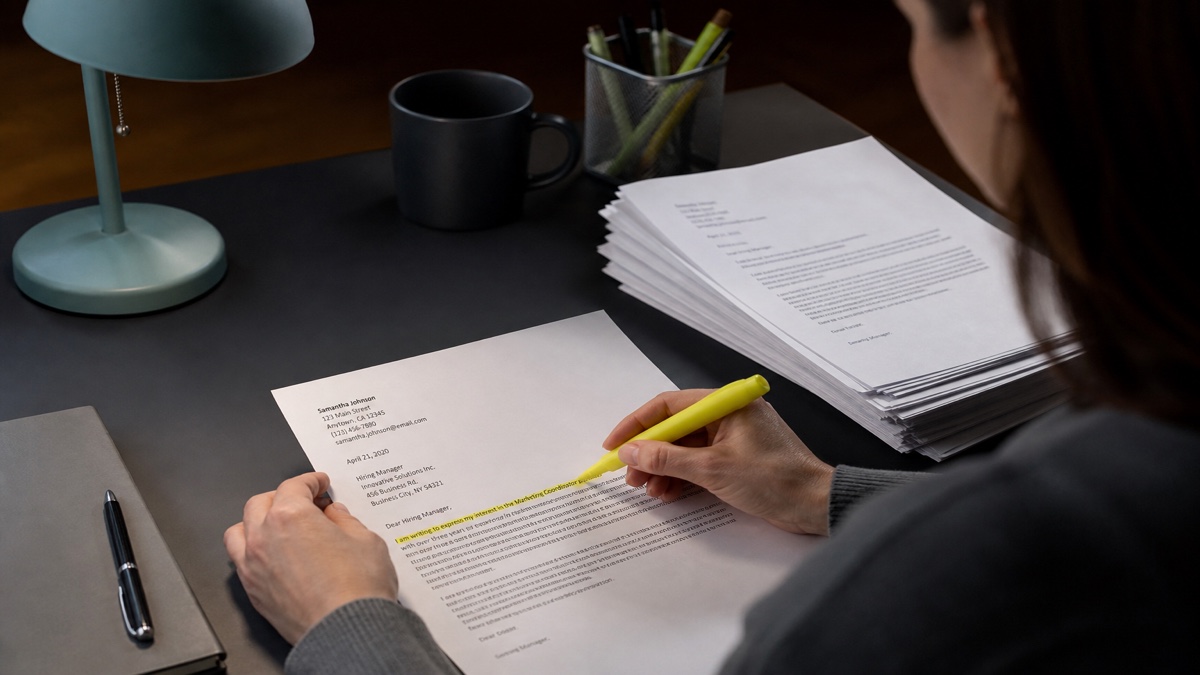
- Open the posting and highlight the exact job title plus two required tools.
- Rewrite your opening two sentences using the weak vs strong pattern below.
- Export a one-column PDF and read it aloud once before you upload.
What cover letter examples are (and are not)
A cover letter example is a skeleton you swap for your facts—not a personality transplant. It shows where proof goes, how long each block should run, and what recruiters skim past.
Definition: A one-page letter that names the role, cites two verifiable results, and explains context the resume cannot carry (referral, pivot, relocation, gap).
It is not a second resume pasted in paragraph form. It is not a place to repeat every bullet from the last five years. I've screened stacks of these on Greenhouse, and the file that wins is boring and specific.
Most systems store the attachment and search it if a recruiter asks. Ranking still leans on resume fields first. That means your cover letter examples should support a parseable resume—not replace one. For when letters matter at all, see do cover letters matter in 2026 .
Step-by-step: turn a cover letter example into your draft
Step 1: Harvest three lines from the posting
Copy the exact job title, two must-have tools or methods, and one outcome phrase (e.g., "reduce reporting cycle time"). Paste them at the top of your doc as comments—you'll delete them before export.
Step 2: Pick one resume bullet to expand
Choose a result that maps to those must-haves. Rewrite it as two sentences: what changed, for whom, with which tools. If you cannot name a tool from the posting in that bullet, pick a different bullet.
Step 3: Draft the opening (two sentences max)
Weak openings announce that you are writing to apply. Strong openings name the role and one proof point. Compare:
| Weak | Strong |
|---|---|
| I am writing to express my interest in the Analyst role. I am a hard worker with excellent communication skills. | I'm applying for the Revenue Operations Analyst role. At my current company I rebuilt the weekly pipeline report in SQL and cut prep time from six hours to under two. |
Step 4: Middle paragraph = evidence, not adjectives
One paragraph, three to five sentences. Tie a second result to the posting. Use numbers only if they're true and you can explain them. No "proven track record" without the track.
Step 5: Close with one next step
Thank them once. Say you'd welcome a conversation. Do not promise you're the perfect candidate. Sign with your name and phone—some portals strip attachments from threads.
Do this now: open the posting, highlight the title and two tools, and paste them above your draft before you write sentence one.
Cover letter example: mid-level analyst (composite)
Pattern for a data or operations analyst applying through Workday. Swap bracketed text for your facts.
Notice what's missing: no paragraph about being passionate about data. The tools and the outcome do that work. For deeper tailoring mechanics, see how to write a cover letter from a job description .
Cover letter example: registered nurse (composite)
Clinical roles still read letters when the unit is small or the posting asks for one. Keep it clinical and calm—no drama, no invented patient stories.
If you're changing specialties, use one honest bridge sentence: "I've spent two years in step-down and I'm moving to med-surg because…"—then proof from transferable skills, not wishful thinking.
Cover letter example: account executive (composite)
Sales letters should sound like a good cold email: short, numeric where true, and tied to the company's buyer.
Edge cases: when cover letter examples need a different shape
Career change
Lead with the bridge: "I'm moving from classroom teaching to customer education because…" Then one project that proves the new skill. Do not pretend the old career did not happen.
Referral
First sentence: "[Name] suggested I apply for…" Second sentence: why you said yes. Recruiters track referrals; give them the name spelling the referrer used.
Employment gap
One line on what you did (caregiving, coursework, contract work). Then back to proof. Unexplained gaps worry people more than explained ones.
Optional upload on Lever or Greenhouse
If you have nothing new to say, skip. If you have a referral or pivot, upload. Optional plus generic hurts more than silence.
Returning to work after caregiving
One factual line: "I stepped away from full-time work in 2023 to care for a family member and completed two online courses in project management during that period." Then pivot to a recent contract or volunteer project with measurable output. Do not apologize for the gap—explain it and move to proof.
Salary or relocation in the letter
Only address salary when the posting asks. Give a range aligned with your research, not a single number unless required. For relocation, one sentence: "I am planning a move to Denver in Q2 and am available for on-site work from May 1." Keep it factual; no long personal narrative.
Cover letter format checklist before upload
Run this list on every export. It takes two minutes and prevents embarrassing uploads.
| Check | Pass? |
|---|---|
| Exact job title and company name spelled correctly | Search doc for old employer names |
| One page, 11–12 pt standard font, single column | No text boxes or icons for contact info |
| Opening names role + one proof point | No "I am writing to apply" throat-clearing |
| Every metric matches the resume | No invented percentages from AI drafts |
| Filename: FirstName-LastName-Role-Cover-Letter.pdf | Not cover_letter_FINAL_v7.pdf |
Read the letter aloud once. If you stumble on a sentence, a recruiter will too. Shorten it.
Entry-level cover letter example (composite)
New grads often over-explain coursework. Lead with one project or internship result instead.
No paragraph listing every club you joined. One project, one tool stack, one tie to the posting.
When you have no internship, use a class project with a real client (campus org, local nonprofit) and describe deliverables the same way you would a job—scope, tools, outcome. Avoid listing coursework titles without outputs.
For remote roles, state time zone and overlap hours in one line if the posting mentions collaboration windows. That removes a common unspoken objection without a full paragraph on "work ethic."
Common mistakes with cover letter examples
- Pasting the whole job description. Recruiters already have it. Mirror three terms, not thirty.
- Repeating the resume verbatim. The letter should add context, not duplicate bullets.
- Fancy layout. Text boxes and two-column Canva exports break parsing the same way resumes do.
- Wrong company name. Search your draft for the last employer you applied to. Fix it before export.
- AI inventions. Generators guess metrics. Delete anything you cannot defend.
Another mistake: writing a letter when the posting forbids extra documents. Some government and university reqs accept resume only—respect that. A ignored instruction is an easy reject.
Finally, do not address the letter to "Sir or Madam" when the posting lists a hiring manager or recruiter. Search the company site or the posting footer. "Dear Hiring Manager" is fine when the name truly is not available—do not guess and get it wrong.
Uploading cover letters on Workday and Greenhouse
On Workday, the cover letter field is often optional and stored as a separate attachment. It does not replace the resume import—recruiters still see parsed fields first. Upload a one-column PDF with the same contact header style as your resume.
On Greenhouse, some companies paste a text box instead of a file upload. Keep paragraphs short; line breaks may not render. If both file and text box exist, use the file for formatting and paste a plain-text version into the box only if required.
File name matters in shared drives: Jane-Doe-Product-Analyst-Cover-Letter.pdf beats
cover letter.pdf when a recruiter downloads twenty at once.
If you are submitting through email instead of a portal, put the letter in the message body only when the employer asks for email applications. Otherwise attach PDF plus a two-line message: role, attachment names, phone. Recruiters forward files; they rarely forward walls of text.
Use HireFlow to draft faster and verify the resume match
Start with the free cover letter generator when you have a blank page—not when you need to outsource judgment. Paste the posting, attach facts from your resume, then edit every claim.
Before you upload on Workday or Taleo, check your resume for free so titles, dates, and skills parse cleanly. A strong letter cannot fix a scrambled profile. For role fit, run the job match score against the posting after you tailor.
Conclusion
- Cover letter examples are patterns—swap in real tools, titles, and outcomes.
- Open with the role and one proof point; never throat-clear about applying.
- Match the resume first; upload a plain PDF; skip optional generic letters.
Pick one example above, tailor it to tonight's posting, and read it aloud. If it sounds like you, export and attach. If it sounds like a template, fix the opening—not the adjectives.
Stop guessing whether your resume backs up the letter. Check your resume for free before you submit—and keep these cover letter examples handy for the next role that actually needs context.
Frequently asked questions
Aim for one page and roughly 250 to 400 words for most corporate roles. Hiring managers skim. Two short evidence paragraphs plus a direct opening and close usually outperform a second page of enthusiasm. If the posting sets a word limit, follow it exactly.
Use the structure and swap in your real facts, tools, and outcomes. Copying generic praise or invented metrics is obvious. The examples on this page are patterns—your version should name the employer, the role, and one result you can defend in an interview.
Use the exact job title once, plus tools or methods you actually used that match the posting. Do not paste the requirements list into the letter. Recruiters read for proof, not keyword density. Match the resume first; the letter adds context the resume cannot hold.
Skip optional uploads when you would paste the same three paragraphs everywhere. Write one when the field is required, when you have a referral, a career change, a gap, or one posting-specific result that does not fit cleanly on the resume. Optional plus generic is worse than empty.
Use a simple one-column PDF or DOCX with standard fonts—Calibri, Arial, or Times at 11 or 12 point. Avoid text boxes, headers with your contact info only, and Canva layouts. The same parsing rules that apply to resumes apply when the ATS stores and searches the attachment.