11 min read
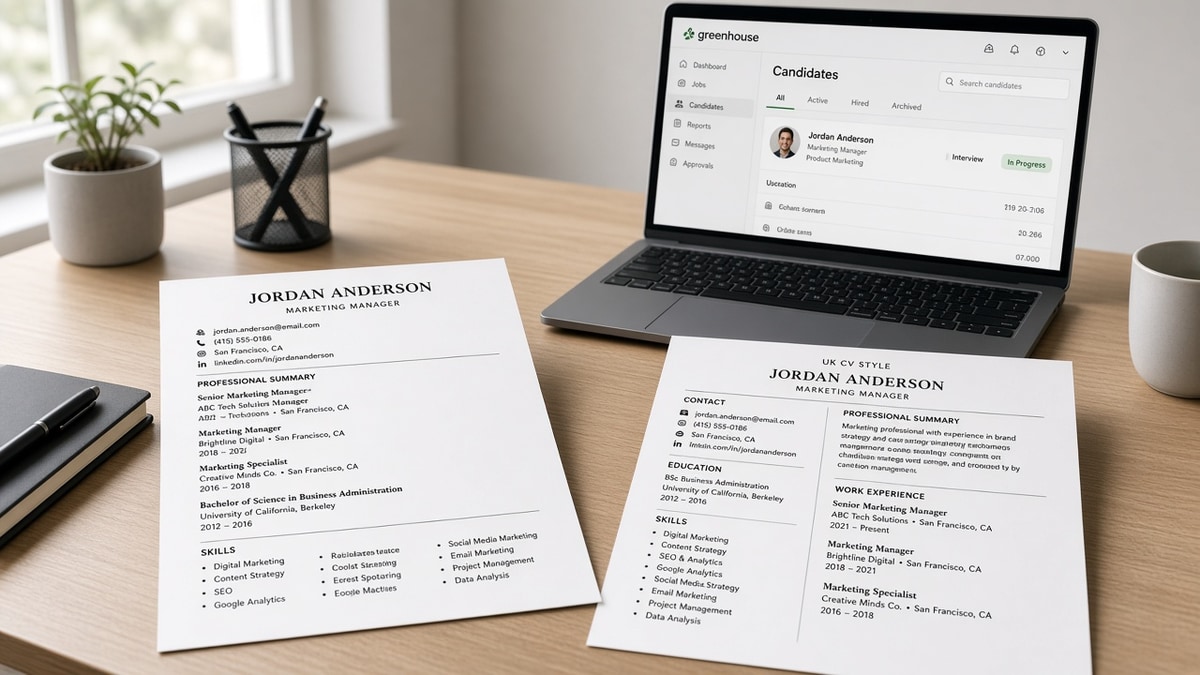
You're targeting a mid-level backend role in London and a parallel req in Austin with the same Git history. You shouldn't need two careers. You do need two parser-safe exports because the US and UK CV formats mid-level tech recruiters open in Greenhouse and Workday aren't interchangeable.
If you've been using one PDF for both markets, you're not alone. Most candidates don't notice the break until a UK portal shows empty employer fields while the US upload looked fine in preview mode.
Check your resume for free on each export before you upload. A UK personal profile sitting above experience can shove your Kubernetes bullets to page two in a US req while the US version looks fine to you in Preview.
Job searching across borders is already stressful. This page names the symptom, three causes, how to spot yours, and fixes you can run tonight without inventing a third format from a template site.
When you need a cover letter for the UK posting only, use the cover letter generator after the UK export passes a parse check, not before you strip the US summary block.
Quick Wins
- Duplicate the master DOCX into US and UK versions with distinct filenames.
- Move right-to-work to one UK line under contact, not a profile essay.
- Standardize Month Year dates in both files; drop numeric-only dates.
- Rename Experience to Employment History only on the UK export.
When the same mid-level tech CV parses in one country and breaks in the other
The symptom: US applications auto-fill title and employer from your upload. UK applications show blank experience rows or scramble job titles into the skills field. You assume the UK ATS is stricter. Often the file still carries US section order with UK spelling, or a UK personal block the US parser never trained on.
A composite platform engineer keeps one Canva PDF because it looked polished in a US bootcamp. US Greenhouse uploads partially map. UK Workday reads the sidebar as body text and drops months from dates. The candidate blames keyword density when the layout never belonged in either market.
Another pattern: the developer who adds nationality and visa lines at the top for every application worldwide. US screens skip the file for unrelated EEO reasons while UK recruiters wanted that line lower and shorter.
This will not turn a junior file into a staff profile. It stops qualified mid-level tech candidates from losing bullets to locale-specific formatting they can fix in one editing pass per market.
For broader parser failures, read why resume formatting breaks in ATS before you chase keyword lists on a two-column export.
US vs UK CV formats mid-level tech parsers reject most often
Three causes cover most cross-border failures. Match the signal, run the fix, and ignore fixes meant for the other market.
Cause 1: Personal and work-authorization blocks in the wrong place
US mid-level tech resumes should not open with date of birth, marital status, or photos. UK postings may ask for right to work in plain language, but a long Personal Profile before Employment History still pushes technical bullets down the parse stack.
How to tell: page one is half personal narrative and half jobs. US auto-fill pulls hobbies into employer fields. UK recruiters see visa detail but miss your last role title in the preview pane.
Fix: US export: name, city, phone, email, optional LinkedIn URL line only. UK export: add one line such as Right to work: [status] under contact, then Employment History. Keep profile text to three lines max or fold it into bullet one under the current role.
Before: UK CV opened with a six-line personal statement and photo placeholder.
After: UK CV opened with contact, one right-to-work line, first job title visible in line twelve of plain text view.
Cause 2: Layout tricks that look modern to humans
Icons for skills, two-column contact bars, and tables for employment dates look fine in PDF preview. Taleo and iCIMS read columns out of order. UK CV templates from design sites are repeat offenders.
How to tell: select all text in Word and watch order jump compared to visual PDF. Parser preview shows skills duplicated or employers merged.
Fix: single column, 11-point Calibri or Arial, bullets as simple hyphens or dots, dates on the same line as employer. Re-export PDF from Word Save As, not a screenshot.
Before: Side-by-side skills column beside a timeline table for four roles.
After: Skills section below experience, each role as Company, Title, Month Year to Month Year, then bullets.
Cause 3: Mixed US and UK date and spelling habits
Numeric dates like 04/07/2023 mean April in the US and July in the UK. Mixing organise and organize in the same file signals copy-paste, not tailoring. Mid-level tech CVs should pick one spelling market per export.
How to tell: find any slash date or dual spelling of specialize and specialise in one document. ATS date parsers drop tenure length when months vanish.
Fix: US file uses Month Year and US spelling. UK file uses Month Year or DD Month YYYY consistently and UK spelling. Run find-replace for color versus colour before each upload.
I've screened cross-border stacks where the candidate's US resume was clean but the UK CV still carried a US-style Objective line and a skills table, and Workday mapped only the first bullet under each job.
Copy-paste block: contact header by market
Copy-paste headers (edit brackets)
US export (top of page)
[Full Name]
[City, ST] | [phone] | [email] | [linkedin.com/in/handle]
Summary
[Two lines: title + stack from posting paragraph one]

UK export (top of page)
[Full Name]
[City, UK] | [phone] | [email] | [linkedin.com/in/handle]
Right to work: [one line status if required]
Employment History
[Company], [Job Title], [Month Year] to [Month Year or Present]
Before: Mid-level SRE resume listed Kubernetes in a icon grid with no bullets tying scale.
After: Same role, bullet opened: Owned on-call for 40 microservices on EKS, cut p95 latency 18% in Q2 (illustrative bullet only).
Before: UK CV listed Programming Languages as a paragraph wall.
After: Technical Skills line matched posting order: Python, Terraform, AWS, then bullets proved each.
Edge case: US citizen applying only in UK. Still drop US-style objective blocks; keep right-to-work factual, not a essay about relocation dreams.
Edge case: UK candidate applying only in US. Remove photos and birthdate lines even if your home CV template includes them. US hiring teams expect EEO-safe headers.
So what if the posting asks for salary history? US applications often want expected range in the portal, not on the PDF. UK forms may ask current package in a cover letter. Keep numbers off the CV file unless the form explicitly demands it on the upload itself.
Contract versus permanent titles differ by market wording. Mirror the posting title string in headline and first bullet, whether it says Software Engineer III or Senior Developer.
Education placement: US mid-level tech resumes usually keep degrees after experience unless you are a new grad. UK CVs sometimes list education earlier. For ATS, keep one Education header with Month Year completion, not tables split across pages.
References available upon request lines waste space in both markets. Recruiters ask later. Use the lines for another proof bullet instead.
Certifications behave similarly: US resumes often tuck AWS or Azure lines under Skills, while UK CVs sometimes break them into a separate section. Pick one header per export and keep cert names spelled exactly like the vendor writes them so keyword search still hits.
Open source links belong in bullets when the posting cares about public work, not in a footer QR code. Parsers ignore QR blocks and may read the URL as garbled text mid-page.
Phone number format: US exports use a ten-digit pattern recruiters expect in CRM autofill. UK exports can keep country code with a plus sign on one line. Do not embed phone inside a text box shape in Word.
GitHub handles fit on one contact line for both markets when the posting mentions code samples. Skip listing every fork from college unless the req asks for breadth.
When a UK employer uses American payroll for a US subsidiary, send the US export even if the team sits abroad. When a US employer hires through a UK entity, ask which parser their HR portal uses before you guess.
Version control your files in a folder named by market and date, not final_final_v7. You will reuse the skeleton on the next search and you'll thank yourself when a recruiter requests a quick tweak before screen two.
If you're pivoting from bootcamp to mid-level, keep one employment block honest about title level. US and UK parsers both map job title strings to seniority filters. Inflated titles break later in background steps, not in ATS alone.
Cover letters stay separate files in both markets unless the portal has one upload slot. Never merge letter and CV into one PDF unless the form explicitly demands a single attachment.
Misreads when comparing US and UK CV formats
Believing UK CVs must be longer no matter what. Length is not a virtue when bullets repeat tools without scope. Trim duplicate skills before you add personal history.
Using one spelling checker default for both exports. Pick US or UK dictionary per file. Mixed spelling is a cheap signal you did not maintain two masters.
Renaming a PDF without opening the source. Filename says UK but content still says Resume at the top with US dates. Recruiters notice in five seconds.
Before: Changed file name from resume.pdf to cv.pdf only.
After: Saved Smith_platform_US.docx and Smith_platform_UK.docx with distinct headers and section labels.
Trusting a UK board's built-in CV builder for US follow-up. Board parsers differ from employer ATS. Export your master and run the same checker you use for US Workday uploads.
This will not fix applying to roles you are not qualified for. It stops a qualified mid-level engineer from losing interviews because the UK export never mapped employer names.
Pair formatting fixes with how hiring software decides who gets seen so you know when the problem is rank, not layout.
Run parse checks on both exports
Treat US and UK uploads as two submissions. Match score and parse check run on the file you will attach, not on the version still open in Canva.
Paste the US posting into score your job match against the US export, then repeat with the UK posting and UK export. Do not average one score across both reqs.
After each rewrite, run the free ATS checker on the PDF that matches the portal's accepted format. UK Word uploads still benefit from a PDF parse preview first.
Do this now: Duplicate your master file, label US and UK in the filename, and fix only the header and section names before your next apply block.
Save two exports before the next apply block
US vs UK CV formats for mid-level tech roles share one rule: boring, single-column, and honest bullets beat a clever layout every time. Maintain two masters, not one renamed PDF.
- Strip personal blocks from the US file; shorten them in the UK file.
- Align dates and spelling per market before keyword tweaks.
- Label filenames so you never upload the wrong export to a req.
- Parse-check each file against its own posting text.
Run a free ATS check on tonight's UK export, then again on the US version. Two markets, two checks, one calendar row each.
And when a recruiter asks for a Word copy, send the market-specific DOCX you already validated, not a quick PDF print-to-file from a browser tab.
Read more
Frequently asked questions
Most UK employers now prefer you skip photos and sensitive personal data unless the posting asks. For ATS, extra personal lines often push work history down the parse order. Put right to work in one plain line if the role requires it, not a full personal profile block above experience.
US resumes for mid-level engineers usually stay at two pages with tight bullets. UK CVs can run two pages with slightly more role context, but length is not permission to add tables or icons. If the parser drops content after page one, trim skills duplication before you add a third page.
Both markets accept single-column PDF or DOCX from Word or Google Docs export. UK boards sometimes ask for Word specifically. Avoid Canva PDFs, column layouts, and header/footer contact lines that repeat on every page. Run the same export through a checker before each market upload.
Match the market on the application. US postings expect Month Year with a clear en dash or the word to between dates. UK CVs often use DD Month YYYY in body text but Month Year in tables still parses cleaner. Mixed numeric dates like 03/04/2022 confuse parsers trained on the wrong locale.