Boomerang Employees in 2026: How to Rejoin a Former Employer (and Explain It)
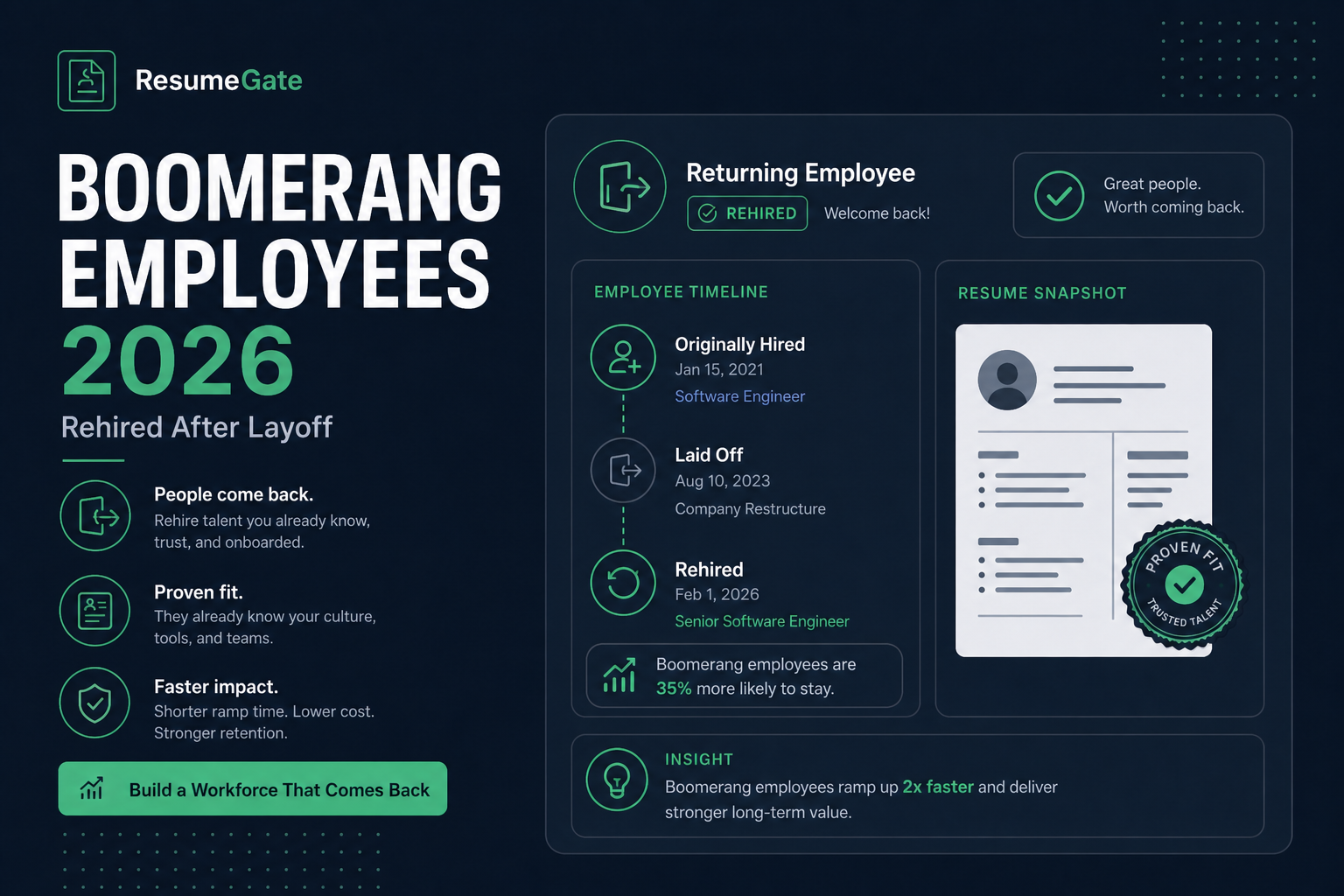
A boomerang employee is someone who leaves a company—voluntarily or through a layoff—and then gets rehired by that same employer at a later date. The pattern has always existed quietly in the background of the labor market, but 2026 has turned it into a mainstream hiring strategy. After two years of mass layoffs across tech, finance, and media, many companies that over-cut are now quietly reaching back out to the exact people they let go. Several are doing it formally, with dedicated alumni networks and rehire pipelines built directly into their applicant tracking systems.
If you were laid off—or if you left a job on good terms and the door seemed genuinely open—2026 may be the most favorable moment in recent memory to explore a return. But "favorable moment" does not mean "no strategy required." Reapplying to a former employer carries a specific set of social dynamics, resume framing challenges, and interview questions that are completely different from applying somewhere new. Getting those wrong can make a promising opportunity feel awkward for everyone involved.
This guide covers everything you need to navigate a boomerang move in 2026: why the trend is real, how to tell whether a company actually wants you back, how to approach the reapplication without it being uncomfortable, and exactly how to explain it on your resume and in interviews.
- Why companies are actively seeking to rehire former employees in 2026
- Concrete signals that a specific company might want you back
- How to reapply without the process feeling awkward on either side
- How to frame a boomerang return on your resume and in interviews
- Six frequently asked questions about boomerang hiring
Why companies are actively rehiring people they laid off in 2026
The simplest version of the answer is economic: rehiring a known quantity is cheaper and lower-risk than hiring someone new. A returning employee already understands the systems, the culture, the internal vocabulary, and the stakeholders. They do not need three to six months to reach full productivity. They have demonstrated, in the company's own environment, that they can do the job. From a recruiter's perspective, that track record collapses a significant portion of the screening and onboarding cost—and in a job market where a bad senior hire can cost a company well in excess of twice that person's annual salary to unwind, the downside risk of a returning employee is meaningfully lower than that of an external stranger.
A second driver is structural: alumni networks are now formally tracked inside many companies' ATS and CRM systems in a way they simply were not five years ago. Several enterprise HR platforms added dedicated "talent community" and alumni re-engagement modules between 2022 and 2025, partly in response to the layoff wave. Companies that used those tools to tag former employees as "eligible for rehire" now have queryable databases of pre-vetted candidates they can reach out to directly when a role reopens—often before that role is ever posted publicly. If you were laid off from a company that uses one of these systems, you may already be in a pipeline you do not know exists.
The third driver is the most direct: many companies that cut aggressively during the 2022 to 2024 downturn simply over-cut, and they are now facing skills gaps in exactly the functions they hollowed out. Backfilling with people who already know the role, the team, and the expected output is the path of least resistance. This is especially common in engineering, product, and data functions where institutional knowledge is hard to transfer and onboarding a net-new hire from zero takes real time. Companies in this position are often motivated enough to move quickly, offer a title upgrade, and skip several rounds of interviewing— all factors that favor the returning candidate.
None of this means every company with former layoffs is eager to boomerang people back. Leadership may have changed, the strategy may have pivoted, or the budget approval may be genuinely tighter than before. But the structural conditions in 2026—over-cutting followed by recovery, formal alumni tracking, and the rising cost of bad external hires—make this a particularly good moment to have the conversation.
There is also a cultural shift worth noting. A few years ago, returning to a former employer could carry a faint stigma—the implicit suggestion being that the candidate had nowhere else to go. That association has faded significantly. In the post-layoff labor market of 2024 and 2025, lateral movement across companies, time spent on contract work, and non-linear career paths have all become so common that a clean boomerang move—especially one where the candidate clearly grew in the interim—reads as normal professional behavior rather than a consolation. Recruiters and hiring managers who have watched colleagues cycle through three or four employers in two years are not going to raise an eyebrow at someone who went away, built something new, and came back for good reasons.
Signals a company might want you back
Not every former employer is a good boomerang target. Before you invest time in a reapplication, look for signals that the conditions are actually right. Two or three of the following together is a strong indicator the conversation is worth having.
| Signal | What it means |
|---|---|
| The company has a formal alumni or boomerang program | They have deliberately built infrastructure to rehire former employees—this is the clearest possible signal that a return is welcome and procedurally supported. |
| Your former manager is still there and has reached out informally | An informal "hey, we're looking again" message from a former direct manager is about as close to an invitation as you can get without a formal offer letter. |
| A nearly identical req to your old role has reopened | The company is actively trying to fill the gap your departure created. The role itself is the signal—your name is likely in their ATS already. |
| Former teammates are engaging warmly with your LinkedIn content | Consistent, warm engagement from people still inside the company often reflects an internal awareness that things are opening up again—and sometimes deliberate outreach on someone's behalf. |
| You left on good terms with a positive performance record | Your internal reputation is still the baseline for any rehire conversation. If your last review was strong and the departure was respectful, you are in a favorable starting position regardless of whether they have formally reached out. |
| The company is publicly growing again after a freeze | A hiring ramp after a publicly announced freeze creates a recruiting backlog that internal teams often fill first with known quantities before posting externally. |
The absence of signals does not mean a return is impossible—it just means you are starting the conversation from a colder position, and you should calibrate the amount of effort accordingly. A warm inbound signal from a former manager warrants immediate action; a hunch with no external evidence warrants a discreet, low-pressure inquiry before you commit significant time.
Which industries and roles are seeing the most boomerang hiring
Boomerang hiring is not evenly distributed across the labor market. Some industries laid off heavily enough—and are recovering fast enough—that the conditions for boomerang rehires are nearly ideal. Others never cut deeply, so there is no cohort of former employees sitting in alumni databases waiting for a call. Knowing where you sit in this picture helps you calibrate how actively to pursue the channel.
High boomerang activity in 2026
- Software engineering and product management at post-freeze tech companies
- Data science and ML engineering roles that were over-cut in 2023
- Finance and fintech operations teams backfilling after strategic pivots
- Media and content roles at companies that are growing again after digital consolidation
- Growth and performance marketing at companies ramping spend after an austerity period
Lower boomerang activity in 2026
- Clinical healthcare roles, where turnover is backfilled with new hires continuously
- Government and public sector positions with strict open-competition requirements
- Early-stage startups, where the team composition has often changed completely
- Retail and hospitality, where per-role institutional knowledge matters less
- Any company that has changed ownership or undergone a significant strategic rebrand
Seniority also matters significantly. Senior individual contributors and managers tend to be the most common boomerang targets because the institutional knowledge they carry is the hardest to replicate externally. Entry-level roles have higher supply, shorter ramp times, and less premium placed on prior institutional knowledge, so companies in those categories are less likely to reach specifically for former employees rather than recruiting broadly.
If you are in a high-activity category—especially mid-to-senior tech, data, or finance—and you left a company in the past twelve to twenty-four months, it is worth being proactive rather than waiting for the inbound signal. The companies most likely to boomerang candidates back are often the ones still figuring out that they need to, and a well-timed, well-framed reach-out can get ahead of the formal process entirely.
How to reapply without it feeling awkward
The mechanics of reapplying to a former employer are deceptively simple—you already know people there, which is an enormous advantage. The awkwardness usually comes from not knowing how to use that advantage without overplaying it. Follow this sequence:
- Reach out directly to your former manager or a close former teammate before you touch the application portal. A cold application through the ATS from a former employee is not a bad outcome, but it is a missed opportunity. A brief, direct message—something like "I saw the role reopen and wanted to check in before applying formally"—turns a cold application into a warm referral in a single step. Most former managers who are open to a return will tell you quickly, which tells you whether to invest serious time in the application.
- Name what has changed since you left, briefly and without being asked. Do not wait for the interview to explain the gap or the return interest. In your outreach message or cover letter, one or two sentences acknowledging what you learned or built elsewhere, and why you are genuinely interested in returning now, defuses the elephant in the room and signals self-awareness. Avoiding the topic entirely tends to read as awkward or evasive—the person you are messaging will be wondering about it anyway.
- Be honest about your timing and the reason for leaving. If you were laid off, say so plainly—there is zero stigma in 2026 given how widespread the layoffs were, and the company often knows this already because they are the ones who let you go. If you left voluntarily, explain briefly what drew you away and what makes the company the right fit now. A clear, honest framing is more persuasive than a polished evasion.
- Respect the timing. Reapplying within the first few months of a layoff—especially if the budget that eliminated your role has not changed—is often premature and can read as desperate. A window of roughly six to twelve months gives the company time to stabilize, reassess, and open new budget. If you left voluntarily, a shorter window can be appropriate if the circumstances have genuinely changed, but anything fewer than four to six months can raise questions about whether your reasons for leaving were actually resolved.
- Apply formally through the portal after making the warm connection, not instead of it. Some companies require a formal ATS record for compliance even when the hire is effectively decided. Submit the application so the paperwork exists, but treat the actual hiring conversation as happening through the relationship channel you have already opened.
Explaining a return to a former employer — on your resume and in interviews
The single most common mistake boomerang candidates make is trying to hide or minimize the return. They bury the original employer, give the gap a vague label, or wait to see if the interviewer notices. This consistently backfires. A return to a former employer is not something to explain away—it is a signal of validated mutual fit, and when framed correctly, it reads exactly that way.
On your resume, list both tenures at the company clearly, with their own date ranges, titles, and bullet points. Do not collapse them into a single entry to obscure the gap—that approach either confuses the reader or looks like you are hiding something. The gap itself should be accounted for with a clear entry showing what you did in between: a different employer, contract work, or a defined personal situation. Recruiters are experienced at reading timelines, and a clearly labeled gap with an explanation is always easier to process than a timeline that does not add up.
In interviews, the framing question is almost always some version of "why are you coming back?" or "why did you leave in the first place?" Here is the difference between a defensive answer and a confident one:
Before — awkward and defensive
"Well, I left because I thought the opportunity at the other company was a good move at the time, but it turned out not to be exactly what I expected. So I started looking around again and saw that this role had reopened, and I thought maybe it could be worth exploring."
After — confident and framed as validated fit
"I left to take on a broader scope at a Series B company, and I built out their entire data pipeline from scratch over eighteen months—which was the specific experience I was looking for. Coming back here makes sense now because I have that skill set, I already know your systems and team, and I chose this company originally for reasons that have not changed: the pace, the ownership model, and the specific problem space. I am not returning because the other thing failed— I am returning because I am more capable than when I left and the fit is genuinely strong."
The structural difference between those two answers is not the content—both candidates left and are now returning. The difference is agency. The first answer sounds reactive; the candidate left, something went wrong, and now they are back. The second answer sounds intentional: the candidate left with a specific goal, achieved it, and is returning because the fit is strong on both sides. That framing is not dishonest—it is just a more accurate representation of what a confident career move actually looks like. Interviewers respond to it accordingly.
One practical resume note: because the company will already have your original application or profile in their ATS, your returning resume will sometimes be compared directly against your previous one. This is actually an advantage—it lets you make the growth visible in a concrete way. Update your skills section to reflect what you added elsewhere, ensure your new bullet points show measurable output that exceeds what you had in the prior tenure, and if you received a promotion or title change at the intervening company, make sure that is clearly visible. The implicit narrative the recruiter is reading is "are they more capable now than when we last worked together?"—make sure the answer is obviously yes.
When you tailor the resume for the boomerang application, align it to the specific job description the same way you would for any new role. Do not assume the company remembers your strengths in detail—the person reviewing the req may be a new recruiter who does not know your history at all. Running the resume through an ATS check before submitting is still worth doing; even at a former employer, most applications pass through automated scoring before a human sees them. A job match score check takes two minutes and removes any doubt about whether the document is optimally aligned to the description before you send it.
Frequently asked questions
Does boomeranging hurt my reputation with other employers?
Generally no—and in 2026 specifically, less than ever. The widespread layoff cycle of the past several years has normalized non-linear career paths in a way that makes a return to a former employer read as intentional rather than desperate. Where the optics can become complicated is if you boomerang back very quickly (fewer than six months after leaving voluntarily) or if you have a pattern of short tenures that makes the return look like indecision rather than strategy. A single boomerang move with a clear narrative is not a red flag to most hiring managers; a repeated pattern of leaving and returning without apparent growth at each stage is a different matter.
Will I return at the same level and salary, or start over?
This varies significantly by company and circumstance, and you should ask directly rather than assume. Many companies will offer a returning employee at least the same level they held before, often with a title bump to reflect growth since leaving. On compensation, returning employees frequently have more negotiating leverage than external candidates, particularly if the company reached out first—the implicit message is that they want you specifically, which is a strong negotiating position. Do not assume you will slot back in at your old salary; come prepared with market data and a specific ask. The worst likely outcome is that they say no and you negotiate from there.
Does it matter if I was laid off versus if I quit?
From the company's perspective, being laid off is almost always the more favorable starting position for a boomerang conversation. A layoff means the company already signaled they valued you as an employee—the exit was about budget, not performance. You did not leave them; circumstances created the gap. When someone was laid off and then returns, the internal read is often "we got lucky they were still available." If you left voluntarily, the conversation requires a bit more explanation—specifically, what changed such that the original reason for leaving is no longer the dominant factor. That is a manageable conversation, but it requires more deliberate framing than a layoff return does.
How long should I wait before reapplying?
For a layoff: six to twelve months is a reasonable window, depending on the pace of the company's recovery. Earlier than six months risks the budget not having recovered, and you may also need that time to demonstrate what you did with the gap. For a voluntary departure: four to six months at minimum, and ideally longer unless the circumstances have changed dramatically and obviously. Returning very quickly after a voluntary departure raises the question of whether you actually thought the original decision through. In both cases, having something to show for the intervening period—a new skill, a meaningful project, a role where you grew—makes the timing argument much easier to make.
Do formal alumni and rehire databases actually exist, or is this informal?
They exist, and they are more common than most candidates realize. Enterprise ATS platforms including Workday, Greenhouse, and Lever have alumni re-engagement and talent community features that let recruiters tag former employees as eligible for rehire and surface them automatically when relevant roles open. Many large companies also run LinkedIn alumni groups and private community tools specifically to stay connected with former employees. If you were laid off by a mid-to-large employer in the past two years, there is a reasonable chance your record exists in their system with a rehire-eligible tag—and if you stay professionally visible, that record may surface before you ever have to reach out. The informal version (a former manager keeping your number saved) is also real and often more effective, but the formal infrastructure is now a real part of many companies' sourcing strategy.
Should I tell my current employer I'm talking to my old one?
No—at least not until you have a formal offer in hand. The same discretion that applies to any job search applies here. The fact that you are talking to a former employer rather than a new one does not change the professional calculus: your current employer does not need to know you are exploring options until you have decided to leave, and disclosing it early risks introducing tension or prompting a managed exit on their timeline rather than yours. Once you have an offer and have decided to accept it, give the standard notice and handle the transition professionally—the same way you would with any other move.
Where to take this next
A boomerang move is one of the most efficient paths through a job search—you skip most of the uncertainty that makes external applications slow and unpredictable. But the window for a strong return is not indefinite. Reaching out while you are still professionally visible, while your former manager still has institutional memory of your work, and while the company is actively growing again is far more effective than waiting until the moment is perfect.
The practical next step is simple: identify the one or two former employers where the conditions above are strongest, draft a short and direct message to your former manager or closest former teammate, and send it. You do not need a full cover letter to start the conversation—a two or three sentence LinkedIn message or email that acknowledges the gap, names what you have been doing, and expresses genuine interest is enough to open the door. If the answer is warm, the formal process follows naturally. If the answer is a polite "not right now," you have spent five minutes and have your answer cleanly, with the relationship intact for the future.
If the boomerang path is not available or not the right move right now, the same principles apply to your broader search: the quality and targeting of each application matters far more than volume. Run your resume through HireFlow's Job Match Score to see how well your document aligns with the specific role you are targeting before you submit, and make sure the file parses cleanly with a free scan on HireFlow . If you are weighing a boomerang return against other options and want to understand how frequent job moves are being read by hiring teams right now, our guide on job hopping in 2026 and how to position it covers the current recruiter perspective in detail.
Done for you
Turn this advice into an interview-ready resume
Professional writers rebuild your resume for ATS + recruiters — unlimited revisions, interview guarantee.